Books
Books
in random order

The History Of Breathing
In the tradition of poets such as Charles Olsen, Alice Notley and Sappho, Allison Grimaldi Donahues poetry connects the history of breath and language with narratives about the discovery and loss of our own voice.
The Etruscan language knew no blank spaces, no breaks between words—its texture resembled an uninterrupted flow of speech; more singing than speaking, form rather than content. Only in the dictum of the pause, the meaningful fragmentation of the breath and the staccato of the Atemwende (Paul Celan) does language become comprehensible rhythmic expression.
In a world full of slogans and catchphrases, Allison Grimaldi Donahue defends the poetological demand of Sound over Content! The History of Breathing weaves linguistics and poetry, verse and song, meaning and sound into a dense narrative about breathing, rhythm, and the gaps in language that allow words to take on meaning in the first place.
Allison Grimaldi Donahue (born 1984 in Middletown, Connecticut, USA, lives and works in Bologna, Italy) works in text and performance exploring modes in which language and text can move between individual and collective experience. She is author of Body to Mineral and On Endings, and translator of Blown Away by vito m. bonito and Self-portrait by Carla Lonzi. She has given performances at Short Theatre, Almanac Turin, MACRO, MAMbo, Fondazione Giuliani, Kunsthalle Bern, Hangar Biccoca, and Flip Napoli.

ESDS Archives 3 : Pascal Doury - carnet inédit c.97-99
Facsimilé d'un carnet inédit de Pascal Doury réalisé par Jonas Delaborde (Der Vierte Pförtner Verlag) et co-produit par les Editions l'Amazone, réalisé dans le cadre de la publication des Archives Elles Sont de Sortie suite à la parution de Choquer le monde à mort. Elles Sont de sortie. Bruno Richard - Pascal Doury.

Self-Romancing
In a tonal mash-up of Jenny Holzer’s Truisms, confessional poetry, and fortune telling, Self-Romancing draws you into the amorous and obsessive inner life of an unnamed romantic. Relatable and snarky, heartfelt and horny, L Scully fortifies irony with vulnerability, bringing readers into a narrative as intimate as slumber parties and ordinary as Trader Joe’s. Bursting with the giddy charm of the everyday, Self-Romancing plays with form, turning a book into a crush, a crank call, a manifesto.

Dominique: The Case of an Adolescent
"Dolto’s Dominique is the only case I’ve found that rivals Freud, and brings us up to date, replete with questions of incestuous trauma, repressed sexualities, autism and cognitive disability, and a profound sense for the contradictions of polite society and histories of colonial and racist violence. I love this child and encountering Dolto’s otherworldly voice as an analyst." — Jamieson Webster
While the child psychoanalyst Françoise Dolto stands alongside Jacques Lacan as a leading light of the Other French School, she has been little translated and remains curiously unknown in the English-speaking world. First published in 1971, Dominique: The Case of an Adolescent is frank and close to the clinical experience. A masterpiece of the genre, it is at once a granular psychological portrait of a troubled adolescent and his familial inheritance, and a historical case study, set in the France of the 1960s, of the of the relationship between subjectivity, nationality, and time and space.
With a foreword by Michael Ryzner-Basiewicz
Translated by Ivan Kats, revised by Lionel and Sharmini Bailly
Cover image by Mike Kelley, Untitled 1975
Françoise Dolto (born 6 November 1908, Paris) was a psychoanalyst and paediatrician. Alongside private practice at her home, where she saw adults and children, Dolto practised in four institutions where she saw only children patients: the Polyclinique Ney, the Centre Claude Bernard, the Hôpital Trousseau and the Centre Etienne Marcel. From 1967 to 1969, Dolto answered adult and child listeners of the French radio station Europe No. 1, live and anonymously under the name ‘Docteur X’. The programme enjoyed excellent ratings, but Dolto found dialogue to be hindered by the demands of live broadcasting and advertising. In 1976, she agreed to return to radio with Lorsque l’enfant paraît on France Inter, on the condition that she replied to listeners’ letters, which enabled her to go into depth. The programme was a huge success, and would make her a household name. In 1978 Dolto retired as an adult psychoanalyst: her fame had become such that it distorted the therapeutic relationship with patients. She now devoted herself to prevention, training of young analysts, group and individual supervision, publications, conferences and radio and television broadcasts. She also continued her work with children in the care of the Aide Sociale à l’Enfance, some of whom she received at her home until the end of her life. In 1979, along with a small team, she founded the Maison Verte, a place for early-years socialisation welcoming children from ages zero to four along with their caregivers, for sessions of play and talk. This model spread throughout France and Europe, to Russia, Armenia and Latin America. Dolto is the author of more than a dozen books, and several essays, interviews and seminars. In English, her books have been translated as Psychoanalysis and Pediatrics (Routeledge, 2013) and The Unconscious Body Image (Routledge, 2022). Françoise Dolto died on 25 August 1988 in Paris.

Archives on Show – Revoicing, Shapeshifting, Displacing – A Curatorial Glossary
Archives on Show brings the potential of reformulating the social and political relevance of archives by curatorial means into focus.
Based on the specific properties, faculties and methods of curation, the volume highlights those techniques and strategies that deal with archives not only to make their genesis and history apparent but also to open them up for the future. The 22 different ways of dealing with archives testify to the curatorial participation in (re)shaping the archival logic, structures and conditions. As process-oriented, collective and relational modes of producing meaning, these curatorial practices allow for the alteration, reconfiguration and mobilization of the laws, norms and narratives that the archive preserves as preconditions of its power.
The contributions to this volume by artists, curators and theorists demonstrate approaches that curatorially insist on building other relations between human and non-human archival participants. Each is using the book to create a curatorial constellation that generates and forms new connections between different times and spaces, narratives, disciplines and discourses. Configured as a glossary, the positions assembled in this volume exemplify curatorial methods with which to treat the archive as site and tool of collective, ongoing negotiations over its potential societal role and function.
Contributions by Heba Y. Amin, Talal Afifi, Eiman Hussein, Tamer El Said, Stefanie Schulte, Strathaus, Haytham El Wardany, Julie Ault, Kader Attia, Roger M. Buergel, Sophia Prinz, Yael Bartana, Rosi Braidotti, Kirsten Cooke, Ann Harezlak, Alice Creischer, Andreas Siekmann, Octavian Esanu, Megan Hoetger, Carlos Kong, Iman Issa, Kayfa ta, Kapwani Kiwanga, Doreen Mende, Stefan Nowotny, Marion von Osten, pad.ma, Abdias Nascimento, Eran Schaerf, Magdalena Tyżlik-Carver, Françoise Vergès.

Afterimages 3: Lis Rhodes Volume 1
This DVD contains:
Light Reading, 1978, 20 min.
Pictures on Pink Paper, 1982, 35 min.
Cold Draft, 1988, 28 min.
Lis Rhodes has been at the forefront of British experimental filmmaking since the early 1970s. She studied at the North East London Polytechnic and the Royal College of Art. A strong formal aesthetic has been developed in her films, reflecting her involvement with the debates and practice which emerged from the London Filmmakers' Co-operative, where she was Cinema Curator 1975-6. Early 'expanded' works such as Light Music (1975) fused performance and multi-screen projection with an exploration of the visual qualities of sound. Her analysis of broader political and social questions can be traced to her later films, which combine formal rigour with a passionate critique of issues from nuclear power to domestic violence. As an active campaigner for women's rights, Rhodes was a founder member of Circles, the first women's artist film and video (1979) and was an Arts Advisor to the Greater London Council between 1982 and 1985. She lives and works in London and teaches at Slade School of Fine Art, University College, London.

Shapes found for living
Books in dreams were once made of scrolls and parchments. Once, books in dreams could only manifest themselves as clay. Scratches became meaningful. Books still tumble down. Most rooms are flooded; the waters are generally at ankle height.
Shapes Found for Living offers short tales—rumours and fables coalescing from the uneven experience of living in this century and vivifying the reader’s imagined memory theatre. The collection moves from rude immediacy via questioning forms of language depicting unstable mental states, the near madness of trying to live or love, to the absurd remnants of an (envisioned) ancestral recall.

Movement Research Performance Journal
Issue #62 - We Exist in the Ambivalence of Those Motherfuckers
Anh Vo, maura nguyen-donohue and 1 more
What began as a project responding to the fiftieth anniversary of the ‘end’ of the Vietnam War became a project of inhabiting the Movement Research Performance Journal (MRPJ) from within the landscape of contemporary Vietnamese performance art. The result, Issue #62, is a window onto a community of insiders who reflect a set of concerns, questions, historical trajectories, and aesthetic legacies that differ from what has more often been foregrounded in our U.S./New York City-centric publication. Like other documents of this kind, which endeavor to portray a performance scene that will be foreign to many readers, the texts from this group of intergenerational, contemporary artists demonstrate a careful navigation of the dialectics of inside and outside, self and other, performer and audience, seeing and being seen, that informs every exchange across cultural difference.
The texts are also not monolithic, suggesting a range of relations to the Vietnam of the past and present, from within Vietnam’s national borders and among the diaspora. Especially for contributors living and working in Vietnam, writing has also been a practice of choreographing words within a political landscape where to speak publicly, in itself, is a performance of negotiated risk. Embracing the complexities of these differing positions has been the focus of our editorial process—one that has asked the editorial team to embrace the limits of our own knowledge, to recognize we will not be able to recognize all valences others may discover in these texts, and not to edit these layers out of the works that follows.

On Dangerous Ground
Vaginal Davis offers insights into her collaborative practice of making music in art-punk bands in Los Angles and Berlin.
The artist Vaginal Davis certainly moves on dangerous ground with her transgressive shuffling of gender and genre boundaries. The self-described "sexual repulsive" co-founded several art/punk bands in her expansive 40-year-plus career, namely Afro Sisters, ¡Cholita!, Pedro, Muriel & Esther (PME), black fag and Tenderloin. As a writer and "Whoracle et Delphi", Ms. Davis turns her quirky hairy eyeball to the collective practice of making music in the saucy underground scenes of Los Angeles and Berlin. In their contributions, longtime comrades and collaborators Bibbe Hansen (artist and Warhol Silver Factory habitué) and Felix Knoke (guest performer for The Hidden Cameras and band member of Tenderloin) rave about joint performances and rehearsals, divulging sacred secrets and rifts. Bruce "Judy" LaBruce, Glen Meadmore and Lisa "Suckdog" Carver make surprise guest appearances, along with images from live performance spectacles The White to Be Angry, Trust Fund, Interracial Dating Game, We're Taking Over, Afro De Sade and Camp/Anti-Camp: A Queer Guide to Everyday Life.
Edited by Jenny Schlenzka and Julia Grosse.
Texts and works by Vaginal Davis, Bibbe Hansen, Felix Knoke.
Published on the occasion of Vaginal Davis's exhibition at Gropius Bau, Berlin, in 2025.
Vaginal Davis is a Berlin-based American intersexed artist, queer icon of art and music. Vaginal Davis herself is a living work of art: a performer, writer and creator of iconic zines; a visual artist, experimental filmmaker; a self-proclaimed Blacktress and drag terrorist, a gossip columnist, influential socialite, educator and countercultural renegade. Since the late 1970s, her oeuvre has pushed the boundaries of art, music and performance. Inspired by the militancy of the Black Panthers’ pursuit of social justice in the United States, she named herself after feminist and Black Power activist Angela Davis.

Walking from Scores
An anthology of text and graphic scores to be used while walking, from Fluxus to the critical works of current artists, through the tradition of experimental musicand performance, gathered and presented by Elena Biserna.
Walking from Scores is a hundred or so collection of non site-specific protocols, instructions and textual and graphic scores centred on walking, listening and playing sound in urban environment. It explores the relationship between art and the everyday, the dynamics of sound and listening in various environments and the (porous) frontiers between artists and audiences. It starts with two premises: an interest in walking envisaged as a relational practice and tactic enabling us to read and rewrite space; an interpretation of scores understood as open invitations and catalysers of action in the tradition of Fluxus event scores.
With scores and texts by Peter Ablinger, Milan Adamčiak, G. Douglas Barrett, Elena Biserna, Blank Noise, George Brecht, Cornelius Cardew, Stephen Chase, Giuseppe Chiari, Seth Cluett, Philip Corner, Viv Corringham, Bill Dietz, Amy Dignam, David Dunn, Haytham El-Wardany, Esther Ferrer, Simone Forti, Francesco Gagliardi, Jérôme Giller, Oliver Ginger, Anna & Lawrence Halprin, David Helbich, Dick Higgins, Christopher Hobbs, Jérôme Joy, katrinem, Debbie Kent, Bengt af Klintberg, James Klopfleisch, Milan Knížák, Alison Knowles, Takehisa Kosugi, Jirí Kovanda, Anne Leilehua Lanzilotti, Bob Lens, Ligia Lewis, Alvin Lucier, Walter Marchetti, Larry Miller, iLAND/Jennifer Monson, Max Neuhaus, Alisa Oleva, Pauline Oliveros, Yoko Ono, Open City & Emma Cocker, Nam June Paik, Michael Parsons, Ben Patterson, Cesare Pietroiusti, Mathias Poisson, Anna Raimondo, Pheobe riley Law, Jez riley French, Paul Sharits, Mieko Shiomi, Mark So, Standards, Nicolas Tardy, Davide Tidoni, Ultra-red, Isolde Venrooy, Carole Weber, Manfred Werder, Franziska Windisch, Ben Vautier, La Monte Young.
Elena Biserna is a scholar and independent curator based in Marseille, France. She is associate researcher at PRI SM (AMU / CNRS) and TEAMeD (Université Paris 8). Her interests are focused on listening and on contextual, "situated" art practices in relationship with urban dynamics, sociocultural processes, the public and political sphere. Her writings have appeared in several publications. As a curator, she has collaborated with different organisations and presented her projects internationally.

Spike #88 – Spirituality
For our Summer 2026 issue, amid the latest revival of SPIRITUALITY in culture, Spike asked: what are people reaching for beyond what can be measured? The answers are eclectic, emphatic, and most of all personal: Johanna Hedva’s essay about the human voice’s part in the divine; portraits of mystic artists Lee “Scratch” Perry, Natasha Tontey, and Santiago Yahuarcani by Isis Semaj-Hall, Riar Rizaldi, and Miguel A. López; Jamieson Webster’s psychoanalytic look at Renaissance painting’s body of Christ; a spiritual history of perfumes by Élisabeth de Feydeau; Patrick McGraw’s soulful reading of America’s (perhaps) greatest living author, Joy Williams; queries of Gen Z’s search for God by Lamorna Ash, the disappearance of atheism by Steven Phillips-Horst, and a new form of contemplation by Aodhan Madden; and LIFEMAXXING recommendations to purge the soul, sometimes devilishly. Plus, some backpage words of wisdom from Tea Hačić-Vlahović: “Devotion and humiliation are holy.”

RUSTIQUE
“RUSTIQUE” is an artist book created by Nicola Godman. This book is sprung out of a residency in September 2021 at Hôtel Chevillon, a former Scandinavian artist colony in Grez-sur-Loing, France. Barbizon, the village where the painter Jean-François Millet (1814–1875) lived and died, is located 20 km away from there. The book interweaves the life and work of Millet with Godman’s photographs, drawings and personal anecdotes.
“RUSTIQUE” wishes to put forward the artistic gaze towards rural life by artists who themselves are born peasants. Nicola Godman (b. 1989, Rute) is an artist working with photography, video, books and stories, currently based in Stockholm, Sweden. Having grown up on an organic dairy farm, she is researching depictions of rural life in art history and contemporary culture.

SABR N°04 - Half a life
“Perhaps much of what we once believed was never truth but a gentle and necessary illusion.It was something we chose quietly and almost unconsciously so we could continue without falling apart.”
Bayan Abu Nahla is a visual artist born in 2001 in Gaza, Palestine. Her artistic practice functions as a visual diary, documenting and reflecting rapidly evolving events, both before and after the genocide. Through her work, she explores realities and daily living conditions often unknown to those who have not lived in Gaza.
SABR/Collection is a series of publications that bring together short literary works in a variety of genres. Curated by Nesrine Salem, SABR/Collection wishes to highlight the macro-realities of the authors chosen, to make visible the intersectional nature of struggles.

The Ultraviolet Catastrophe
Legal-high addict, gaming enthusiast, and principal shareholder of AstroLabs™, Lex Rameses, has recently discovered—and purchased—Proserpina: a planet with a near-identical ecosystem to Earth’s. Yet, although his humanistic, hipster pretensions mean that many people admire him, there is still one thing standing in the way of his space-colonization program: as of yet, there is no way to travel to Proserpina safely.
Enter a cast of mad scientists, Astro–Marxists, a neurorobotic AI hivemind, an extinction anxiety addict, the victims of an interrelated crypto-currency gaming scam, and a seemingly endless succession of ravers and gamers in search of the ultimate hallucinogenic, carcinogenic, neü-space-age high…
The Ultraviolet Catastrophe is raucous, hilarious, irreverent, and wildly smart, taking aim at techno-salvation fantasies, startup culture, and the eternal humiliation of having a body under the ridiculous conditions of late capitalism. Finlay's new novel is as unexpected and unique as all of her work. Read it now.
— Elvia Wilk, author of Oval and Death by Landscape

Wind & De wilgen - Wind & The Willows
Wind & De Wilgen (English/Dutch) was designed by Lawrence Weiner and published on the occasion of the execution of his work Wind & The Willows in the Openluchtmuseum voor beeldhouwkunst Middelheim, Antwerp.
Lawrence Weiner was an American artist and one of the central figures in the formation of conceptual art in de 60s. His work was strongly language-based and often took form in typographic texts, also visible in this artist book.
Edition of 1000 copies
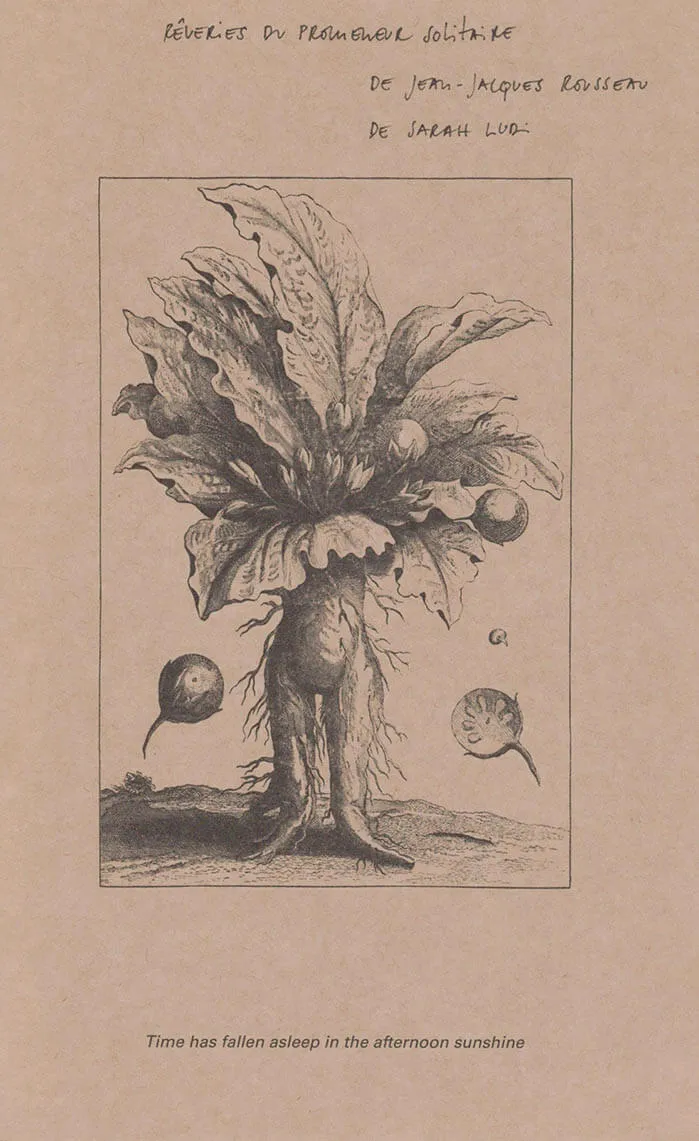
Time has fallen asleep in the afternoon sunshine
Rêveries du promeneur solitaire
For the project Time has fallen asleep in the afternoon sunshine a group of people/ performers memorize a book of their choice. Together they form a library collection consisting of living books. After years of learning by heart and reciting for readers, some of the books have now been written down from memory to create new editions, versions resulting from this process. This book is one of those books, chosen by one person, learned by heart and recited many times, and now written down again from memory. This edition is not a re-edition of the original text. It is a re-writing of the text after the process of reading, memorizing and reciting, with all the alterations that might have occured in the course of this process.

Ethical Portraits: In Search Of Representational Justice
Ethical Portraits investigates the representation of the incarcerated in the U.S. criminal justice system. Through interviews, creative non-fiction, and cultural theory, Hatty Nestor deconstructs a range of different prison portraiture.
Prisons systematically dehumanise the imprisoned. Visualised through mugshots and surveillance recordings, the incarcerated lose control of their own image and identity. The criminal justice system in the United States does not only carry out so-called justice in ways that compound inequality, it also minimises the possibility for empathetic encounters with those who are most marginalised. It is therefore urgent to understand how prisoners are portrayed by the carceral state and how this might be countered or recuperated. How can understanding the visual representation of prisoners help us confront the invisible forms of power in the American prison system? Ethical Portraits investigates the representation of the incarcerated in the United States criminal justice system, and the state's failure to represent those incarcerated humanely.
Through wide-ranging interviews and creative nonfiction, Hatty Nestor deconstructs the different roles of prison portraiture, such as in courtroom sketches, DNA profiling, and the incarceration of Chelsea Manning. Includes a foreword by Jackie Wang.
Hatty Nestor is a cultural critic and writer, published in Frieze, The Times Literary Supplement, The White Review and many other publications. She is currently completing a PhD at Birkbeck, University of London.

The Premise of a Better Life
An artist's book by New York-based author and artist Sam Pulitzer (born 1984), The Premise of a Better Life combines photographs with ethical and existential questions addressed to the viewer, in an allegory of the contemporary condition. These photographs of everyday things, ambiguous details, nondescript landscapes and cityscapes were mostly taken in New York, although the city appears as the pale reflection of a model city.
Each picture is accompanied by a question: "Can you afford yourself?" "Are you waiting for a moment that just won't come?" "If you knew then what you know now, would it make a difference?" "Do you trust happiness?" The montages offer a complex, personal, at times satirical image of the present age.
An original essay by Pulitzer unfolds the project's philosophical and political issues, notably discussing a key reference for the project, Ernst Bloch's The Principle of Hope.

A Queer Theory of the State
How queer theory can wed its critically anti-normative impulses to the empirical need for a state.
Queer theory has often been hesitant to align itself with a politics of the state, approaching it with a negative or pragmatic framework. A Queer Theory of the State offers a more optimistic perspective. Rather than eschew engagement with democratic theorizing, the historian Samuel Clowes Huneke asks how queer theory can wed its critically anti-normative impulses to the empirical need for a state. In answering this question, Huneke shows how the state is an integral component of a politics that seeks to subvert and undo the oppression of queer lives.
Samuel Clowes Huneke is assistant professor of history at George Mason University. His first book, States of Liberation: Gay Men Between Dictatorship and Democracy in Cold War Germany (2022), won the Charles E. Smith Award for best book in European History from the European History Section of the Southern Historical Association. Huneke has written for Boston Review, the Washington Post, The Point, and the Los Angeles Review of Books.

Les liens qui empêchent: L'homophobie familiale et ses conséquences
Dans Les liens qui empêchent, Sarah Schulman analyse la reproduction de l’homophobie au sein du cercle familial, quand bien même ce dernier devrait être le lieu du développement et de l’épanouissement de chacun·e.
En s’appuyant aussi bien sur des théories sociologiques que sur des témoignages individuels, l’autrice décortique les mécanismes qui conduisent les familles à exclure certains de leurs membres. Bien que l’homosexualité soit de plus en plus représentée dans les médias et dans la culture populaire, Sarah Schulman montre en quoi celle-ci est souvent caricaturée et pathologisée. Ainsi, cette visibilisation ne s’accompagne pas nécessairement d’une meilleure acceptation des personnes homosexuelles dans le cercle familial.
Virulent plaidoyer visant à faire de l’homophobie une question de société qui ne serait plus uniquement reléguée à la sphère privée, Sarah Schulman offre ici des pistes permettant de mettre un terme à la souffrance endurée par de nombreux·ses homosexuel·les au sein du foyer familial.

Antonio Obá: Rituals of Care
Antonio Obá: Rituals of Care traces the practice of the Brazilian artist since 2016, offering a broad survey of his recent work, dwelling on the recurring motifs and iconographic sources that feed the complex imagery of his painting. Extensively illustrated, the book returns the richness of Obá's paintings, with enlargements on some of the details woven into the pictorial texture that, in addition to showing his masterful technique, make certain elements of his visual vocabulary stand out.
The conversation between Andrea Bellini and Antonio Obá that opens the book offers the opportunity to learn, through the artist's voice, about the key passages of his research, and to examine his diverse cultural references—from the Baroque of Minas Gerais to traditional Chinese painting, from Rembrandt to the Catholic ex-votos—until we discover the Obá's civic vocation, of painting as a spiritual practice.
The two essays commissioned for the occasion analyze the complexity of these layered signifiers. Lorraine Mendes's essay "Every Boy Is a King" offers an in-depth analysis of Obá's religious syncretism. It suggests an interpretation of its layered symbols, particularly the sankofa and the deity Exú, both of which pay tribute to the artist's West African roots. Above and beyond the specific cultural contexts of this iconography, the author emphasizes the universal value of Obá's work, its evocative, transformative, dynamic power, which—like music or dance—knows no national boundaries or barriers.
Larry Ossei-Mensah's essay "Embodiment: The Art of Antonio Obá" investigates the complex cultural legacy that is intertwined with the artist's practice, connected to his Afro-Brazilian roots, to the social and political realities of the Black diaspora, and to Christian, Candomblé, and Umbanda traditions. In addition to examining the context in which Obá's work is rooted, the author situates it within a galaxy of artists who have focused on questions of identity, often using their own bodies as tools of social and cultural critique.
Completing the book is a chronology, compiled by Sara De Chiara, tracing the artist's formative years and exhibition history, accompanied by rich documentary materials.
Published on the occasion of Antonio Obá: Rituals of Care, the first mid-career survey in Europe dedicated to the Brazilian artist, curated by Andrea Bellini, at the Centre d'Art Contemporain Genève, in 2025.
Antonio Obá (born 1983 in Ceilândia, Brazil) lives and works in Brasília. His multifaceted practice encompasses painting, sculpture, photography, installation, video, and performance. His œuvre interrogates and subverts historical representations, reappropriating spiritual practices and stigmas of racism. Obá endeavors to reclaim his African heritage in a societal framework that has historically sought to dilute Black culture. His works therefore confront the violence inflicted over centuries upon African-Brazilian traditions and communities with new narratives.

The Villain’s Dance
Fiston Mwanza Mujila, Roland Glasser
Full of wit, music, and a rollicking cast of characters, The Villain’s Dance shows Fiston Mwanza Mujila is back with a bang.
Zaire. Late nineties. Mobutu’s thirty-year reign is tottering. In Lubumbashi, the stubbornly homeless Sanza has fallen in with a trio of veteran street kids led by the devious Ngungi. A chance encounter with the mysterious Monsieur Guillaume seems to offer a way out . . . Meanwhile in Angola, Molakisi has joined thousands of fellow Zairians hoping to make their fortunes hunting diamonds, while Austrian Franz finds himself roped into writing the memoirs of the charismatic Tshiamuena, the “Madonna of the Cafunfo Mines.” Things are drawing to a head, but at the Mambo de la Fête, they still dance the Villain’s Dance from dusk till dawn.

After Delores
A new edition of Sarah Schulman's acclaimed 1988 novel, a noirish tale about a no-nonsense coffee-shop waitress in New York who is nursing a broken heart after her girlfriend Dolores leaves her; her attempts to find love again are funny, sexy, and ultimately even violent. After Delores is a fast-paced, electrifying chronicle of the Lower East Side's lesbian subculture in the 1980s.
Sarah Schulman is the author of sixteen books, including the novels The Mere Future, The Child, Rat Bohemia, and Empathy (all from Arsenal Pulp Press) and the recent nonfiction works The Gentrification of the Mind: Witness to a Lost Imagination and Israel/Palestine and the Queer International. She was also co-producer with Jim Hubbard of the feature documentary United in Anger: A History of ACT UP and is co-director of the ACT UP Oral History Project. She lives in New York, where she is Distinguished Professor of English at City University of New York (College of Staten Island) and a Fellow at the New York Institute for the Humanities at NYU.

The Tiniest Muzzle Sings Songs of Freedom
Taking readers from suburban carports to wintry Russian novels, from summer tomato gardens to the sublime interiors of presleep thoughts, Magdalena Zurawski's poems anchor the complexities of our interconnected world in the singularity of the human experience. Balancing artistic experimentation with earnest expression, achingly real detail with dazzling prismatic abstraction, humor with frustration, light with dark, she offers a book of great human depth that is to be carried around, opened to anywhere, and encountered.
Magdalena Zurawski is the author of the novel The Bruise, which won the Ronald Sukenick Award from FC2 in 2008 and a LAMBDA literary award in 2009, and the collection of poems Companion Animal, which was published by Litmus Press in 2015 and won a Norma Faber First Book Award from the Poetry Society of America. She attended Brown University where she studied with poets Rosmarie and Keith Waldrop, C.D. Wright, and Peter Gizzi. She has lived in Berlin, New York, Philadelphia, San Francisco, and Durham, NC where she ran the Minor American Reading Series. She is currently Assistant Professor of English and Creative Writing at the University of Georgia.
Published April 2019