Books
Books
in random order

Myth Lab: Theories of Plastic Love
Myth Lab: Theories of Plastic Love is a genre-defiant sex-trip to post-human dimensions. If C.G Jung, magic-mushroom shaman Terence McKenna and Camille Paglia (Sexual Personae) had a three-way while binging on George Bataille and undergoing Hormone Replacement Therapy, their baby might be the erotic cocktail of Myth Lab. Its extreme theme is nothing less than the fate of the species.
“Brilliant and wild, Jack Skelley’s Myth Lab is a manifesto of exuberance disguised as a sci-fi sex test-center for the invention of communal futures. Skelley’s a mad scientist, scholar and poet.” - Chris Kraus, author of After Kathy Acker
“In Myth Lab, Jack Skelley adroitly molds an “Einsteinian elasticity between objects and ether” to the “clitoverse.” If this formulation seems too vast, just think about a) the last time you felt good about power and b) all the ways to say yes to pleasure as a source of liberation. In conducting a “cosmologic psychoanalysis,” Myth Lab thrillingly hot wires our neurons to an endless mirror stage reflective of our own instinctual nature.” - Kim Rosenfield, author of Phantom Captain
"An explosion of clit-cock-and-pop-culture worship. Skelley’s eroto-celestial universe fights back not only against the denial of desire – “also known as fuckheadocracy and market forces” – but against death itself." - Francesca Lia Block, author of Weetzie Bat
"A hallucinatory book that straddles gender studies, science-fiction, and cultural criticism (to name but three of many genres). Ever eager to use a newfound Skelley-ism, I urge everyone to read Myth Lab and be “Kardashian'd” with love (i.e buy it now, it's great)." - Susan Finlay, author of The Jacques Lacan Foundation
"In Jack Skelley’s Myth Lab, something weird and beautiful is forged in the crucible of infinite horny grief. It’s an epic, delirious descent into the inferno, navigating the concentric circles of romance and desire as literary malady, TikTok psyop, benevolent cosmological principle, and more. Simultaneously a quest, a physics experiment and an elegy. I loved following its narrator - a tender, erotomanic, Blakean particle - seeking and finding visionary head." - Daisy Lafarge, author of Love Bug

Grab Bag
Cult novelist Dennis Cooper launches the third title of Little House on the Bowery, the Akashic series he is editing and promoting.
Grab Bag is comprised of two interrelated novels, Dark Rides and Wish Book, from one of Canada’s most important young writers. Both books are set in the same small rural city, in different eras (1950s, 1930s), each characterized by McCormack’s spare and elliptical prose.

Le conflit n’est pas une agression
Des relations intimes aux politiques globales, Sarah Schulman fait le constat d’un continuum: individus comme États font souvent basculer les situations conflictuelles dans le registre de l’agression, criminalisant leurs opposants pour couper court à la contradiction et échappant ainsi à leur propre responsabilité dans les conflits. En distinguant conflit et agression, l’autrice interroge notre culture de la stigmatisation.
Ce travail profond, aussi courageux qu’impertinent, montre comment la sanction et la répression prennent le pas sur l’auto-analyse à l’échelle individuelle et collective, et comment l’altérité sert de justification à la violence et à l’exclusion. Ce livre intentionnellement polémique offre un aperçu des dynamiques contemporaines et historiques qui prennent les différences intimes, raciales et géopolitiques pour des éléments déclencheurs de la course à l’injustice, à l’exclusion et à la répression.
Le conflit n’est pas une agression est un virulent plaidoyer contre le phénomène culturel de l’accusation, révélant combien les personnes en situation de pouvoir exacerbent et manipulent la crainte de l’« autre » pour éviter toute remise en question.

Maisa in Webland
What does ‘user-friendly’ website mean if, on it, online behaviors like stalking, teasing, and ghosting — once considered peripheral — are now central to survival, care, and belonging? How to thrive without becoming an “Interdisciplinary Unicorn”: the state’s most beloved user-citizen fluent in multiple registers of production, optimization, and self-branding? How in this beautiful world is one supposed to log off, when surveillance and privacy erosion have been normalized? And how, oh how, could users possibly think of building the alternatives, when cool and cringe online acts, all activate the platform’s reward system: the unleashing of emoji-filled praise? How to resist the platform’s toxic seduction?
Haunted by screenshots of early cyberfeminist websites and in dialogue with digital sages, web scripts, and business interests, media artist, web developer, and author Maisa Imamović embarks on a philosophical and practice-based crusade through the internet’s surface and its shadows. To expose the various ways of thriving online without surrendering to optimization, the book explores imperfect uses of perfect software, preservation of precarious web infrastructures, tactical content strategies, and experiments with autonomous financial systems — all wrapped in educational efforts to sustain criticality amid automation. Through these traversals beneath the scroll, Maisa finds her Webland: speculative, broken, and oftentimes, poetic infrastructure where logic destabilizes, binaries dissolve, and meaning evades monetization. But can a non-extractive internet exist beyond metaphor? Can poetry rewire protocol? Or will her sanctuary be absorbed into the very architectures it resists?
"In Maisa in Webland, Maisa Imamovic evokes the multidimensional, spontaneous human elements of the early web, using interviews, case studies, critical theory and fiction as her organic materials. She peeks behind the screen and through time to trace the subtle erosion of the web’s early utopian ideals to its cold and extractive present. Imamovic bravely wades through the swampy digital muck that mediates our everyday reality, examining its invisible psychic scaffolding with academic rigor, and a big dose of humor and heart. Was it an inevitable entropy, or an aberration? How and when did we get so off-course? Can we return? Do we want to? In Maisa’s Webland, we might very well be doomed, and maybe that’s a good thing. When the center of this tangled web no longer holds, something new can take shape.” - Nada Alic, author of Bad Thoughts

Of Planters; an Herbarium
Published in tumult of “Planters, a garden show” by COUR: with Noëmi Orgaer, Orson Van Beek, Charlotte Bombel, Moreno Schweikle, Shun Yoon, Yen Proesmans, Benny Van den Meulengracht-Vrancx, HansWuyts, Malte van der Meyden, Fritz Adamski, Hannah Kuhlmann, Delphine Lejeune, Grażyna Mielech and Giseok Kim.

From The Prop To The Inside
FROM THE PROP TO THE INSIDE gathers texts on the concept of the prop—as object, requisite and support—on stage and in the exhibition space. The starting points of this book are objects and installations of the artist Michaela Schweighofer, which deal with the stage as a platform and the sculpture as a prop.
The authors are friends: artists, critics and curators whom she has invited to write a text at the interface of their and her practice. The contributions within take on multiple forms; letters, essays and interviews—they are intended to create a theoretical-subjective anthology that makes visible the phenomena of the private as symptoms of the structural, as well as to provide a direct insight into contemporary artistic creation.
Text: Juliane Bischoff, Veronika Eberhart, Cornelia Lein, Cathrin Mayer, Gianna Virgina Prein, Agnieszka Roguski, Juliane Saupe, Michaela Schweighofer & Chloe Stead

Sharks Come Closer at Night
Sharks Come Closer at Night explores the bond the photographer Lauranne Leunis formed with friends during a first experience far from home. It becomes an intimate reflection on the sacred space they created during their evening walks. In these moments, they found solace in one another while navigating the challenges of young adulthood and the complexities of femininity. The work aims to slow down time, capturing moments of vulnerability, freedom, and connection. Yet even in the stillness, the persistent sound of crashing waves and splashing water serves as a reminder that time is always moving.
All photographs are made on analogue black-and-white film, using various camera formats. This approach adds a raw, fleeting quality to the images, distinguishing them from more staged photographs.

MW Collected Texts (Bootleg)
This bootleg edition collects scanned copies of Monique Wittig's writing. It includes; The Lesbian Body, Les Guérillères, The Opoponax, and Lesbian Peoples: material for a dictionary— In true bootleg style, punk enough to carry the truly radical words of Wittig: scans, a little grainy, with marginalia of unknown origins. Now, we can dress ourselves in the ravishingly erotic, violent splendorous brilliance to become baby Wittigs.
This edition was assembled out of a deep love of Wittig's work by Chloe Chignell.
Monique Wittig was a French author and feminist theorist particularly interested in overcoming gender and the heterosexual contract. She published her first novel, L'opoponax, in 1964. Her second novel, Les Guérillères (1969), was a landmark in lesbian feminism.

Archive Dora Diamant #06
A collection of photographs from the archives of the icon of underground and alternative Parisian nights Dora Diamant.
A self-taught photographer, Dora Diamant has left thousands of photos. The Dora Diamant Association, custodian of this archive, and Éditions L'Amazone have joined forces to bring them to life by devoting a series of publications to them. Each volume of the Dora Diamant Archive was created by a different person and is the result of a subjective selection and arrangement specific to its author.
Figurehead of the Parisian underground and queer nights, photographer, DJ, multimedia and polymorphic artist, Dora Diamant was the daughter of Pascal Doury.
Selected by Leopold Duchemin.

Festival
The festival is a space of communion and celebration, a romanticized collision of bodies, music and magic. The revolution will look like a festival, we’ve been told by philosophers, writers, artists, and marketers. But the festival is also, of course, the space of formalizing ideology, ritualizing the consumption and violence that propels existing structures of power.
This poetry collection views the migrant, female body as both the glorified and martyred totem of the festival-of-all-festivals we call globalization. Drawing from sources such as Sigmund Freud, James George Frazer, H.D., the Situationist International, seventeenth century narratives of Dutch sailors shipwrecked on the Korean peninsula, the rise of K-pop and the “Korean Wave,” and a zoo-breaking gorilla named Bokito, Festival features kaleidoscopic poetic sequences aiming to show that if anything universal is to be found in lyric poetry’s “I,” it is the result of centuries-long entanglements and contaminations, and of the bodies made to bear these exchanges, to give birth to this century’s globalized subject.
“FESTIVAL is an ode to both beauty and misery. Mia You’s ingenious poetry will have you laughing through your tears. Do NOT miss out!”
— Yael van der Wouden
"She reanimates the form-of-life which is a poem with a feminist skepticism, without foreclosing her robustly idealist commitment to poetry’s continuance"
— Lisa Robertson
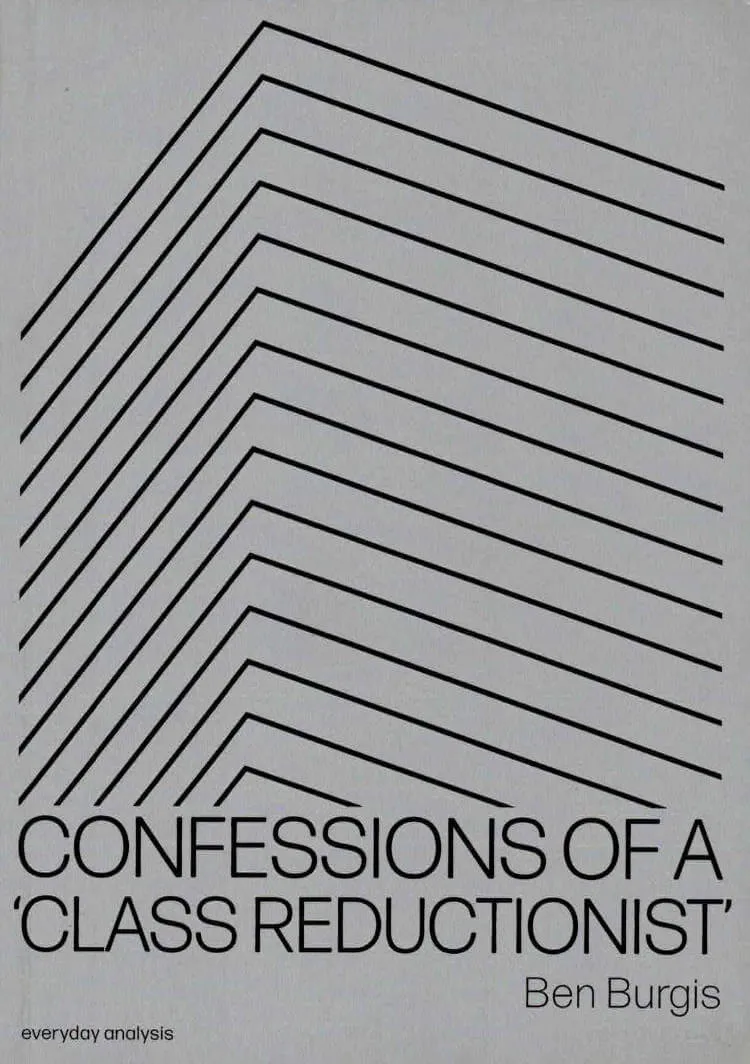
Confessions Of A Class Reductionist
In these essays, Ben Burgis criticizes fashionable radical-liberal identity politics and makes the case for universalism about rights and an unabashedly “class-first” approach to socialist political strategy. This may sound to some ears like a call for abandoning marginalized people. On the contrary, he argues, focusing on economic inequality empowers the victims of bigotry and retrograde social practices the resources and material security to stand up for themselves far more effectively than any diversity trainer or “anti-racism” consultant could represent their interests. As we face a rising tide of reactionary authoritarianism, it’s more important than ever to ditch the identitarian pieties of the recent past and think hard about how the Left can actually win.

La locataire
The Tenant is a monographic critical essay by Marie Canet. It is the first text to directly address the connections between McKenzie’s work, pornography, and special effects. The title refers to the way the artist moves through different periods and aesthetic spaces, appropriating their codes in order to construct new visual fictions. The book is infused with post-#MeToo feminist thinking, alternative uses of biography, reflections on the art world, and contemporary debates surrounding appropriation, embodiment, and the status of the artwork.
McKenzie and Canet worked with each other for over eight years, on projects like Atelier E.B: Passer-by catalogue, published on the occasion of the Fondation Galeries Lafayette exhibition, or the book Pervert or Detective, a conversation between Lucy McKenzie and artist Reba Maybury. This collaboration now culminated in an exhibition and a book: Plastic Newspaper (presented at CRAC Sète in March 2026) and Lucy McKenzie, The Tenant.
Texts by Marie Canet and Lucy McKenzie
Translations: Catherine Petit & Paul Buck (Marie Canet), Juliette Desorgues (Lucy McKenzie)
Published in connection with the exhibition Lucy McKenzie, Plastic Newspaper, at Crac Occitanie, Centre régional d‘art contemporain Occitanie/Pyrénées-Méditerranée à Sète, 21.03.-06.09.26

The Letters of Rosemary & Bernadette Mayer, 1976-1980
Bernadette Mayer, Rosemary Mayer
This collection of the correspondence between artist Rosemary Mayer (1943-2014) and poet Bernadette Mayer (born 1945) occurs between the years of 1976 and 1980, a period of rich creativity in New York's artistic avant-garde, and one which includes the development of major bodies of work by the two women.
Rosemary Mayer was creating sculptures, watercolors, books and temporary monuments from weather balloons and snow, while Bernadette Mayer was working on some of her best-known publications, including the book-length poem Midwinter Day and the poetry collection The Golden Book of Words.
Spanning the worlds of Conceptual art, Postminimalism, feminism, the New York School, Language poetry and more, these letters elucidate the bonds of sisterhood through intimate exchanges about art, relationships and everyday life.

The Rambling Figures of Mani Kaul
Arindam Sen, Stoffel Debuysere
Published on the occasion of the program Soft Notes on A Sharp Scale — The Rambling Figures of Mani Kaul, produced as part of the Courtisane festival 2018, as well as the associated Mani Kaul programme organized by the Essay Film Festival 2018, in collaboration with the Otolith Group.

Estonian Academy of Arts / EKA GD MA
Typing...
The fourth in a series of publications, featuring writing by graphic design students of EKA GD MA. Typing... includes essays, scripts, translations and stories on a wide range of topics: killing vowels and milling fonts, personal knowledge management, shortcuts, tedious/careful/tiring/joyful typesetting, type of Georgianness, typing in 3rab(izi) and typing in all lowercase.
With contributions by Anna Wittenkamp Rich, Archil Tsereteli, Fa(tima)-Ezzahra El Khammas, João (Juca) Pedro Nogueira, Karthik Palepu, Laura Martens, Linnea Lindgren, Rok Ifko Kranjc.
Designed by Fatima-Ezzahra El Khammas and Laura Martens
Cover by Hanafi Gazali

Painting Photographs
TBW Books is pleased to announce the publication of Painting Photographs, a new book by Creative Growth Art Center artist Alice Wong. Wong's bold interpretation of vintage vernacular photographs breathes new life into family album kitsch and cliché shots of plants and landscapes, transforming them into a hyper-color plane of vivid abstraction. Using paint markers to enhance and obscure the formal qualities of appropriated imagery, Wong's hand brings energy to each underlying image, recalibrating the viewer's eye and sparking appreciation for otherwise still compositions. With fluid mark-making and a striking approach to color-blocking, Wong's craft merges with the photographic process to create work that feels at once of times past and completely contemporary.
Creative Growth Art Center is the oldest and largest nonprofit art studio for artists with developmental disabilities in the United States. Since 1974, Creative Growth has played a significant role in increasing public interest in the artistic capabilities and achievements of people with disabilities, providing a professional studio environment for artistic development, gallery exhibition and representation.

All Ah We is One: Caribbean Carnival Costume
Caribbean Carnivals have been taking place around the UK since 1959. These joyous celebrations of culture and community began as acts of resistance in the face of enslavement — a defiant stand from communities who refused to lose who they were and where they came from.
Drawing from this rich and radical history, Aisling Serrant explores Carnival through one of its most vibrant and unmissable features: costume. First turned to by former slaves in the Caribbean as an act of reclamation and quiet resistance, with roots in West African and European masquerade alike, the colourful costumes of Carnival weekend remain a vital mode of self-expression, protest, and camaraderie. From Canboulay to Leeds and Notting Hill, the costume makers, wearers, and the communities they attract, embody Carnival in the spirit of an expression used across the Caribbean to signify unity among nations and peoples: all ah we is one.

addictive no an adjective
A text on speaking, listening and being understood made in conversation with iOS speech-to-text software.

F.R. David - what I mean is—
F.R.DAVID is a typographical journal, dealing with the organisation of reading and writing in contemporary art practises. “what I mean is—” the 16th issue, edited by Will Holder.

The North Road Songbook
The North Road Songbook collects together eight sequences of poems, most of which were composed between 2019 and 2024. The title sequence is a set of lyrics written around North Road in Brighton, originally a mediaeval field boundary, now a chaotic thoroughfare filled with ghosts, sirens and songs.
Verity Spott is a poet, teacher and care worker from Brighton, England, whose books include Hopelessness (the 87press), Poems of Sappho (in translation) and Prayers Manifestos Bravery (Pilot Press). Verity’s poetry has appeared in The New York Times and has been translated into French, German and Greek.

Black Cine-Body Sonics: Racializing the Soundtrack
Black Cine-Body Sonics: Racializing the Soundtrack surveys how Black audiovisuality developed and thrives in films and television through importing and materializing the sonics of Black musical representation — from 'Blaxploitation' classics (Shaft and Truck Turner) to cine-auteurs (Melvin Van Peebles, Spike Lee and Jordan Peele) to music video performers (Michael Jackson, Beyoncé and Kendrick Lamar) to video artists (Arthur Jafa and Isaac Julien) to contemporary multi-genre explorations of race (Sinners, Lovecraft Country, Atlanta and Swarm). The book views Jazz Soul Funk Disco Hip Hop Techno and House not as 'source music' but as genetic origins in the transformation of movies and shows resulting in new cinematic and televisual formations — all of which foreground the body performance and musicality.
— Philip Brophy
This is the 4th publication in the Echoes of Dissent series, devoted to the politics of the soundtrack.

University of California Press
Sleeping with the Dictionary
Harryette Mullen's fifth poetry collection, Sleeping with the Dictionary, is the abecedarian offspring of her collaboration with two of the poet's most seductive writing partners, Roget's Thesaurus and The American Heritage Dictionary. In her ménage à trois with these faithful companions, the poet is aware that while Roget seems obsessed with categories and hierarchies, the American Heritage, whatever its faults, was compiled with the assistance of a democratic usage panel that included black poets Langston Hughes and Arna Bontemps, as well as feminist author and editor Gloria Steinem.
With its arbitrary yet determinant alphabetical arrangement, its gleeful pursuit of the ludic pleasure of word games (acrostic, anagram, homophone, parody, pun), as well as its reflections on the politics of language and dialect, Mullen's work is serious play. A number of the poems are inspired or influenced by a technique of the international literary avant-garde group Oulipo, a dictionary game called S+7 or N+7. This method of textual transformation—which is used to compose nonsensical travesties reminiscent of Lewis Carroll's "Jabberwocky"—also creates a kind of automatic poetic discourse.
Mullen's parodies reconceive the African American's relation to the English language and Anglophone writing, through textual reproduction, recombining the genetic structure of texts from the Shakespearean sonnet and the fairy tale to airline safety instructions and unsolicited mail. The poet admits to being "licked all over by the English tongue," and the title of this book may remind readers that an intimate partner who also gives language lessons is called, euphemistically, a "pillow dictionary."

Empire of the Senseless
Originally published in 1988, Empire of the Senseless marked a turning point in Acker's wild, inimitable style. Considered one of her more accessible works, here Acker candidly addresses her lifelong obsessions: childhood and trauma, language and sexuality, criminality and corruption, oppression and rebellion.
Abhor (part human, part robot) and her lover Thivai (a pirate) traverse Paris in a dystopian future, in search of a mysterious drug that Thivai needs in order to maintain his ability to love. Navigating the chaotic city, they encounter mad doctors, prisoners, bikers, sailors, tattooists, terrorists, and prostitutes, while a band of Algerian revolutionaries take over, and the C.I.A. plots to thwart them all.
Sexually explicit, graphically violent, Empire of the Senseless resists the desensitizing of cultural consciousness and the disintegration of interpersonal communication. A timeless, prescient parable, it speaks profoundly to our social and political history as well as our present reality.

Mirrorstage
A raw and profound novel in verse about mental health, addiction, queerness and shame that explores ideas of hybridity and identity.
Following their discharge from hospital, Mirrorstage follows its narrator on a road trip through the grey, liminal landscapes of modern Britain. As they pass graffitied bus shelters, construction sites and flooded motorways, factories and high-rises, the narrator’s internal and external journeys begin to converge, leading them down paths they have been trying to avoid: the mental illness and substance use that led them to the inpatient ward, the uneasy balance of their own gender identity, their troubled relationship with their estranged father, the perils and pleasures of the queer scene, and the shame that has haunted them throughout their life.
Woven around the psychoanalytic concept of its title, Mirrorstage is an experimental fable exploring the boundaries of selfhood and literary forms, told in fragments of prose and verse that are equal parts heartbreaking, sexy, and witty.