Books
Books
in random order

Piles of Bricks / Piles de briques
‘Piles of Bricks / Piles de briques’ by Bie Michels presents the working proces of her project ‘Bricks in Madagascar’. This project consists of two films, ‘La couleur de la brique’ and ‘Ingahy Kama’, the installation ‘Circular construction versus human body—referring to Toshikatsu Endo’, which she showed in Madagascar (October 2017) and Argos Brussels (May 2018), and the performance ‘Piles of bricks (working process)’, on which she will work 8 weeks before the book presentation and which will be performed at that moment.
Besides images and stills, five writers deliver a contribution in their own working field related to the project: Hobisoa Raininoro (Art assistent and former director of CRAAM (Centre de Ressources des Arts Actuels de Madagascar, MG), Rafolo Andrianaivoarivony (Professor History University of Antanarivo, MG), Petra Van Brabandt (Doctor philosophy Sint Lucas Antwerp, B), Gwyn Campbell (Professor History Mc Gill University, CA) and Nanne op ‘t Ende (writer, NL)

Cancelled Confessions (or Disavowals)
First published in 1930 by anti-fascist, avant-garde publisher Éditions du Carrefour in Paris as Aveux non Avenus, Cancelled Confessions (or Disavowals) is Claude Cahun’s wildly radical answer to an invitation to write a memoir. Shattering the very premise of the “memoir”—the singularity of identity—into sharp and prismatic fragments, Cahun assembles an ever-mutating inquiry into the instability of “self” and its many masks.
Masculine? Feminine? It depends on the situation. Neuter is the only gender that always suits me.
Using a multitude of forms (fables, jokes, aphorisms, letters, dialogues, dreams, hymns, pronouncements, etc.), to plumb the subjects of desire, love, gender, sex, fear, faith, religion, and vanity (among others), Cancelled Confessions (or Disavowals) is a tour-de-force work of resistance: it provokes the reader to enter the capacious, provocative, playful, and deeply imaginative space constructed by Cahun in defiance of all categorization, to repudiate a delimited, censured world and embrace, instead, the outcasts and cast-offs, the unknowable and the unknown.
I believe, but in the conditional: I would like to believe.
Thoughtfully redesigned to emulate the original artist’s book, this revised edition of the out-of-print English translation by Susan de Muth—originally published in the UK by the Tate in 2007 and in the U.S. by MIT Press in 2008—includes novelist and critic Pierre Mac Orlan’s original 1930 preface along with contemporary essays by scholar Amelia Groom and translator de Muth. Almost 100-years-old, it is not only prescient, but urgent, in.
It’s not enough to be vanquished, you also have to know how to turn defeat to your advantage.
Translated by Susan de Muth, preface by Pierre Mac Orlan, essay by Amelia Groom.

Movement Research Performance Journal
Issue #62 - We Exist in the Ambivalence of Those Motherfuckers
Anh Vo, maura nguyen-donohue and 1 more
What began as a project responding to the fiftieth anniversary of the ‘end’ of the Vietnam War became a project of inhabiting the Movement Research Performance Journal (MRPJ) from within the landscape of contemporary Vietnamese performance art. The result, Issue #62, is a window onto a community of insiders who reflect a set of concerns, questions, historical trajectories, and aesthetic legacies that differ from what has more often been foregrounded in our U.S./New York City-centric publication. Like other documents of this kind, which endeavor to portray a performance scene that will be foreign to many readers, the texts from this group of intergenerational, contemporary artists demonstrate a careful navigation of the dialectics of inside and outside, self and other, performer and audience, seeing and being seen, that informs every exchange across cultural difference.
The texts are also not monolithic, suggesting a range of relations to the Vietnam of the past and present, from within Vietnam’s national borders and among the diaspora. Especially for contributors living and working in Vietnam, writing has also been a practice of choreographing words within a political landscape where to speak publicly, in itself, is a performance of negotiated risk. Embracing the complexities of these differing positions has been the focus of our editorial process—one that has asked the editorial team to embrace the limits of our own knowledge, to recognize we will not be able to recognize all valences others may discover in these texts, and not to edit these layers out of the works that follows.

Local Ecology – Moulin des Ribes
A contemplative photographic series by Jochen Lempert, created during a residency at the Moulin des Ribes in Grasse, a former mill nestled in the Provençal landscape.
Known for his background in biology and his distinctive analogue black-and-white photography, Lempert brings a scientific sensitivity and poetic restraint to his exploration of the site's immediate environment.
Shot entirely on location, the images focus on subtle interactions between natural forms and their surroundings. Rather than constructing grand ecological narratives, Lempert observes everyday life in and around the mill, drawing attention to the interdependencies and ephemeral presences that define a place.
With the intimacy of field notes and the tactility of silver gelatin prints, Local Ecology. Moulin des Ribes is both a document and a meditation. It reveals the overlooked ecologies that persist on the periphery of human attention, transforming the act of looking into a form of ecological engagement. In the silence of these photographs, Lempert proposes a different kind of knowledge—rooted in slowness, attunement, and care.
The photographs included in this publication were taken in the summer of 2021 during a residency at La Società delle Api, Moulin des Ribes, Grasse, based on an idea by Cristiano Raimondi.
Jochen Lempert (born 1958 in Moers) is a German photographer. Trained as a biologist specializing in dragonflies, he began his career as a photographer in 1989, at the age of 31, developing an artistic practice based on this scientific heritage, marked by images of nature where the animal and vegetal go hand in hand.
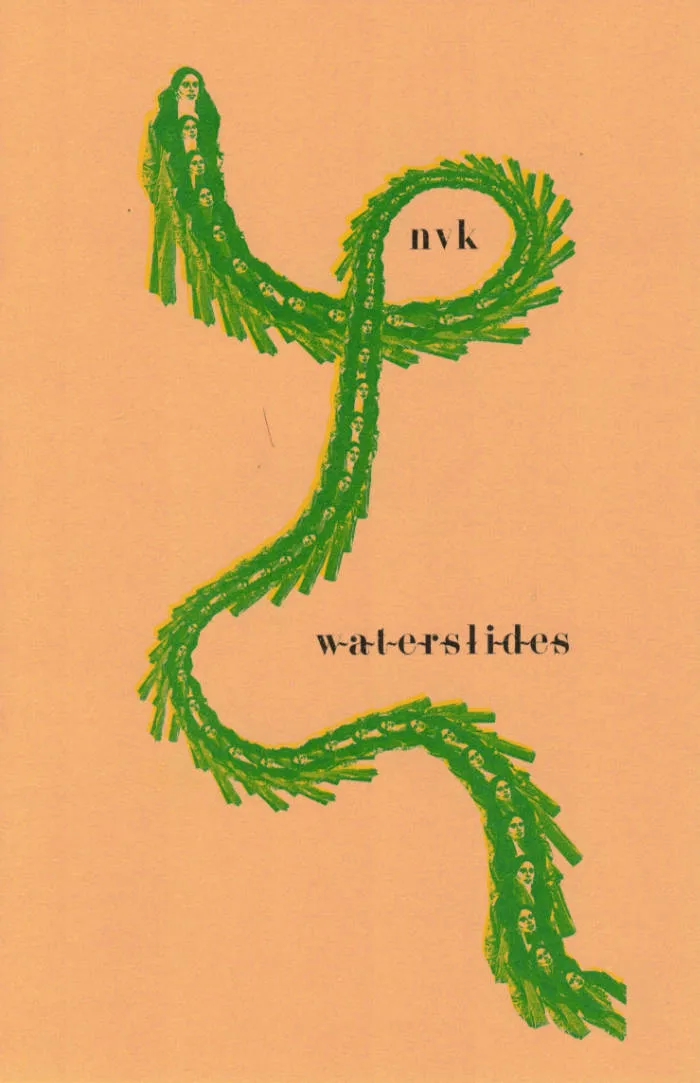
Waterslides
"Waterslides is a falling and plunging, short starts and stops aided by movement, until we splash, climb and plunge again. Each sliding is the same but different—with each descent new expectations and thoughts swirl, shifting focus and gaining new insights or blockages. Waterslides are brief moments of remembering, remembering as a present tense activity, one that happens as we think of it, projected on our now. The waterslide is the moment of past and present working in tandem, a movement of repeating, revisiting and remembering all at once.”
Written by nvk 2021-2023. Dedicated to Judi, MM & TNN.
A version of these poems was published as an audio work through Ignota Press’ The Mountain (2023) and included in a reading with James Loop on Montez Press Radio (2023). nvk would like to thank Jan Matthé, Stine Sampers and Michelangelo Miccolis for their patience & love.
This book was first presented at Kransen in Antwerp, May 6th 2023, with a performance by Sassy (costume by Rosa Schützendorf). Printed and bound at Risiko Press, Borgerhout. Cover image by nvk. Fonts: Adonis, Garamond Pro. Limited to 150 copies.
128x195mm, 16p., stapled, cover: green, yellow and black risoprint on 160gsm caramel paper, inside: black and blue riso on 120gsm Munken Pure paper.

Pearls from Their Mouth
This book is built of stories and provocations—like the birth of a pearl, it transforms that which irritates, layer by layer.
Through speculative fiction and critical essays, Pear Nuallak explores what happens when messy, desiring bodies collide with the hard edge of power. The world’s neat categories are unmade and rewritten, revealing that racial capitalism’s myths are just as much fantasies as Thai bird princesses and transgender magic.
Moving playfully across folktale, horror, satire and critique, Nuallak examines how different beings are formed politically, bodily and emotionally. We discover interdimensional fungi resisting colonisation, queer monsters living on Hampstead Heath, and a mysterious canal running through the ruins of capitalism into interstitial realms. We test the borders of queer diasporic nationalism and take apart the racially melancholic memoir. In this fiery yet delicate collection, we aren’t bound by truth, but flow with it into new worlds.
Pear Nuallak is a visual artist and writer from London. They run community art workshops and co-organise a queer social hub with the Black Cap Community Benefit Society. Their writing has been published in The Dark and Interfictions. Pearls from Their Mouth is their first book.

knot body
Bringing together poetry, essay, and letters to “lovers, friends and in-betweens,” Eli Tareq El Bechelany-Lynch confronts the ways capitalism, fatphobia, ableism, transness, and racializations affect people with chronic pain, illness, and disability. knot body explores what it means to discover the limits of your body, and contends with what those limitations bring up in the world we live in.
knot body was shortlisted for the QWF First Book Prize. Their second collection of poetry, The Good Arabs (Metonymy Press), won the 2022 Grand Prix du Livre de Montréal.
“For me, the power of knot body stems from its courage and unique voice in writing the ache, the ache of chronic pain, the ache of faulty diagnoses and bodily misreadings, and, equally, the ache for honest answers on how to love each other in all our dignity. Eli Tareq El Bechelany-Lynch is an artist and philosopher of talent, generosity, and heart.” – David Chariandy, author of Brother (Penguin Random House)
“In this moment, when trans, racialized and disabled bodies are met with violent and polarizing commentary within the public sphere, Eli Tareq El Bechelany-Lynch offers us the uninterrupted intimacy of knot body. As self-communional as Kiese Laymon’s Heavy and Terese Marie Mailhot’s Heart Berries, they amplify and queer the epistolary memoir genre. Each letter is emotionally and thematically complete and, too, each letter decidedly speaks to the next. Readers may ruminate on the sharp and sensual inquiry offered by each individual letter, or read cover-to-cover and be present to the gorgeously-engaged, call-and-response quality of knot body as a whole.” – Amber Dawn, author of My Art is Killing Me (Arsenal Pulp Press)
“knot body is such a generous tapestry of tenderness—a collection that brilliantly utilizes the direct address in a way that is not universal, but still beautifully communal. I reached the end of this collection and breathed in a newer, better world.” – Hanif Abdurraqib, author of A Fortune for Your Disaster (Tin House)
Eli Tareq El Bechelany-Lynch is a queer Arab poet living in Tio’tia:ke, unceded Kanien’kehá:ka territory (Montreal). Their work has appeared in The Best Canadian Poetry 2018 anthology, GUTS, carte blanche, the Shade Journal, The New Quarterly, Arc Poetry Magazine, Room Magazine, and elsewhere. They participated in the Banff Centre’s ‘Centering Ourselves’ BIPOC residency, and they were longlisted for the CBC Poetry Prize in 2019. Their second collection of poetry, The Good Arabs, was published by Metonymy Press in 2021.

I presumed possession, my language, my loss
In I presumed possession, my language, my loss, I begin in third person to write about what it means to lose a mother tongue, and about how that loss is never natural but engineered: by state assessments, border conditions, and a free market of articulation. I write about language as transaction—what you gain in the language of power at the cost of becoming inarticulate in the language of origin. I write about the monolingual paradigm as a political demand rather than a natural inheritance, about standardization as a form of border-drawing, and about the grief of hearing the people you love measured as insufficient. The text moves between the personal and the structural, between a grandmother forgetting and a language policy forbidding. It is about what we lose, and about what we have learned to accept as acceptable to lose.
Cecilie Fang is an anti-disciplinary artist and writer from China and Denmark, based in Amsterdam. Generated through writing, her process-oriented work unfolds across performance, publication, material micro-performativity, and installation.

Telling is Listening: Selected Essays 1973-2014
Ursula K. Le Guin, Conner Bouchard-Roberts
An essential collection of essays on language, the imagination, and the art of words by one of the great literary masters of the last century.
This book traces a long sweep (1973-2014) through Ursula K. Le Guin's career; offering both a portrait of the author as a philosopher and a reference text for new generations of wordworkers and bookmakers.

Dregs, Beacons
Poems on light and remnants. Light as mordant, as acid that etches through surface, as something that wraps itself around and between things, revealing form. The writing touches on dregs, remnants, residue and how we make sense of them, by making constellations and navigating through those diagrams.
Anna-Rose Stefatou (b.1996, Athens) is a Greek-British artist based between Athens and London, working between moving image, installation, photography, and writing. Stefatou’s interdisciplinary works attend to stories attached to place and beginning to exist through writing, whether they become a structure to hold it, or whether language simply runs through them. Language is used both as an outset and as a distillation mechanism for ideas, with materials and imagery in visual works responding directly to the text. Gathering and repositioning knowledge guides her creative process: research includes archival footage, taking interviews, collecting objects, and location visits. This process is made visible through her material approach to the photographic image, transformed through different materials, forms and uses, as it unfolds and re-invents itself within new contexts. Stefatou graduated from the Slade School of Fine Art in 2019. Recently, she undertook a residency at Hospitalfield House, Scotland in 2023. Upcoming projects include an exhibition at Pharmakeion, Athens in 2025 as well as a publication Dregs, Beacons that will be realised in 2025.

Movement Research Performance Journal
Issue #60 - Gender Disarray
Kay Gabriel, Amalle Dublon and 2 more
Under the direction of four contributing editors—Amalle Dublon, Kay Gabriel, Keioui Keijaun Thomas, and Anh Vo— we’ve assembled a new body of work by mostly trans and queer artists reflecting on the keyword “gender” and its relation to contemporary performance. Their work moves across multiple genres of writing, from analytic essays to poetry to performance scripts.
“Read My Lips” is a phrase that will be familiar to longtime readers of the Movement Research Performance Journal—so familiar that the mere reference will bring to mind an image posted by the artist collective GANG, an image that lies at the heart of one of the journal’s most spectacular moments. Issue #3, with its focus “Gender Performance,” was published in 1991 amid that era’s Culture Wars, receiving almost immediately negative reception from government officials (the NEA threatened to withdraw funding from Movement Research) and many members of the dance community (who considered Issue #3 to be deliberately provoking the so-called “war,” intentionally taking a political position that some worried might comprise future funding of the field). In the thirty-three years since its publication, Issue #3 has developed a patina familiar to many artist-activist histories that are looked upon with romance and nostalgia, often by those for whom that history is only a fantasy (rather than a lived experience).

Ban En Banlieue
Bhanu Kapil's 'Ban en Banlieue' follows a brown (black) girl as she walks home from school in the first moments of a riot. An April night in London, in 1979, is the axis of this startling work of overlapping arcs and varying approaches. By the end of the night, Ban moves into an incarnate and untethered presence, becoming all matter - soot, meat, diesel oil and force - as she loops the city with the energy of global weather. Derived from performances in India, England and throughout the U.S., 'Ban en Banlieue' is written at the limit of somatic and civic aims.

How To Wash A Heart
How To Wash A Heart, Kapil's first full-length collection published in the U.K., depicts the complex relations that emerge between an immigrant guest and a citizen host. Drawn from a first performance at the ICA in London in 2019, and using poetry as a mode of interrogation that is both rigorous, compassionate, surreal, comic, painful and tender, by turn, Kapil begins to ask difficult and urgent questions about the limits of inclusion, hospitality and care.
Winner of the T.S. Eliot Prize 2020.
Poetry Book Society Choice for Summer 2020.


The Waves
"I am made and remade continually. Different people draw different words from me."
Innovative and deeply poetic, The Waves is often regarded as Virginia Woolf's masterpiece. It begins with six children—three boys and three girls—playing in a garden by the sea, and follows their lives as they grow up, experience friendship and love, and grapple with the death of their beloved friend Percival. Instead of describing their outward expressions of grief, Woolf draws her characters from the inside, revealing their inner lives: their aspirations, their triumphs and regrets, their awareness of unity and isolation.
Virginia Woolf (1882-1941) was one of the major literary figures of the twentieth century. An admired literary critic, she authored many essays, letters, journals, and short stories in addition to her groundbreaking novels, including Mrs. Dalloway, To The Lighthouse, and Orlando.

Read Me: Selected Works
Read Me gathers the tools necessary to make sense of contemporary problems so ubiquitous they seem too big to name. Spanning a multiplicity of genres, media, and tonal registers, this book surveys Holly Melgard’s formally experimental poetic works produced between 2008 and 2023, including sound poems, essays on poetics, and books that exploit print on demand to, for example, counterfeit money. In often wildly comic turns of thought, Melgard’s work cleaves personal agency from automated defaults by mapping trauma and technocracy from the inside out.
From critical talks to fictional monologues, the poet translates into language the unremarkable torments of neoliberalization in the digital age.

A Map of Absence: An Anthology of Palestinian Writing on the Nakba
A Map of Absence presents the finest poetry and prose by Palestinian writers over the last seventy years. Featuring writers in the diaspora and those living under occupation, these striking entries pay testament to one of the most pivotal events in modern history – the 1948 Nakba.
This unique, landmark anthology includes translated excerpts of works by major authors such as Mahmoud Darwish, Ghassan Kanafani and Fadwa Tuqan alongside those of emerging writers, published here in English for the first time. Depicting the varied aspects of Palestinian life both before and after 1948, their writings highlight the ongoing resonances of the Nakba.
An intimate companion for all lovers of world literature, A Map of Absence reveals the depth and breadth of Palestinian writing.

Better Do It Now before You Die Later: Sonny Simmons with Marc Chaloin
Though his years in the New York free-jazz scene of the sixties cemented his reputation as "one of the most forceful and convincing composers and soloists in his field," saxophonist Sonny Simmons (1933–2021) was nearly forgotten by the '80s, which found him broke, heavily dependent on drugs and alcohol, and separated from his wife and kids. "I played on the streets from 1980 to 1994, 365 days a year," Simmons tells jazz historian and biographer Marc Chaloin. "I would go to North Beach, and I'd sleep in the park. The word got around town that Sonny is a junkie, really strung out."
The resurrection of Simmons' career―upon the release of his critically acclaimed Ancient Ritual (Qwest Records) in 1994―has become a modern legend of the genre. In the last two decades of his musical career, Simmons broke through to a new echelon of recognition, joining the pantheon of great innovators and masters of the music. But to this day he remains an undersung figure. Here, in the first ever book dedicated to his life, Simmons recounts his childhood in the backwoods of Louisiana, his adolescence in the burgeoning Bay Area jazz scene and his star-studded life in New York playing alongside the greats.

Fuck Me Judith
In Claire Star Finch’s first novel, love and the void question each other in action.
Judith, an academic celebrity, and Wendy, a slightly less famous academic celebrity, fall in love. They break up. In her ensuing grief, Wendy finds herself in a pornographic, epistolary haze that slumps toward the narrative. Fueled by the only things that cut through the pain—sex and democratic theory—Wendy takes us along on her wild ride toward self-actualization.
Claire Star Finch is a Paris-based experimental writer & performer. Their literary performances and hybrid ficto-theories are regularly presented in art spaces, both as part of their solo work and with the collective RER Q. Their research centers on themes like dildos and vomit, defining these objects as forms of emancipatory literary technologies.
They published in French the experimental fiction Crache dans ma bouche puis crache dans mon autre bouche (Les Petits Matins, 2024).
Design by Victoire Le Bars

Story of the Eye
Bataille’s first novel: a legendary shocker that uncovers the dark side of the erotic by means of forbidden obsessive fantasies of excess and sexual extremes.
A classic of pornographic literature, Story of the Eye finds the parallels in Sade and Nietzsche and in the investigations of contemporary psychology; it also forecasts Bataille’s own theories of ecstasy, death and transgression which he developed in later work.
“Bataille’s works … indicated the aesthetic possibilities of pornography as an art form: Story of the Eye being the most accomplished artistically of all pornographic prose I’ve read.” – Susan Sontag, “Notes on ‘Camp'”
“Bataille denudes himself, exposes himself, his exhibitionism aims at destroying all literature. He has a holocaust of words. Bataille speaks about man’s condition, not his nature. His tone recalls the scornful aggressiveness of the surrealist. Bataille has survived the death of God. In him, reality is conflict.” – Jean Paul Sartre, Nausea
“I found myself being absorbed in Story of the Eye … the symbolism really intrigued me. … I am fascinated by the surreal erotic style of Bataille; I think he is an author I need to explore in greater details.” – Michael Kito, Knowledge Lost

Nilling
NILLING: PROSE is a sequence of five loosely linked prose essays about noise, pornography, the codex, melancholy, Lucretius, folds, cities and related aporias: in short, these are essays on reading.
"I have tried to make a sketch or a model in several dimensions of the potency of Arendt's idea of invisibility, the necessary inconspicuousness of thinking and reading, and the ambivalently joyous and knotted agency to be found there. Just beneath the surface of the phonemes, a gendered name rhythmically explodes into a founding variousness. And then the strictures of the text assert again themselves. I want to claim for this inconspicuousness a transformational agency that runs counter to the teleology of readerly intention. Syllables might call to gods who do and don't exist. That is, they appear in the text's absences and densities as a motile graphic and phonemic force that abnegates its own necessity. Overwhelmingly in my submission to reading's supple snare, I feel love."

Three moments of a script that never was written but might have happened
This publication departs from three video works by the artist Hu Wei, exploring the possibilities of devising new scripts within the manifold connections between materials for creative works, images, and texts.
The first part of the publication transcribes and recompiles the narrations in his videos into three sets of juxtaposed scripts. Each of these textual fragments showcases an “anatomical section of an era” from disparate geopolitical contexts: a family letter from Sabah, a set of Rashomonian testimony, and an anecdote about the anonymous.
The second part is a notebook-like atlas that unfolds following the clues of three keywords: “Fabrication,” “Anonymity,” and “Boundary.” Within this section, different types of images and texts, including factual materials, embodied research and survey records, as well as fabricated documents, interlace with each other. They serve as an interrogation, extension, reconstruction, and reassemblage of three muted histories or events.

Nine Ways to Cry
Cecilia Pavón, Jacob Steinberg
Cecilia Pavón has been a defining figure of the Argentine cultural scene since the 1990s. She is the author of over 10 volumes of poetry, 3 short story collections, and an anthology of blog posts, and was co-founder of the legendary art gallery and publishing press Belleza y Felicidad. Nine Ways to Cry collects Cecilia Pavón’s complete poetry published from 1999 to 2012 in one bilingual volume for the first time, including A Hotel With My Name, Licorice Candies, and other beloved classics.
Prefaced by a loving foreword from contemporary US poet Dorothea Lasky, this collection serves as the definitive introduction to the poetry of a living legend. She currently lives in Buenos Aires.

Semi-Nomadic Debt-Ridden Bedouins
Semi-Nomadic Debt-Ridden Bedouins offers an in-depth look at nearly two decades of artistic output by the Palestinian artist and filmmaker Basma al-Sharif. Retracing her practice from recent works back to her earliest experiments, the book provides an original overview of how her visual language and conceptual concerns have evolved over time.
Basma al-Sharif's films and installations navigate the unstable terrains of displacement, colonialism, and representation—often shaped by the ongoing reality of the occupation of Palestine. Through a rich selection of images and curatorial essays, the monograph highlights the layered political and cinematic frameworks within which her works are embedded.
Also included are two newly commissioned literary contributions: a fictional piece by Karim Kattan that resonates with the themes of place and estrangement, and a conversation between al-Sharif and the artist Diego Marcon, in which they reflect on shared affinities, artistic processes, and their long-standing dialogue. Blurring the personal and the political, the real and the imagined, Semi-Nomadic Debt-Ridden Bedouins captures the complexity and urgency of al-Sharif's artistic journey.
Texts by Basma al-Sharif, Karim Kattan, Diego Marcon, et al.
Basma al-Sharif (born 1983 in Koweit) is a Palestinian artist working in cinema and installation. She developed her practice nomadically between the Middle East, Europe, and North America and is currently based in Berlin. Her practice looks at cyclical political conflicts and confronts the legacy of colonialism through satirical, immersive, and lyrical works.