Books
Books
published in 2019

Cookbook of Invisible Writing
A Cookbook of Invisible Writing, by Dutch artist, designer and teacher Amy Wu, is an introduction to analog steganography—a type of secret writing that is hidden in plain sight. This book serves as a starter pack to run workshops with groups who are interested in alternative forms of communication. It contains invisible ink recipes and other invisible communication techniques that may be used to subvert surveillance and bypass censorship, but also inspire your community to develop poetic and playful forms of communication to nurture social bonds. In the tradition of esoteric manuals published on secret writing, this cookbook also channels the spirit of everyday access and the easy distribution and sharing of practical knowledge.
Following Giambattista della Porta's 1558 popular science book Natural Magic—one of the first major publications that detailed simple but diverse recipes of invisible inks for public consumption—this cookbook aims to bring this obscure field to a wider audience. The publication includes a critical essay about the history of surveillance through a feminist and postcolonial lens. The last chapter presents Wu's own body of work that aims to revive analog techniques as a counter to today's digitally surveilled mediascape.

Constamment effrayée par le nuage noir je me marie avec
Quelques textes de Kathy Acker, écrits avant ses trente ans, traduits par Elodie Petit et Claire Finch.

Chantal Akerman Retrospective Handbook
A book from A Nos Amours gathering up all the research and writing that went into making the London Chantal Akerman retrospective possible.
Between 2013 and 2015, A Nos Amours presented in London a complete retrospective of the films of the celebrated film-maker Chantal Akerman. This was a complex and demanding project as rights and screening copies turned out to be widely scattered and difficult to access. The research needed to present this retrospective is offered in this book so that others may easily follow suit.
Also included are the texts, journalism and blogging that was offered to the audience as a means to engage with film-works that are at once radical, heterodox and, in many cases, little known. The book aims to be accurate and a reliable source of detailed information about the films.
Texts are included that provide invaluable insight, including by:
Raymond Bellour, Richard Brody, Ivone Margulies, Marion Schmid and Ginette Vincendeau.
Laura Mulvey has written an expansive foreword, surveying Akerman's achievement, making use of the book as an aide-mémoire for what stands as one of the astonishing bodies of work in all cinema:
"As a collage of writing of many different kinds, the Handbook crucially bears witness to the effect that Akerman has had on the film community, from her earliest movies until her last... The high quality of the texts included in the book are all a reminder of the way that her ‘cinematic’ qualities have advanced our understanding of film." (Laura Mulvey preface)

Heroine
In a bathtub in a rooming house in Montreal in 1980, a woman tries to imagine a new life for herself: a life after a passionate affair with a man while falling for a woman, a life that makes sense after her deep involvement in far left politics during the turbulent seventies of Quebec, a life whose form she knows can only be grasped as she speaks it. A new, revised edition of a seminal work of edgy, experimental feminism. With a foreword by Eileen Myles.

Kathy Acker (1971-1975)
First critical edition of Kathy Acker’s unpublished early writings from (1969-1976). Comprises almost all the typescripts from that period present in the Kathy Acker’s archives. Features also the transcription and presentation of Acker’s two 1974 experimental videos.
Editor: Justin Gajoux. Critical notes: Justin Gajoux & Claire Finch. Also with texts of: Alan Sondheim, Emily Cheng, Jill Kroesen, Peter Gordon, Claire Finch, Anna Maria Pinaka, Matias Viegener, Justin Gajoux.

False Hours
Adriana Gheorghe works with performance and writing and a gravely irreverent sense of indeterminacy, while in relation to contexts (conceptual, physical, political, human), and for the reformulation of the same ongoing artistic and living practice – the performative imagining of the humans in relation to language and representation, hijacking subjectivity and identity with the crack of endless potentiality.

Square of Will in Square of Love
A collection of texts, notes and drawings from Alina Popa (1982-2019), edited as a tribute publication by her longtime accomplice, the artist Florin Flueras. A political and theoretical work that questioned both the intimate and social mechanisms of the contemporary.
Square of Will in Square of Love gathers a selection of texts, notes and drawings by Alina Popa, edited by Florin Flueras. Most texts are more poetic and more personal than Alina’s previously published writing, “...a mixture of styles, subjects and mediums—theory, poetry, drawings, diary notes, it's unclassifiable, as she liked it.” (Florin Flueras).
Alina Popa (1982-2019) was a Romanian artist who moved between choreography, theory, and contemporary art.

Corner Vol. 1
Paul Breazu, Raluca Voinea and 2 more
CORNER football+society VOL.1 comprises all contributions from the first six issues of the eponymous artist-run magazine, published in Romanian between 20015-2017.
With texts and conversations by: Mihnea Anţilă, Octav Avramescu, Violeta Beclea-Szekely, Matei Bejenaru, Declan Clarke, Irina Costache, Ion Dumitrescu, Florin Flueras, Bogdan Ghiu, Christopher Johnson, Cosima Opârtan, Florin Oprea, V. Leac, Andrei Mihail, Vasile Mihalache, Anca Verona Mihuleţ, Petrica Mogoş, James Montague, Cat Năstăsoiu, Pompiliu Nicolae-Constantin, Alexandra Pirici, Florin Poenaru, Ovidiu Pop, Powerpuff, Corneliu Porumboiu, Anamaria Pravicencu, Claudiu Revnic, Matei Sâmihaian, Ben Shave, Ştefan Tiron, Ovidiu Ţichindeleanu and artworks by: Enric Fort Ballester, Alex Bodea, Irina Botea + Jon Dean, Ion Grigorescu, Hortensia Mi Kafchin, Cătălin Mihalache, Monotremu, Dan Perjovschi, Alexandra Pirici & Jonas Lund, Raluca Popa, Gabriele de Santis, Sergiu Sas.
CORNER fotbal + societate is a periodical publication that proposes a crossdisciplinary approach, taking football and its complex contemporary and historical context as a starting point. This material foregrounds less (re)presented subjects and follows its evolution and social determinations. Aiming to intersect the culture of sport with various fields of knowledge such as anthropology, art, contemporary dance, architecture and economics, it follows less discussed aspects such as horizontal organisation, representation of minorities, gender power relations, subcultures and the relationship between the individual, group and society - amongst other topics. Under the current conditions, where both sport and art are being confiscated by the media and transformed into commodities, CORNER reclaims the democratic and emancipatory aspects of football, alongside a critical analysis of its functioning and reception modes.

F.R. David - Recto Verso
F.R.DAVID is a typographical journal, dealing with the organisation of reading and writing in contemporary art practises. The 18th issue, “Recto Verso” is edited by Will Holder, and had its beginnings in prosody, the measure of language, geometry, and a notion of imagist transcription, even. A two-dimensional exercise, it turns out, on paper. Words were tuned out, in favour of the volume of values our bodies exchanged: “the historical and bodily movement of language amongst subjects.” Attentions turned—taking (the measure of) classes in body language: the non-verbal: the insinuated: the reverse-side of image: the backside, and, oddly: Oh no: we don’t speak about that—to the next page…

A Generous Spirit: Selected Work by Beth Brant
Sinister Wisdom and Inanna Publications & Education Inc. are proud to present a new volume of the work of Native American writer Beth Brant, edited by Janice Gould.
A Generous Spirit: Selected Work by Beth Brant collects the writing of Beth Brant, Mohawk lesbian poet, essayist and activist. During her life, Brant’s work gave voice to an often unacknowledged Two-Spirit identity, and today, her words represent continued strength, growth, and connection in the face of deep suffering.
A Generous Spirit is Brant’s portrait of survival and empathy at the intersection of Native American and lesbian experience. A Generous Spirit recounts and enacts the continuance of her people and her sisters with distinct, organic voices and Brant’s characteristic warmth. Her work is a simultaneous cry of grief and celebration of human compassion and connection in its shared experience. Through storytelling, her characters wrest their own voices from years of silence and find communion with other souls.
With a substantial introduction by Janice Gould situating Brant in a broader political and literary context, a foreword by acclaimed Canadian poet Lee Maracle, and a moving afterword by scholar and poet Deborah Miranda, A Generous Spirit is a tribute to the influence of Brant on a generation of Indigenous writers.

What's the Use?
In What’s the Use? Sara Ahmed continues the work she began in The Promise of Happiness and Willful Subjects by taking up a single word—in this case, use—and following it around. She shows how use became associated with life and strength in nineteenth-century biological and social thought and considers how utilitarianism offered a set of educational techniques for shaping individuals by directing them toward useful ends.
Ahmed also explores how spaces become restricted to some uses and users, with specific reference to universities. She notes, however, the potential for queer use: how things can be used in ways that were not intended or by those for whom they were not intended. Ahmed posits queer use as a way of reanimating the project of diversity work as the ordinary and painstaking task of opening up institutions to those who have historically been excluded.

My Mother Laughs
Chantal Akerman, Daniella Shreir
In 2013, the filmmaker Chantal Akerman's mother was dying. She flew back from New York to Brussels to care for her, and between dressing her, feeding her and putting her to bed, she wrote. She wrote about her childhood, the escape her mother made from Auschwitz but didn't talk about, the difficulty of loving her girlfriend, C., her fear of what she would do when her mother did die. Among these imperfectly perfect fragments of writing about her life, she placed stills from her films. My Mother Laughs is both the distillation of the themes Akerman pursued throughout her creative life, and a version of the simplest and most complicated love story of all: that between a mother and a daughter.
With an introduction by Eileen Myles and afterword by Frances Morgan.

Artificial Gut Feeling
If winning can only occur in a competition between equal opponents, someone who isn’t equal will need to adopt a different strategy and let go of the promise, or the curse, of victory. Anna Zett takes up the challenge in this collection of personal science fiction, registering the traces systems of power leave in the body, in its locomotory, nervous and digestive systems. Zett’s voice appears in several textual guises, addressing authority, resistance, trauma and the physicality of language. Dedicated to the feminist revolution, the post-socialist subject of Artificial Gut Feeling questions logocentric and capitalist beliefs about the economy of meaning. This book gathers together fists, guts and brains to gain a deeper understanding of the non-verbal roots of dialogue.
"This being is able to transform movement into speech. It winds itself about inside me like a thick snake and I have to use all my strength to let it spin and do what it does. When I wilfully try to stop it, it begins to whisper words to me and that is even more unpleasant. If I were to associate this gut feeling with an emotion, I would say disgust. But this disgust is not directly linked to your name."—Anna Zett

How I Became One of the Invisible
The only collection of Rattray's prose: essays that offer a kind of secret history and guidebook to a poetic and mystical tradition. Since its first publication in 1992, David Rattray's How I Became One of the Invisible has functioned as a kind of secret history and guidebook to a poetic and mystical tradition running through Western civilization from Pythagoras to In Nomine music to Hölderlin and Antonin Artaud. Rattray not only excavated this tradition, he embodied and lived it. He studied at Harvard and the Sorbonne but remained a poet, outside the academy. His stories "Van" and "The Angel" chronicle his travels in southern Mexico with his friend, the poet Van Buskirk, and his adventures after graduating from Dartmouth in the mid-1950s.
Eclipsed by the more mediagenic Beat writers during his lifetime, Rattray has become a powerful influence on contemporary artists and writers. Living in Paris, Rattray became the first English translator of Antonin Artaud, and he understood Artaud's incisive scholarship and technological prophecies as few others would.
As he writes of his translations in How I Became One of the Invisible, "You have to identify with the man or the woman. If you don't, then you shouldn't be translating it. Why would you translate something that you didn't think had an important message for other people? I translated Artaud because I wanted to turn my friends on and pass a message that had relevance to our lives. Not to get a grant, or be hired by an English department."
Compiled in the months before his untimely death at age 57, How I Became One of the Invisible is the only volume of Rattray's prose. This new edition, edited by Robert Dewhurst, includes five additional pieces, two of them previously unpublished.

In the Stomach of the Predators
A selection of 22 texts that were written between 1989-2019 that problematize Creischer's constant struggle for a vocabulary to analyze and criticize, to comment and intervene in the social fabric she finds herself surrounded by. Rather than neatly discriminating between form and content, between emancipation and information, Creischer's lessons suggest various ways of inscribing one into the other of juxtaposing opposing poles.
Alice Creischer is a German artist, writer and theorist. Her artistic practice and theoretical work focuses on issues of economic and institutional critique, globalization and the history of capitalism.

Time has fallen asleep in the afternoon sunshine
Runa Borch Skolseg, Victoria Pérez Royo and 2 more
A book on reading, writing, memory and forgetting in a library of living books.
This publication documents a project inspired by Bradbury's Fahrenheit 451, in which performers memorize a book to form a collection of living books to be read in libraries by visitors. The publication brings together eighteen text contributions from artists and theoreticians, and a visual essay.
The project Time has fallen asleep in the afternoon sunshine starts as a group of people who dedicate themselves to memorizing a book of their choice. Together they form a library collection consisting of living books. The “books” pass their time in libraries reading, memorizing, talking to each other, going for walks outside, prepared to be read by a visitor. The readings take place as intimate one-to-one encounters where the “book” recites its content to the reader. Over time the project grew into a library collection of more than eighty living books in twelve different languages across Europe and beyond. The project developed into a bookshop, a publishing house and an exhibition format, and hosted workshops, lectures and talks and, eventually, a book.
The publication brings together eighteen text contributions from artists and theoreticians with a varying degree of proximity to the project. Their reflections touch on memory and forgetting; on the practice of learning by heart and its corporeality; on reading, re-reading, reading aloud, reading for oneself and for others; on writing, re-writing and translating; on invisible and impossible literatures; on alternative temporalities and their respective economies; on archives, libraries, bodies and other sites for conservation; on the problems of authorship and originality; on immateriality and its discontents; on the equivocal borders between reality and fiction; and on the strange and unforeseeable dynamics of people and stories coming together, disseminating and unexpectedly crossing paths again. The second part of the book is a visual essay that documents the processes of memorizing, reading and re-writing.
Contributions by: Mette Edvardsen, Kristien Van Den Brande, Johan Sonnenschein, Bruno De Wachter, Lizzie Thompson, Sébastien Hendrickx, Victoria Pérez Royo, Jon Refsdal Moe, Bojana Cvejić, Melanie Fieldseth, Jeroen Peeters, Lara Khalidi, Emiliano Battista, Thomaz Bîrzan, Susanne Christensen, Olivia Fairweather and Laurence Rassel.

Fade the Lure
Fade the Lure is a collection of poems and photographs created between 2014 and 2017, during Dena Yago’s experience working and living alongside emotional support dogs in Los Angeles. In Yago’s words, poetry is sometimes “a form of communication created out of the desire to avoid, and an inability to engage in other forms of direct communication” with animals or humans. Fade the Lure explores the possibility for the poem to account for relationships that materialize and live beyond words, while being embedded in a consumerist society’s confined structures.
Dena Yago (born 1988, lives & works in NYC) is an artist, a writer and a poet. She was one of the founding members of K-HOLE, a trend forecasting group active from 2010 to 2016. Recent publications include Ambergris (Bodega) and Esprit Reprise (Pork Salad Press). Her work has been exhibited worldwide, including at the Museum of Modern Art in Warsaw and at Bodega in New York.

NXS #4 Algorithmic Anxiety
NXS #4 Algorithmic Anxiety explores the spectrum of algorithmic authority over our lives (whether perceived or not). The contributors question or reveal the inconspicuous influence of algorithms, in their various forms, on our behavioral patterns, emotions, and self perceptions of our position in the world.

Salt Magazine #10
Jala Wahid, Thea Smith and 1 more
SALT.’s tenth issue is themed ‘Glossolalia’. Glossolalia means to speak in tongues, to speak in a language misunderstood, perhaps dead, perhaps not yet existent: a latent language waiting to be translated. It is in this almost-silence that we have found our submissions to reside, often emerging from a feeling of isolation or alienation where a will to speak reverberates but has not yet come to the fore.
Contributors: Sabeen Chaudhry, Gabriella Hirst, Anna Ilsley, Yessica Klein, Carlos Kong, Jessie Makinson, Harriet Middleton Baker, Jessa Mockridge, Penny Newell, Hannah Regel, Lou Lou Sainsbury, Thea Smith, Jala Wahid, Evie Ward, Eleanor Ivory Weber, Charlott Weise, Nicola Woodham.

The Faggots and Their Friends Between Revolutions
The Faggots and Their Friends Between Revolutions is a beloved queer utopian text written by Larry Mitchell with lush illustrations by Ned Asta, published by Calamus Press in 1977. Part-fable, part-manifesto, the book takes place in Ramrod, an empire in decline, and introduces us to the communities of the faggots, the women, the queens, the queer men, and the women who love women who are surviving the ways and world of men.
This new edition will feature essays from performance artist Morgan Bassichis, who adapted the book to music with TM Davy in 2017 for a performance at the New Museum, and activist filmmaker Tourmaline.

Puro Silencio
Puro Silencio is a collection of poems by queer chicanx artist Marcel Alcalá. The publication also features photographs by Marcel Alcalá, Parker Bright, David Josef Tamargo, Birk Høgsted Thomassen & Camille McOuat. This is the first book released by Marcel Alcalá

XYZT
Based on the author's experiences of living as an American in Iran, Kristen Alvanson's XYZT is a wildly imaginative dramatization of the idea of a "dialogue of civilizations" and its potentially outlandish ramifications. As part of an advanced technological test program, volunteers are shuttled back and forth between the US and Iran, hidden from the watchful eyes of immigration police and state bureaucracies. Each is given a single opportunity to be received by a local host and to have a brief authentic experience of what it means to live as “them” before being transported back home.
But far from heralding the bliss of mutual recognition, the experiment unleashes a series of displacements so disorienting that the fabric of reality begins to fray. Ordinary people become entangled in extraordinary situations, and everyday life bleeds into mythological encounters, alternate universes and dark psychedelic journeys in alien lands where the real and the imaginary are indistinguishable.
A treasury of tales told from multiple perspectives and in a multiplicity of styles, XYZT is an audacious cross-genre experiment, a firsthand memoir of what it means to see what "they" see, and a science-fictional, nonstandard engagement with anthropology in which cross-cultural encounters take on all the unpredictable features of a contemporary fairy tale.

After Cinema
This book marks the ten-year anniversary of the project A Collective Memory by Azin Feizabadi. The project encompasses five narrative-driven films, alongside other artworks. Each film has its own urgency, approach, and point of departure. The films naturally vary in their subjects, they touch upon stories of migration, uprising, transformation, revolution, renewal, collapse, defeat, depression, and desire that connect the life of the artist with those around him. The research materials that have come up over the course of this project consist, on the one hand, of concrete historical events and, on the other hand, all the innumerable, fragmented personal memories spread between pats, presents, and futures that narrate every-changing stories of how things were, are, and may be.
Contributors: Jens Maier-Rothe & Ashkan Sepahvand (co-editors) Shahab Fotouhi, Nanna Heidenreich, Sarah Rifky, Rasha Salti, Ashkan Sepahvand, Jan Verwoert, Chiara Figone
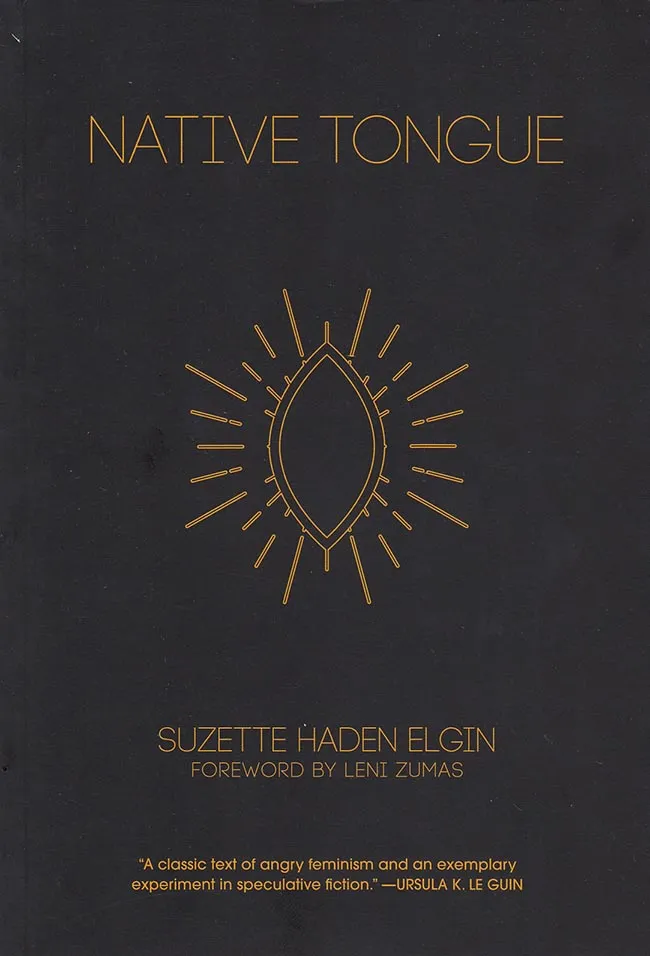
Native Tongue
Originally published in 1984, this classic dystopian trilogy is a testament to the power of language and women's collective action.
In 2205, the Nineteenth Amendment has long been repealed and women are only valued for their utility. The Earth's economy depends on an insular group of linguists who "breed" women to be perfect interstellar translators until they are sent to the Barren House to await death. But instead, these women are slowly creating a language of their own to make resistance possible. Ignorant to this brewing revolution, Nazareth, a brilliant linguist, and Michaela, a servant, both seek emancipation in their own ways. But their personal rebellions risk exposing the secret language, and threaten the possibility of freedom for all.