Books
Books

The queen's ball
The Queen’s Ball ingests taboo as fuel for a baroque and spiraling story of love in its most prismatic and absurd iterations. Through frightening distortions and hallucinogenic twists of fate, a demented circus of artists, writers, gender-hustling aesthetes, and religious fanatics collude in a glorious discombobulation of propriety and convention. I have never laughed this much at a novel that could somehow shock even the most irreverent of libertines, demanding, at times, absolute disgust. Truly nasty work. Iconic. —Juliana Huxtable
Translated by Kit Schluter
Afterword and notes by Thibaud Croisy, translated by Olivia Baes
Set among the flamboyant demi-monde of the 1970s Paris underground, The Queens’ Ball follows the narrator Copi in his attempt to write a novel as life comes undone around him. His Roman lover Pietro is stolen by a Marilyn Monroe impersonator whose coterie take up residence in Copi’s flat and pump out low-budget pornographic rags and films. His friends leave him, burnt out from the theatrical excess of the decade. And worst of all his editor keeps calling him, demanding to know where the book is. Propelled by Copi’s careening prose and incisive humor, The Queens’ Ball swerves from Paris to Ibiza to New York and back again in a whirlwind frenzy of love, loss, and madness. Featuring an illuminating critical appendix by Copi’s current French editor, Thibaud Croisy, Kit Schluter’s rhapsodic translation marks the début of Copi’s world-renowned fiction in English.
The Queen’s Ball is a heedless novel of transformation of bodies and tenses, a novel of enormity and loss which is, in the end, about writing a novel. Copi is a feckless romantic-his theme is the persistence of love in the phantasmagoria. His tender psychos hurtle through increasingly outré adventures that seem to expand and contract like accordions. Here is crime à la française. Here is a great queen’s verbal aggression, radiant detail, and joyous destructive energy. —Robert Glück
The Queens’ Ball is probably Copi’s masterpiece... By 1978, Copi was already an aesthetic: The Queens’ Ball was the magnet, the inverted whirlpool that brought that aesthetic to the surface. —César Aira

Unconscious/Television
This book stems from the author’s discontents with Lacanian Psychoanalysis, by drawing from psychoanalysts like Félix Guattari and Sándor Ferenczi, as well as authors like Viveiro DeCastro, and Thomas Lamarre, to whom the book is dedicated.
As Lucas Ferraço Nassif elaborates on the possibility of a multiplicitous Unconscious, or rather, a mass of many Unconscious(es), he attempts here to fold the book itself into the text, to make the organisation of the physical book itself a part of the elaboration.
This 2nd Edition comes with a few editorial changes, and a slightly different design approach. It is being presented now with a suite of endorsements from a group of exciting writers and researchers, including Persis Bekkering, Thomas Lamarre, and Yuchen Li. Much of the first edition is preserved, and an extra text has been added, written by the editor as a part of the lecture at Ifilnova. There has been a focus on making this book more accessible, so we have reworked the design of this edition in Black & White.
The Unconscious is Semiotic, not Linguistic, and it only jumps out when you read between the lines. Do you remember, back in 1997, when 600 kids had epileptic shocks whilst watching Television—the Pokémon Shock? This might sound strange at first, but Lucas Ferraço Nassif theorises that, contrary to the claim that this was caused by oscillations of blue and red light alone, it could have been caused by microperceptions and intensities within narrative. As Porygon takes Ash and friends into the digital world, the immanence of unconscious assemblages drags viewers in, too.
Such is the haptic and imagetic nature of this book. Using several design and editorial strategies, and a particular mode of writing, the author attempts to elaborate on their work on the Unconscious by recreating a similar possibility—where book, language and reader collapse into a composition, an assemblage or a haecceity. Unconsciousness operates as the multiplanar compositions of Japanese Anime do, so this book has been organized accordingly—different texts, different temporalities, different voices—and like the Japanese concept of Ma (negative space), or even like CoreCore, something jumps out of the breaks, the gaps in between the layers, and therein lies, for this book, a departure point for elaborating on not just one, but many, Unconscious(es).

Risking the Self. Philosophy, Tai Chi and Psychedelics
A philosopher’s path towards embodiment through Tai Chi and psychedelics.
This book proposes different forms of embodiment that are not necessarily leading to production of subjectivity or territorialized identities but rather putting the “self” at risk allowing us to be emancipated from the mandatory illusion of self-realization. This can be facilitated by a daily commitment with a set of body altering practices that disjoint us from the ordinary accustomed experience of reality and provide us access to “other” layers of the real. These practices grant access to the primary control centers of the body that regulate frequencies of energy and consciousness in a deeper way and enable the body to unfold in different dimensional spaces of experience: rendering sensible the multi-layered energetic body.

My Kevin, My Paris
In the fall of 2017, Obe Alkema got acquainted with the American poet Kevin Killian, first at the New Narrative conference at UC Berkeley, then at the Poets & Critics Symposium in Paris that was all about his poetry. A year and a half later, Alkema traveled back to Paris, this time as a participant of a writing residency. He was there to research the landscape of memory, but more than he expected and initially realized, Kevin’s death the previous month (June 2019) affected his return. Besides inevitable, mourning and remembering became obsessions for Alkema, as he shows in ‘My Kevin, Our Paris’, a memoir about Kevin Killian (1952–2019), but especially about his Kevin and their Paris.

Forgetful Secretary
After diagnosis, the fact was that Austin Gross lived in his home country. He sat on the porch squinting like a potato and it was a comforting thing to imagine: rock-climbing with a blindfold. ‘Can swim, eyes open,’ he jotted and covered his eyes again. Sun, centrifuge, prognosis, bird-listening. The collision shaped genres like tectonic ripples. Windows open, a story while forgetting. ‘I am a memory eater.’
Aras was furloughed from prison that summer. Five years before, she’d missed their movie plan, and the fact was that since then, she lived in her home country. Furlough, Aras wrote, was ‘no-time.’ They investigated the situation together.
Austin Gross is an essayist and collaborator in elliptical orbit. His home discipline is philosophy and language English, on one condition: having left home. Trans-disciplinarity gives us a chance to be hosts and guests.

Festival
The festival is a space of communion and celebration, a romanticized collision of bodies, music and magic. The revolution will look like a festival, we’ve been told by philosophers, writers, artists, and marketers. But the festival is also, of course, the space of formalizing ideology, ritualizing the consumption and violence that propels existing structures of power.
This poetry collection views the migrant, female body as both the glorified and martyred totem of the festival-of-all-festivals we call globalization. Drawing from sources such as Sigmund Freud, James George Frazer, H.D., the Situationist International, seventeenth century narratives of Dutch sailors shipwrecked on the Korean peninsula, the rise of K-pop and the “Korean Wave,” and a zoo-breaking gorilla named Bokito, Festival features kaleidoscopic poetic sequences aiming to show that if anything universal is to be found in lyric poetry’s “I,” it is the result of centuries-long entanglements and contaminations, and of the bodies made to bear these exchanges, to give birth to this century’s globalized subject.
“FESTIVAL is an ode to both beauty and misery. Mia You’s ingenious poetry will have you laughing through your tears. Do NOT miss out!”
— Yael van der Wouden
"She reanimates the form-of-life which is a poem with a feminist skepticism, without foreclosing her robustly idealist commitment to poetry’s continuance"
— Lisa Robertson
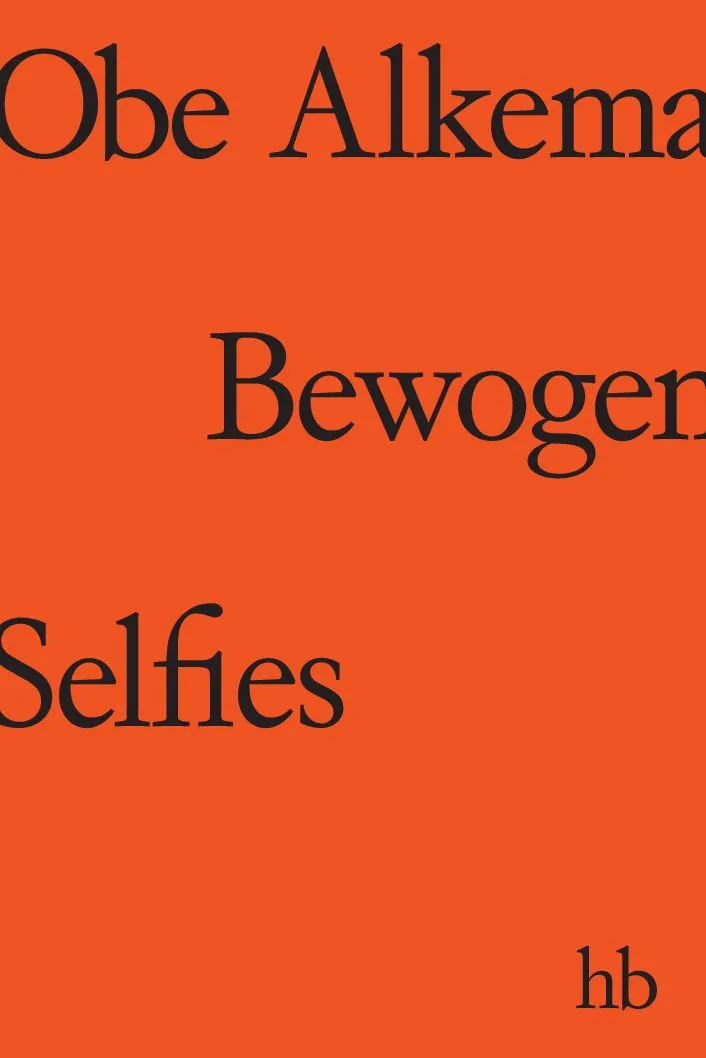
Bewogen selfies
In Bewogen selfies onderzoekt Obe Alkema de verhouding tussen landschap en herinnering. Wat treft hij aan bij terugkeer naar belangrijke plaatsen uit zijn geheugen? Wat herinnert hij zich niet, maar Google wel? Is er een gedenkschrift te puren uit zijn metadata?
Memoires, rechtstreeks verteld en met omwegen, uit eerste hand en van horen zeggen. Archieven en herinneringen eisen spreektijd, houden het niet meer droog of worden tot spreken gebracht. Wat hebben ze eigenlijk te melden? Ze lopen helemaal leeg, net als Alkema zelf. Een leven zoals zovele, poedelnaakt en geretoucheerd, vol zin en onzin.

Mountainish
Zsuzsanna Gahse, Katy Derbyshire
A narrator and her dog are criss-crossing the Swiss Alps. She travels with friends who share her interest in food, languages and their topographical contexts. They collect colours, even look for colourlessness, and develop the idea of a walk-in diary, a vain attempt to archive their observations, encompassing portraits, descriptions and ruminations on mountains, hotels, people, language, food, flora and fauna.
Gradually, other mountains appear in their observations and memories, as do the mountains of literature and art. Mountains may be sites of fear and awe, of narrow-mindedness, racism and ever-looming collapse; Alpine lodges may be places of hospitality, retreat and unexpected encounters; of nature under threat.
In 515 notes, Zsuzsanna Gahse unfolds a finely woven interplay between her six characters while giving us a vivid panorama of mountain worlds, a multi-layered typology of all things mountainish.

I have brought you a severed hand
Ghayath Almadhoun, Catherine Cobham
Fluid and unselfconscious, Ghayath Almadhoun writes love poems in the shape of nightmares: I have brought you a severed hand is a surreal mix of absurd humour, heteroerotic lust and dead seriousness. Caught between two exiles, the one inherited from his Palestinian father and the one he chose and lives, Almadhoun attempts to explain water and tame hope.
This book never misses the defiant beat of an exile’s haunted footing across wars, seas and memory. Almadhoun turns the genocidal logic of colonialism upside down, emptying out the crumbs of humanity and civilisation. —Don Mee Choi
Almadhoun uses every possible means of silence to make the total devastation palpable. —Alfred Schaffer
Many poets attempt to traverse the gulf between the experience of tragedy and the ability to relay its magnitude to anyone else. But few living have done it with such flourish, such sustained passion and formal precision as Ghayath Almadhoun. —Kaveh Akbar
Ghayath Almadhoun (born 1979, Damascus) is a Syrian-Palestinian poet who moved to Sweden in 2008. He has published five collections of poetry in Arabic, the latest being Adrenalin (Almutawassit, 2017) and I have brought you a severed hand (Almutawassit, 2024). In 2017, Adrenalin was translated into English by Catherine Cobham and published by Action Books. In 2023, Almadhoun curated, edited and translated the poetry anthology Kontinentaldrift: Das Arabische Europa (Verlag Das Wunderhorn and Haus für Poesie), which includes thirty-one Arabic poets living in Europe. The English translation of I have brought you a severed hand is published simultaneously by Divided in the UK and Europe and by Action Books in the USA. Almadhoun currently lives between Berlin and Stockholm. His work has been translated into nearly thirty languages.
Catherine Cobham taught Arabic language and literature at the University of St Andrews, Scotland, for many years and was head of the department of Arabic and Persian from 2011 until 2021. She has translated the work of a number of Arab writers, including poetry by Adonis, Mahmoud Darwish, Ghayath Almadhoun, Tammam Hunaidy and Nouri al-Jarrah, and novels and short stories by Yusuf Idris, Naguib Mahfouz, Hanan al-Shaykh, Fuad al-Takarli and Jamal Saeed. She has written articles in academic journals and co-written with Fabio Caiani The Iraqi Novel: Key Writers, Key Texts (Edinburgh University Press, 2013).

Pleasureis Amiracle
A book of poems written out of a depressive episode, in which a devotional approach to music and desire reestablishes communication between the poet's body and the world.
In pleasureis amiracle, the poems invoke the lyric and refuse it, moving between time and sound—words re-connect and re-cohere, resisting separation and challenging readers to feel their way to meaning. Perception becomes a many-limbed entanglement from which the reader is never let go. Music is both divine and accessible, a sublimation of everyday movements into an erotics of sensation.
An experiment in form as much as content, it asks what can be cured by music, what is trans about desire, and how can one allow the body to feel what the mind sees, or vice versa.

About Narration – Materials, Comments, Interventions
Ingemo Engström, Harun Farocki
Published in collaboration with Harun Farocki Institut, this book unpacks About Narration [Erzählen], a 1975 essay film directed by Ingemo Engström and Harun Farocki.
Edited and introduced by Sezgin Boynik and Tom Holert, this book focuses on About Narration [Erzählen] directed by Ingemo Engström and Harun Farocki.
It includes the film's script alongside the historical documents related to its making and Farocki's previously unpublished theoretical and programmatic essay on the film. The publication also includes a retrospective essay by Ingemo Engström on the film's political and artistic background.
Volker Pantenburg's detailed elaboration of the conditions of its making, alongside Boynik and Holert's concluding remarks, further contextualizes the film. The interview with Cathy Porter on Larisa Reisner, a heroine of About Narration, gives an overview of the life of a militant writer who inspired Engström and Farocki.
Edited and introduced by Sezgin Boynik and Tom Holert.

Ripcord
A novel about escape and connection, class, sex, and queer intimacy in the American Midwest.
The oldest story: an insider pretends to be an outsider and receives praise for his empathy and imagination and intelligence. Maybe some asshole even says bravery. An outsider pretends to be an insider, is exposed as a fraud, a liar, and burned to the ground.
In Ripcord, Nate Lippens continues his meditations on escape and connection, class, sex, and intimacy. Stuck in Milwaukee, the narrator cobbles together a living by bartending and catering weddings, enmeshed in a semiaffair with a younger, married man. Cruising apps while tallying his youthful romantic failures, he fantasizes about disappearance but finds both solace and frustration in his friendships with Charlie, an aging punk who was prominent in the 1990s Chicago queercore scene, and Greer, a painter who never broke through but continues making work.

Agitated Air: Poems After Ibn Arabi
Born in Murcia in 1165, Ibn Arabi was a prolific Muslim philosopher and poet. He travelled extensively before settling in Damascus, where he died in 1240. Tarjuman al-Ashwaq, or The Interpreter of Desires, is a cycle of sixty-one Arabic poems. They speak of loss and bewilderment, a spiritual and sensual yearning for the divine, and a hunger for communion in which near and far collapse.
Agitated Air is a correspondence in poems between Istanbul and Cape Town, following the wake of The Interpreter of Desires. Collaborating at a distance, Yasmine Seale and Robin Moger work in close counterpoint, making separate translations of each poem, exchanging them, then writing new poems in response to what they receive. The process continues until they are exhausted, and then a new chain begins.
Translated and re-translated, these poems fray and eddy and, their themes of intimacy across distance made various, sing back and forth, circling and never landing. Absence and approach, knowing and unknowing, failure and repetition: Ibn Arabi’s cycle of ecstatic love shimmers with turbulence. Seale and Moger move into and against these contending drifts, finding in the play of dissatisfaction and endurance a prompt for new poetry.

The Land of All Time
The latest collection from prolific American poet Clark Coolidge, who has often been associated with the Language School and the New York School but has truly forged a unique style. A life-long jazz drummer, his poems can be approached as improvisational compositions with strange arrangements of words, statements, and sounds that are vibrant, frequently hilarious, and jarring. His upended syntax and surprising associations reflect a world awash in information; an advanced civilization dealing with ever more rapid change. His poems are explorations into the possibilities of language. This kind of work could, serendipitously, lead to new patterns of thinking, new definitions, new meanings, perhaps even new ways of dealing with old problems.

An Anarchist Playbook. Radical Translation Workshop
Cristina Viti, Jacob McGuinn and 2 more
The Conspiracy of Equals (1796) is often hailed as the first revolution against a revolutionary state. Even if the conspirators were soon found out and put on trial, their ideas of radical equality and liberty shaped future generations of revolutionaries worldwide. An Anarchist Playbook—the first publication in Tenement’s new imprint, No University Press—gathers together many of the key documents from their trial across a myriad forms, with a number of these texts appearing herein in their first English-language translation.
Assembled in the Playbook are the last words of Gracchus Babeuf, the leader of the conspiracy and a radical proponent of the abolition of private property, and of his fellow conspirator Augustin Darthé, as they faced the guillotine. We’ve a letter, written in the popular idiom of the sans-culottes, that urges the common soldier to rebel; the score and lyrics of a street song that names the new class enemy: the wealthy bourgeoisie who have profited from the revolution; a first-time English translation of ‘The Last Judgement of All Kings’—an extraordinary one-act play by Sylvain Maréchal, the unofficial poet of the Conspiracy, that was performed to considerable acclaim in Year II of the Revolution (and that the Workshop is in the process of adapting for contemporary audiences).
Many of these texts were never published in their own time, and form a part of the testament left behind by Philippe Buonarroti, a leading conspirator who inspired new generations of revolutionaries across Europe over the course of the nineteenth and early twentieth centuries. Among the best known works included is the Manifesto of Equals, long considered a founding text of social, communist and anarchist revolutions. The Playbook presents a translation of the Manifesto alongside other key texts by the conspirators, reconstructing the richness and variety of revolutionary communication that informs the editorship, shape, and scope of this volume.

Anxiety vol.1
Featuring poems and short stories by Coco Gordon Moore, Nate Lippens, Jimmy Cooper, Danielle Chelosky, Matthew Kinlin, and Thomas Moore, as well as an interview of Jack Skelley by Lydia Sviatoslavsky and photographs by David Catalano. Edited

La rabbia / Anger
In a first-time English language translation by Cristina Viti to mark the poet’s centenary, Tenement Press will publish Pier Paolo Pasolini’s groundbreaking, filmic work of prose and verse, La rabbia / Anger.
Why is our life dominated by discontent, by anguish, by the fear of war, by war? In order to answer this question I have written La rabbia, not following a chronological or perhaps even a logical thread, but only my political reasons and my poetic sense. - Pier Paolo Pasolini
Written in response to producer Gastone Ferranti’s request for his comments on a set of newsreel items, the poet would respond with a montage of his own. Via the unfolding of a chrysalis of images, in La rabbia (1963), Pasolini’s lens pans over Soviet repression in Hungary; the Cuban revolution; (the utopian object of) space exploration; political imprisonment in Algeria; the liberation of the former European colonies; the election of Pope John XXIII; the prospect of revolution in Africa and the Middle East; in Europe and in Latin America... Here, we’ve a panoply of photorealist intimations of Pasolini’s ‘poetic sense.’ The death of Marilyn Monroe crests as an idea in this tidal pooling of reflections, and as the poet’s line lights out for conceptual rhymes and counterpoints.
In Viti’s translation, the weave of prose and poetry that forms La rabbia portrays the vitality of Pasolini’s work in its capacity to speak to both the specifics of his contexts, the character of our own present tense, and the ironic fact of a life lived against the gulf of discontent in its myriad forms. Here, we’ve a startling confrontation of a revolutionary struggle in stasis set in lines that crystallise a rallying call against blindness. ‘I’ll not have peace, not ever,’ he writes. A lucid acceptance of the poet’s restlessness, and a marker for Pasolini’s commitment to a solidarity with the oppressed that we find reaffirmed on every page, in La rabbia the poet charts how ‘the powerful world of capital takes an abstract painting as its brash banner’ in this unravelling of ‘crisis in the world.’

Angst
In 1942, butcher Heinrich Angst started to set up his own business in Zurich. Today, Angst AG operates the municipal abattoir and supplies catering businesses and butchers throughout the canton. Angst is a book documenting an installation with 50 used and framed sausage wrapping papers presented at Fondation Fernet Branca in Saint Louis, France. On the other hand the book is gathering 50 systemically relevant poems surrounding writing, everyday life as a dance with obligation and panic, a society without children, fear as a fundamental quality of life and hopefulness to bury fear together.

Choquer le monde à mort – Elles sont de sortie – Pascal Doury – Bruno Richard
Bruno Richard, Pascal Doury and 1 more
"Elles sont de sortie" is the title of a periodic publication launched in 1977 by Pascal Doury and Bruno Richard. The plural and feminine form of the enigmatic phrase "elles sont de sortie," chosen almost by chance, announces a protean work and often collective experience. From its origins to the most recent iterations, including Doury's more confidential individual trajectory after "Elles sont de sortie," Choquer le Monde à Mort traces five decades of a corpus of nearly three hundred publications. It addresses some of the most emblematic editorial works, as well as others that remain unpublished, alongside ambitious and sometimes scandalous exhibitions, few of which are documented.
This work is the result of several years of research, enriched by numerous firsthand interviews, and unfolds in three parts: a chronology and analysis of a singular and marginal artistic history, works and iconographic documents, and an anthology bibliography. Together, these elements reveal the complexity of an editorial object with porous boundaries, both in its forms and its contents, oscillating between graphzine, artist book, poetry collection, and personal journal. Its ramifications, status, and legacy retrospectively reveal the importance of a discreet yet seminal work.
Thus, "Elles Sont de Sortie" also serves as an opportunity to revisit the paths of two aesthetic and provocative artists, deeply devoted to their art and true free spirits in an art world often too narrow for them. It immerses us in a plethora of works that are intimate and raw, as well as subtle and refined, all in service of a project that, in Doury's words, aims to "shock the world to death."
Edited by Tiphanie Blanc, Jonas Delaborde, Anna Lejemmetel.
Contribution by Anna Lejemmetel.

Other Forms of Presence
When he was prevented from guiding a writing workshop, Quim Pujol resorted to collecting exercises for the participants to work with by themselves, either alone or in small groups. These exercises, suggestions and scores draw on a wide variety of sources, such as poetry, experimental literature, dance, popular performance practices, visual art and all kinds of text populating everyday life. Now expanded into a book, they are invitations to read, write and daydream, to ‘complicate our relationship to language’ and imagine texts in multiple guises. Potential literatures that give pause, redirect the attention or, at times, simply ‘produce a comforting doodle in the volatile palimpsest of human flesh’.
Quim Pujol is an experimental artist and curator working at the crossroads of language and live arts.

Country Lesbians
A bootleg of the first edition of Country Lesbians, published by WomanShare Books in 1976. It was printed in the context of a 2024 exhibition at Shmorévaz, a Paris-based independent art space, dedicated to the WomanShare collective, taking the book as its starting point, and borrowing its title.
WomanShare Collective is Sue Deevy, Billie Miracle, Nelly Kaufer, Carol Newhouse and Dian Wagner.
Co-published by Ness Books and Shmooks
Graphic design: Espace Ness

Darryl
Darryl Cook is a cuckold, and that’s exactly how he likes it. He has an inheritance that spares him from work, a manageable and seemingly consequence-free drug habit, and a lovely wife called Mindy who’s generally game for anything—and for as much of it as she can get. But after an accidental overdose and some serious oversharing, Darryl’s world begins to crack up. Tormented by what seems to be the secret truth in sex, and less assured of that secret’s form, Darryl steps into what used to be called real life . . . Darryl is a disarmingly funny and unabashedly intelligent look at a community of people parsing masculinity, marriage, sex (and love) on their own terms.
Underneath the sharp satire and hilarious sexual irreverence this is a deadly serious book: a brilliant novel of a seeker, like The Pilgrim’s Progress refracted by queer internet culture. —Torrey Peters
Ess is what I might call a burgeoning cult literary figure, armed with an unmistakable lyric deadpan and a taste for provocative subject matter. — Stephen Ira, Poetry Project
What Darryl is looking for is a crisis of sufficient severity that it will cause him to feel real to himself. — Dominic Fox, Review 31

Passage to the Plaza
In Bab Al-Saha, a quarter of Nablus, Palestine, sits a house of ill repute. In it lives Nuzha, a young woman ostracized from and shamed by her community. When the Intifada breaks out, Nuzha’s abode unexpectedly becomes a sanctuary for those in the quarter: Hussam, an injured resistance fighter; Samar, a university researcher exploring the impact of the Intifada on women’s lives; and Sitt Zakia, the pious midwife.
In the furnace of conflict at the heart of the 1987 Intifada, notions of freedom, love, respectability, nationhood, the rights of women, and Palestinian identity—both among the reluctant residents of the house and the inhabitants of the quarter at large—will be melted and re-forged. Vividly recounted through the eyes of its female protagonists, Passage to the Plaza is a groundbreaking story that shatters the myth of a uniform gendered experience of conflict.

Trans Femme Futures: Abolitionist Ethics for Transfeminist Worlds
'Femme' describes a constellation of queer, gendered expressions that uproot expectations of what it means to be feminine. Building upon experiences of transformation, belonging and harm, this book is a transfeminist call for collective liberation.
Trans Femme Futures envisions the future through everyday actions that revolutionise our lives. Nat Raha and Mijke van der Drift discuss struggles around trans healthcare, the need for collectives over institutions, the importance of mutual care, and transfeminism as abolition.
The authors show how social change can be achieved through transformative practices that allow queer life to thrive in a time of climate, health, political and economic crises.
'A brilliant, useful, and immensely moving book that deals a critical blow to the epistemic austerity of our times' - Jordy Rosenberg