Books
Books
published in 2024

Hopscotch
Fatemeh Shams, Armen Davoudian
In Hopscotch, Fatemeh Shams crafts a vivid liminal world of Berlin-based poems, a canvas where home and exile blur into an intimate middle ground. Her work, geographically and metaphorically situated between her birthplace in Iran and her current life in exile, evokes a “third space”—a realm of creative liberation and a sanctuary for the play of memories, language, and place. Shams frames this space with tangible metaphors—airports, suitcases, the thresholds of nightclubs. Her poems, like the game of hopscotch itself, leap over borders with a childlike agility, contrasting against the harsh reality of exile. They invite us to consider our own places of belonging and the potential spaces we inhabit—those rich intersections of language and lived experience.
Fatemeh Shams is the author of 88 (Gardoon, Berlin), Writing in the Mist (H&S Media, London), and When They Broke Down the Door (Mage, Washington D.C). Her poems and translations have been published in Poetry magazine, the Michigan Quarterly Review, The Penguin Book of Feminist Writing, and elsewhere. Fatemeh grew up in Mashhad, Iran and is an Associate Professor of Persian Literature at the University of Pennsylvania.
Armen Davoudian is the author of The Palace of Forty Pillars, published by Tin House (US) and Corsair (UK). His poems and translations from Persian appear in Poetry magazine, the Hopkins Review, the Yale Review, and elsewhere. Armen grew up in Isfahan, Iran, and is a PhD candidate in English at Stanford University.
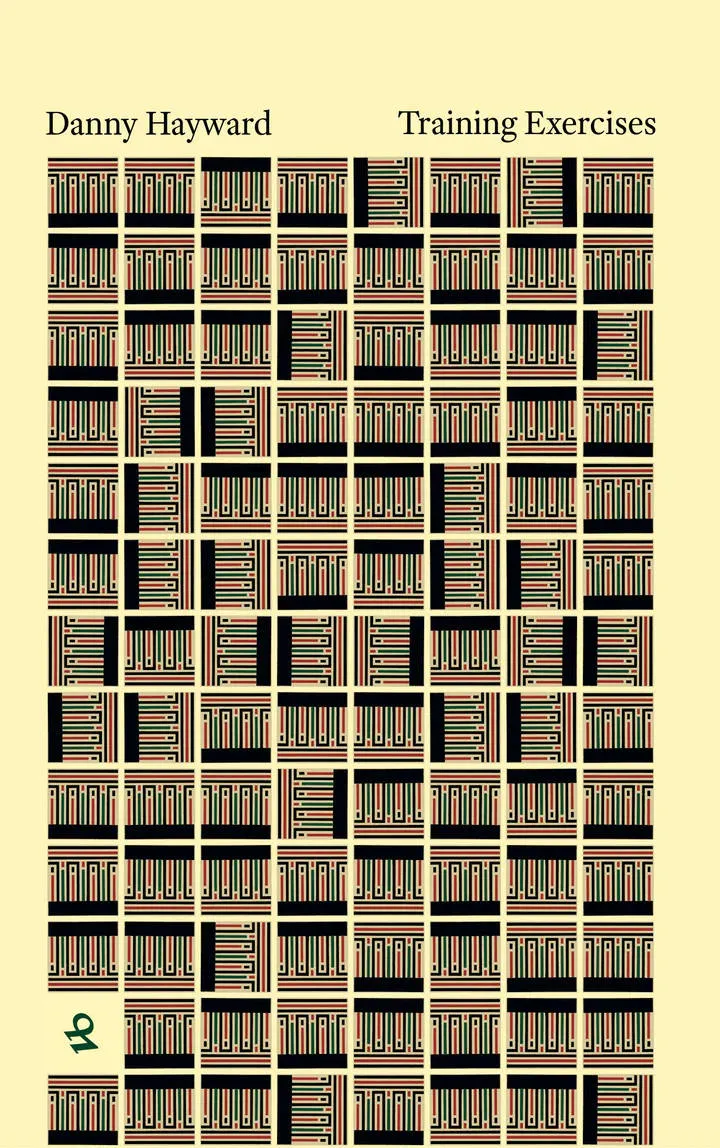
Training Exercises
Organized violence committed on ordinary speech’ is therapy for those who don’t believe in literature as value. Training Exercises is an unpacking of that dictum: seven short essays, letters, reports and anti-biographies written to overcome the feeling of resistance to the defacement of what strikes us as true. An anti-purge written out by lipstick or hammer, scrawled over the top of itself and run through a translation program that turns everything upside inside down, its pieces include: a polemic against catharsis; a letter to the poet Dom Hale on his book Seizures; and a series of on-the-spot reports on the UK Illegal Migration Bill, East London poetry readings, the politics of the war in Ukraine, and a conversation about the meaning of damage in contemporary literature.
‘First you learn to write down your ideas, then you learn again how to write all of your lurid political and intellectual and intimate disappointments and all of your childhood hopes over the top of them’. Jack Spicer scrawled the name of his book in pink lipstick on the cover of the academic journal he had published in: Training Exercises scrawls itself on top of that.
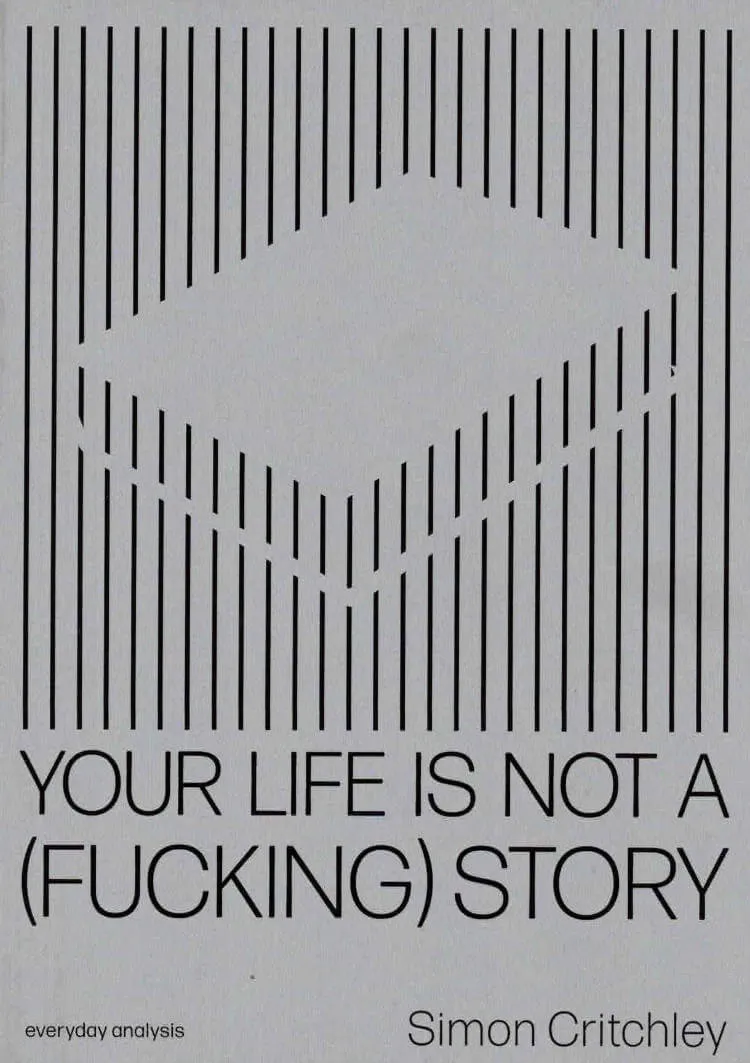
Your Life Is Not A (Fucking) Story
In this new collected edition of his recent articles, Simon Critchley - one of the most important living philosophers - takes us through his reflections on death, questions of doubt and reason, the legacy of David Bowie, the nature of fear and empathy in a broken society and a critique of narrative identity - among other things. YOUR LIFE IS NOT A STORY explores the contemporary world and its psychological impact on us, offering us a way to see our situation different and resist its tricks and contrivances.

Whitney Museum of American Art
Edges of Ailey
Alvin Ailey is one of the most celebrated choreographers of the twentieth century. The creator of iconic works such as Blues Suite, Revelations, and Cry, he is widely recognized for the dance company he founded in 1958 when he was just twenty-seven years old. Ailey imagined and cultivated a platform for modern dance through his innovative repertoire, interdisciplinary sensibility, and support of dancers and choreographers. This expansive volume situates Ailey within a broader social, creative, and cultural context, looking at the artists who influenced and collaborated with him, the spaces and scenes he frequented, the dynamic themes within his dances, and how his vision and work changed contemporary dance.
Essays by artists, scholars, and critics cover topics ranging from the Black church, the South, and the Great Migration to nightclubs, musical influences, and queerness. With more than four hundred images including photographs of works Ailey choreographed, archival materials such as notebooks, sketches, letters, and never-before-published behind-the-scenes photos, and conversations about the legacy of the company with Sylvia Waters, Judith Jamison, and Masazumi Chaya as well as several contemporary dancers and scholars, this study offers an unprecedented full picture of one of the twentieth century’s leading artists and the way his work continues to inspire today’s generation of dancers.
Contributions by Horace D. Ballard, Harmony Bench, Kate Elswit, Aimee Meredith Cox, Thomas F. DeFrantz, Malik Gaines, Jasmine Johnson, Joshua Lubin-Levy, Uri McMillan, Ariel Osterweis, J Wortham, CJ Salapare, Kyle Abraham, Claire Bishop, Masazumi Chaya, Brenda Dixon-Gottschild, Jennifer Homans, Judith Jamison, Sylvia Waters, Jamila Wignot and Jawole Willa Jo Zollar

Eselsohren Dog Ears
"The impossible takes a little longer. [pen scribbling]"
Presented at Kransen in Borgerhout, 1—3 March 2024, with an exhibition titled Dog Ears and a remote reading by fellow-Stockholmian artist Dave Allen.

Season of the Swamp
New Orleans, 1853. A young Zapotec exile from Mexico named Benito Juárez disembarks at a fetid port city at the edge of a swamp. Years later, he will become the first indigenous head of state in the postcolonial Americas, but now he is as anonymous and invisible as any other migrant to the roiling and alluring city.
Accompanied by a small group of fellow exiles who plot their return and hoped-for victory over the Mexican dictatorship, Juárez immerses himself in the city, which absorbs him like a sponge. He and his compatriots work odd jobs, fall victim to the cons and confusions of a strange young nation, succumb to the hallucinations of yellow fever, and fall in love with the music and food all around them. But unavoidable, too, is the stark trade in human beings.
With the extraordinary linguistic play and love of popular forms that have characterized all of Herrera’s fiction, Season of the Swamp is a magnificent work of speculative history, a love letter to the city of New Orleans and its polyglot culture, and a cautionary statement that informs our understanding of the world we live in.

Wanderlust
Soufiane Ababri's sketchbooks.
Soufiane Ababri (b. 1985, Rabat) is a Moroccan artist based in France. His protean work (drawings, installations, performances) explores questions of gender, homosexuality, racism and colonialism.

Revolutionary Tofu
Revolutionary Tofu. Transnational Flows in the Making of Chinese Anarchism, through the clue of soy, attempts to resurface the historical threads of Chinese anarchy in the early 20th century and the transnational flow in the making of it, weaves between France and China, from Manchukuo to São Paulo. Revolutionaries from different regions encountered one another in various historical moments, quietly opening up an alternative path that history might have taken.
The story was first published in 44 Monthly (September 2022) in China , revised, translated and printed in Berlin in 2024.
Written by Wu Qin
Designed by IfA
Published by Tofu Stand (Tofulogy 001)

SABR N°01 - Trois dattes et une dent
« [...] la stratégie de la terre brûlée c’est aussi un héritage mais adaptation 2024 on brûle désormais des arrêts de bus et des commissariats et si à la télé iels disent ces jeunes sont complètements cons détruire leur propre ville c’est que Bolloré a rien compris [...] »
Fanny Souade Sow est artiste plasticienne, son travail est habité par des questionnements d’ordre sociopolitique et historique et évoque en outre la violence latente des structures urbaines qui excluent, séparent, condamnent et contraignent un certain nombre de corps et d’existences minorisées.
SABR/Collection est une série de publications qui rassemble des œuvres littéraires de format court et de genres variés. Dirigée par Nesrine Salem, la collection souhaite mettre en avant les macro-réalités des auteur·ices choisi·es pour rendre visible le caractère intersectionnel des luttes.

Lassie, Des amis pour la vie
Ce que je vois, c’est comment un animal se détermine à créer une relation avec un garçon malheureux.
Fiction vu en boucle gamine, que je superposais à ma chienne, une colley comme Lassie.
Suivi par Émilie Ferrat.

Juvenilia #2
Ludi Juvenales (Latin for "juvenile games') is a poetry, art and games series interested in youth, childhood, play, and immaturity.
Ludi Juvenales is edited by Elise Houcek & Zoe Darsee.
www.ludijuvenales.com
Juvenilia #2 by Willa Smart.
Copyright C Willa Smart 2024. All rights reserved.
Cover art by K. Fabricant.
Design by Elise Houcek & Zoe Darsee.
Risograph printed with BearBear in Milwaukee, Wisconsin.
Edition of 50.

Dance History(s): Imagination as a Form of Study
Annie-B Parson, Thomas F. DeFrantz
Authored by twelve diverse American dance artists in the form of twelve small booklets, Dance History(s): Imagination as a Form of Studyapproaches and celebrates dance history as a subjective, artistic inquiry. It reimagines and radicalizes our understanding of dance throughout human history through the voices of working choreographers. Simultaneously, the project is dedicated to the power of an artist-centric view of history itself, thus placing the dance history back into the body, where it began. Here, history occurs in vertical layers of time and space and moves into the street, the football field, the yard, the screen, the memory, the womb, the sky, and the future.
Text by mayfield brooks, thomas f. defrantz, maura nguyễn donohue, Keith Hennessy, Bebe Miller, Okwui Okpokwasili, Eiko Otake, Annie-B Parson, Javier Stell-Frésquez, Ogemdi Ude, Mariana Valencia, and Andros Zins-Browne

KW Institute for Contemporary Art
Pia Arke
Pia Arke, Ros Carter and 1 more
Pia Arke (1958–2007) was a Greenlandic Inuk and Danish artist, writer and photographer. She is known for her self-portraits and landscape photographs of Kalaallit Nunaat (Greenland), as well as for her paintings, collages, performative film works and writing. Arke strove to make visible the silence that surrounded the colonial history and complex political and cultural relationship between Greenland and Denmark.
This publication accompanies the first international exhibitions of Arke’s work outside of Greenland and the Nordic countries, happening over the course of 2024 at John Hansard Gallery in Southampton (UK) and at KW Institute for Contemporary Art in Berlin (DE). It reflects on Arke’s ideas and legacy in a wider international context and aims to demonstrate how the work she made and the ideas she expressed connect with current discourse and contemporary thinking.
Texts by Krist Gruijthuijsen, Woodrow Kernohan, Ros Carter, Alice Maude-Roxby, Mette Sandbye, Tiara Roxanne, Sofie Krogh Christensen, Nivi Christensen, Siri Paulsen, Trinh T. Minh-ha

Verlag der Buchhandlung Walther König
Movement Notation
Eshkol and Wachmann focused dance on its basic element: the movement of the human body. They treated the different parts of the body as separate instruments, similar to the musical instruments of an orchestra–each with its own rules for the movements to be performed. This new edition of the 1958 publication is supplemented by contributions from Eshkol’s companions and further archive material, which contextualizes and supplements the history of the 'EWMN’s‘ origins and embeds it in contemporary discourses on dance and movement.
The publication is published in the context of the performance 'Pause: The Noa Eshkol Chamber Dance Group‘ at KW Institute for Contemporary Art (August 2023), as well as the exhibition 'Noa Eshkol: No Time to Dance‘ at the Georg Kolbe Museum (15 March–25 August 2024). The new edition was developed together with the 'Noa Eshkol Foundation for Movement Notation‘.

Verlag der Buchhandlung Walther König
Ian Burn: Collected Writings 1966–1993
Ian Burn has been described as many things: an activist, a trade-unionist, a journalist, an art critic, a curator and an art historian—or, as he once described himself in a moment of self-deprecating alienation, ‘an ex-conceptual artist’. Born in Geelong in 1939, Burn studied painting in Melbourne and went on to live and work in London and New York. Burn moved back to Australia in 1977 and passed away in 1993 at the age of 53. Burn sought to grapple with how art history intersects and engages with contemporary art and political debate, arguing for a decentred view of the world.
His legacy is international and can be seen in retrospective exhibitions as recent as 2022, and his work remains a key touchstone in art history. Edited by Burn’s friend, frequent collaborator and eminent art historian, Dr Ann Stephen, this volume brings together 49 pieces of Burn’s own agile and expansive writings alongside a vast collection of his artworks. The collection concludes with reflections on Burn’s life and work from prominent figures and past collaborators in the form of memorial lectures.
Ian Burn: COLLECTED WRITINGS 1966–1993 is edited by Ann Stephen and designed by Robert Milne, with contributions by Art & Language, Adrian Piper, Paul Wood, Allan Sekula, and Mel Ramsden.

The Secret History Of Kate Bush (And The Strange Art Of Pop)
The Secret History of Kate Bush, first published in 1982 as Kate was on the verge of superstardom, is a daring and unorthodox dive into the world of music, fame, and cultural obsession. Written by Fred Vermorel—a close associate of Malcolm McLaren and Vivienne Westwood, and renowned for his subversive "anti-biographies"—the book shatters the boundaries of traditional celebrity profiles. Told from the perspective of a die-hard fan, it unveils the mystique of one of pop’s most elusive icons while exposing the capitalist machinery driving the entertainment industry. Part biography, part cultural critique, and entirely provocative, this is not just a book about Kate Bush but a rebellious manifesto against the commodification of art.
Republished in 2022 by Le Gospel in France, this special edition goes even deeper with unpublished treasures from Vermorel’s personal archive. Featuring an exclusive interview with Kate’s father, Dr. Robert Bush, a razor-sharp foreword by novelist and musician Tony O’Neill (Digging the Vein), and Vermorel’s own afterword reflecting on his explosive work four decades later, this is a must-read for anyone fascinated by Kate Bush, the art of fandom, and the raw power of creative rebellion. Fred Vermorel is a pioneer of the in-depth study of celebrity and fan cultures, best known for his controversial "anti-biographies" of pop icons including the Sex Pistols, Kate Bush, Vivienne Westwood, and Kate Moss.

Constructing Worlds Otherwise
Raúl Zibechi, George Ygarza Quispe
A new collection from one of Latin America's most dynamic radical thinkers—in the tradition of Frantz Fanon and Eduardo Galeano.
Through a survey of the most marginalized voices across Latin America—feminists, the Indigenous, people of African descent, and inhabitants of urban favelas and rural towns—Zibechi introduces the Anglo world to a range of critical perspectives and new forms of struggle in Peru, Mexico, Brazil, Colombia, and Bolivia. His book contributes to global geographies of autonomous and anti-state thinking, including that of the revolutionaries in Rojava and Abdullah Öcalan, ideological theorist of Kurdish resistance, for a rich and dynamic survey of movements of nonstate power. Constructing Worlds Otherwise comes at a time when the global left—struggling to expand its vision in an era of climate chaos and rising authoritarianism—finds itself at an impasse, desperate to animate and renew its critical imaginary.

The Consequences
The Consequences is a hybrid collection of prose and poetry; an autofictional examination of the pain of a transatlantic relocation from New York to the blanketing beige of Paris to rejoin a totemic muse. It also focuses on corgi attacks, Maryland, painful anxiety, the struggle to accept the things one cannot change, the third party and the past as adamantine shackles. The "towering sexual iconography of Mike Immerman" looms over the disorientation of a reluctant resident in “the City of Light.”

CUNY Center for the Humanities
Algeria: Capital Algiers
Algeria, Capital: Algiers by Anna Gréki is co-published by Pinsapo Press and CUNY Lost & Found, translated by Marine Cornuet, and introduced by Ammiel Alcalay.
Anna Gréki (1931-1966) was an Algerian poet of French descent. A member of the Algerian Communist Party, she was arrested and imprisoned for her participation in the Algerian liberation struggle in Algiers, in 1957. Algérie, capitale Alger, a collection of poems written during Gréki's imprisonment, was published in 1963 in a French and Arabic bilingual edition. Algeria, Capital: Algiers makes this work available to English readers for the first time.
"Anna Gréki was a particularly inconvenient pied noir—not loyal enough for the French colonists and too compromised for the Algerian nationalists—and so she was shunted to the margins of Algerian literary history. Nevertheless, it’s time she takes her place at the center of that narrative, and these accomplished translations constitute a necessary English-language introduction to this secret garden of Maghrebi poetry. Gréki’s poetry is electrified by the heady heights of the war of liberation, but arguably it finds its truest expression in her paeans to the wild hills and impregnable peaks of the Aurès mountains, where she was born and where she found a sense of peace which otherwise eluded her in her brief life." —André Naffis-Sahely
“Nothing happens here but everything burns.” From the prison where she was tortured by French authorities in 1950s Algeria, Anna Greki stays in touch, feverishly, with “this world of vulnerable flesh.” Addressed to her friends and comrades in struggle, to the land and the leaves and the birds, these poems defy “the war, this male ax,” invoking the future with “a trust so total / I can almost touch it.” Marine Cornuet’s translation deftly conveys Greki’s intimate language of the senses, to “transcribe with words what is done without them.” —Omar Berrada
"How fitting that a bilingual edition of Anna Gréki’s poems should be published now: a French poet born in Algeria, anti-colonialist (imprisoned for that) as Algeria battled for independence, writing in French, like Kateb Yacine, to show her freedom from French hegemony, but also her freedom as a woman writer to forge a transcendent and engaged poetics." —Marilyn Hacker

Tips of the sung
Tips of the Sung is a collection of interdisciplinary texts from Samuel Brzeski composed over the five years whilst he was Associate Artist at Lydgalleriet. The collection brings together performance scripts for voice and video with newly composed texts for the page. Centring on the vibrations of the voice, the texts exist somewhere between signification and delirium, at times making more sound than sense.
The texts are full of bumbling mumbles, meandering hums, homophones, inner voices, affirmations, motivations, subvocalisations, resolutions, errors in speech production, peach seduction, car maintenance manuals, self-help fallacies, roomy echo chambers, overheard language lessons, morning meditations, and other forms of verbal rehearsal at the limits of language.

Film X Autochthonous Struggles Today
Nicole Brenez, Jonathan Larcher and 2 more
First global exploration of contemporary forms of filmmaking from political and cultural self-determination movements of Autochthonous communities and peoples.
Film X Autochthonous Struggles Today brings together for the first time filmmakers, activists, film curators, and scholars who share a common interest in filmmaking practices that emerge from and participate in the various situations of struggle that the Autochthonous/Indigenous/Native/Aboriginal/First Nations peoples and communities are involved in worldwide.
Starting with the Edison Studio's 1894 short films Buffalo Dance and Sioux Ghost Dance, representations of Autochthonous peoples have been part of cinema right from its inception. The vast majority of these representations, however, have not been produced by nor for Autochthonous peoples. In the wake of political and cultural self-determination movements of the 1960s and 1970s, and with the gradual democratization and accessibility of the tools of moving-image making, Autochthonous communities have displaced and renewed cinema's forms and means of production, increasingly reclaiming their right for self-representation by way of film and video.
Along with the vibrant forms of moving images arising from within the communities, close to their existential political concerns, filmmaking has also become a potent tool in Autochthonous struggles. This book answers the need to take a global look at the diverse ways of filmmaking that fight for land rights and against environmental injustice (Brazil, Morocco, Taiwan, USA), that resist neocolonial domination, economic and political exploitation (Japan, Philippines), that offer a counterpoint during low intensity or drawn-out armed conflicts (Colombia, Mexico), that invent strategies of counter information and representation (Australia, Canada, Russia, Samoa), and that strive for visibility.
Contributions by Myrla Baldonado, Mayaw Biho, Nadir Bouhmouch, Ricardo Matos Cabo, Carolina Canguçu, Amaranta Cesar, Karrabing Film Collective, Rupert Cox, Nicolas Défossé, Etienne De France, Sophie Gergaud, John Gianvito, David Harper, Aurélie Journée-Duez, Blackhouse Lowe, Caroline San Martin, Laura Langa Martínez, Isael Maxakali, Sueli Maxakali, Dan Taulapapa Mcmullin, Chie Mikami, Francisco Vázquez Mota, Omar Moujane, Marie Pierre-Bouthier, Perrine Poupin, Ariel Arango Prada, Beatriz Rodovalho, Roberto Romero, Jonathan Sims, Mercedes Vicente, Jamahke Welsh.

The Hormone of Darkness: A Playlist
In Tilsa Otta’s The Hormone of Darkness, we find a queer, Latinx person who has lived through iterations of authoritarian rule, and who answers these conditions by creating poetry that doubles down on a life force that precedes and exceeds received notions of the poetic. Here poetry is bawdy, fabulist, and spiritual—in short, it is alive. Otta has created a heaven where readers can go after they die.
Drawing from four volumes spanning Otta’s career, translator-poet Farid Matuk has curated a playlist we can dance and dream to, one that honors Otta’s drive toward liberation through both perreo in the club and transdimensional wandering among the stars.
We can go on like that forever
building paradise from our urges
out of our fetishes our loves our vices
How lucky
We’ll wait for you then
Don’t be too long
Bookmark the page
We’ll be Here
—From “The New Heaven”
Translated from the Spanish by Farid Matuk.

4 Tales
The power of Sabahattin Ali comes from beyond his words. It is his sense of observation, insight and commitment to fight for a fairer society that have carried his voice into the modern day.
The four tales in this book - Death of the Giants, A Tale of Love, A Tale of Sheep and The Glass Pavilion - were compiled and published in Sırça Köşk [The Glass Pavilion] in 1947. At the time Sabahattin Ali penned these tales, the young Turkish Republic was still struggling to establish a proper democracy with one sole party in parliament. In 1948 the Turkish Council of Ministers decided to ban Sırça Köşk, and all remaining copies were swiftly confiscated. Even after his death, the words of Sabahattin Ali were deemed as a governmental threat and for decades publishers were reluctant to print his work.
Almost eighty years later, these political and social tales remain just as poignant. Does this showcase Sabahattin Ali’s visionary spirit or a general lack of vision within our societies?

5 Prison songs / 5 Hapishane Şarkısı
This booklet is a collection of 5 Prison Songs written by Sabahattin Ali in 1932-1933 whilst imprisoned in Konya and Sinop, Turkey.
Bu kitapçık Sabahattin Ali’nin 1932-1933 senelerinde önce Konya sonra Sinop hapishanesinde kaleme aldığı 5 Hapishane Şarkısı içerir.