Books
Books
Paperback

The Glover Group – A Los Angeles Story
A portrait of the cohesive community of women artists in Frogtown, Los Angeles, including Ruby Neri, Hilary Pecis, Megan Reed, Lily Stockman, and Austyn Weiner.
The Glover Group: A Los Angeles Story narrates the journey of an extraordinary group of artists who have nurtured their unique artistic voices within the same studio complex in Frogtown, Los Angeles. The Glover Group includes Ruby Neri, Hilary Pecis, Megan Reed, Lily Stockman, and Austyn Weiner, a coincidental yet cohesive community of women artists sharing a unique bond through their interconnected workspace.
This catalog, designed to document their collaborative exhibition held at MASSIMODECARLO in Milan during July and August 2023, features interviews to the artists by Cecilia Alemani, Alison M. Gingeras, Justine Ludwig, Marta Papini, and Heidi Zuckerman, together with photographs by Tracy Nguyen.
Contributions by Ruby Neri & Alison M. Gingeras, Hilary Pecis & Cecilia Alemani, Megan Reed & Marta Papini, Lily Stockman & Heidi Zuckerman, Austyn Weiner & Justine Ludwig.

Sweat Shame Etc.
Across objects, writing, sound and choreography, British artist Cally Spooner addresses the manners in which specific technological and financial conditions shape and organize life. This volume surveys her artistic output of the last five years.
Sweat Shame Etc. includes a lecture by Spooner along newly commissioned essays by Laura McLean Ferris, Pierre Bal-Blanc, and Lucrezia Calabrò Visconti. A 2018 series of drawings on paper, from which the monograph takes its name, features hastily sketched figures that take care of their bodies while shedding clothes, socks, limbs, and torsos. Though their heads are scratched out, they remain unexpectedly determined and unperturbed.
Published following the eponymous exhibition at the Swiss Institute, New York, in 2018-2019.
Cally Spooner (born 1983 in Ascot, UK, lives and works in London and Turin) is an artist who exhibits performances that unfold across media—on film, in text, as objects, through sound, and as illustrated in drawings.
Edited by Alison Coplan and Laura McLean-Ferris.
Texts by Pierre Bal-Blanc, Lucrezia Calabrò Visconti, Laura McLean-Ferris, Cally Spooner.

Not a Force of Nature
If capital makes life a seething, complex nightmare for most people on the planet's surface, if "words do cleave the producer from the land," then what does all this dispossession feel like? Amy De'Ath turns poetry into a hot, potent, and highly funny form of criticism, in which social force is felt intimately, and voiced in the acid niceness of a work email. Amy's poems move like pieces of machinery in a cognitive amusement park, which spit you a thousand feet into the air but keep your viewpoint fixed on the same spot as before—what's different? "Land in Saskatchewan, land in Delhi," or "everything…that you want from women and gays." Not a Force of Nature makes me want to change everything. "Behold me I'm you now," Amy writes—we should be so lucky, to be thus transformed. — Kay Gabriel
Not a Force of Nature's expertly crafted poems explore the catastrophe we live among and speak through. They form a sort of feminist manifesto addressed to all forms of resistance. But also: here are love sonnets! This book is angrily precise and always a lot of fun. "No, you're a Canadianist!" — Kevin Davies
Not a Force of Nature is the kind of book that becomes possible only after rejecting the "we" evoked so often in contemporary literary culture—sometimes said to need poetry now more than ever, sometimes called community. Amy De'Ath's motley vision of solidarity, of "actual emboldened people," is way weirder, more lively, and possible. Nor do these poems content themselves, like the ghost of Marxist theory past, with pointing towards the contradictions that surround them. Do you remember email? Sonnets? Not a Force of Nature is like that, thrashing inside generic forms and always coming next: after the tendency of the rate of profit to fall, after Jane's abortion service, after the 1970s, 80s, and 90s, after Creeley, after Raworth, after Mayer, after the Xenofeminist Manifesto, after Pluto enters Aquarius. "There are still tactics like this roaming free," De'Ath writes. There are still these fervent lyric parries. Be with Not a Force of Nature now. — Stephanie Young
Through slips of verbal acuity, Amy De'Ath scrapes her way out of determinism to a world "made by hands," where our material relations are ours to make and break. History is long and history is short. History is translucent. De'Ath presents the Ferris wheel of capitalist production, where the subject lives once as worker, twice as commodity. Here, in these "concrete trousers," is a "totally liberated" working class poem turning everything into nothing as praxis. — Anahita Jamali Rad

The Dogs
In Noah Ross's new book THE DOGS, Ross opens the question of authority and possession in what he deems an illicit act of translation. THE DOGS may begin with Herve Guibert's Les Chiens, but through multiple reiterations of translation, Guibert's text ultimately meets Ross to celebrate, among other sources, Marie de France, Teen Wolf, Auden, and Dom Orejudos in establishing a unique pack of hungry werewolves. You know what happens when werewolves get together: the play can get a little rough. THE DOGS empowers these snarls and yips, growls and howls, on the level of the sentence in translation as much as the embodied erotogenic zones of the body.

Comeback Death
Comeback Death, Jennifer Soong's third book, weaves its registers of what Soong names as "dread, gender, sarcasm, sublimation of pain, fruit, ambition, and fecundity" through an English which is not only polyvocal but uncannily porous. Its languages (English, Russian, German, ancient Greek) underscore a perverse pastoral range that somehow bridges Oxford, New Jersey, and Lesbos. With a ferocity both musical and analytic, Soong's third book offers an unprecedented set of tonalities for immense architectures of feeling.
"In Comeback Death, Jennifer Soong dramatizes one of the key problems of our time, and indeed any time, which is how to reorganize the (negative) affects structuring intersubjectivity and thus conditioning our capacity to act in a common interest among others."—Thom Donovan

Psalmist Kaput
Through the harsh noise of reality, a signal appears. At first faint, but slowly, as we approach, it grows louder, more defined. Aerial photographs depict odd structures and garbled sounds, blurred images of decaying media, alien architecture. It calls out your name.
Psalmist Kaput lures the reader into a misama of fragmented speech, disembodied voices, deteriortating thresholds, and lo-res nightmares. Fusing text and image, it is a work undefinable and wholly its own.
Enter the exclusion zone, witness its monuments, and if you're able, find your way back out again. "Soon we will all be submerged."

Discrete Categories Forced Into Coupling
"Discrete Categories Forced Into Coupling is consummate masterwork by a singuarly perceptive and articulate poet. Deceptively quiet in manner, its intimate foci and tone make clear the ground of our contemporary lives, our 'being together' despite the distances of isolating thought. I love Kathleen Fraser's extraordinary intelligence, her persistent care for where she is—and for all those she finds there too"—Robert Creeley.
"Here is a language of poetry that recognizes, beyond its intimacies, the intellectual and elusively sensate aspects of visual and literary aesthetic connection"—Carla Harryman.

That They Were at the Beach
For this collection of poems and prose, Leslie Scalapino has gathered four sequences into what she calls an “aeolotropic series.” The poems reflect each other like crystals and change like highly polished glass illuminated by a shifting light. They follow the mind from thought and observation to afterthought, reflection, and obsession.
Leslie Scalapino (1947-2010) is the author of thirty books of poetry, prose, inter-genre fiction, plays, and essays, including numerous collaborations with artists, writers, and dancers. Her long poem way (North Point Press, 1988) won the Poetry Center Award, the Lawrence Lipton Prize, and the American Book Award from the Before Columbus Foundation. Scalapino taught at the Naropa Institute, Bard College, Mills College, and UC San Diego. She was the editor and founder of O Books.

Understanding Molecular Typography
Molecular typography is the study of the chemical and physical underpinnings of letters. All characters are formed from seven basic atomic building blocks, known as typtoms. These typtoms come together in various combinations and configurations to form letters, numbers, and punctuation. Typtoms are not just theoretical tools for exploring the anatomy of type, but actual particles. Letters are molecules.
H.F. Henderson’s work, Understanding Molecular Typography, originally published in 1992, was a seminal work in the field. By condensing information pulled from nearly forty years of publications from the top molecular typographic scientists, Henderson made the science approachable to the everyday American for the first time. Part primer, part field guide, it lays out the basic principles, followed by detailed diagrams of the molecular formation of letters, numbers, and punctuation. A conclusion sums up the field of molecular typography to date, and a comprehensive bibliography provides valuable reference for the reader looking to learn more.
With the demise of the field of molecular typography as a whole in the mid-to-late ‘90s, (perhaps even due to its increased popularity brought on by Henderson’s work), Understanding Molecular Typography ran out of print, and has long since been forgotten. Peculiar as it may be, molecular typography is nevertheless a science worthy of being brought back to mainstream attention, if for no other reason than demonstrating humanity’s frequent scientific misconceptions throughout history. This reprint edition, with a new introduction by Woody Leslie, seeks to do just that.
"Until Henderson's incredible analysis, no one had created a conceptual framework sophisticated enough to do the analytic work in graphical physics that the alphabet required if it was to be fully understood. True, some of the Russian futurists, like Ilia Zdanevich, in their examinations of the properties of language, had begun to grasp the vague outlines of a modern scientific approach to molecular components, to the formation of compounds, and their behavior as chemical substances, within the structure of poetics. But Henderson's research was comprehensive and the results nothing short of astonishing." —Johanna Drucker

Notes on Conceptualisms
Vanessa Place, Robert Fitterman
What is conceptual writing, how does it differ from Conceptual Art, what are some of the dominant forms of conceptualism,where does an impure or hybrid conceptualism fit in, what about the baroque, what about the prosody of procedure, what are the links between appropriation and conceptual writing, how does conceptual writing rely on a new way of reading, a “thinkership” that can shift the focus away from the text and onto the concept, what is the relationship between conceptual writing and technology or information culture, and why has this tendency taken hold in the poetry community now? What follows, then, is a collection of notes, aphorisms, quotes and inquiries on conceptual writing. We have co-authored this text through correspondence, shared reading interests, and similar explorations. Notes on Conceptualisms is far from a definitive text, and much closer to a primer, a purposefully incomplete starting place, where readers, hopefully, can enter so as to participate.

In Commemoration of the Visit
About her collaboration with Robert Glück, Kathleen Fraser writes:
"In Commemoration of the Visit of Foreign Commercial Representatives to Japan, 1947 is a small picture book assembled as a memento of Japan’s finest tourist sites, to be given to their new allies (and recent adversaries). I discovered the book when my friend Bob Glück sent me to an Asian antique store, where he thought I might find 'little things' for Christmas gifts. Seeing this book in the $1 box, I bought a copy and began to write a poem sequence based on each of the photos and their captions, not knowing that Bob had also bought this book and was writing his own version from the same collection of pictures."
Featuring color reproductions of the entire postcard book, In Commemoration of the Visit is an accidental collaboration–and we couldn’t be happier for the accident.

In the forest of grief I grew into a shrub of gold
For British artist Delaine Le Bas, dress is divine. Clothes appear as both mask a nd memorial within an expansive body of work exploring mythologies of Le Bas’s Romani ancestry. Embroidered and hand-painted textile is central to the artist’s lyrically activist practice, alongside costume, writing and performance. In a new series of portraits by the British photographer Tara Darby, directed by Jane Howard, gold leaf dances across the planes of Le Bas’s face in repose, it wraps and jangles around her wrists, glimmers across her clothes. In a notebook she has inscribed: “In the forest of grief I grew into a shrub of gold.” The grief is alchemical.
As Stephen Ellcock writes:
‘The maxim ‘Know Thyself’ was inscribed in gold on a column on the threshold of Pythia’s temple, serving as a warning that wisdom, understanding, empathy and anything remotely resembling peace of mind are unachievable without selfawareness, reflection and ruthless self-criticism.’
The fragments of hope, anger, magic and curiosity redolent in Le Bas’s work form a call to action. A reminder of the racism, exclusion and subjugation that abound. Photographs of Le Bas, which Darby has been making for more than a decade, present the artist as truth sayer, inquisitive goddess and modern-day Sibyl.
Through the incorporation of texts—a conversation between gallerists John Marchant and Keiko Yamamoto with curator Claire Jackson—drawings from Le Bas’s journals, archival images taken at her home and the restyling—and reflection—of her own personal wardrobe, In the forest of grief I grew into a shrub of gold radiates psychological, social and political wisdom. Fashion is revealed as both tyrannical disguise and liberating regalia.

Contextures
Linda Goode Bryant, Marcy S. Philips
Contextures was originally published in 1978 by New York City’s legendary Just Above Midtown gallery. Edited by gallery founder Linda Goode Bryant and Marcy S. Philips, the publication provides an extensive history of Black artists working in abstraction from 1945 to 1978, while also articulating a newly-emerging movement of Black Conceptual Art in the 1970s.
The publication contains extensive writing by Goode Bryant and Philips drawn from interviews with the featured artists, as well as 58 black-and-white and 16 color images documenting the work of 25 artists: Banerjee, Frank Bowling, Donna Byars, Ed Clark, Houston Conwill, John Dowell, Mel Edwards, Wendy Ward Ehlers, Fred Eversley, Susan Fitzsimmons, Sam Gilliam, Gini Hamilton, David Hammons, Manuel Hughes, Suzanne Jackson, Noah Jemison, James Little, Al Loving, Senga Nengudi, Howardena Pindell, Betye Saar, Raymond Saunders, Sharon Sutton, Randy Williams, and William T. Williams. A newly commissioned afterword by Thomas (T.) Jean Lax, curator of the exhibition Just Above Midtown: Changing Spaces at the Museum of Modern Art, is also included.
Goode Bryant and Philips originally conceived Contextures to accompany The Afro-American Artists in the Abstract Continuum of American Art: 1945–1977. Functioning more like a textbook than a traditional catalog, the book nonetheless realizes a vital mission of their curatorial vision, placing Black artists within the still-prevalent, white-dominated canon of post-war abstract art. Despite its historical importance and visionary scholarship, Contextures was originally produced in a limited run of just a few hundred copies by the gallery and remains rare and largely unknown.
This new edition is produced in facsimile form and is a co-publication with Pacific.

Language Arts
Justin Allen’s Language Arts takes up writing as an integral part of an interdisciplinary art practice. Across poems, essays, lyrics, screenwriting, and drawings, works touch on themes of music and subculture, African diasporic language, visual art, and more, bringing together Allen's numerous influences into one collection.
Justin Allen's Language Arts is the 2022 Open Reading Period Editors' Pick.
About the author
Justin Allen is a writer and performer from Northern Virginia. With a background in tap dancing and creative writing, his work often combines a variety of art forms. He has been commissioned by The Chocolate Factory Theater and The Shed and has held residencies at ISSUE Project Room and the Center for Afrofuturist Studies. He has received support from Franklin Furnace, Foundation for Contemporary Arts, and the Jerome Foundation, and shared his work both stateside and abroad.
"In Hatnaha, Justin Allen has reinvented the myth of Atlantis for our postlapsarian age. His art of language cannibalizes the American grammar book, spawning gorgeous new idiolects. Through the buzz and rumble of Afro-diasporic sound clash, Allen hears the frequency of bodies becoming ungovernable. Set to a soundtrack of punk phonotactics, Language Arts is just the book to toss over the barbed wire fences that cordon us off from our post-Reparations future." —Tavia Nyong’o
"Language Arts shares a name with an elementary school class I always wished was more “art” and less rote memorization, and it fully delivers on that desire with its spellbinding assortment of prose poetry, screamo lyricism, screenplay, conlang, and Black political fiction as vibrant as any comp on physical media or stream. nunats nen-tuk nutaks dipa. Justin Allen creates an executable file, one that's bound to spread like Soulja Boy's "Crank That" renamed “britney_spears-hitmebabyonemoretimeremix.mp3," but without the need for tricknology." —Devin Kenny

An Inherent Tear
Rodrigo Quijano’s An Inherent Tear assembles a suite of poems first published in Lima in 1998 as Una procesión entera va por dentro and his 2014 essay “A Terrace in Valparaiso,” translated into English for the first time by Judah Rubin. Written during the Fujimori years of the 1990s—a period characterized by the end of the conflict between the Maoist Sendero Luminoso insurgency, the Peruvian army, and the Marxist-Leninist Túpac Amaru Revolutionary Movement—Quijano’s bracingly mournful and incisively wry poems insist that we not turn away from the unburied dead. Shifting between neo-baroque hermeticism and a poetics of the conversational, his work destabilizes lyric subjectivity, testing the limits of the structure of metaphor to relay the impasses of the present. Reflecting almost twenty years later from the “city of wildfires,” Quijano’s essay charts the continued landscape of state violence that carries with it the “payroll of bones” Cesar Vallejo evoked nearly a century earlier. In this new, searing collection, Quijano searches amid the smoke and the ashes for “A place to spend the night, / or a language to speak in, / walking through the desert, or drilling into our / insubstantial dreams.”
About the author
Rodrigo Quijano is a poet and art researcher. He has worked on contemporary art exhibitions in Lima, São Paulo, Mexico, Buenos Aires, Santiago, Bogotá, and the 57th Venice Biennale.
About the translator
Judah Rubin is the author, most recently, of Antiquarian Historiography (Oxeye Press, 2020). Recent translations can be found in the anthology The Beauty Salons/Salones de la Belleza (Aeromoto/Gato Negro/UNAM, 2021), the journals Firmament and Jacket2, and elsewhere. He is the editor of A Perfect Vacuum and lives in Queens, New York.

Christian Eschatology of Artificial Intelligence: Pastoral Technologies of Cybernetic Flesh
The book tracks the overlap of various “regimes of truth” from the Greco- Roman period through to the AI and cybernetic period, in order to present a continuity that ties together Christian Pastoralism and Neoliberal Self-Governance. The result is a fascinating and detailed examination of western hegemonial doctrines and signs, such as the Logos, the Flesh, and the Fall.
Vachnadze leaves us with no conclusion besides a certain feeling in our stomachs, a feeling that often comes when someone makes you aware of something fascinating, but deeply unnerving. The author weaves scripture and theory together in a way which can be as exciting as conspiratorial fictions, but it is executed without compromising the respectable position he has established at the point where non meets sense.

Semiotics of the End: Essays on Capitalism and the Apocalypse
The apocalypse as such will not take place, as it is already finished. Today, there is no longer any difference between the end of the world and capitalism itself: from Britney Spears’ Till the World Ends to The Caretaker’s Everywhere at the End of Time, from Avenger’s Endgame to Donnie Darko, and all the way down to the internet’s Backrooms, the world never ends but is reproduced again and again according to the semio-logic of capital.
In contrast with Mark Fisher’s Capitalist Realism, Semiotics of the End is a manifesto for the imagination of another relationship with the end. If it is easier to imagine the end of the world than the end of capitalism, as Slavoj Žižek, Fredric Jameson, and Mark Fisher put it, it is only because we have not imagined anything yet. The end is just the beginning.
With an Afterword by Matt Bluemink

Where does a Body begin? Biology's function in contemporary capitalism
While presented as a contiguous work, the book is formed of different essays that have been dissected, recomposed with artificial connective tissue. The result lies somewhere between the rhizomatic continuity of a Body-without-Organs, and the disjointed assemblage of roadkill; either way, the question of where to even begin remains the same.
These essays each grow out of a particular resentment that developed through years of experience as a working-student of biology, but the task of the book was to transform this into something productive, something that sticks granular propositions into Biology like acupuncture needles. Inherent sexism within Biological research is, after all, not entirely disconnected to Pharmaceutical giants flooding the streets with opiates—and it is simply a writer’s hope that some well positioned words can remind enough people of how its all connected.
In what could be perceived as a philosophical turn, the importance of talking about science, as much as doing it, is re-entering the popular scientific consciousness, and it is high time, too. What was already getting bad under Biden, became catastrophic under Trump, and the infiltration into public research by private institutions and capitalist enterprises, which this book highlights, is proving dire. The capitalisation of all things bio, whether -yoghurt, -metric data or -logical institutions, is necrotic—MeltdownYourBooks didn’t flinch, they just grabbed the scalpel, dowsed the flesh in ethanol, and asked the question we all forget needs answering: where first, Doc?
Meltdown Your Books (M.Y.B.), the pen name, was made as a portmanteau of the seminal essay Meltdown by Nick Land, and the landmark film Throw Away Your Books, Rally in the Streets by Shuji Terayama. I chose the name, almost 3 years ago now, to reflect the political and digital black hole I saw hovering at the edge of contemporary media experience, and to present my work without the muddy veneer of personal identity. It has remained, since its inception, an anonymous project in only the loosest terms. The dedicated could always find my real identity, and some have, and so its anonymous character existed primarily as an element of presentation. Its anonymity existed to emphasize its deindividuated character. The things I discuss and emphasize under the M.Y.B. label are not items with definitive characteristics, they are collective experiences. M.Y.B. is something I cherish beyond self.

My Death
A widowed writer begins to work on a biography of a novelist and artist—and soon uncovers bizarre parallels between her life and her subject’s—in this chilling and singularly strange novella by a contemporary master of horror and fantasy.
The narrator of Lisa Tuttle’s uncanny novella is a recent widow, a writer adrift. Not only has she lost her husband, but her muse seems to have deserted her altogether. Her agent summons her to Edinburgh to discuss her next book. What will she tell him? At once the answer comes to she will write the biography of Helen Ralston, best known, if at all, as the subject of W.E. Logan’s much-reproduced painting Circe , and the inspiration for his classic children’s book.
But Ralston was a novelist and artist in her own right, though her writing is no longer in print and her most storied painting too shocking, too powerful—malevolent even—to be shown in public. Over the months that follow, Ralston proves a reluctantly cooperative subject, even as her biographer uncovers eerie resonances between the older woman’s life and her own. Whose biography is she writing, really?

Starship 20
Contributors to Starship № 20:
Rosa Aiello, Terry Atkinson, Tenzing Barshee, Gerry Bibby, Mercedes Bunz, David Bussel, Jay Chung, Eric D. Clark, Caleb Considine, Hans-Christian Dany, Albert Dichy, Nikola Dietrich, Martin Ebner, Ruth Angel Edwards, Stephanie Fezer, Jean Genet, Simone Gilges, Julian Göthe, Michèle Graf, Selina Grüter, Ulrich Heinke, Toni Hildebrandt, Beatrice Hilke, Karl Holmqvist, Stephan Janitzky, G. Peter Jemison, Charlotte Johannesson, Julia Jost, Julia Jung, Jakob Kolding, Nina Könnemann, Lars Bang Larsen, Anita Leisz, Norman Lewis, Elisa R. Linn, Sebastian Lütgert, Vera Lutz, Chloée Maugile, Robert McKenzie, Ariane Müller, Christopher Müller, Robert M. Ochshorn, Henrik Olesen, Kari Rittenbach, Nina Rhode, Ulla Rossek, Cameron Rowland, Mark von Schlegell, Ryan Siegan Smith, Philipp Simon, Valerie Stahl Stromberg, Josef Strau, Vera Tollmann, Eleanor Ivory Weber, Camilla Wills, Amelie von Wulffen and Florian Zeyfang.
"This is the 20th issue of Starship and we are proud and very happy to present it, and mainly want to thank all the artists, the contributors, the columnists, and the people who helped us gather images of exhibitions past, and gave us texts from books not yet published. Starship never starts with a clear concept about its future content, or what could be called a theme, but always with a sort of attentive interest. The theme may develop through its columnists—we now think it is easy to distinguish lines of thoughts, images, and texts answering each other. But it surely does so out of this editorial interest that wanders, and finds, and collects, is enthusiastic about artworks, and texts, and people, and then, well, brings this all together in a magazine. This was our working mode during the past year, and the responsiveness of those who regularly write for Starship (the columnists) has shown us that out there others are involved in thoughts that run very much in parallel. It is a strange form, a magazine like this, not getting funded, appearing irregularly, but still following a sort of conventional form that shows its consistency. It is at its core an excess of producing something that might prove itself valuable and liberating in the future."
—Ariane Müller, Henrik Olesen

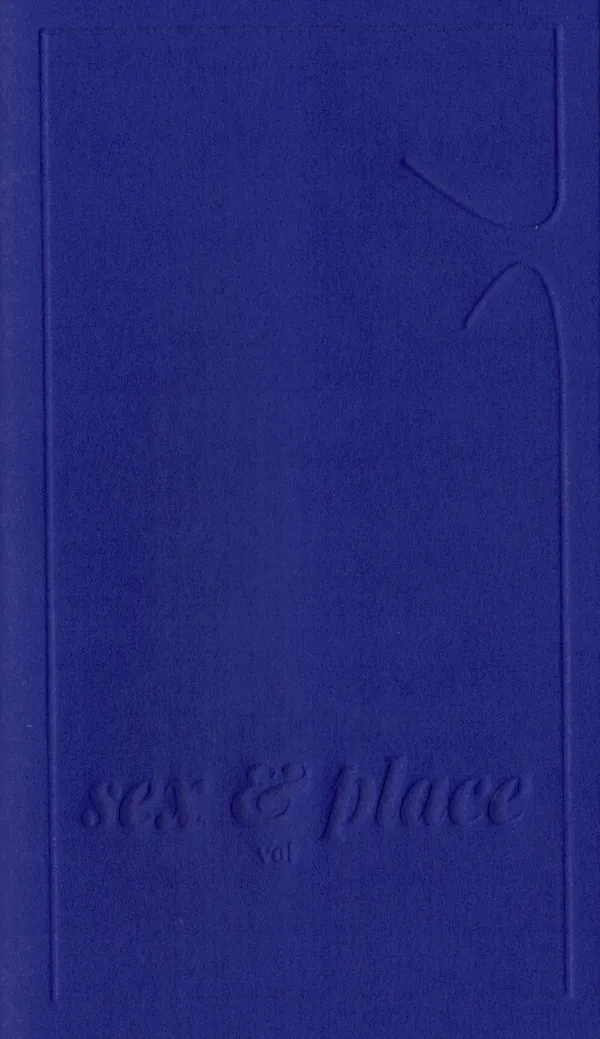
sex and place vol 2
Adriano Wilfert Jensen, Andrea Zavala Folache
sex and place is a series of workshops and publications exploring score-based and semi-anonymous writing as a tool for articulating shared concerns.
Vol 2 ‘discores’ is written by Kexin Hao, Luca Soudant, HaYoung, Andrea Zavala Folache & Adriano Wilfert Jensen. Five strangers are stuck in changing boots next to each other and decide to embark on an intimate conversation starting from the question: “What is troubling your sexuality at the moment?”.
The ‘sex and place’ series is part Domestic Anarchism, a project devoted to coalition-building beyond biological, chosen, or national conceptions of family. Dance serves as a set of tools and knowledge that can be applied beyond “the spectacle” to collectively study, write, and move.
Andrea Zavala Folache and Adriano Wilfert Jensen are choreographers and they co-parent three-year-old Penélope Cleo. Andrea and Adriano use dance and choreography to think about the distribution of care and solidarity beyond ‘the family’, and in turn consider how such a distribution could inform their dance practice. Inevitably themes like sex, economy, gender, and class get activated. But also notions such as prefiguration, anarchism, clitoridian* thinking, zones of non-domination and coalition building. They see dance as a knowledge that can be applied to different practices. Some of these include: co-habitations, score based writing and dancing, self-organised study groups and publications, workshops and dance performances.
sex and place vol 1
Adriano Wilfert Jensen, Andrea Zavala Folache
sex and place is a series of workshops and publications exploring score-based and semi-anonymous writing as a tool for articulating shared concerns.
Vol. 1 ‘preliminiaries’ is written by Andrea Zavala Folache and Adriano Wilfert Jensen. In the midst of (learning) child care, (unlearning) performance and (experimenting with) sex, the publication interweaves three registers of writing as analogies and interruptions of each other.
The ‘sex and place’ series is part Domestic Anarchism, a project devoted to coalition-building beyond biological, chosen, or national conceptions of family. Dance serves as a set of tools and knowledge that can be applied beyond “the spectacle” to collectively study, write, and move.
Andrea Zavala Folache and Adriano Wilfert Jensen are choreographers and they co-parent three-year-old Penélope Cleo. Andrea and Adriano use dance and choreography to think about the distribution of care and solidarity beyond ‘the family’, and in turn consider how such a distribution could inform their dance practice. Inevitably themes like sex, economy, gender, and class get activated. But also notions such as prefiguration, anarchism, clitoridian* thinking, zones of non-domination and coalition building. They see dance as a knowledge that can be applied to different practices. Some of these include: co-habitations, score based writing and dancing, self-organised study groups and publications, workshops and dance performances.

Hechtmappen bieden geen soelaas
Hechtmappen bieden geen soelaas is wat overbleef na een vakantiejob waarbij de taakinhoud vooral bestond uit het verwijderen van nietjes uit verouderde documenten. Deze weken waren de bron voor fascinaties voor ongemakkelijke stiltes, gesprekken in liften, de diefstal van fluorescerende pennen en een ontplofte ventilator.

She Follows No Progression
She Follows No Progression reflects on the plurality of Theresa Hak Kyung Cha (1951–1982)’s work and legacy, collecting essays, personal narratives, poems, conversations, letters, and the extratextual in a reader that attests to Cha’s genre-bending vision and political imagination. The writers, artists, scholars, organizers, and educators collected here, each unique in their voice and method, multiply approaches to language, colonial history, migration, and time in dialogue with Cha’s unequivocally interdisciplinary practice. Their contributions traverse subjects from Asian American studies to literary history, translation, film theory, and experimental poetics, while attending to the gaps between these fields and the intractable entanglements of race, class, and gender that underlie them. She Follows No Progression echoes Cha’s appeal for a liberatory horizon emergent from all that we are affixed to in the present.
She Follows No Progression is published on the occasion of the 2022 program, The Quick and the Dead: Theresa Hak Kyung Cha Edition. The Quick and the Dead is a yearlong, multiphase project that highlights the life, work, and legacy of a deceased writer by bridging their work to that of contemporary practitioners. In its third year, the program focused on Theresa Hak Kyung Cha.
Contributors:
Sam Cha, Marian Chudnovsky, Jesse Chun, Una Chung, Anton Haugen, Irene Hsu, Valentina Jager, Juwon Jun, Youbin Kang, Eunsong Kim, Youna Kwak, Jennifer Kwon Dobbs, Andrew Yong Hoon Lee, Jennifer Gayoung Lee, Sujin Lee, Florence Li, Serubiri Moses, Jed Munson, Yves Tong Nguyen, Wirunwan Victoria Pitaktong, Brandon Shimoda, Caterina Stamou, Megan Sungyoon, Teline Trần, and Soyoung Yoon.