Translations
Translations

The Obscene Madame D
Nathanaël, Hilda Hilst and 1 more
A wickedly funny work of depraved genius by one of Brazil’s most radical twentieth-century writers; imagine the Marquis de Sade as written by Clarice Lispecter.
An electrifying masterpiece by one of modern Brazilian literature’s most significant and controversial writers, Hilda Hilst takes us into the disorder and beauty of a mind restlessly testing its own limits.
Every month I ingested the body of God, not in the way one swallows green peas or agrostis, or swallows swords, I ingested the body of God the way people do when they know they are swallowing the More, the All, the Incommensurable, for not believing in finitude I would lose myself in absolute infinity…
The Obscene Madame D tells the story of Hillé, a sixty-year-old woman who has decided to abandon conventional life and spend the rest of her days in contemplation in a recess under the stairs. There, she is haunted by the perplexity of her recently deceased lover, Ehud, who cannot understand her rejection of common sense, sex and a simple life in favour of metaphysical speculations that he considers delusional and vain.
In a stream-of-consciousness monologue that’s part James Joyce, part Clarice Lispector, and part de Sade, Hillé speaks of her search for spiritual fulfilment from a space of dereliction, as she searches for answers to great questions of life, death and the relationship between body and soul.
Translated by Nathanaël and Rachel Gontijo Araujo

SMALLTOWNNOVELLA
Ronald M. Schernikau, Lucy Jones
An homage and reimagining of the classic German Bildungsroman, Schernikau paid tribute to the form even as he challenged stylistic, sexual, and political conventions. Written in all lower-case, SMALLTOWNNOVELLA is a brilliant stream-of-consciousness narrative that follows b, a teenager navigating politics and queer desire in a small, West German town. When b—who is interested in communism and knitting—falls in love with leif, a popular jock, b’s life at school is very predictably upended.
“A mighty, slender record of the provocative intelligence of a queer teenage mind.” —Eliot Duncan
Ronald M. Schernikau was born in 1960 in Magdeburg, East Germany and grew up in Hanover, West Germany. After completing his Abitur in 1980, he moved to West Berlin and studied German literature, philosophy, and psychology. In 1986, he started studying at the Institut für Literatur Johannes R. Becher (German Institute for Literature) in Leipzig, GDR. In 1989 he obtained GDR citizenship and relocated to Berlin. He worked as a dramaturge, and in radio and TV until his death in 1991. His publications include Kleinstadtnovelle (Small-Town Novella, 1980); Die Tage in L. (The Days in L., 1989); Legende (Legends, 1999); Königin im Dreck (Queen in the Dirt, 2009); and Irene Binz. Die Befragung (Irene Binz. The Interview, 2010).
Lucy Jones is a British translator and writer based in Berlin. She is the translator of Brigitte Reimann’s Siblings, (Penguin Modern Classics), Anke Stelling’s Higher Ground (Scribe) and Annemarie Schwarzenbach’s Lyric Novella (Seagull Books), among others. Her translations and book reviews have appeared in Asymptote, Words Without Borders and CulturMag. She is the runner-up for the Society of Author’s Schlegel-Tieck Prize in 2023.
PRAISE
“This slender book is a fierce account of queer teenage imagination: provocative, haughty, coy, insolent, and wild. As angsty as it is intelligent, Schernikau’s prose also feels protective and sweet. SMALLTOWNNOVELLA is the book, the friend, I wish I had in high school.” —Eliot Duncan
“…an earnest, seemingly offhand account of a brilliant young man growing up in a small town and realizing that his queerness and his communist politics will come to structure his life. (…) the first of Schernikau’s many attempts to lay out a gay politics that would open him to the world rather than fating him to a specific lot within it: an identity politics not constructed to elaborate and defend a single perspective, but one that sought to locate the self within a broader movement to transform society." —Ben Miller & Nicholas Courtman, LARB

Tripwire 15 - Narrative/Prose
Narrative/Prose issue, featuring a special section: I was writing, but it was drawing: a Renee Gladman mini-feature with work by Renee Gladman * Earl Jackson, Jr. * Bruna Mori * Alexis Almeida on Renee Gladman & Julie Carr * Lewis Freedman & Vanessa Thill on Renee Gladman & Mirtha Dermisache. as well as work by Isabel Waidner * sissi tax (translated by Joel Scott & Charlotte Theißen) * Susan Hefuna * Mira Mattar * Lital Khaikin * Maryam Madjidi (translated by Ruth Diver) * Omer Wasim & Saira Sheikh * Ilse Aichinger (translated by Christian Hawkey & Uljana Wolf) * Bronka Nowicka (translated by Katarzyna Szuster) * Maude Pilon (translated by Simon Brown) * Mehmet Dere * Syd Staiti * Jena Osman * Germán Sierra * Natani Notah * Julia Bloch on Bernadette Mayer * Robert Glück on Clarice Lispector * Rob Halpern on Bruce Boone & Dennis Cooper *Dylan Byron on/after Bruce Boone * Linda Bakke on Communal Presence: New Narrative Writing Today * Anna Fidler * Corey Zielinski on Bob Glück & Writers Who Love Too Much: New Narrative 1977-97 * Jackie Kirby on From Our Hearts to Yours: New Narrative as Contemporary Practice * David W. Pritchard on Kevin Killian * Dale Enggass on Simone White * Allison Cardon on Anne Boyer * Robert Balun on Leslie Kaplan * Marco Antonio Huerta on Omar Pimienta * Allison Grimaldi Donahue on Josué Guébo * Sara Florian on Lasana Sekou * Louis Bury on Allison Cobb * Hugo Gibson on Annie Ernaux.

Bodies Found in Various Places
Elvira Hernández, Daniel Borzutzky and 1 more
The first anthology of Elvira Hernández’s poetry translated into English brings the award-winning contemporary Chilean poet's work of love, survival, persistence, disturbance, amazement, and delight to a new audience.
Elvira Hernández has occupied a marginal position in the Chilean poetic scene for decades, her quiet but mordant voice looking inward and outward, ironizing the circumstances of life that have brought us to this critical point in society. As recently as 2018, her work has become more visible after receiving the Jorge Teillier National Poetry Award (2018), the Pablo Neruda Ibero-American Poetry Award (2018), and the National Literature Prize (Chile 2024). With this belated recognition of her work has come an interest in studying her unique poetic language, with new critical books forthcoming from Spanish and Latin American publishers. Bodies Found in Various Places collects poems written from 1981-2016, providing readers with a curation of texts that show why Hernández is one of the most vital Latin American poets writing today.
"Elvira Hernández wrote her poem “The Chilean Flag” after she herself had been detained and tortured by the dictatorship for not complying with its lies. While Chileans were trained to look the other way, to go quiet by this terror, Elvira Hernández wrote a poem that could not be printed. Yet, the poem escaped like a prisoner and began circulating in Xeroxes, from hand to hand, until ten years later it was finally printed in Buenos Aires. In Elvira Hernández’s poetry, each line restores the right of words to speak. Each word becomes a healer, a prayer for a wounded, enslaved humanity forced to obey the rule of profit over life."— Cecilia Vicuña, author of Spit Temple

Tripwire 19 - Sean Bonney Tribute Issue
Sean Bonney Tribute Issue
Don’t say “Rest in Peace,” say Fuck the Police: A Sean Bonney Tribute Portfolio, featuring: Katharina Ludwig, Lama El Khatib & Haytham El Wardany, Anahid Nersessian, Vicky Sparrow, Koshka Duff, Max Henninger, Joshua Clover, Jasper Bernes, D.S. Marriott, Fran Lock, Joey Frances, Mathilda Cullen, Nicholas Komodore, David Lau, Eve Richens, Sacha Kahir, Uwe Möllhusen & Marie Schubenz, Kashif Sharma-Patel, Linda Kemp, Daniel Eltringham & Fred Carter, Hugo García Manríquez, Jèssica Pujol Duran & Macarena Urzúa Opazo. With additional work by Belén Roca, translated by Noah Mazer, Adelaide Ivánova, translated by Chris Daniels, stevie redwood, Cait O’Kane, Mau Baiocco, Peter Bouscheljong, translated by Jonathan Styles. Zheng Xiaoqiong, translated by Zhou Xiaojing, Mayamor, translated by Eric Abalajon, Afrizal Malna, translated by Daniel Owen, Jorge Carlos Fonseca, translated by Shook, James Goodwin, Amalia Tenuta. Plus Engagements: Anne Boyer interviewed by Eduardo Rabassa, Gail Scott interviewed by Michael Nardone, Noah Ross on David Melnick, Guillermo Rebollo Gil on Pedro Pietri, Coco Fitterman on Ennio Moltedo, Sam Moore on Aaron Shurin, David Grundy on Lorenzo Thomas

The Hormone of Darkness: A Playlist
In Tilsa Otta’s The Hormone of Darkness, we find a queer, Latinx person who has lived through iterations of authoritarian rule, and who answers these conditions by creating poetry that doubles down on a life force that precedes and exceeds received notions of the poetic. Here poetry is bawdy, fabulist, and spiritual—in short, it is alive. Otta has created a heaven where readers can go after they die.
Drawing from four volumes spanning Otta’s career, translator-poet Farid Matuk has curated a playlist we can dance and dream to, one that honors Otta’s drive toward liberation through both perreo in the club and transdimensional wandering among the stars.
We can go on like that forever
building paradise from our urges
out of our fetishes our loves our vices
How lucky
We’ll wait for you then
Don’t be too long
Bookmark the page
We’ll be Here
—From “The New Heaven”
Translated from the Spanish by Farid Matuk.

Michigan State University Press
Citizens of Beauty: Poems of Jean Sénac
This stunning collection of poems by the Algerian poet Jean Sénac (1926–1973) was originally published when he was forty-one. Sénac represented the hope of the new generation of Algerians who were celebrating their independence from France after 130 years of colonialism, and in the tradition of René Char and the early Albert Camus, he portrayed an Algeria whose land and people would finally sing with their own voice.
Sénac celebrates revolution, love, and the body, beginning with the resonant verses: “And now we’ll sing love / for there’s no Revolution without love.” He sang, as well, of beauty: “No morning without smiling. / Beauty on our lips is one continuous fruit.”
Translated by Jack Hirschman

SIAHKAL 2.0: An A.I. resurrected discourse on Marxism & Islam
This is a limited edition book. The author trained an LLM on the texts of a deceased theorist, and then proceeded to interact with the LLM and produce simulations of what the theorist may have said in regards to various pertinent topics. The book is primarily a free online resource, but a few copies are being printed to commemorate the work. It has a foreword and afterword by the Editors.
At the core of this project is a translation of “Marxist Islam or Islamic Marxism,” a groundbreaking text written by Bizhan Jazani during his imprisonment in the 1970s under the Shah’s oppressive regime. Translated by Parham Ghalamdar, this work is accompanied by an introduction contextualizing Jazani’s radical vision. Ghalamdar also contributes a series of ASCII-style illustrations and diagrams—AI-assisted reinterpretations of Jazani’s original paintings and photographs—that bridge the past and present, offering a new perspective on his revolutionary artistry.
Siahkal names a place in the forests of Gilan and a threshold in revolutionary time. In 1971 a guerrilla action near Siahkal shook the order of the Shah. The action failed militarily yet seeded a myth for the People’s Fedai Guerrillas. Bizhan Jazani, a founding thinker, wrote and painted in prison and was executed in 1975. His work teaches that strategy rather than sentiment endures. // This book treats Siahkal as a Deep Object, a persistent attractor that gathers memory, images, and tactics. An AI model trained on Jazani’s writings and paintings translates his essay on Islamic Marxism and proposes annotations. The machine functions as a probe that widens attention while remaining accountable to the source. Parham Ghalamdar trained the AI, wrote the introduction, and composed ASCII diagrams and diagrammatic readings from Jazani’s artworks. Parsa Esmaeilzadeh contributes an essay that reads Jazani through Karatani and left accelerationism. // It is a call to reimagine and export revolution as a Deep Object that asks for Deep Time to unfold. This clandestine edition invites the reader to study, test, and build strategy that can outlast the news cycle and meet the future head on.
Parham Ghalamdar is a multidisciplinary artist currently based in the UK. Ghalamdar’s work traces forgotten mythologies, buried philosophies, and visual ruins, reconfiguring them into speculative worlds where memory, fiction, and futurism collapse into one another. Drawing on cybernetic theory and generative AI, he explores how systems of feedback, simulation, and machine vision mediate our understanding of history and possibility. Through painting, film, and writing, he builds narratives that feel both ancient and yet-to-come, haunted by lost histories and animated by possible futures.

Across the Acheron
Monique Wittig, David Le Vay and 1 more
In her darkly funny 1985 take on Dante’s Divine Comedy, acclaimed French writer and activist Monique Wittig restages the journey through the circles of hell, limbo, paradise from a lesbian feminist perspective.
Never-before published in the US, Across the Acheron follows the adventures of “Wittig” and her anti-Virgilian guide through laundromats, billiard parlors, dyke bars, and picnic grounds of a 1980s San Francisco populated by hunters and their prey, lost souls, and fantastical beasts, including a robotic eagle and angelic bikers. Wittig reimagines Dante’s epic poem through a feminist and queer lens, subverting his cosmological order and upending gender identities and literary traditions. This edition brings the English translation of Wittig’s final novel back into print for the first time since the early-1990s, revised according to the author's notes, and with a new introduction by Sophie Lewis.
“Across the Acheron is a work of lesbian struggle and triumph across two kinds of hell. The hell of the classic western literary canon—and the hell of San Francisco. Monique Wittig brings all of her writerly powers and political experience to bear here, as witness to the horrors of heterosexual patriarchy and also to the possibility of another world for another life. Her work is a rare combination of deeply felt materialism and radical linguistic freedom. If we're to have another world, we'll need to create another language. She knew that, and she lived it.” — McKenzie Wark
“Even in fiction Monique Wittig’s writing is critical, prescient, brilliant, satirical, searing, and way ahead of its time. I’m so glad this work is back in circulation to revisit and revel in.” — Pamela Sneed
“In this unendurable yet compelling journey through the circles of patriarchal hell, Wittig encounters hordes of tortured women who do not struggle against their oppressors. Their brainwashing is as difficult to witness as their bloodied flesh. Only through communal activism does the seeker’s soul becomes tough enough to enter Paradise, where bare-breasted angels dismount motorcycles and offer baskets of 'cherries, strawberries, raspberries, apricots, peaches, plums, tomatoes, avocados, green melons, cantaloupes, watermelons, lemons, pawpaws, pineapples and coconuts.’ The bounties of Across the Acheron are lush and many.” — Dodie Bellamy
“A Guernica of the human (feminist) condition, a blacker, bleaker, more vengeful Alice’s tea party, this is a novel as graphic as a painting, whose brilliance its translators have creditably preserved.” — Publishers Weekly
Introduction by Sophie Lewis
Translated by David Le Vay with Margaret Crosland

The Lesbian Body
In this genre- and gender-breaking work of theory-fiction, legendary writer and cofounder of the 1970s French feminist movement Monique Wittig celebrates the body—lesbian, literary and defiantly political—and challenges the order of heterosexuality in literature.
First published in French in 1973, The Lesbian Body mines the relationship between a lover and a beloved—also a writer and a text—to explore the ideological and historical constructions of the female subject. Organized according to the principle of montage, poetic passages are juxtaposed with anatomic lists that mark lesbian eros. Through expressions of joy, violence, and tenderness, the site of pleasure is celebrated. In her transfiguration of gender and its paradigms, Wittig transformed French vocabulary, feminizing grammar and lesbianizing myths. This edition brings the English translation of Wittig’s groundbreaking work back into circulation for the first time since the mid-1980s, revised according to the author's notes, and with an introduction by Paul B. Preciado.
“The Lesbian Body is a fundamental work of lesbian existence. Wittig's applied vision is a state of natural delirium, a revolutionary excess of utopianism, refusal, and mutual self-creation. Revisiting it reveals how much passionate free thought has been lost, and simultaneously, how many of her tropes and discoveries have integrated into our collective consciousness.” — Sarah Schulman
“In this stunning new rendering of The Lesbian Body by the French author, theorist, activist and teacher, the late Monique Wittig, we are plunged into an imagined world of passionate violence and erotic lesbian mayhem intertwined in strikingly bold poetic images. Wittig, in the reach and volatility of her imagination, stands alongside such important American writers as Audre Lorde, Adrienne Rich, and Valerie Solanas, all of whose work deserves to be read again, or for the first time.” — Esther Newton
“To read the book is to be forced by Wittig into another grammar and happily contaminated by its strange forms. You will never think straight again.” — Jack Halberstam
“For me, Wittig opened up a sense of the world that had been, quite literally, unimaginable. She tore us apart.” — Judith Butler
“Together with Ursula Le Guin and Samuel R. Delany, Wittig is the first to design a nonbinary utopia, a world in which the binary categorization of sexes and genders will have ceased to exist.” — Paul B. Preciado
Introduction by Paul B. Preciado
Translated by David Le Vay

I Will Always Be Looking For You – A Queer Anthology on Arab Art
I Will Always Be Looking For You – A Queer Anthology on Arab Art brings together the works of 31 artists from 13 Arabic-speaking countries, with literary contributions by 24 writers from across the region and its diaspora. The individual texts span a wide variety of genres – poetry, essays, fiction, experimental writing – and enter into dialogue with the visual artworks that accompany them. In this interplay, the definition of queerness in the Arab world is both documented and expanded – not as a fixed identity, but as a generative force, a method, a rupture and a refusal. The book represents the first purposeful collection of intergenerational artistic voices in one and the same volume, creating an important archive of queer voices in Arab art that is at once intimate and collective.
The book was commissioned by the Lebanese feminist collective Haven for Artists, translated by Rayyan Abdel Khalek, and designed by Marwan Kaabour. For its launch, editors Yasmine Rifaii and Nadim Choufi enter into a conversation with Dayna Ash from Haven for Artists.

Licorice Candies
Cecilia Pavón, Jacob Steinberg
Licorice Candies collects short stories and poems written during the author’s most experimental and frenzied phase. The backdrop shifts from barren plazas in Buenos Aires to basement parties in Berlin. “I wished that, by continually moving horizontally, in a straight line, my body would touch Germany…that you could reach Berlin from Buenos Aires in a second without any planes that all the coolest cities in the world were each a continuation of the next: Lima, Buenos Aires, Berlin.” The medium through which these desires manifest is the Internet. The Internet—a ubiquitous force that becomes the notebook for the author’s poetry: typo-ridden love letters the grammarless confessions of a polyglot a geography that bends to the author’s will, making everything closer, more intimate.
Translated from Spanish by Jacob Steinberg

Nine Ways to Cry
Cecilia Pavón, Jacob Steinberg
Cecilia Pavón has been a defining figure of the Argentine cultural scene since the 1990s. She is the author of over 10 volumes of poetry, 3 short story collections, and an anthology of blog posts, and was co-founder of the legendary art gallery and publishing press Belleza y Felicidad. Nine Ways to Cry collects Cecilia Pavón’s complete poetry published from 1999 to 2012 in one bilingual volume for the first time, including A Hotel With My Name, Licorice Candies, and other beloved classics.
Prefaced by a loving foreword from contemporary US poet Dorothea Lasky, this collection serves as the definitive introduction to the poetry of a living legend. She currently lives in Buenos Aires.

Thomas the Obscure
Maurice Blanchot, Robert Lamberton
Before Sartre, before Beckett, before Robbe-Grillet, Maurice Blanchot created the new novel, the ultimate post-modern fiction. Written between 1932 and 1940, Blanchot's first novel, here brilliantly translated by Robert Lamberton, contains all the remarkable aspects of his famous and perplexing invention, the ontological narrative—a tale whose subject is the nature of being itself. This paradoxical work discovers being in the absence of being, mystery in the absence of mystery, both to be searched for limitlessly. As Blanchot launches this endless search in his own masterful way, he transforms the possibilities of the novel. First issued in English in 1973 in a limited edition, this re-issue includes an illuminating essay on translation by Lamberton.

Unfit
Ariana Harwicz, Jessie Mendez Sayer
A bracing novel that asks how far we would go for the ones we love—and what we would do to destroy the ones we hate.
Lisa has lost custody of her young twin boys. Caught between the French legal system’s sluggish bureaucracy and her sinister, scheming in-laws, she’s alone and lost, an Argentine migrant in rural France picking grapes for a pittance, only allowed to see her children in supervised visits once a month. Scapegoated and outcast, destitute and desperate, Lisa decides to take radical action: early one morning, she sneaks into her in-laws’ farmhouse, takes back her children, sets the barn ablaze, and makes her escape.
What follows is a white-knuckled road trip that explores human beings pushed to the edge. Clearly, Lisa is not in her right mind, and as Harwicz deftly mingles a chorus of contradictory voices into her very unreliable narration, the reader comes to regard the protagonist with an unsettling mixture of sympathy and suspicion. Written in savage, chiseled prose, Unfit shoots off, a gripping chase that questions all our assumptions—and points out our hypocrisies— about motherhood, custody rights, love, violence, anti-semitism, and migration. The latest novel by the acclaimed author of Die, My Love (soon to be adapted to a film starring Jennifer Lawrence), Unfit is addictively terrifying, savagely sophisticated, and shockingly brilliant.
Translated from Spanish by Jessie Mendez Sayer
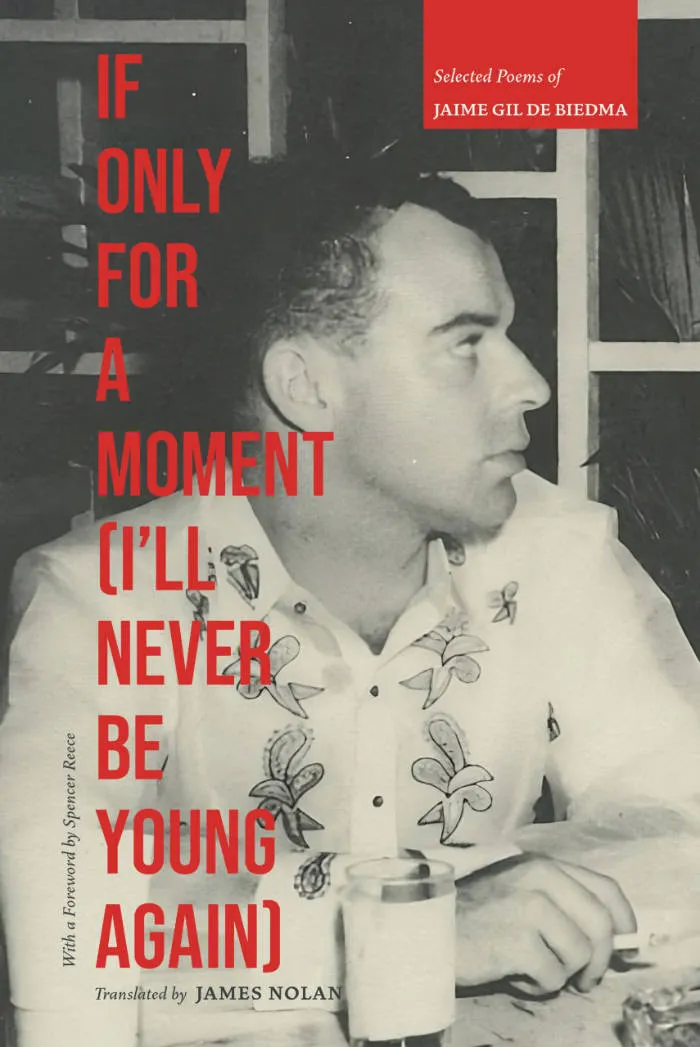
If Only For a Moment (I’ll Never Be Young Again)
Jaime Gil de Biedma, James Nolan
Jaime Gil de Biedma is the most original and influential among the poets known as the ‘50’s Generation in Spain, and is considered the greatest Spanish poet to emerge in the second half of the 20th century. His life and literary career were bracketed almost entirely by the rise and fall of Generalissimo Francisco Franco, notorious for the suppression of literature. Born in 1929, Gil de Biedma was six years old when García Lorca was murdered in Granada at the outbreak of the Civil War, and his collected poems, Las personas del verbo, first appeared in 1975, the year Franco died. What is surprising is that Gil de Biedma was a leftist, homosexual poet from the Catalan capitol, Barcelona – all of Franco’s favorite things – who not only published books of autobiographical poetry in Spain but was known as a poet of social conscience as well as erotic lyricism. Like other Spanish poets of his time, he chose his words carefully. Gil de Biedma died of AIDS in 1990.
If Only For a Moment (I’ll Never Be Young Again) consists of an extensive bilingual selection of Gil de Biedma’s poetry, including all of his most well-known work. The book additionally consists of a Foreword by Spencer Reece, Jaime Gil de Biedma’s short essay “I wanted to be the poem,” and two different essays on Gil de Biedma and the art of translation by James Nolan, the volume’s translator.

Six Films
The English-language debut of a beautiful and beguiling cycle of experimental texts by the legendary Marguerite Duras.
In the late 1970s, Marguerite Duras embarked on an experimental journey to expand the boundaries of writing and film. For Duras, writing need not be text on a page nor cinema merely images on a screen. Six Films is the result of her efforts to redefine the two arts in order to create a hybrid work. Taking narration, voiceovers, and dialogue from six of her films, Duras re-envisions them as extended prose poems and monologues, tangling with self-identity, personal relationships, colonialism, and expression as the celluoid images recede and the text becomes the film itself. Now available for the first time in English, Six Films is a document of an artist at the apex of her creative prowess.
Translated by Olivia Baes and Emma Ramadan.

Death Sentence
This long awaited reprint of a book about which John Hollander wrote: “A masterful version of one of the most remarkable novels in any language since World War II,” is the story of the narrator’s relations with two women, one terminally ill, the other found motionless by him in a darkened room after a bomb explosion has separated them. “Through more than 40 years, the French writer Maurice Blanchot has produced an astonishing body of fiction and criticism,” writes Gilbert Sorrentino in the New York Review of Books, and John Updike in The New Yorker: “Blanchot’s prose gives an impression, like Henry James, of carrying meanings so fragile they might crumble in transit.”
Translated from the French by Lydia Davis.

Little Joy: Selected Stories
Jacob Steinberg, Cecilia Pavón
Poet, writer, and translator Cecilia Pavón emerged in the late 1990s as one of the most prolific and central figures of the young Argentine literary scene—the so-called “Generation of the 90s”: artists and writers whose aesthetics and politics were an earnest response to the disastrous impact of American-exported neoliberal policies and the resulting economic crisis of 2001. Their publications were fragile—xeroxed, painted on cardboard—but their cultural impact, indelible.
A cofounder of Buenos Aires’s independent art space and publishing press Belleza y Felicidad—where a whole generation of soon-to-be-famous Argentine artists showed their work for the first time—Pavón pioneered the use of “unpoetic” and intimate content—her verses often lifted from text messages or chat rooms, her tone often impish, yet brutally sincere.
In 2015, Pavón’s first volume of collected poems, ‘A Hotel with My Name’, was published in English. Contemporary writers in the United States, Australasia, and Europe discovered a deep affinity with her work. Pavón’s protagonists, Ariana Reines noted, “are absolute women, guileless dreamers, saints in sneakers, on sidewalks, in jail, in Zara, on buses, in nightclubs, in bed.”
Translated by Pavón’s own poetic protégé Jacob Steinberg, ‘Little Joy’ collects the best of Pavón’s short stories written between 1999-2020, originally published in three volumes in Spanish.

Flood Tide
In moderate physical decline, and with an immoderate weed habit, the novelist Dunja Anko returns home to the Adriatic coast to play detective and solve the mystery of her brother’s death. The going is arduous, the people inscrutable; her old friends have had years to forget – or to convince themselves they don’t remember. Dunja must contend with desire and disgust, curiosity and fear, as she begins to doubt her reasons for returning. Elegantly plotted, funny and self-reflexive, Flood Tide is a psychologically deft exploration of the trauma wrought by human limitation and indecision.
"A dazzling mix of narrative styles (even genres), a linguistic rollercoaster, and a book that demands both close attention and literary sensibility . . . The reader is hooked." — Boštjan Videmšek
"Mysterious, precise and haunting, Flood Tide suggests that every homecoming is a return to a crime scene." — Chris Kraus
Ana Schnabl (b. 1985) is a Slovenian writer and editor. She writes for several Slovenian media outlets and is a monthly columnist for the Guardian. Her collection of short stories Razvezani (Beletrina, 2017) met with critical acclaim and won the Best Debut Award at the Slovenian Book Fair, followed by the Edo Budiša Award in Croatia; the collection has been translated into German and Serbian. Three years later Schnabl published her first novel Masterpiece (Mojstrovina, Beletrina, 2020). She toured Europe with the English, German and Serbian translations of the book, which included a residence in the Museumsquartier in Vienna, the Literarisches Colloquium Berlin, and the first European Writer’s Festival in London. The novel was given favourable reviews and mentions in numerous Austrian, German and English media, and was longlisted for the Dublin Literary Award. Her second novel Flood Tide (Plima, Beletrina, 2022) was nominated for the Slovenian Kresnik Award. Her third novel September (Beletrina, 2024) won the Kresnik Award in 2025.
Rawley Grau has been translating literary works from Slovenian for over twenty years, including by such first-rate novelists as Dušan Šarotar, Mojca Kumerdej, Sebastijan Pregelj, Gabriela Babnik and Vlado Žabot. Six of his translations have been longlisted for the Dublin Literary Award, while his translations of Šarotar’s Panorama and Billiards at the Hotel Dobray were shortlisted for the Oxford-Weidenfeld Translation Prize. He has also translated poetry by Miljana Cunta, Miklavž Komelj, Janez Ramoveš and Tomaž Šalamun, among others. In 2021, he received the prestigious Lavrin Diploma from the Association of Slovenian Literary Translators. Translations from other languages include A Science Not for the Earth: Selected Poems and Letters by the Russian poet Yevgeny Baratynsky, which received the AATSEEL prize for best scholarly translation, and, co-translated with Christina E. Kramer, The Long Coming of the Fire: Selected Poems by the modernist poet Aco Šopov, which won the 2025 International Dragi Award for best translation from Macedonian. Originally from Baltimore, Maryland, he has lived in Ljubljana since the early 2000s.

Tripwire 22
Featuring work by Sara M Saleh, Joni Prince, Shatr Collective, Carlos Soto Román, Petra Kuppers, Diane Ward, Dianna Settles, Mayra Santos-Febres translated by Seth Michelson, Elena Gomez & Chelsea Hart, Noah Mazer, Daniel Borzutzky, Ash(ley) Michelle C., Ghazal Mosadeq, Darius Simpson, Mohammed Zenia, Mario Payeras translated by Dan Eltringham, Ferreira Gullar translated by Chris Daniels, Christophe Tarkos translated & read by Marty Hiatt, Andrew Spragg on Tom Raworth, Matthew Rana on Ida Börjel, & Paisley Conrad on Harryette Mullen

The Darkroom
Marguerite Duras, Alta Ifland and 1 more
The Darkroom contains the script for Marguerite Duras’s 1977 radically experimental film Le camion (The Truck). Between images of a truck in motion, juxtaposed voiceovers, and cutaways to Duras in conversation with Gérard Depardieu, Le camion turns the art of film into a means of enabling the viewer to engage multiple faculties—not only the visual and the aural, but also memory, imagination, and desire.
Also included here is a series of short essays in which Duras makes provocative connections between film and textuality, as well as a fascinating dialogue with Michelle Porte. Together amounting to a crucial contribution to the field of film theory, these texts make brilliantly apparent the depth and integrity of Duras’s aesthetic, philosophical, and political thinking.
Translated by Alta Ifland and Eireene Nealand. Introduction by Jean-Luc Nancy

The Screwball Asses and Other Texts
Christian Maurel, Noura Wedell
A foundational work of queer theory.
First published anonymously in the notorious "Three Billion Perverts" issue of Félix Guattari's journal Recherches—banned by French authorities upon its release in 1973—The Screwball Asses was erroneously attributed to Guy Hocquenghem when it was first published in English in 2009. This second edition of that translation, with a new preface by Hocquenghem biographer Antoine Idier that clarifies the different theoretical positions within France's Front Homosexuel d'Action Révolutionaire, returns the text to its true author: writer, journalist, and activist Christian Maurel.
In this dramatic treatise on erotic desire, Maurel takes on the militant delusions and internal contradictions of the gay-liberation movement. He vivisects not only the stifled mores of bourgeois capitalism, but also the phallocratic concessions of so-called homophiles and, ultimately, the very act of speaking desire. Rejecting any “pure theory” of homosexuality that would figure its “otherness” as revolutionary, Maurel contends that the ruling classes have invented homosexuality as a sexual ghetto, splitting and mutilating desire in the process. It is only when nondesire and the desire of desire are enacted simultaneously through speech and body that homosexuality can finally be sublimated under the true act of “making love.” There are thousands of sexes on earth, according to Maurel, but only one sexual desire. The Screwball Asses is a revelatory disquisition.
Introduction by Antoine Idier
Translated by Noura Wedell

The Stone Door
The Stone Door is a surrealist allegory intertwining myth, mysticism, and romance. Written by Leonora Carrington after World War II, the novel follows a woman's symbolic journey through esoteric teachings, ancient lands, and dreamlike visions in pursuit of spiritual awakening and the unification of male and female forces. Both a metaphysical adventure and a tribute to Carrington's personal love story, it offers a visionary exploration of transformation and liberation.