Poetry
Poetry

Black Bedouin
Black Bedouin, by Mohammed Zenia and Tenaya Nasser is a book of the IMMEDIATE — written immediately (in the span of five days, very literally at the printing press at 1080PRESS) in response to the current genocide against, and in solidarity with, the people of Sudan and in the context of immediate echoes in Palestine, Congo, Pakistan, and more — and throughout it all imbued with the immediacy that the global situation demands of us and our moral consciences. Black Bedouin rings in the creative immediacy of New York School all-night-writing-to-mimeograph-next-day with the political immediacy of a this-is-happening-right-now Crass single or Etel Adnan's incomparable (but here spiritually correlated) The Arab Apocalypse. In other words, Black Bedouin hits every star in a very cool and specific constellation. — Dave Morse

Textdemic: A Retrospective on Jenny Holzer’s Laments
Textdemic | A Retrospective on Jenny Holzer’s Laments” Ed. by A.L. Steiner and GenderFail, a publication based on A.L. Steiner + Friends on Jenny Holzer at Dia Chelsea. This book is based on the Artists on Artists Lecture Series when the Dia Art Foundation invited Steiner to curate a public program based on a work of the artist's choice.
Steiner chose Jenny Holzer’s Laments and invited Morgan Bassichis, Riel Bellow, Gregg Bordowitz, Alexander Chee, Malik Gaines, Guadalupe Maravilla + Alexa Mishell Guillen, Lucas Michael, Eileen Myles and Pamela Sneed to present in Dia’s first in-person program after the Covid-19 pandemic began in 2021. This publication features records of the poems, lectures, and performances during this memorial program. The book's design plays homage to the 1990 Laments publication by the Dia Art Foundation.
For this publication, Steiner and GenderFail invited Matilde Guidelli-Guidi, Associate Curator at Dia Art Foundation and the organizer of the Artists on Artists Lecture Series, to write an afterword for the book. In this, she states: "Dispensing altogether with the monographic formula that characterizes the institution, for her Lecture A.L. Steiner convened a group of artists, writers, and activists to join her in responding to Jenny Holzer’s 1989 text-based installation, Laments. Holzer identified the thirteen texts that comprise Laments as 'voices of the dead,' a visual choir in response to the raging HIV/AIDS epidemic and government inaction. Over the protracted COVID-19 lockdown, Steiner developed the idea to organize an evening for the voices of the living to lament today's crises.”

Nan Vant solèy la
Through creative nonfiction, poetry, and the printed image, the publication considers the playful and purposeful self-actualization of a bicultural queer identity while navigating grief as a landscape to address themes of (be)longing, futurity, and place. Alongside a collection of their works and research, Abigail Lucien weaves written and visual offerings by fellow Caribbean and queer artists, including works by Lukaza Branfman-Verissimo, Justin Chance, Cielo Felix-Hernandez, Sucking Salt, and Tamara Santibañez, to create an expanded context for their work rooted in friendship and radical love.
Abigail Lucien (b.1992) is a Haitian-American interdisciplinary artist, educator, auntie, lover, and friend. Working in sculpture, literature, and time-based media, Lucien’s practice addresses themes of (be)longing, futurity, myth, and place by considering our relationship to inherited colonial structures and systems of belief/care. Past exhibitions include SculptureCenter (NY), MoMA PS1 (NY), Deli Gallery (NY), MAC Panamá (Panamá), Frost Art Museum (Miami, FL), Atlanta Contemporary (Atlanta, GA), UICA (Grand Rapids, MI), and The Fabric Workshop and Museum (Philadelphia, PA). Residencies include Amant Studio & Research Residency (NY), Skowhegan School of Painting & Sculpture (Madison, ME), the Eugeniusz Geppert Academy of Fine Arts (Wrocław, Poland), The Luminary (St. Louis, MO), Santa Fe Art Institute (Santa Fe, NM), ACRE (Steuben, WI), and Ox-Bow School of Art & Artist Residency (Saugatuck, MI).
Lucien has taught as a full-time faculty member and professor in the Department of Sculpture & Extended Media at Virginia Commonwealth University and the Interdisciplinary Sculpture Department at the Maryland Institute College of Art. In the fall of 2023, they will join the Department of Art and Art History as an Assistant Professor of Sculpture at Hunter College in NYC. Deli Gallery represents Abigail Lucien.

New York Temps
Composé à la fois de récits personnels, de citations et de collages provenant notamment du New York Times, New York Temps suggère une discontinuité des états intérieurs, accentuée par la multiplicité des orateur.ices : les voix se succèdent à elles-mêmes, sont à chaque moment ce qu’elles n’étaient pas celui d’avant, apprenantes et à l’écoute de tout ce qui n’est pas elles. À travers des questions d’intertextualité et de sampling en poésie, le texte porte en lui une violence immanente – rendue plus intérieure, faite sienne –, une gêne, non seulement ressentie, mais aussi imposée, comme une protestation.
Titre original : NYT. Publié pour la première fois chez Gauss PDF en 2018. Traduit de l’anglais par Salomé Burstein.
Aurelia Guo est écrivaine et chercheuse à Londres. Elle est également l’autrice de World of Interiors (Divided Publishing, 2022).
![Cover of [...]: Poems](https://rile.space/storage/3222/conversions/01JRFE9N8ZCVXTMHJAS60D283M-webp.webp)
[...]: Poems
From one of our most acclaimed contemporary writers, an urgent and essential collection of poems illuminating the visionary presence of Palestinians.
Fady Joudah’s powerful sixth collection of poems opens with, “I am unfinished business,” articulating the ongoing pathos of the Palestinian people. A rendering of Joudah’s survivance, [...] speaks to Palestine’s daily and historic erasure and insists on presence inside and outside the ancestral land.
Responding to the unspeakable in real time, Joudah offers multiple ways of seeing the world through a Palestinian lens—a world filled with ordinary desires, no matter how grand or tragic the details may be—and asks their reader to be changed by them. The sequences are meditations on a the past returns as the future is foretold. But “Repetition won’t guarantee wisdom,” Joudah writes, demanding that we resuscitate language “before [our] wisdom is an echo.” These poems of urgency and care sing powerfully through a combination of intimate clarity and great dilations of scale, sending the reader on heartrending spins through echelons of time. […] is a wonder. Joudah reminds us “Wonder belongs to all.”

We Don’t Live Here Anymore
A fragmented reflection on movement, absence, and the unraveling of identity within the shifting landscapes of departure and return. Tarren Johnson explores the tension between private longing and public expression, where moments of love and vulnerability emerge in transient encounters.
Tarren Johnson grew up in North County San Diego, where she began dancing and writings a child. She continued her studies at CalArts in Los Angeles before moving to Europe, where she built a decade-long career in the performing arts. Her debut book of poetry, We Don’t Live Here Anymore, also serves as the foundation for the stage work of the same title.


Drafts
A weaving draft is a kind of notation for planning and sharing woven textil structures. The threading, along the top, shows how the warp is threaded through the heddles and frames; the treadling, along the right-hand side, show the order in which the treadles of the loom are to be pressed; and the tie-up, in the upper right-hand corner, shows how each treadle interacts with the loom’ frames. The drawdown, in the lower left, shows whether the warp or weft will be on top at any particular intersection of threads—thereby providing a “preview” of the completed textile. Often a draft diagram will indicate the intended color of the warp and weft threads, and the drawdown will show the completed textile’s color patterns. In “Drafts,” Allison uses letters instead of colors, melding digital weaving with writing.
WITHOUT THE E is a series of pamphlets responding to a presence or an absence felt in contemporary digital culture.

Deer Book/Libro Venado
Inspired initially by Jerome Rothenberg’s translation Flower World Variations, which Cecilia Vicuña first encountered in 1985, Deer Book brings together nearly forty years of the artist’s poetry, “poethical” translations, and drawings related to cosmologies and mythologies surrounding the deer, and sacrificial dance in cultures around the world.
Woven like one of her quipu installations, Vicuña’s texts—which include original compositions in Spanish as well as English translations by Daniel Borzutzky—become meditations on translation, not just of the sacred nature of this animal but on how our understandings of ceremony and ritual are transformed, by this ongoing process. Taken as inspiration rather than conundrum, the impossibility of translation opens up poetic possibilities for Vicuña as she continues her lifelong exploration into the nature of communication across eras and distant lands, languages and shared symbols within Indigenous spiritualities.

Hemisferio Cuir: an anthology of young Queer Latin American Poetry.
Edited and selected by the brilliant Leo Boix and with poems in Spanish and English from across Latin America. There’s more than 30 poets featured, covering poems about what it is to be queer in contemporary Latin America. These poems cover gender, sexuality, politics, nature, and everything in between.

Festival
The festival is a space of communion and celebration, a romanticized collision of bodies, music and magic. The revolution will look like a festival, we’ve been told by philosophers, writers, artists, and marketers. But the festival is also, of course, the space of formalizing ideology, ritualizing the consumption and violence that propels existing structures of power.
This poetry collection views the migrant, female body as both the glorified and martyred totem of the festival-of-all-festivals we call globalization. Drawing from sources such as Sigmund Freud, James George Frazer, H.D., the Situationist International, seventeenth century narratives of Dutch sailors shipwrecked on the Korean peninsula, the rise of K-pop and the “Korean Wave,” and a zoo-breaking gorilla named Bokito, Festival features kaleidoscopic poetic sequences aiming to show that if anything universal is to be found in lyric poetry’s “I,” it is the result of centuries-long entanglements and contaminations, and of the bodies made to bear these exchanges, to give birth to this century’s globalized subject.
“FESTIVAL is an ode to both beauty and misery. Mia You’s ingenious poetry will have you laughing through your tears. Do NOT miss out!”
— Yael van der Wouden
"She reanimates the form-of-life which is a poem with a feminist skepticism, without foreclosing her robustly idealist commitment to poetry’s continuance"
— Lisa Robertson
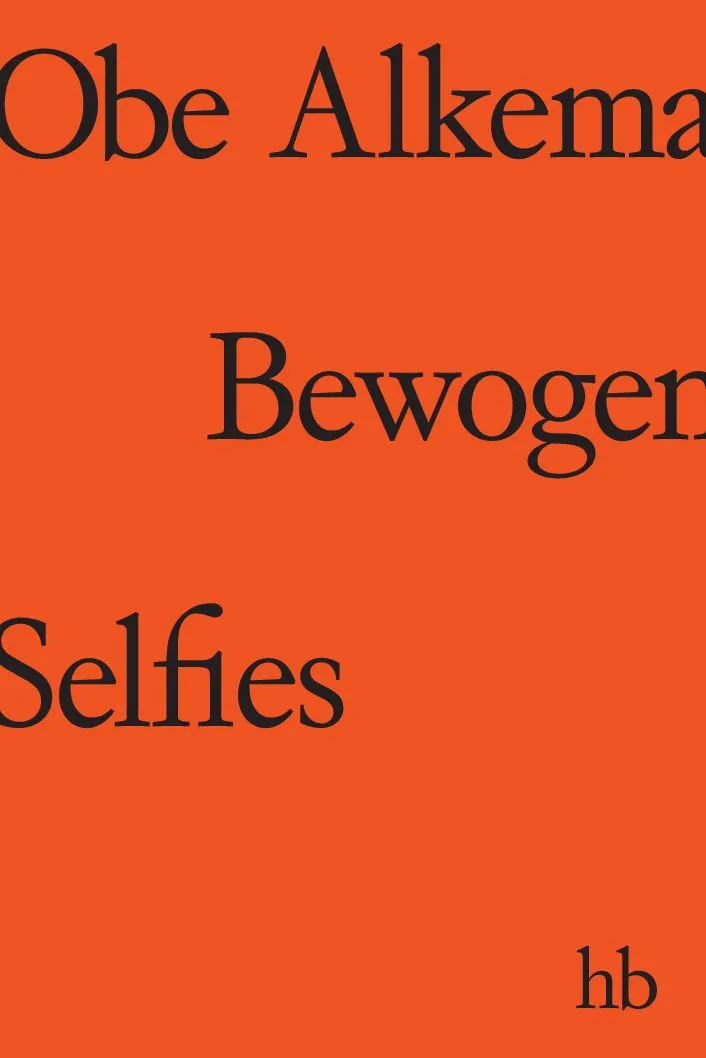
Bewogen selfies
In Bewogen selfies onderzoekt Obe Alkema de verhouding tussen landschap en herinnering. Wat treft hij aan bij terugkeer naar belangrijke plaatsen uit zijn geheugen? Wat herinnert hij zich niet, maar Google wel? Is er een gedenkschrift te puren uit zijn metadata?
Memoires, rechtstreeks verteld en met omwegen, uit eerste hand en van horen zeggen. Archieven en herinneringen eisen spreektijd, houden het niet meer droog of worden tot spreken gebracht. Wat hebben ze eigenlijk te melden? Ze lopen helemaal leeg, net als Alkema zelf. Een leven zoals zovele, poedelnaakt en geretoucheerd, vol zin en onzin.

I have brought you a severed hand
Ghayath Almadhoun, Catherine Cobham
Fluid and unselfconscious, Ghayath Almadhoun writes love poems in the shape of nightmares: I have brought you a severed hand is a surreal mix of absurd humour, heteroerotic lust and dead seriousness. Caught between two exiles, the one inherited from his Palestinian father and the one he chose and lives, Almadhoun attempts to explain water and tame hope.
This book never misses the defiant beat of an exile’s haunted footing across wars, seas and memory. Almadhoun turns the genocidal logic of colonialism upside down, emptying out the crumbs of humanity and civilisation. —Don Mee Choi
Almadhoun uses every possible means of silence to make the total devastation palpable. —Alfred Schaffer
Many poets attempt to traverse the gulf between the experience of tragedy and the ability to relay its magnitude to anyone else. But few living have done it with such flourish, such sustained passion and formal precision as Ghayath Almadhoun. —Kaveh Akbar
Ghayath Almadhoun (born 1979, Damascus) is a Syrian-Palestinian poet who moved to Sweden in 2008. He has published five collections of poetry in Arabic, the latest being Adrenalin (Almutawassit, 2017) and I have brought you a severed hand (Almutawassit, 2024). In 2017, Adrenalin was translated into English by Catherine Cobham and published by Action Books. In 2023, Almadhoun curated, edited and translated the poetry anthology Kontinentaldrift: Das Arabische Europa (Verlag Das Wunderhorn and Haus für Poesie), which includes thirty-one Arabic poets living in Europe. The English translation of I have brought you a severed hand is published simultaneously by Divided in the UK and Europe and by Action Books in the USA. Almadhoun currently lives between Berlin and Stockholm. His work has been translated into nearly thirty languages.
Catherine Cobham taught Arabic language and literature at the University of St Andrews, Scotland, for many years and was head of the department of Arabic and Persian from 2011 until 2021. She has translated the work of a number of Arab writers, including poetry by Adonis, Mahmoud Darwish, Ghayath Almadhoun, Tammam Hunaidy and Nouri al-Jarrah, and novels and short stories by Yusuf Idris, Naguib Mahfouz, Hanan al-Shaykh, Fuad al-Takarli and Jamal Saeed. She has written articles in academic journals and co-written with Fabio Caiani The Iraqi Novel: Key Writers, Key Texts (Edinburgh University Press, 2013).

Pleasureis Amiracle
A book of poems written out of a depressive episode, in which a devotional approach to music and desire reestablishes communication between the poet's body and the world.
In pleasureis amiracle, the poems invoke the lyric and refuse it, moving between time and sound—words re-connect and re-cohere, resisting separation and challenging readers to feel their way to meaning. Perception becomes a many-limbed entanglement from which the reader is never let go. Music is both divine and accessible, a sublimation of everyday movements into an erotics of sensation.
An experiment in form as much as content, it asks what can be cured by music, what is trans about desire, and how can one allow the body to feel what the mind sees, or vice versa.

Agitated Air: Poems After Ibn Arabi
Born in Murcia in 1165, Ibn Arabi was a prolific Muslim philosopher and poet. He travelled extensively before settling in Damascus, where he died in 1240. Tarjuman al-Ashwaq, or The Interpreter of Desires, is a cycle of sixty-one Arabic poems. They speak of loss and bewilderment, a spiritual and sensual yearning for the divine, and a hunger for communion in which near and far collapse.
Agitated Air is a correspondence in poems between Istanbul and Cape Town, following the wake of The Interpreter of Desires. Collaborating at a distance, Yasmine Seale and Robin Moger work in close counterpoint, making separate translations of each poem, exchanging them, then writing new poems in response to what they receive. The process continues until they are exhausted, and then a new chain begins.
Translated and re-translated, these poems fray and eddy and, their themes of intimacy across distance made various, sing back and forth, circling and never landing. Absence and approach, knowing and unknowing, failure and repetition: Ibn Arabi’s cycle of ecstatic love shimmers with turbulence. Seale and Moger move into and against these contending drifts, finding in the play of dissatisfaction and endurance a prompt for new poetry.

The Land of All Time
The latest collection from prolific American poet Clark Coolidge, who has often been associated with the Language School and the New York School but has truly forged a unique style. A life-long jazz drummer, his poems can be approached as improvisational compositions with strange arrangements of words, statements, and sounds that are vibrant, frequently hilarious, and jarring. His upended syntax and surprising associations reflect a world awash in information; an advanced civilization dealing with ever more rapid change. His poems are explorations into the possibilities of language. This kind of work could, serendipitously, lead to new patterns of thinking, new definitions, new meanings, perhaps even new ways of dealing with old problems.

La rabbia / Anger
Pier Paolo Pasolini, Cristina Viti
In a first-time English language translation by Cristina Viti to mark the poet’s centenary, Tenement Press will publish Pier Paolo Pasolini’s groundbreaking, filmic work of prose and verse, La rabbia / Anger.
Why is our life dominated by discontent, by anguish, by the fear of war, by war? In order to answer this question I have written La rabbia, not following a chronological or perhaps even a logical thread, but only my political reasons and my poetic sense. - Pier Paolo Pasolini
Written in response to producer Gastone Ferranti’s request for his comments on a set of newsreel items, the poet would respond with a montage of his own. Via the unfolding of a chrysalis of images, in La rabbia (1963), Pasolini’s lens pans over Soviet repression in Hungary; the Cuban revolution; (the utopian object of) space exploration; political imprisonment in Algeria; the liberation of the former European colonies; the election of Pope John XXIII; the prospect of revolution in Africa and the Middle East; in Europe and in Latin America... Here, we’ve a panoply of photorealist intimations of Pasolini’s ‘poetic sense.’ The death of Marilyn Monroe crests as an idea in this tidal pooling of reflections, and as the poet’s line lights out for conceptual rhymes and counterpoints.
In Viti’s translation, the weave of prose and poetry that forms La rabbia portrays the vitality of Pasolini’s work in its capacity to speak to both the specifics of his contexts, the character of our own present tense, and the ironic fact of a life lived against the gulf of discontent in its myriad forms. Here, we’ve a startling confrontation of a revolutionary struggle in stasis set in lines that crystallise a rallying call against blindness. ‘I’ll not have peace, not ever,’ he writes. A lucid acceptance of the poet’s restlessness, and a marker for Pasolini’s commitment to a solidarity with the oppressed that we find reaffirmed on every page, in La rabbia the poet charts how ‘the powerful world of capital takes an abstract painting as its brash banner’ in this unravelling of ‘crisis in the world.’

Angst
In 1942, butcher Heinrich Angst started to set up his own business in Zurich. Today, Angst AG operates the municipal abattoir and supplies catering businesses and butchers throughout the canton. Angst is a book documenting an installation with 50 used and framed sausage wrapping papers presented at Fondation Fernet Branca in Saint Louis, France. On the other hand the book is gathering 50 systemically relevant poems surrounding writing, everyday life as a dance with obligation and panic, a society without children, fear as a fundamental quality of life and hopefulness to bury fear together.

+|'me'S-pace
+|`me'S-pace, doc. 001.b is book 1, volume 2 of a wider, ongoing project known as "For Love Alone" Christina'S-tead, a poetic enquiry into the current state of the English tongue.
"In a time when many are questioning if we still need formalism and feminism, Wertheim's +|`me'S-pace, doc. 001.b is a spirited and fun defense of both. Written in part as a didactic instructional manual that cannot keep itself from constantly going astray into beautiful and challenging language play, this is a book that asks crucial questions and reconfigures recent histories. It is essential for its arguments. But even more, it is fun to read for its word play"—Juliana Spahr.
Introduction by Dodie Bellamy and art by Lisa Darms.

The Flesh
The Flesh is a collection of Yves B. Golden's poems, lyric essays and social criticism – and often these generic distinctions become blurred. Published by Ediciones La Escocesa (Barcelona, ES), TABLOID facilitated this book's production as editors and book designers. A selection of Golden's texts are also translated by Leto Ybarra, rendering the author's work into Spanish for the first time.
“Respectfully! The Flesh feels like a conjuring and a force of nature—unyieldingly raw, full of delectable sensitivity that shapes a world Yves B. Golden deliveries with formidable honesty—where her word is the journey, the body and the bond. Yves writes: ‘not one bird is declined entry into heaven’. The Flesh is succulent in the mouth of the mother— Yves is a steward of time machines, celestial bliss and untethered healing. The Flesh unties the tongue, waters the mouth and the garden. Within Yves’ 5th book she offers us a timeline in recognizing that all birds and angels alike can touch the sky. We are always, already, held and drenched in glory and deserving of love and safety. The Flesh is Black like obsidian. May our love bloom like the flesh in every lifetime.”
- keioui keijaun thomas
“Yves B Golden has given us a protection spell against tyranny; a Blue Guide for the conscious and the daydream; raw free jazz that knows the standards as well. Golden’s linguistically liberated fantasies can transmute into a body of politically imperturbable ethoses in the same sentence. This book offers information for an evolutionary sensitivity, for the next level of sense-making and particularity of the human being. Though the poet urges us to de-realize the flesh, to split our own heads open, we must also accommodate the flesh’s intangibles that interlock, conjoin, negate, and negotiate: such ‘outward and inward facing conundrums’ go on and on. Welcome this ‘bearer of turbulent news.’”
- Losarc Raal

To After That (Toaf)
A warm-spirited elegy to an abandoned work, brilliantly comic and wryly contemplative, by one of the great artist-investigators of our time.
Originally published in 2008 in the groundbreaking Atelos series, To After That (TOAF) introduced a new kind of writing—somewhere between criticism and memoir and philosophy—that Renee Gladman has continued to explore in books like Calamities and My Lesbian Novel.
TOAF is a recuperative song, an effort to give space and life to an abandoned project, but it is also, itself, a beautiful meditation on process and distance and duration, and a reminder that time is the subject of any writing.

Inheritance
Taylor Johnson’s debut poetry collection, Inheritance, explores the complexities and limitations of language, physicality and capitalism. Resisting singularities, each poem emerges with a distinct sound, space and sensibility. Whether driving in a Lincoln Town Car; moving through pine forests and becoming immersed in the sounds of animals and nature; languishing in a lovers’ invitation, transcending from the syncopation of Go-go or walking the pavements of Washington D.C.—‘dissolving into sound’. Johnson’s critical perspective is rooted in connection. These poems gesture towards the tools we might need for living alongside rather than against or in spite of an inundation of daily oppressions. Be it redefining trans Blackness, environmental degradation, or land ownership and labour. With receptiveness and tenderness Johnson strolls around language, listening to silence—inheriting it, filling it and remaking it.

Not a Force of Nature
If capital makes life a seething, complex nightmare for most people on the planet's surface, if "words do cleave the producer from the land," then what does all this dispossession feel like? Amy De'Ath turns poetry into a hot, potent, and highly funny form of criticism, in which social force is felt intimately, and voiced in the acid niceness of a work email. Amy's poems move like pieces of machinery in a cognitive amusement park, which spit you a thousand feet into the air but keep your viewpoint fixed on the same spot as before—what's different? "Land in Saskatchewan, land in Delhi," or "everything…that you want from women and gays." Not a Force of Nature makes me want to change everything. "Behold me I'm you now," Amy writes—we should be so lucky, to be thus transformed. — Kay Gabriel
Not a Force of Nature's expertly crafted poems explore the catastrophe we live among and speak through. They form a sort of feminist manifesto addressed to all forms of resistance. But also: here are love sonnets! This book is angrily precise and always a lot of fun. "No, you're a Canadianist!" — Kevin Davies
Not a Force of Nature is the kind of book that becomes possible only after rejecting the "we" evoked so often in contemporary literary culture—sometimes said to need poetry now more than ever, sometimes called community. Amy De'Ath's motley vision of solidarity, of "actual emboldened people," is way weirder, more lively, and possible. Nor do these poems content themselves, like the ghost of Marxist theory past, with pointing towards the contradictions that surround them. Do you remember email? Sonnets? Not a Force of Nature is like that, thrashing inside generic forms and always coming next: after the tendency of the rate of profit to fall, after Jane's abortion service, after the 1970s, 80s, and 90s, after Creeley, after Raworth, after Mayer, after the Xenofeminist Manifesto, after Pluto enters Aquarius. "There are still tactics like this roaming free," De'Ath writes. There are still these fervent lyric parries. Be with Not a Force of Nature now. — Stephanie Young
Through slips of verbal acuity, Amy De'Ath scrapes her way out of determinism to a world "made by hands," where our material relations are ours to make and break. History is long and history is short. History is translucent. De'Ath presents the Ferris wheel of capitalist production, where the subject lives once as worker, twice as commodity. Here, in these "concrete trousers," is a "totally liberated" working class poem turning everything into nothing as praxis. — Anahita Jamali Rad

The Dogs
In Noah Ross's new book THE DOGS, Ross opens the question of authority and possession in what he deems an illicit act of translation. THE DOGS may begin with Herve Guibert's Les Chiens, but through multiple reiterations of translation, Guibert's text ultimately meets Ross to celebrate, among other sources, Marie de France, Teen Wolf, Auden, and Dom Orejudos in establishing a unique pack of hungry werewolves. You know what happens when werewolves get together: the play can get a little rough. THE DOGS empowers these snarls and yips, growls and howls, on the level of the sentence in translation as much as the embodied erotogenic zones of the body.