Poetry
Poetry

She Will Last as Long as Stones
Weaving together the matter of geology, migration, and computation, kathy wu’s debut book She Will Last as Long as Stones mines data from the United States Geological Survey, pairing it with (mis)translations of conversations with the author’s mother, narratives of racialized and gendered labor, and elegies on end-of-life care. Through text, photo-collage, and diagrammatic circuitry, wu mobilizes language toward the edges of things, where glitch and failure meet grief, outpour.
kathy wu's She Will Last as Long as Stones is the 2024 Open Reading Period Book Prize winner, and was selected by guest judge Bhanu Kapil.
kathy wu is a Chinese–American artist, poet, and designer living in Providence, Rhode Island, on Narragansett land. She works across digital media, fiber, book arts, and language to pull at histories of science and technology. Her work has appeared via The New School, Dialogist, Rain Taxi, NatBrut, and Tilted House, and has been anthologized by Fonograf Editions and Nightboat Books. She has been awarded fine arts residencies at Blue Mountain Center, Black Mountain College Museum, and Pao Arts Center. She currently teaches full-time at Rhode Island School of Design (RISD), and holds an MFA from Brown University’s Literary Arts program.
She Will Last as Long as Stones has the inter-genre brilliance of asking where materials originate, and following that question until writing becomes a kind of listening with stone, with metal, for magnetic reverberations, for the thinking at the back of the cave.
— Bhanu Kapil
There just might be currents coursing through landscape, language, software, and labor—presences that escape extraction and will not be denied. She Will Last as Long as Stones looks into the multiple temporalities and operations of many things: material place, mining, social and scientific documentation, computation, migrant women's work, and mother-daughter relations, constellating them into a poetics of wondrous design and resonant beauty.
— Kimberly Alidio
She Will Last as Long as Stones is a subtle circuit that conducts a charge but (paradoxically) remains open. wu's intricate parataxis offers readers fertile resistance, while simultaneously leading us to grounded revelations about the intertwined materialities of technology, language, and memory.
— Allison Parrish

ONE THOUSAND GHOSTS IN THIS FEAST
Sahar Khraibani’s ONE THOUSAND GHOSTS IN THIS FEAST contends with desire, grief, and language as sites of injury and release. Written over a period of three days—amid ongoing genocide, land seizure, and displacement—the long poem counters logics of possession with those of relation. Khraibani’s all-caps, first-person address impels the poem forward, centering intertextuality as a force through which spectral presences shine.
Sahar Khraibani is a writer and artist whose work has been presented with Montez Press, The Brooklyn Rail, Magnum Foundation, the Poetry Foundation, the Poetry Project, and Hyperallergic among others. Sahar is a recipient of the Creative Capital / Arts Writers Grant, a fellowship at The Poetry Project, a MacDowell Fellowship, a 2024 residency at Mass MoCA, and is an alumni of the Whitney Independent Study Program. Sahar teaches at Pratt Institute and is the author of Anatomy of A Refusal (1080PRESS, 2025).
ONE THOUSAND GHOSTS IN THIS FEAST lays bare the “SENSELESS DECAY” potentiated by empire’s relentless categorization, containment, and calculated death delivery. Khraibani’s debut chapbook collapses the imposed and perceived distance written by borders, disrupts anticipated colonial language logics, and bursts “INTO THE MADNESS OF THE ORGY” with queer interference reverberating in all directions. From the soil, from the graveyard, from the dancefloor, from their favorite spot on the eroding waterfront, Sahar broadcasts, IN ALL CAPS, “THE UNNAMEABLE TRUTH.”
— Andrea Abi-Karam

Bodies Found in Various Places
Elvira Hernández, Daniel Borzutzky and 1 more
The first anthology of Elvira Hernández’s poetry translated into English brings the award-winning contemporary Chilean poet's work of love, survival, persistence, disturbance, amazement, and delight to a new audience.
Elvira Hernández has occupied a marginal position in the Chilean poetic scene for decades, her quiet but mordant voice looking inward and outward, ironizing the circumstances of life that have brought us to this critical point in society. As recently as 2018, her work has become more visible after receiving the Jorge Teillier National Poetry Award (2018), the Pablo Neruda Ibero-American Poetry Award (2018), and the National Literature Prize (Chile 2024). With this belated recognition of her work has come an interest in studying her unique poetic language, with new critical books forthcoming from Spanish and Latin American publishers. Bodies Found in Various Places collects poems written from 1981-2016, providing readers with a curation of texts that show why Hernández is one of the most vital Latin American poets writing today.
"Elvira Hernández wrote her poem “The Chilean Flag” after she herself had been detained and tortured by the dictatorship for not complying with its lies. While Chileans were trained to look the other way, to go quiet by this terror, Elvira Hernández wrote a poem that could not be printed. Yet, the poem escaped like a prisoner and began circulating in Xeroxes, from hand to hand, until ten years later it was finally printed in Buenos Aires. In Elvira Hernández’s poetry, each line restores the right of words to speak. Each word becomes a healer, a prayer for a wounded, enslaved humanity forced to obey the rule of profit over life."— Cecilia Vicuña, author of Spit Temple

Tripwire 16 - Performance/Writing
A special issue focused on performance writing, with work by Tanya Lukin Linklater (with Michael Nardone), Jibade-Khalil Huffman & Simone White, Jean-Thomas Tremblay, Claudina Domingo (trans. Ryan Greene), Kim Rosenfield, Nathan Walker, Liz Knox, Rona Lorimer, Léo Richard, & Hector Uniacke, Mohamed A. Gawad & Dalia Neis, Mei-mei Berssenbrugge & Teddy Yoshikami, interviewed by Michelle N. Huang, Kyoo Lee and Jocelyn Saidenberg, Adriana Garriga-López, Gabrielle Civil, plus a Kevin Killian Tribute, with Eileen Myles * Scott Hewicker * Cliff Hengst * Karla Milosevich * Craig Goodman * Michelle Rollman * Anne McGuire * Wayne Smith * Tanya Hollis * Steve Orth * Lindsey Boldt * Maxe Crandall * Arnold J. Kemp * Carla Harryman, Lee Ann Brown & Tony Torn * Susan Gevirtz * Laynie Browne * Patrick Durgin * Norma Cole * Jo Giardini. & reviews: Jessica Lopez Lyman & Jocelyn E. Marshall on Gabrielle Civil, alex cruse on Merce Cunningham, Rob Stanton on Anne Boyer, Jack Chelgren on Miyó Vestrini, David Grundy on Stephen Jonas, Virginia Konchan on Sarah Vap.

Tripwire 19 - Sean Bonney Tribute Issue
Sean Bonney Tribute Issue
Don’t say “Rest in Peace,” say Fuck the Police: A Sean Bonney Tribute Portfolio, featuring: Katharina Ludwig, Lama El Khatib & Haytham El Wardany, Anahid Nersessian, Vicky Sparrow, Koshka Duff, Max Henninger, Joshua Clover, Jasper Bernes, D.S. Marriott, Fran Lock, Joey Frances, Mathilda Cullen, Nicholas Komodore, David Lau, Eve Richens, Sacha Kahir, Uwe Möllhusen & Marie Schubenz, Kashif Sharma-Patel, Linda Kemp, Daniel Eltringham & Fred Carter, Hugo García Manríquez, Jèssica Pujol Duran & Macarena Urzúa Opazo. With additional work by Belén Roca, translated by Noah Mazer, Adelaide Ivánova, translated by Chris Daniels, stevie redwood, Cait O’Kane, Mau Baiocco, Peter Bouscheljong, translated by Jonathan Styles. Zheng Xiaoqiong, translated by Zhou Xiaojing, Mayamor, translated by Eric Abalajon, Afrizal Malna, translated by Daniel Owen, Jorge Carlos Fonseca, translated by Shook, James Goodwin, Amalia Tenuta. Plus Engagements: Anne Boyer interviewed by Eduardo Rabassa, Gail Scott interviewed by Michael Nardone, Noah Ross on David Melnick, Guillermo Rebollo Gil on Pedro Pietri, Coco Fitterman on Ennio Moltedo, Sam Moore on Aaron Shurin, David Grundy on Lorenzo Thomas

My Earliest Person
Lyrical drifts warped by syntax into blizzarding softness; odes to beauty, meaning, and inexperience splintered by history and grammar. An aqueous surface marbled with the lightest possible touch, lost footings arrested by change’s near-griplessness.
None of this matters. It’s only supposed
to save you from yourself. None of this
matters, when I try to take it out of me into
the world, which to find I can praise
I go out to
Composed across two winters between late 2022 and early 2024. Contains 43 poems.
“This luscious and needle sharp collection is a real feat of the textual imagination, wow.” —Adam Piette, Blackbox Manifold, no. 34

Peach machine
Peach machine comprises nine months of poems, tracing a recurrent cycle of sickness, heartbreak, reparation, and recovery from late summer back into early Spring. The work is roughshod: grieving, oxygen-starved, jetlagged, reflective, and relieved.
Designed and typeset by Phil Baber.

First Nettles
First Nettles collects poems written between 2021 and 2024, from precarious off-key lyrics to sprawling elegies of damaged life. A book of flailing, desperate music, hurt and hopeful, held together by pins and gaffer tape, art and courage and comradeship. Includes the sequence “Seizures” (2022) – “perfect in its openness and lyrical disfigurement” (Danny Hayward).
“[An] exhilarating collection […]. The sequences here are ferociously and admirably radical, with some superb political satire and verve to the poems.” —Adam Piette, Blackbox Manifold, no. 34
Designed and typeset by Phil Baber; cover collage by Sam Keogh

In Abeyance
With this new book of sedimented lyric, John Wilkinson’s poetry enters a terrain of creatures flattened in shale, in flat screen and in digital code. If Silicon Valley would repopulate Jurassic Park and defeat death, Wilkinson’s poetry would make actual what slides past in the disregarded day, whether the flattening of a city or the return of seasonal blossom. This poetry swells dry roots; it breaches the total coverage that flatlines the heart’s response, through its urgent and generous rhythms.
Designed and typeset by Phil Baber.

Retour
Retour is a book featuring a collection of drawings made on train journeys between Belgium and the Netherlands. It combines hand-written typography and train interiors, subtly highlighting cultural differences forming the countries’ border.

5 Prison songs / 5 Hapishane Şarkısı
This booklet is a collection of 5 Prison Songs written by Sabahattin Ali in 1932-1933 whilst imprisoned in Konya and Sinop, Turkey.
Bu kitapçık Sabahattin Ali’nin 1932-1933 senelerinde önce Konya sonra Sinop hapishanesinde kaleme aldığı 5 Hapishane Şarkısı içerir.

ODD / GARİP
"[…] this new poetry will not serve the taste of the prosperous class. which only represents a minority. The people who populate this earth find the right to live at the end of a constant struggle. Like everything else, they also have a right to poetry, and it will appeal to their taste."
Three friends —Orhan Veli Kanik, Melih Cevdet Anday and Oktay Rifat— followed this principle as they were composing their "odd" poems. Their aim was to write poetry for everyone, about everyone.
This books gathers the poems Orhan Veli published with his friends in Odd (1941), the manifesto he wrote for this new poetry, and the foreword he wrote for the 1945 re-edition.

Padam Padam: Collected Poems
A posthumous celebration of the poet and provocateur Kevin Killian, Padam Padam pulses with camp, pop culture, and pleasure.
Kevin Killian—the puckish poet, playwright, novelist, scholar, and impresario of the Bay Area arts community—channeled the charisma of the pop stars. Pulled from his legendary corpus, and long out of print, the work collected here is the record of Killian’s life as a radical littérateur. In Argento Series, Killian conjures the horror, suspense, and cinematic imagery of director Dario Argento as he documents the AIDS epidemic in San Francisco. In Action Kylie, he revels in queer identity and the universal love of fandom. In Tweaky Village and Tony Greene Era, Killian elevates artists and friends to legendary status within his personal pantheon. And Elements, Killian’s wink at the periodic table, makes its U.S. debut.
The collection features an introduction by Kay Gabriel, who writes of Killian’s “fabulous, permissive body of work, charming, filthy and smarmy at turns, with its retchable milk enemas and its devilish twists.”
Edited by Evan Kennedy & Jason Morris

Michigan State University Press
Citizens of Beauty: Poems of Jean Sénac
This stunning collection of poems by the Algerian poet Jean Sénac (1926–1973) was originally published when he was forty-one. Sénac represented the hope of the new generation of Algerians who were celebrating their independence from France after 130 years of colonialism, and in the tradition of René Char and the early Albert Camus, he portrayed an Algeria whose land and people would finally sing with their own voice.
Sénac celebrates revolution, love, and the body, beginning with the resonant verses: “And now we’ll sing love / for there’s no Revolution without love.” He sang, as well, of beauty: “No morning without smiling. / Beauty on our lips is one continuous fruit.”
Translated by Jack Hirschman

Cyclamen
A debut collection from the poet, artist and designer, a suite of unfaithful translations/transversions of works drawn from Baudelaire’s Les Fleurs du mal / Flowers of Evil, a bunch of flowers in decay, pressed and frayed, ‘a flock of pockmarked words.’
Through these creative ‘translations’ of Charles Baudelaire, Alix Chauvet—artist, designer, poet—refuses fidelity in favour of flirtation: her ‘flowers of evil’ line Amsterdam’s canals, drink from the same rainclouds as Rachel Ruysch’s bewitching bouquets, sprout through peat, and are tended by a distinctly feminist and nomadic sensibility. Chauvet—akin to Olive Moore, Sean Bonney and Lisa Robertson—takes the nineteenth-century French decadent as a contemporary accomplice for aesthetic and linguistic misbehaviour. Walter Benjamin once wrote of Baudelaire that he is ‘der geheime Architekt der Moderne,’ and in Chauvet’s hands, those foundations are made porous, unbuilt into cast shadows, into ribbons, into veins streaming across the page. Accompanied by scans of the French poems and Chauvet’s shadow photography, what Cyclamen ultimately offers us is a regenerative rewilding of the English language: a wondrous terrain ringed by vines of unruly syntax and dotted with the fruit of words refusing domestication by any single tongue. — Mia You
Alix Chauvet is a Swiss-French poet and graphic designer based in Amsterdam, taking pleasure in the possibilities of translation. She received her BA in Graphic Design from the Gerrit Rietveld Academie (Amsterdam, 2020), and has since been working independently and in collaboration with contemporary artists. Investigating the relationships between language and body, intimacy and collectivity, past and contemporary, her hybrid practice covers a wide range of visual and linguistic experiments from artist’s book design to experimental translation. Her method is rooted in decelerating the creative process through the use of analogue and unprofitable techniques such as cut-outs, letterpress, linocut, handwriting and painting. Chauvet’s poetic approach follows the same logic, prioritising English over her mother tongue as a way to revise language with both critical detachment and a degree of identification. Her poems have appeared in literary magazines such as Blackbox Manifold, and Cyclamen is her debut collection.

Tongue Ring: Issue 01
Aodhan Madden, Claire Star Finch
Oh oh this is the first issue of Tongue Ring, a journal of experimental writing in English & French, with original contributions and translations of texts* by Ariana Reines*, CAConrad*, Camille Kingué, Kaur Alia Ahmed*, Rafael Moreno, Taos Bertrand, and Théo Robine-Langlois*.
Vous voyez, c’est ça mon genre. Je ne sais pas ce que c’est.
Mais c’est mon genre. J’ai cet esprit en moi—qui est très ému
par la féminité. Je pourrais me mettre à pleurer. Je veux poser
mon manteau par terre pour la laisser marcher dessus
—Ariana Reines
Premier numéro de la nouvelle revue fantastique et bilingue (FR + EN) d’écriture expérimentale Tongue Ring, avec des contributions originales ainsi que des traductions* de textes de Ariana Reines*, CAConrad*, Camille Kingué, Kaur Alia Ahmed*, Rafael Moreno, Taos Bertrand, and Théo Robine-Langlois*.

Nine Ways to Cry
Cecilia Pavón, Jacob Steinberg
Cecilia Pavón has been a defining figure of the Argentine cultural scene since the 1990s. She is the author of over 10 volumes of poetry, 3 short story collections, and an anthology of blog posts, and was co-founder of the legendary art gallery and publishing press Belleza y Felicidad. Nine Ways to Cry collects Cecilia Pavón’s complete poetry published from 1999 to 2012 in one bilingual volume for the first time, including A Hotel With My Name, Licorice Candies, and other beloved classics.
Prefaced by a loving foreword from contemporary US poet Dorothea Lasky, this collection serves as the definitive introduction to the poetry of a living legend. She currently lives in Buenos Aires.

University of California Press
The Totality for Kids
The Totality for Kids is the second collection of poems by Joshua Clover. This volume takes as its subject the troubled sleep of late modernity, from the grandeur and failure of megacities to the retreats and displacements of the suburbs. The power of crowds and architecture commingles with the alienation and idleness of the observer, caught between “the brutal red dream/Of the collective” and “the parade/Of the ideal citizen.” The book’s action takes place in these gaps, “dead spaces beside the endlessly grieving stream.” The frozen tableau of the spectacle meets its double in the sense that something is always about to happen. Political furies and erotic imaginings coalesce and escape within a welter of unmoored allusions, encounters, citations, and histories, the dreams possible within the modern’s excess of signification—as if to return revolutionary possibility to the regime of information by singing it its own song.
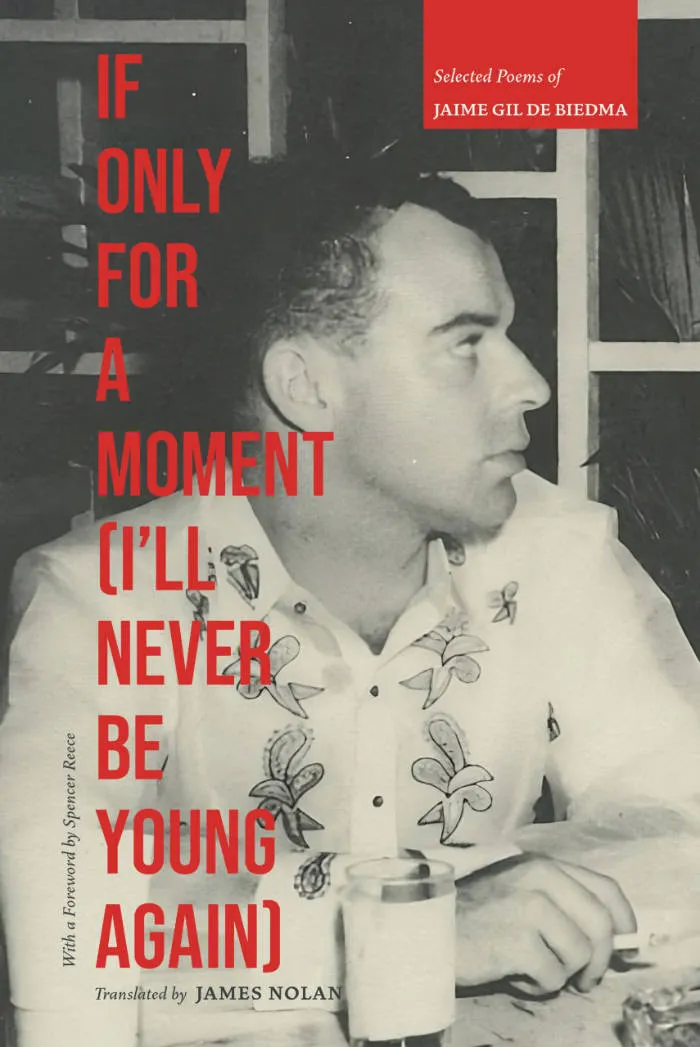
If Only For a Moment (I’ll Never Be Young Again)
Jaime Gil de Biedma, James Nolan
Jaime Gil de Biedma is the most original and influential among the poets known as the ‘50’s Generation in Spain, and is considered the greatest Spanish poet to emerge in the second half of the 20th century. His life and literary career were bracketed almost entirely by the rise and fall of Generalissimo Francisco Franco, notorious for the suppression of literature. Born in 1929, Gil de Biedma was six years old when García Lorca was murdered in Granada at the outbreak of the Civil War, and his collected poems, Las personas del verbo, first appeared in 1975, the year Franco died. What is surprising is that Gil de Biedma was a leftist, homosexual poet from the Catalan capitol, Barcelona – all of Franco’s favorite things – who not only published books of autobiographical poetry in Spain but was known as a poet of social conscience as well as erotic lyricism. Like other Spanish poets of his time, he chose his words carefully. Gil de Biedma died of AIDS in 1990.
If Only For a Moment (I’ll Never Be Young Again) consists of an extensive bilingual selection of Gil de Biedma’s poetry, including all of his most well-known work. The book additionally consists of a Foreword by Spencer Reece, Jaime Gil de Biedma’s short essay “I wanted to be the poem,” and two different essays on Gil de Biedma and the art of translation by James Nolan, the volume’s translator.

Palestine is everywhere
‘Palestine is everywhere because it names a political subject of radical universal emancipation,’ writes teacher and writer Nasser Abourahme. In Palestine is everywhere, writers, thinkers, poets and artists map the Palestinian struggle for freedom and its global resonances.
Vital dispatches from Gaza, essays, poems, protest chronicles, images and letters from prison reflect upon resistance, solidarity and the right to self-determination. Amid a world-historical moment marked by unknowability and loss, this collection offers essential reading for those interested in Palestinian liberation.
This collection is edited by Skye Arundhati Thomas, with contributions from Alaa Abd El-Fattah, Nasser Abourahme, Amal Al-Nakhala, Muhammad Al-Zaqzouq, Maisara Baroud, Ahmed Bassiouny, Houria Bouteldja, Anees Ghanima, Sahar Khalifeh, Laleh Khalili, Lujayn, Mira Mattar, Lina Meruane, Mohammed Mhawish, Nahil Mohana, Rahul Rao, Nasser Rabah, Adam Rouhana, Ahmad Zaghmouri.
Co-published by TBA21.
All royalties from this project will be donated to Medical Aid for Palestinians (MAP) and The Arab Group for the Protection of Nature (APN).

The Infinite Now
In The Infinite Now, Taras Gembik crafts an intimate meditation on solitude, faith, and the search for meaning, ten years in the making. Moving between Ukraine and Poland, these twenty-five poems trace a decade-long journey of self-discovery.
Through stark winter evenings and quiet conversations, Gembik's verses explore ancient and universal questions of existence and identity: the nature of God, the comfort of walls and communion with others, the circular path of memory. The collection transforms everyday moments into profound reflections on love, displacement, how to build community, and the possibility of finding home in transience.
Taras Gembik (born Kamin-Kashyrskyi, 1996, lives in Warsaw, Poland) is a poet, curator, performer, and activist. He is the curator of the public programme at Zachęta National Gallery of Warsaw, where in 2024 he also curated, together with Joanna Kordjak, Siergiej Parajanov's retrospective. Since 2018, he has worked with the Museum of Modern Art in Warsaw to provide a platform for refugees and those afflicted by the homelessness crisis. After Russia's invasion of Ukraine in 2022, he co-created the Sunflower Solidarity Community Centre, praised in an extensive profile in Frieze Magazine, as part of a dossier on "Forms of Resistance".

This Household of Earthly Nature: An Essay: A Year, a Life, a Country, a Global Network
In This Household of Earthly Nature poet and poetic essayist Cody-Rose Clevidence delves into the far reaches of our planet, from homestead to information theory, from ancient history to global economics to possible futures, connecting all things; Walmart, shipping lanes, what it means to have family, friends and memories, to labor, love, to ways of knowing, and all of us together inside these vast and shifting networks. Rooted firmly in the Anthropocene, in the fragmented and information-dense internet-connected world and also in their own rural daily life, this essay-poem charts a mind grappling with what it means to be alive now, in this particular time in our planet's and our species' evolution, from the domestication of the first grain to whatever is inevitably coming next.

Aunonomic Reasoning
Precipitous philosophies. Synaptic-nerve narrations. Syntactic spirals. Hyper-coiled horizons. Will Alexander’s mental range has arrived. An anomalous scripting of the word “automatic,” Aunonomic Reasoning is a whirlwind of lingual torrents triggered by creative mishearing that at once exposes the occupations of orthodox surrealism, summons a voice for the scathed populace of imperial affliction, and forges new paths of phonetic potentiality to mend semantic injury. Pushing prosaic margins beyond their boundaries, these texts take on the etymological condition of the essay as “attempt” with iridescent siege, prepositional frenzy, paratactic provocation, noetic disreckoning, and a critical demand to dismantle: all of which signatures of Alexander’s unilateral poetic innovations.

Anatomy of a Refusal
Written after the Beirut Port Explosion on August 4, 2020, when 2,750 tonnes of ammonium nitrate exploded in the commercial and residential port of Beirut after years of warning and mismanagement, Anatomy of a Refusal drifts between lineated and prose poetry, creating a transitional space of mourning. Comprised of three sections, “Mutually Assured Destruction” confronts displacement; “Blast” erases and rescribes bureaucratic documents written about the explosion, and “Deterrence” “return[s] to the place of injury.”
Intertextually poetic, Sahar Khraibani writes in conversation with other writers and philosophers to question, “who owns my language?” and “What does it mean to be in / place?" And yet, between bureaucracy and philosophy, there are moments of intimacy, friendship coexisting in the shared space of the poem—between speaker and addressee, the body and the living world—where belonging carries the weight of grief.
—Blurb written by Clarise Reichley