Poetry
Poetry

All My Dead Jesters
All My Dead Jesters is an assembly of select poems previously published in de Vries’ first two English language collections—Dark Hour and I Failed to Swoon (Dostoyevsky Wannabe, 2018 and 2021 respectively). These old works have been lightly revised for republication, and are paired with poems drawn from a manuscript-in-process to institute an autotelic kaleidoscope of some ten years worth of work in verse.
De Vries’ poems are spare, terse and epigrammatical—a barroom Bashō—dedicated to the glimmer of a compact glance; the chance, glamour and negative capability of a passing thought; and the slow drip of liquid crystal as colours our present. All My Dead Jesters is a torch song for our ‘poor subjectivity,’ a slow dance with sour times, a ‘[steering] away from [the] gratuitous provocation’ that litters our contemporary outlook. ‘Her competence as a poet lies in her ability to translate visceral vulnerability’ for the page (The Kelvingrove Review / University of Glasgow), as she patchworks a heroic ‘poetry without [a] hero, a blanket leaving you colder somehow, [...] the map of a world we like to think we know’ [CA Conrad].

Help
Death-obsessed, disengaged and overinvested—the four long poems assembled in Steven Zultanski’s Help theatricalise morbid fascinations, self-protective impulses, and unfocused desire. Help is, at its core, a set of conversations; the result of games played between friends that were then transcribed, edited, and embellished. Participants were asked to talk about loss, the death of acquaintances, secret hiding places, mislaid time, and unmet demands. The resulting poems read like meandering scripts for unrealised plays; incidental excavations of persona and place.
Somewhat reminiscent of Linda Rosenkrantz’s Talk (1968) or Alice Notley’s transcription poems of the 1970s, in Help the poet pretends to be a recording device, and the poem an act of remembering. Zultanski’s writing is at once skeletal and overstuffed, dryly unsentimental and yet dripping with melodrama. Help foregrounds its own contradictions in a collection that is at once both extremely personal and distinctly artificial.
Help brilliantly extends Steven Zultanski’s current phase of writing—looser, more documentary, more situational. In setting up explicit objects of inquiry and conversation—love, death, childhood—the book shows that to know these things is to also know our friends and ourselves. Sustained by an orchestration of relation and memory (and thus reality), affect here is modular, the product of what happens when we transform things by talking about them. A careful and astute experiment in writing and living.
— Jennifer Soong

Tripwire 23 - Work/Anti-work
Work/Anti-work issue with writing by Nat Raha /. lisa minerva luxx /Ghayath Almadhoun, trans. Catherine Cobham / Jacqui Germain / Jazra Khaleed, trans. Peter Constantine / Finn Finneran / Cait O’Kane / Rebecca Kosick / Lara Durback Skye /Lotta Thießen / William Rowe / Danny Hayward / Rona Lorimer / Zoe Beloff / Jike Ayou, trans. Yě Yě / Miguel de Vallester, trans. Erasmo Pantoja / Lucas Martínez / ko ko thett / Hung Q. Tu / Raymond de Borja / etaïnn zwer, trans. Ilan A.L.S. Erikson Weisbrod / Annie Raab on Taylor Portela / Rachael Guynn Wilson on Lyn Hejinian / Will Rowe on Danny Hayward / Chloe Watlington on Joshua Clover.

Red Seed: Poems for Luno
Cruz Alejandra Lucas Juárez, Wendy Call and 1 more
Through a voice at once intimate and collective, Lucas Juárez expands the powerful presence of Tutunakú roots to open up territories and to interweave desirous bodies, dream relationships, and the memories of women ancestors. This beautiful translation by Wendy Call and Whitney DeVos, in a precious handmade edition, affirms the trilingual (Tutunakú, Spanish and English) as an ethical strategy of listening to and translating the world. Red Seed collects twelve poems of women's sexualities and spirits in which body, language and territory are political spaces that Indigenous memory expands within and renews.
—Maricela Guerrero, author of The Dream of Every Cell

Biography of a Fiction
Biography of a Fiction collects poems written between 2020 to 2025. These poems were written in a diaristic way, mostly in short form, while working on larger pieces, some of which also collected here or elsewhere. What started, seemingly, as notes on reproductive desire, gender, and sexuality soon matured into a meditation on the role of fiction in the exercise of writing (and idealizing) a biography, including the thorny aspect of artistic license and the uses of one’s own life and of others.

touxs mes queers sont des poéte·sses
Car archiver nos écrits et nos paroles n'a jamais été aussi important, car il faut rendre compte de nos existences, de ce moment, pour nous et pour les futurs queers en recherche de repères oui, nous avons écrit, donc oui vous pourrez écrire aussi ! oui, nous avons existé, donc oui, vous existerez aussi ! car oui, nous sommes toustes poéte·sses ! car nos vies sont des poèmes et être queer est de la poésie car touxs mes queers sont des poéte·sses!
Because preserving our writings and our words has never been more important, because we must bear witness to our lives, to this moment, for ourselves and for future queers in search of guidance yes, we have written, so yes, you can write too! yes, we have existed, so yes, you will exist too! because yes, we are all poets! because our lives are poems and being queer is poetry because all my queers are poets!
CUNY Center for the Humanities
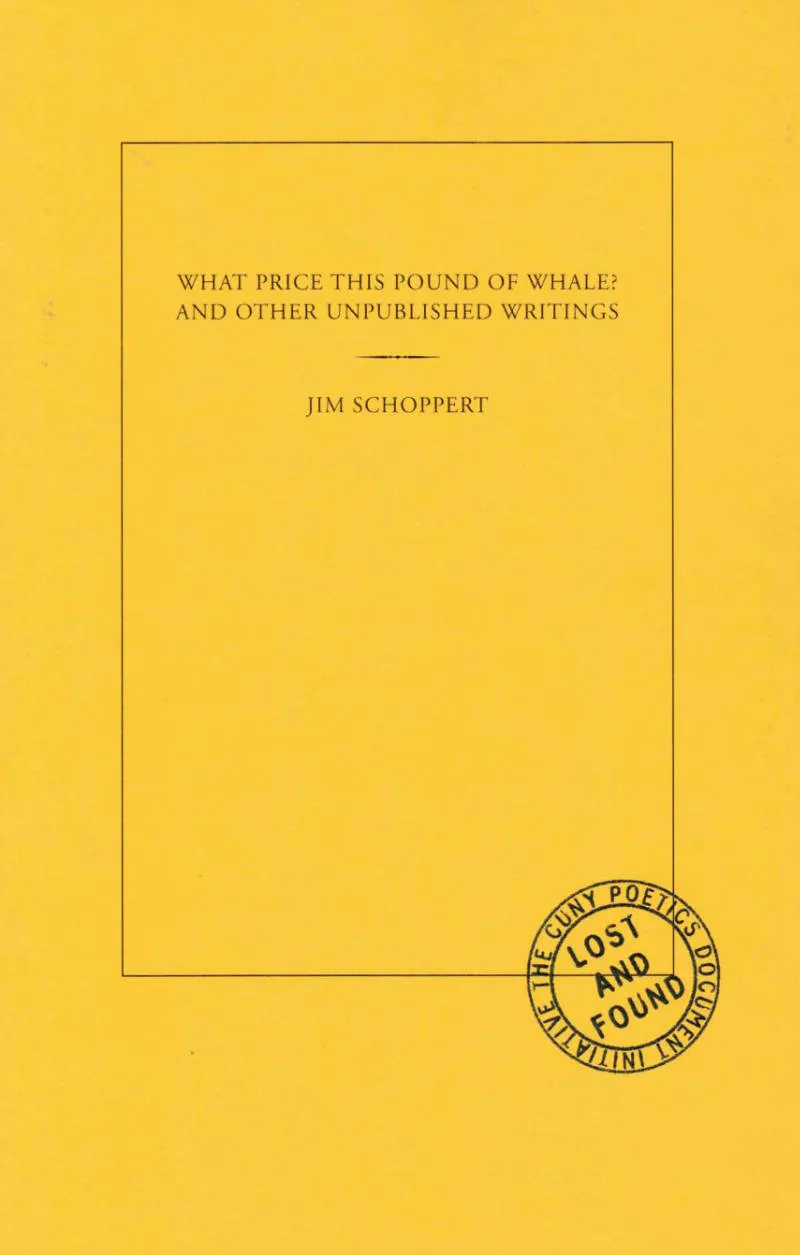
What Price This Pound of Whale? and Other Unpublished Writings
The Tlingit artist Jim Schoppert (1947-1992) was among the most accomplished, innovative, and prolific Alaska Native artists of the twentieth century. His whimsical sculptures and large scale painted wooden carvings reconfigure Tlingit visual motifs, and he challenged the binary categories against which Indigenous artists are so often defined, such as traditional and contemporary, historic and innovative, and artist or craftsperson. While known primarily for his modernist interventions in Tlingit visual traditions, Schoppert was also a prolific writer, an eloquent speaker, and an ardent advocate for Alaska Native artists. This publication brings together a selection of his unpublished poetry and writings from the artist’s personal papers. Presented alongside never before seen sketches and studies, this selection bridges Schoppert’s written and artistic practices in a deeply personal portrait of the artist and Alaska Native life that upsets preconceptions about Native art and unsettles the established narrative of Euro-American and Indigenous aesthetic relations.
Jim Schoppert (1947-1992) was a Tlingit multidisciplinary artist and writer. He was a Taku Tlingit Raven of the Ishkahittaan (Inland Frog) clan from his Tlingit mother and half-German from his father and carried the Łingit name Dom-Yetz. Born in Juneau, Alaska, he earned a BFA in Sculpture and Printmaking from the University of Alaska—Anchorage and an MFA from the University of Washington. In addition to his artistic career, Schoppert was instrumental in promoting Alaska Native arts and organizations. He was Director of Arts and Crafts at the Cook Inlet Native Association, Director of the Alaska Arts in Prisons Program for the University of Alaska Juneau, and organized exhibitions and workshops across Alaska and the Pacific Northwest. He was visiting professor in visual art at the University of Alaska, Fairbanks and directed its Native Art Center. He sat on the Washington State Arts Commission and on the boards of the Alaska State Council on the Arts and the Institute of Alaska Native Arts. His work is held in public and private collections across the United States, including the Smithsonian National Museum of the American Indian, the Anchorage Museum, the Heard Museum, and the Newark Museum, among others. His writing and poetry has appeared in The Greenfield Review and Journal of Alaska Native Arts, among other publications.

Blood On The Tracks
John Joe Kane, Vladimir Nahitchevansky
Blood On The Tracks is an elaboration and cacophony of manic friendship, eroticism and poetic play. Writing into the lyrical text of Bob Dylan's 1975 Album of the same title, the two authors take inspiration from Raymond Roussel's generative mode of translation, and quickly transform the lyrics of Blood On The Tracks into a variety of languages, to then translate these lyrics back into the English text present in the book. The result is a complicated and combative free wheeling text that explores the possibility of co-authorship, and interpretive translation. Featuring a forward by confirmed tramp, filmmaker and photographer Bill Daniel.

God Is a Bitch Too
María Paz Guerrero, Camilo Roldán
God Is a Bitch Too is the accelerated and acidic English-language debut of Colombian poet María Paz Guerrero. In this chapbook, god is needy, Latin American, and an overweight woman. No one asks god to dance. Someone speaks, someone tries: “One is the measure of their body.”
God Is a Bitch Too is #13 in the Señal series for contemporary Latin American poetry in bilingual editions.

Firespitter
Like the jazz rhythms that inspired and punctuated her practice, Jayne Cortez improvised her way through and across disciplines, bridging poetry and performance with music and the visual arts to create a unique body of work. Consciously rupturing the boundaries between art and politics, Cortez’s practice uneasily fits within literary movements of the 20th century, residing everywhere and nowhere between the Black Arts Movement, Surrealism, feminism, and early performance art. As intersectional as it is interdisciplinary, her work is consistently visceral and fearless, acting as a powerful expression of collective rage on behalf of the disenfranchised and dispossessed. In the words of historian Robin D.G. Kelley, “her poetry was never ‘protest’ but a complete revolt, a clarion call for a new way of life.”
The appearance of Firespitter (Nightboat, 2025), a 600-page-plus collected poems, is immensely valuable and long overdue . . . Hers [Jayne Cortez’s] is a voice—both on and off the page—that speaks with authority, curiosity, and an unshakeable faith in the power of poetry to change consciousness and change lives. - David Grundy, Poetry Foundation

The World After Rain
In her signature epic vision, Canisia Lubrin distils a radiant elegy for her mother along an interwoven and unresolvable axis of astonishment, belonging as much to history as to today. Grief, tender and searing, is the channel through which the poet refracts the realm of contemporary life to reveal the paradox of its private and public entanglements. This is poetry of haunting gravity and resonance, with meditations on love, time, and loss, at once meticulously far-seeing, interior and inexpressible.
‘How incandescent the language is, each line emitting light through the membrane of time and anticipated grief. The work has a rigorousness, the poet pushing through the ache of experience from the first to the last word.’ – Dionne Brand

Tendrils: Ecopoetics of Community and Justice
Tendrils threads through grief, joy and solidarity toward futures shaped by collaboration and care. Reaching through ecological crises, these poems seek new ways of living kinship in the more-than-human world.
This anthology gathers international voices that entangle, illuminate and resist: a collective turn to the future with renewal and possibility.
Edited and introduced by fieldnotes collective: Pratyusha, Jessica J. Lee, Alycia Pirmohamed and Nina Mingya Powles.
With contributions by Shasta Hanif Ali, Hala Alyan, Hana Pera Aoake, Polly Atkin, Kara Barlow, Khairani Barokka, Kat Benedict, Ahimsa Timoteo Bodhrán, Corinna Board, Jody Chan, Supriya Kaur Dhaliwal, Kerri ní Dochartaigh, Carlina Duan, Chloe Elliott, Zoë Fay-Stindt, Sophie Hoyle, Petero Kalulé (petals), Bhanu Kapil, Jayant Kashyap, Maija Makela, Lola Olufemi, Carl Phillips, Nat Raha, Shumin Tan, Dženana Vucic and Alice Willitts.

This Poor Book
For decades, Fanny Howe has been the great poet of spirit and conscience, dislocation and bewilderment. In This Poor Book, completed just before her death, she assembled a selection of her writing from the last thirty years into a single, astonishing work.
Fanny Howe is a titan. Absolutely nobody writes like her. Nobody sounds like her. This Poor Book is a miracle she left for us. —Kaveh Akbar
This Poor Book is revelatory and casts Howe’s poetry in a new light, and for those who don’t know her work already, this is a perfect introduction. Fanny Howe is an essential poet. —Rae Armantrout
Fanny Howe spoke about “the difficulty of reconciling multiple registers of consciousness and language. Soul and sticky atoms.” In This Poor Book she delineates and shifts between these layers to conjure a bewildering yet ultimately galvanizing evocation of the human psyche. We are being warned every day that robots and software will soon replace us. Howe’s poetry makes clear that such a notion is based upon a very limited conception of what it is to be a human. We are complex. We are mysterious. We don’t make sense. We do make sense. You will lose and you will find yourself in her words. — Claire-Louise Bennett
This Poor Book is a testament to Fanny Howe’s life and writing. In it, she wields her powers of perception for a long poem that turns inward on the self and out at the world and in every other direction the poet can imagine with lines that speak directly and always suggest more than they say: “There is a little trouble in my eye.” The irony and beauty of its final line—“There was no more reason to die”—will be with me for as long as my memory of Fanny Howe herself. — Jericho Brown
In her final act of literary alchemy, Fanny Howe gathers the scattered constellations of her astonishing life work and forges them into a single unwavering spiritual reckoning. At the dynamic center of the poem, a live beating heart moves through a fractured world—haunted by power, estranged from institutions, yet fiercely open to mystery. There’s a radical humility here, paired with a radiant understanding—that doubt can be a form of faith, and that hope, when unflinching, is the most defiant music of all. This Poor Book is for the ages. — Peter Gizzi
This Poor Book is an astonishing document by an irreplaceable poet. A palimpsest of decades’ worth of writing, assembled here into a long poem as fractured and multitudinous as life itself, Fanny Howe’s last work captures the brutality and beauty of the modern world better than almost anything else I’ve read: “The structure failed to cohere at the end of the struggle. / It had some music in it.” — Maggie Millner
Through Fanny Howe's eyes we look at life differently. She makes us understand that we are part of a mysterious and complex world; one which we urgently need to be receptive to. Beauty appears in unexpectedness, as in “flowers attract scissors” and “why does an eye evolve in the dark?” Who else could turn things upside down with such a sleight of hand? This Poor Book reads like the testament of a newly discovered life-form, offering vital messages from the past and into the future. — Celia Paul
At once evocative and subtly incisive Howe’s writing seems almost like a new language, a language that has been in hiding. She can make the familiar haunting and the ordinary a provocation. — Adam Phillips
This gorgeous final statement by one of our most perceptual writers is a work of accrued understanding. ... Fanny Howe leaves us with profound investigations into the capacity of words, of juxtaposition, what a line, a page, and a book can give. — Sarah Schulman

This Reasonable Habit
Rainer Diana Hamilton, Violet Spurlock
Violet and Rainer, over the course of a long phone call, become hosts of an imaginary literary summit where attendees spar over casualwear, animal metaphors, fascist art, bodily autonomy, and other problems of the everyday. A collaborative work of friendship as much as the occasion for philosophical scholarship, where one can find the answers to burning questions like: What makes sex good? What constitutes a good reason to dislike someone? What does my nipple piercing mean for your nipples? And how have you been, lately?

The Hungering Years
Utterly magnetic, Summer Farah’s debut poetry collection The Hungering Years is a rush of breathless song, voicing confessions so often left unsung amidst personal and collective crisis. “I am afraid of asking the right questions,” Farah admits. But through intimate conversations with fellow Arab-American writer and literary ancestor Etel Adnan, this work finds the courage to ask: What is art? An escape? A reflection? Another unhealthy attachment? Though the answers are elusive, what steps into the light is a collective of friends whose genuine care and companionship anchor these poems through their spiraling search.
“I am always looking for Palestine, and yes, I am always looking for love,” these poems croon, holding so much of the world even as they trace an inheritance of displacement. The Hungering Years conjures startling landscapes where we may also experience what it is to be consumed by obsession, echoing with songs by Mitski, iconic scenes from Supernatural, and the sound of the Mediterranean Sea. But as Lena Khalaf Tuffaha writes in her introduction, Farah’s repetitions “are more than echo. They are a vernacular of this unspeakable era,” anchored in “questions that keep us reaching toward life,” and questions toward each other.
Building glass structures from her questions, Farah pushes their architecture almost to breaking. Then breaking, the spirit—luminous, actualized—reveals itself through the cracks. Through the landscapes of California, Palestine, and all of the distances in between, there emerges a new sense of devotion to what is possible which might thrust us, together, “off the edge, / in love, towards God.”
With an introduction by poet, essayist, and translator Lena Khalaf Tuffaha.
Summer Farah’s debut collection The Hungering Years bubbles with language, is desirous, sensitive, and hysterically (ferociously) human. “I” is I, is mother, is the guiding wisdom of Etel Adnan, is Palestine, is the work that writes Palestine into the future, is the epistolary thread of love that holds this daring young poet’s work together. “i am an enemy of dust i am an amalgamation of everyone i have ever loved …” writes Farah, enlisting us in this vital poetry against the death cult, lush with solidarity, teeming with the futurity we need. — Wendy Xu, author of The Past
What I most adore about Summer Farah's work, and what most comes alive in The Hungering Years is that there is no such thing as an unworthy affection, nothing unworthy of close and careful attention, nothing unworthy of being pressed up against the undeserving world and becoming something greater. This is a gift and a delight, and through that gift, these poems are richly and generously populated, and teeming with beauty. — Hanif Abdurraqib, author of There’s Always This Year
Summer Farah's words ease me, compel me, motivate me. Her work is agile and brilliant, her mind potent and illustrious—like air, a song, rhythmic and concise. These poems move me to my core, rupturing something deep inside of me about place, Palestine and Etel Adnan. "I memorize no language/but their voices," she writes as I memorize her words again and again, uttering gratitude that I get to be alive and read Summer's words. This book is both a spell and an oracle. — Fariha Róisín, author of Survival Takes a Wild Imagination

Tis of Thee
With figures X, Y, and Z, Fanny Howe constructs "a repressed but emotional history" of encounters and unions between races, classes, genders, and epochs. Considering race as "the most random quality assigned to a soul," Howe has undertaken an (American) history of a racially mixed population. The work bears evidence to many creative unions as well: with Ben Watkins, who provided the photographs; with graphic artist Maceo Senna, who illustrated the text; with Nya Patrinos, set designer, video artist, and director of the original production; as well as with composers Miles Anderson and Erica Sharp, whose score adds another voice to the spoken three. The book includes a link to an audio recording of the work, originally performed at the Porter Troupe gallery in San Diego, 1997, with Paul Miles (X), Stephanie French (Y), and Andre Canty (Z). "So whiteness is what is dependent on a witness. / The moon's opaque and egg-like sheen is the kind of zero / that wants to be more than air and negativity."

Negativity
Jocelyn Saidenberg's third book of poetry begins in a "dusky" wood, but instead of descending to hell she journeys through the negativity of earthly relations. We hear of friends, lovers, and a declining country—all filtered by a consciousness equally troubled by its own suffering and the suffering of others. Saidenberg has written some of the most accomplished, grounded and reflective poetry of the last decade. She is previously the author of CUSP (2001) and MORTAL CITY (1998), and the founder and publisher of Krupskaya Books.

Gardener of Stars
Carla Harryman describes GARDENER OF STARS as "an experimental novel that explores the paradise and wastelands of utopian desire." The book offers a mythic history of a post-historical city situated in a garden landscape whose inhabitants are engaged in perpetual tending, limitless generation. Their generatings and tendings take place in speculation and dream, practical and impractical invention, desire and copious sex - all facets of a politicized eros and an erotic politics. The utopia in question ("the unruly utopia of the senses that is not in conflict with the world's current") must be understood first not in terms of place but in terms of personage. M, Serena, Gardener (the eponymous heroine of the novel) are themselves utopias (as distinct from utopians) surviving in a painfully fraught (though sometimes beautiful) milieu. Negotiating this milieu, the various characters come into contact (or, more precisely, throw themselves into contact) with events that are in a ceaseless process.

Of · The · Abyss
A sequence of ten poems; in separated continuance, an outcry that ventriloquises and manifests languages of exclusion and yet with dogged persistence protests them.
“Oh strike the light, float the boat, for sake of common peril they are fallen away as gathered up in sight of lamentable in- difference and will go down against us”.

Faux Ice
James Goodwin’s Faux Ice contains six poems: ‘Roman Street Sweeper’, ‘Technomarine’, ‘Meridian Walk’, ‘Astroturf’, ‘Star Bright Ice’, and ‘Faux Ice, or The Same as Fantasy?’ Goodwin writes:
“A constrained economy of expression is the formative approach I’ve taken with these poems. I was motivated, in my early attempts, to reproduce, as a crystallised element of black lyric expressivity, the condensed form of the grime lyric, and its invocations of blackness as a poetic description of being immersed in and by indistinction. Or aspects of the black life of poetry which do not derive their origins, causes, or relations from communicative modes of clarification in language. And so the poems in Faux Ice are oblique expressions and articulations of the ways reality is refracted by [the] questions of what is real, informing, say, the experience of seeing without being seen on the one hand and having no others on the other.”
Inheriting from eskibeat and drill and from other sources of experimental Black sociopoetics, these poems, with their dispersed and insistently plural voices, aren’t interested in building up, but in dismantling a stable subject, their icy conditions always displaced and subject to change.
“shot of this glean of jewel with the
force of a technomarine to
connect the more looks around the
pressure-encrusted, iced out skip and
lack of any protection”
JAMES GOODWIN is the author of Fleshed out For All the Corners of the Slip (the87press, 2021), and Aspects Caught in The Headspace We’re In: Composition for Friends (Face Press, 2020). He is currently completing a PhD at Birkbeck College, University of London.

Strange Biology
Strange Biology, Charlotte Strange’s first chapbook, opens with a social media advertisement marketing a probiotic as an alternative to the “nuclear bomb” of antibacterial acne medication. As Strange investigates the treatment of the human body as a landscape submissive to medical intervention, they ruminate on the contemporary relationship between microbes, gut-directed medical technologies, and capitalism’s encroachment on life. Drawing on the vernacular of social media marketing, they deftly oscillate between instructive and personal registers, stretching the private across a nexus of microbial interminglings. Strange Biology reflects on the semiotic science of the gut: how the language of medicine defines the mutating edges of the human body.

SIN BUG
A new book by poet-activist CAConrad combining essay, memoir and (Soma)tic poetry rituals. Documenting the pervasive homophobic violence of the 1980s and the overwhelming losses of AIDS, this work is an unwavering testament to queer resilience. CA’s text forms a resounding incantation to friends and lovers lost. SIN BUG is the first book published as part of the Open Narratives series.
he wrote “I have AIDS
and kissed this wall”
X marked the spot
I wrote “I’m not afraid”
and kissed him back
wherever he is
CAConrad has been writing poems for more than 50 years and working with (Soma)tic poetry rituals for over 20 years. Their latest book is Listen to the Golden Boomerang Return (Wave Books / UK Penguin 2024). The Book of Frank is available in 9 different languages, most recently French and Italian. They also exhibit poems as sculpture with recent shows in London, Melbourne, Porto, Santander, and Tucson. Please visit them online at CAConrad.com.

The Consequences
The Consequences is a hybrid collection of prose and poetry; an autofictional examination of the pain of a transatlantic relocation from New York to the blanketing beige of Paris to rejoin a totemic muse. It also focuses on corgi attacks, Maryland, painful anxiety, the struggle to accept the things one cannot change, the third party and the past as adamantine shackles. The "towering sexual iconography of Mike Immerman" looms over the disorientation of a reluctant resident in “the City of Light.”

Paces the Cage
S*an D. Henry-Smith’s second full-length book of poems, PACES THE CAGE, lifts off from their previous book, Wild Peach (2020), by expanding an already-queered language to near breaking point. Through the complexities of Henry-Smith’s personal experiences and the use of a poetically fragmented voice, the literal and metaphorical are here remixed in real time. Henry-Smith’s occasional inclusion of ambient sounds and a musical language and tone used throughout the book helps to build a rich auditory landscape that enhances the immersive quality of the poems, creating a deep and evocative collection by this adventurous and endlessly exciting artist. As if it were an improvised performance itself, PACES THE CAGE actively tunes personal and historical narratives of oppression and adversity with the act of speaking, and what it means to be truly heard by a community of one’s fellow creators and collaborators.
PACES THE CAGE extends S*an D. Henry-Smith’s interdisciplinary, improvisational listening into a poetics of “fissure and measure,” where silence and the sonic converge in boundless motion. Tuning language toward the frequencies of breath, pulse, and sociality, Henry-Smith's poems transport us from natural worlds to communal forms to Bill Gunn’s STOP, recovering wayward images and utterances to compose a surround sound of loss and renewal. What emerges is both reckoning and remedy—a lush sensitivity to the ways language becomes live, as in now, as in “eyes open, full of rage.”
S*an D. Henry-Smith’s reverberant propositions seek the music of mutual renewal, constantly and impatiently approaching the present. This is a field of spiraling, alliterative song, the wild signature of Henry-Smith’s lyric, that renews commitments to militancy by naming and knowing its enemies as doubtlessly as it names and knows it lovers. PACES THE CAGE considers a set of conditions—technical, material phenomena—that produce collective and contradictory imaginations and gives words to the song that makes the gathering last, “all in for all…” PACES THE CAGE is a beautiful rehearsal of attentiveness, a rigorous and generous correspondence with the edges of the frame.
– dove, Christine Kirubi
S*an's PACES THE CAGE recalls to me Akilah Oliver’s 2004 An Arriving Guard of Angels, Thusly Coming to Greet. A lyrical unleashing into the many selves, the author here plays conduit for many beautiful bodies; for those souls wandering at daybreak; for the pudgy greased cheeks and those that murmur in the dew of twilight uncloaked. It is as if the poet has extracted from the marsh, the runoff, roundup and peat to stockpile and make lush a new yet familiar world. S*an has created a collection of diamonds from the salty mines of turtle tears. The divorced defanged possessive absent its apostrophe, left to the mud puddle for butterfly nuptials throughout, tells the reader: How you know me Now will be Different from how you knew me. These buoyant poems that are S*an’s latest songs have not missed the train this time. Make certain that you don’t. I’m in awe.
–LaTasha N. Nevada Diggs
S*an D. Henry-Smith is a poet and photographer, working by extension in sound, performance, and publishing.