Drawing & Illustration
Drawing & Illustration

toi, moi, la pluie
toi, moi, la pluie is a sequence of cards that can be assembled into three-dimensional configurations. The cards present two sides of the same moment: rain falling outdoors, and an art exhibition taking place indoors.
With humour and a sense of casual abandon, Sara Graça reduces the exhibition space to a dry place offering shelter from the rain. Despite a moment of intense intimacy—a passionate kiss—the space is largely inhabited by figures who do not seem to know one another, or to get along. The same kiss takes place outdoors; lovers, after all, do not care about the weather. Drawn in a caricatural style, recalling Ad Reinhardt’s How to Look series, these characters speak English, French, and Portuguese. We cannot tell whether they are visiting or staying; we do not know where they are.
The cards are accompanied by a small cut-out horse that can also be assembled and added. A memory of a past life, a lingering presence, a sense of “other”, the horse becomes the final piece of the puzzle. It acts as an exclamation point to these otherwise trivial human exchanges—cutting across inside and outside, shelter and rain, intimacy, cohabitation, and distance.
The publication is disguised as a book, revealing its playful nature only once opened, and inviting the reader to assemble, rearrange, and make choices of their own.
Sara Graça (Lisbon, 1993) lives in London and works in interdisciplinary ways, mainly using sculpture, drawing, photography and video. Her practice often questions ideas of value, authenticity and impermanence.
All copies are numbered & signed.

La Maison des Maladies
Unica Zürn, Ruth Henry and 1 more
Unica Zürn dans La maison des maladies raconte, par un ensemble de textes et dessins, un séjour en hôpital où elle est soignée d’une jaunisse. Elle y écrit et compose ce carnet où le regard qu’elle pose sur son propre corps, les lieux qu’elle habite et les personnages qu’elle rencontre, témoigne d’une sensibilité hors-norme qui tire à la fantaisie, voire au délire.
Pour la première fois en France, La maison des maladies est publié intégralement.
Le texte est traduit de l’allemand par Ruth Henry & Robert Valençay. Un après-propos de Mathilde Girard clôture le livre.

Nest
Gregory Carlock, Christina Atik
“Ishtar said goodbye to the elephants, goodbye to the clowns, waved to a group of admirers who had gathered on East 43rd Street, and was ushered into a shiny new Escalade, which the NYPD reserved for such occasions. ‘I am the earth,’ she said, as the cops forced her head through the doorframe. The motorcade, fit for heads of state, went 40 down the West Side Highway, past rollerblading homosexuals and New School undergraduates, who held signs with slogans like ‘ISHTAR WE LOVE YOU!’ ‘ARREST ERESHKIGAL AND GILGAMESH,’ and ‘DOWN WITH CAPITALISM.’”
Nest is Gregory Carlock’s vision of Manhattan razed to the ground by Ishtar—Akkadian goddess of love, sex & war—following her liberation from NYPD arrest.
This poem, in 31 sections, combines the 4000-year-old Gilgamesh epic, pre-Islamic poetry, Sufi snippets & Carlock’s own Emily-Dickinsonesque rhymes to vent sulphurous @ New York/Washington’s rape’n plunder of Planetary Mind. Illustrated by the Lebanese artist, Christina Atik.

Abstract Coloring Book
A coloring book conceived as an artist book. Coumba Samba’s publication prompts you to explore geometric forms and structures with a small set of colored pencils. Using those simple materials one realises how interaction and experimentation challenge again and again the relationship between color, abstraction and internalised form systems.
Published in connection with the exhibitions deutschland at Kunstverein in Hamburg and Coumba Samba at MauMaus in Lisbon.

Person with the last name Universe
This book has been self-published for Latvian artist and poet Jelena Glazova's solo exhibition “Person with the last name Universe” at Riga contemporary art space (July - August 2026). The exhibition is the artist’s act of feminist guerrilla resistance within the symbolic territory of contemporary phallocracy. The source and central figure of the post-gender universe conjured by Glazova is the Person with the last name Universe, whose creative strategy the artist unpretentiously calls Glazovism.
Jelena Glazova (Belgium/Latvia) is a poet and multimedia artist who combines visual elements, experimental sound, installation and poetic text in her projects. As an artist, she has participated in international festivals and projects in Latvia, Estonia, Lithuania, Sweden, Austria, Belgium, Germany, the Netherlands, Turkey and other countries. Among the most notable exhibitions are "Identification of a Woman" at the Latvian Museum of Photography (2010) and "Elements of a Puzzle" at the Latvian Centre for Contemporary Art (2011). She is the author of four poetry collections. Glazova's poetry has been translated into 12 languages. Since 2012, she has given more than 200 performances in 18 countries. She is the co-founder of two poetry festivals in Riga: "Blood of a Poet" (2014–2016) and "Poetry without Borders" (2017–2022). https://www.jelena-glazova.com/
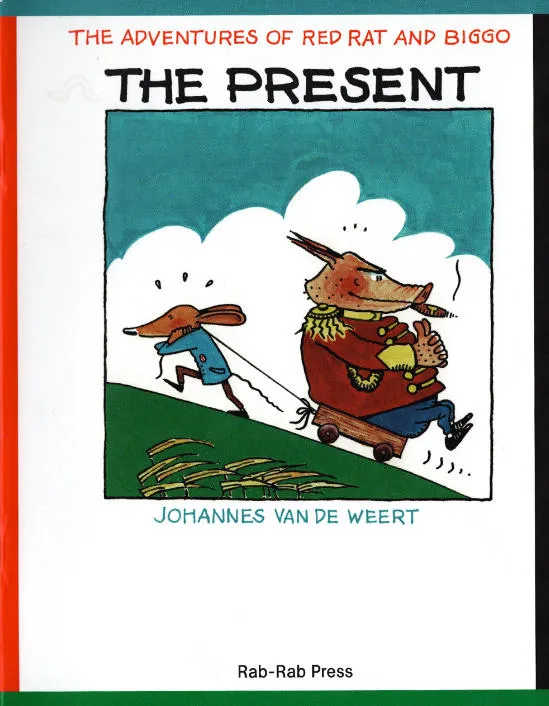
The Adventures of Red Rat and BIGGO – The Present
A children's book by Johannes van de Weert, a veteran of the punk underground (Rondos, The Ex, Red Rat, Raket).
The Adventures of Red Rat and BIGGO – The Present is a remake of Bram konijn en Piet de muis [Bram the Rabbit and Piet the Mouse], a 1982 children's book by Johannes van de Weert, a veteran of the Dutch punk underground who played with Rondos and The Ex, and who was the force behind Red Rat and Raket editions.
The Present is a 2010 remake telling the story of a bully pig who terrifies a poor rat on a daily basis. After a while, the rat falls ill with fear and has to stay in bed. The lonely, evil pig has no one to play with and becomes depressed. The pig gives the rat a present—a bunch of beautiful flowers—and all is well. Now the two can play together.
The 2010 remake, featuring different characters and intended for a North Korean audience, was never published. The 2025 English version opens with an introduction by Van de Weert, telling a bizarre story of a failed political career and an absurd vaudeville class struggle behind the seemingly harmless educational children's book.
Johannes van de Weert was a cartoonist active in the Rotterdam punk and squatter's movements of the 1980s. He was a singer with the punk band De Rondos and he started self-publishing small comic booklets in the late 1970s. He created his character "Redrat" for the fanzine Raket in 1980. The character soon became an icon for the squatter's movement.

Twenty Bookmarks
Twenty Bookmarks is a result of Production & Workflow class of Graphic Design Department at the Royal Academy of Fine Arts Antwerp, Ba1 Class of 2026.

Wanderlust
Soufiane Ababri's sketchbooks.
Soufiane Ababri (b. 1985, Rabat) is a Moroccan artist based in France. His protean work (drawings, installations, performances) explores questions of gender, homosexuality, racism and colonialism.

Carroll Dunham: Drawing Sculpture
Drawing has long been foundational to American painter Carroll Dunham's (born 1949) practice. In this collection of recent, never-before-shown works, we witness Dunham thinking about sculpture through a series of drawings produced over the course of a year. A sampling of his drawings across time offers a chart of his artistic evolution; the 80 drawings presented here are distinctive to a new page within that history. Spurred by a desire to explore the saggy, open-frame cubic boxes that he found himself doodling along the edges of a new series of paintings, Dunham began drawing fantasies of sculpture as a respite whenever he needed a break from working on the paintings. This turned into an ongoing practice that lasted until it unexpectedly segued into a material investigation with the making of sculpture in real space. Offering intimate access to Dunham's process, this book is the first to document his thinking about spatial relationships, presentation and materials for sculptures that don't exist.
Carroll Dunham has developed an extensive oeuvre since the late 1970s in painting, drawing, and printmaking. His work has been the subject of numerous solo exhibitions, most recently a drawing retrospective at the Art Institute of Chicago (2026), and presented in group exhibitions at institutions in the United States and abroad. He lives and works in Connecticut.

Friends and Family
This first monograph includes all of Van der Stokker's murals and most of her drawings.
In an interview in this collection of Van der Stokker's wall paintings and drawings, John Waters says, 'Millions of teenage girls have drawings that are good, but no one ever tells them that they are'. Van der Stokker celebrates teenage girlishness, and has since 1983 found both immense support and immense rejection within the art world community. Includes interviews with Van der Stokker and a complete presentation of her works in situ, printed on full-page spreads on quality mat paper.
Dutch-born van der Stokker (1954, Hertogenbosch), active artist-gallery owner on the East Side of New York in the 80's, now lives between Amsterdam and New York. She developed pictorial murals with happy candy-coated slogans that incited acid sarcasm from her contemporaries.
Texts by Anne Pontégnie, Éric Troncy, John Waters/Charles Esche, Mirjam Westen, Amy Kellner.

The Complete C Comics
In the mid-1960s, legendary artist and writer Joe Brainard (I Remember) teamed with poets such as John Ashbery, Frank O’Hara, Barbara Guest, Ron Padgett, Kenneth Koch, Ted Berrigan, and many more for these pioneering collaborative comic strips—unavailable for decades and collected here for the first time.
“PEOPLE OF THE WORLD… RELAX!”
In the creative hotbed of 1960s New York, Joe Brainard was a whirlwind. He was a maker of paintings, assemblages, collages, book covers, poetry-reading flyers, and more. But some of his most exciting work was done with his friends. In 1964, the twenty-two-year-old Brainard turned his talents to rewiring the lowly comic book form into something new and surprising. He invited his friends Frank O’Hara, Ted Berrigan, John Ashbery, Kenneth Koch, Peter Schjeldahl, Barbara Guest, Ron Padgett, and others—all of them New York School poets—to collaborate with him on comics that they would write and he would draw.
The results were unlike any comics seen before. Previously available only on the rare-book market (at very high prices) but available here under one cover for the first time, the two issues of C Comics still feel as fresh as when the first page rolled off the mimeograph machine more than sixty years ago. Brainard’s energetic line and joyful humor charge across every page, illustrating O’Hara’s recasting of a cowboy as a mash-note-writing lover, Padgett’s experiments with traditional cartoon sound effects (ROAR! GRRR! SKREE!), cameos by Ernie Bushmiller’s Nancy, and heaps of Dadaesque delights.
This edition includes a foreword from Padgett and an essay by comics historian Bill Kartalopolous, who details the creation (and creators) of C Comics. A masterpiece of collaboration and spontaneity, C Comics is a testament to the vastness of Brainard’s creativity and his ability to push any artistic form in a new and powerful direction.
Foreword by Ron Padgett
Contributions by Bill Kartalopoulos

Green Agents in Time
The 71 storyboards in this publication are the result of a collaborative process between G.C. Heemskerk and Bernice Nauta, and function as the foundation for their short film The Plantiarchy (2025). The project proposes a parallel reality in which the relation between plants and humans are drastically transformed. In this proposed universe, the plant is the protagonist: it playfully and critically tells a story of colonial expansion, botany, more-than-human eroticism and speculative plant-sentience, flipping the historicised script of control and dependency.
The Plantiarchy comprises a residency period at Hotel Maria Kapel (Hoorn, NL) and various exhibitions including Museum de Lakenhal (Leiden, NL), IKOB Museum (Eupen, BE) and Marres (Maastricht, NL), followed by the short film which premiered at Go Short (Nijmegen, NL) in 2025.
Introduction by Annosh Urbanke
Edited by Jan-Pieter ‘t Hart
Designed by Tjobo Kho with Lucas M. Franco & Vlad Omelianenko


L'Alpin chez lui
L’ Alpin Chez Lui - Les jolis jouets du Queyras présente une collection de jouets en bois artisanaux fabriqués dans les Alpes. Ces figurines naïves aux couleurs vives et aux contours découpés, montées sur un socle et conçues pour une main d’enfant, attirent le regard par leur graphisme épuré.
Depuis 1920, les Jouets du Queyras sont fabriqués à Arvieux, dans les Hautes-Alpes. Cet ouvrage, réalisé par Clémence Passot, retrace l’histoire et l’évolution de la coopérative ouvrière « L’Alpin chez Lui », offrant un témoignage unique sur la vie sociale et économique de la montagne.
Conception graphique et direction éditoriale: Magali Brueder & Clémence Passot

Real Estate Portfolio
Real Estate Portfolio by Claire Barrow
7 panel concertina + covers / total of 16 pages
9.6 × 14 cm folded / 98 cm extended
Riso 250gsm recycled offset exterior, litho 135gsm recycled offset interior
Glassine sleeve, digitally printed on the front & back
Self-published edition of 300, signed by the artist
Constructed in the UK (£0.016 per cm²)
The zine was drawn in one session using the right wrong hand.

Timothée Trouche, Marteau piqueur
Timothée Trouche, Marteau piqueur
Encre verte pour tableaux noirs. Vingt-sept poèmes de Timothée Trouche (maître d’hôtel et instituteur) compilés avec la complicité de Teddy Coste (groom et solitaire).

Abattre les arbres, boucher les fontaines, renverser les pierres
Abattre les arbres, boucher les fontaines, renverser les pierres réunit les 4 tomes d’un conte épisodique initialement paru en auto-édition tout au long de l’année 2021.
”Abattre les arbres, boucher les fontaines, renverser les pierres” sont les mots d’une archéologue s’exprimant à la radio au sujet des intentions des premiers chrétiens arrivant en Grande Bretagne. Cette formule a attendu de longues années dans mes notes avant de devenir un récit d’images.

Ungenießbare Zeichnungen
„Ungenießbare Zeichnungen“ is a series of visual traces by artist Shin Kudo. „Ungenießbar“ means „Unenjoyable“ in German, which is a term that is used to describe a certain category of fungi, considered not edible but also not poisonous. What is enjoyable and what is not? For whom should it be enjoyable? Spores, Blood vessels, nature energy, Alien….Shin Kudo’s intuitive drawing triggers our feelings between our daily world and the world that we often overlooked - The world full of life circling and endless streaming.
The book contains 24 drawings from the “∞” series and the spore print series “The Unknown Friends”, following with an interview conversation with the artist.

The Sniper in the Brain
Upside-down trees with roots reaching toward the cosmos, glasses, pitchers, transparent vessels, and bodies blending human and animal, male and female features populate Jacopo Pagin’s works. These figures reveal themselves in their decadent and symmetrical being, caught within a web of references centered on the evocative power of the gaze.
The first monograph dedicated to Jacopo Pagin, designed and edited by Ismaël Bennani and Orfée Grandhomme and featuring a critical contribution by Alessandra Franetovich, brings together over 200 drawings and paintings to explore the visionary, obsessive, and hypnotic qualities of the artist’s work and its profound connections with exotic, mediumistic, and new-age practices.
The book is co-published with Make Room, Los Angeles.

Mount Horeb Palestine
In 1962 at the age of 71, Joseph Elmer Yoakum (circa 1891–1972) reported having a dream that inspired him to draw. Thereafter the retired veteran began a daily practice and over the next 10 years produced some 2,000 works.
Yoakum was born into poverty, had very little schooling, and at an early age left home to join a circus. He wound up working with several circuses, traveling across the United States as well as abroad and becoming intimately familiar with the world's various landscapes. These experiences would provide the foundational memories that fueled his deeply spiritual vision decades later.
When he began to put that vision to paper in his apartment on Chicago's South Side in the early 1960s, Yoakum quickly developed a unique visual language, independent and distinct from other artists in the city, such as those involved in the flourishing Black Arts Movement or the up-and-coming Chicago Imagist group. His drawings—predominantly landscapes in ballpoint pen, colored pencil, pastel, and watercolor and inscribed with locations from all seven continents—reflect the scope of his national and international travels as well as his idiosyncratic and poetic vision of the natural world.

Pyre
Michael Cavuto, Astrid Terrazas
"From this moment / and hence backwards / a visitation / echoes thru the apparent opening / to the tomb / the narrow passage is the mind's reasoning / in clarity / as she moves like a shadow / having lived her life before " — Joanne Kyger, from Places to Go (Black Sparrow, 1970)
"All processes measured as form are traceable in curved decay. Seemingly unmeasurable, unquenchable, the heart stone harbors its own native entropy. The evolution of organs is not ours to decipher. We’re drawn slanting toward the stone in helices of approaching circles. Our movements throw shadows, our bodies ring haloes." — Michael Cavuto, "Isis Theses"
"In the dual work of Isis Theses & Pyre I-V, living, death, language’s work of remembrance, place & poetic lineage all take part in shifting throughlines of recombinant forms, as a spiral spirals back on itself, changed over time. Early on, here, Cavuto writes “There is not enough wood for coffins. There is wood enough for a boat.” a Pyre then is a boat, a burning that is going somewhere, not death-as-end but as an upward & outward movement into collectively shared air, an archeology of connection. “Kyger wrote that memory is a weird dimension carried around invisibly in the ‘mind’’ Cavuto writes, in one of those moments that feels like a key, “Writing, she said, gives history back to you.” But it is not only history that Cavuto is carrying forward in these poems, it is something more spatially complex, enlivened & embodied in the dance of the words, & in the vital breakdown of the words themselves. The poems in Pyre I-V enact their answer to the question ‘what essence is left us when no words are left,’ & leave us, after the ritual process, dazzled with the true sense that something is left, something important of resonance & remembrance, in the atomized language-space; the air around the dis-integrating morphemes shimmering on the page as dissipative, potentiate sparks. —Cody-Rose Clevidence
Michael Cavuto is a poet based in Brooklyn, New York. His books include Country Poems (Knife Fork Book, 2020) and Pyre (Spiral Editions, 2025). With the poets Dale Smith and Hoa Nguyen, he publishes the Slow Poetry in America Newsletter. Along with Tessa Bolsover, he publishes hand-bound poetry books through auric press.
Pyre, Michael Cavuto. Illustrations by Astrid Terrazas. 52p, 8.5" x 6.75", hand sewn with red linen thread. Covers letterpressed on a 1963 Vandercook proof press with Strathmore Premium Grandee paper. Copy text and illustrations printed both offset and digitally on Mohawk felt paper in a first edition of 275. Printed, assembled, and bound in “Kingston, New York,” the unceded and currently occupied lands of the Haudenosaunee, Mohican, Munsee Lenape, and Schaghticoke. With thanks to Vladimir Nahitchevansky and the various friends who helped assemble.

The Nightmare Sequence
An extraordinary collaboration by an award-winning duo—poet Omar Sakr and visual artist Safdar Ahmed–that bears witness to the genocide in Gaza.
The Nightmare Sequence is a searing response to the atrocities in Gaza and beyond since October 2023. Heartbreaking and humane, it is a necessary portrait of the violence committed by Israel and its Western allies. Through poetry and visual art, Omar Sakr and Safdar Ahmed capture these historic injustices, while also critiquing the role of art and media—including their own—in this time. Born of collective suffering and despair, their collaboration interrogates the position of witness: the terrible and helpless distance of vision, the impact of being exposed to violence of this scale on a daily basis, and what it means to live in a society that is actively participating in the catastrophic destruction of Arabs and Muslims overseas. With a foreword by Palestinian American poet George Abraham, this book will serve as a vital record in decades to come.

One Big Bang
One Big Bang brings together 78 charcoal and pastel drawings from Adel Abdessemed's recent series Nature Morte and Politics of Drawing, where everyday objects, animals, and flowers are subtly charged with tension. Through these works, Abdessemed explores the intersections of beauty, fragility, and unrest. With texts by Hélène Cixous and David Elliott, One Big Bang offers a thoughtful entry into an artist's visual language shaped by memory, myth, and political urgency.
Published following the eponymous exhibition at Projeckt Brussels in 2024.
Adel Abdessemed (born 1971 in Constantine, Algeria, lives and works in Paris and Berlin) deconstructs identity codes, tackling head-on the tensions that permeate our society. His works, with their typical simplicity—sculptural installations, drawings, photographs, videos and performances—echo precise facts and familiar situations, but go beyond narrative commentary and militant criticism. Adel Abdessemed questions, among other things, the social and economic status of the artist in a system where his foothold is slight, by shrewdly keeping a distance in a gesture of subversive and committed resignation.
Abdessemed refuses to be limited to a single ideology. In his early works he passionately tackled religious, sexual, and taboos subjects and his later exhibitions have often focused on the theme of global violence. In an interview with Elisabeth Lebovici he stated, "I do not live between two cultures. I am not a postcolonial artist. I am not working on the scar and am not mending anything. I am just a detector … In the public sphere, I use passion and rage. Nothing else. I don't do illusions."
Sometimes reduced to a simple word, as in "Mohammedkarlpolpot" (1999), a condensation of names evoking totalitarism and religion, and sometimes complex and monumental installations such as "Habibi" (2004), a suspended skeleton of 17 meters propelled by a jet engine, Abdessemed's practice belongs to a new generation of artists who appeared recently on the French art scene, looking to offer another perspective on culture and identity.

Life with Fifi
Kris Dittel, Angelica Falkeling
A children’s book without a specific age category, offering a glimpse into the small rituals and shared moments that shape a day with Fifi Paris.
Fifi, a Pomeranian-Chihuahua mix, came into the lives of Angelica and Kris a few years ago. Taking care of a puppy is taking responsibility for building their world and letting the small animal transform yours. As her human caretakers, the authors created Fifi’s world with toys, cuddles, rules, snacks and walks in the park. In return, she transforms our world by bringing our community together and reminding us of the importance of caring for one another. In this book, Kris and Angelica narrate a day in the life of Fifi, from the moment she wakes up to when she falls asleep at night. Along the way, they share how they connect with her, how they see her understanding her surroundings and what she has taught them about companionship.
Design by Amy Suo Wu
Copy-editing by Clem Edwards
Photography by Lili Huston-Hertreich