Books
Books
in random order

A Very Large Array: Selected Poems
Osman's writing reinvents poetry as an instrument for dissecting vision, language and power
This extensive collection of poet Jena Osman's acclaimed work spans more than 30 years, gathering poems from journals and books long out of print. Her poetry traces overlooked visual and linguistic incidents across centuries of American history, transforming "official" language—from Supreme Court opinions to the chatter of Predator drone pilots—into writing that is comic, chilling and relentlessly inventive.
Jena Osman's (born 1963) books include Motion Studies (Ugly Duckling Presse, 2019), Public Figures (Wesleyan University Press, 2012), The Network (Fence Books, 2010, selected for the National Poetry Series in 2009), An Essay in Asterisks (Roof Books, 2004) and The Character (Beacon Press, winner of the 1998 Barnard New Women Poets Prize). She lives in Philadelphia.

The Obscene Madame D
A wickedly funny work of depraved genius by one of Brazil’s most radical twentieth-century writers; imagine the Marquis de Sade as written by Clarice Lispecter.
An electrifying masterpiece by one of modern Brazilian literature’s most significant and controversial writers, Hilda Hilst takes us into the disorder and beauty of a mind restlessly testing its own limits.
Every month I ingested the body of God, not in the way one swallows green peas or agrostis, or swallows swords, I ingested the body of God the way people do when they know they are swallowing the More, the All, the Incommensurable, for not believing in finitude I would lose myself in absolute infinity…
The Obscene Madame D tells the story of Hillé, a sixty-year-old woman who has decided to abandon conventional life and spend the rest of her days in contemplation in a recess under the stairs. There, she is haunted by the perplexity of her recently deceased lover, Ehud, who cannot understand her rejection of common sense, sex and a simple life in favour of metaphysical speculations that he considers delusional and vain.
In a stream-of-consciousness monologue that’s part James Joyce, part Clarice Lispector, and part de Sade, Hillé speaks of her search for spiritual fulfilment from a space of dereliction, as she searches for answers to great questions of life, death and the relationship between body and soul.
Translated by Nathanaël and Rachel Gontijo Araujo

Time Suspended
Herman Asselberghs, Els Opsomer and 1 more
The first thing a traveller has to learn in Palestine is to wait: the Palestinians have been doing it for more than 50 years. In the refugee camps in the Gaza Strip and on the West Bank, they have been waiting for permission to return ever since the Nabka, the catastrophe of 1948, when they were driven out of their houses and away from their land.
In November 2002, the Brussels-based authors of Time Suspended went on a ten-day visit to Palestine. Like most, everything they knew of the country came from media. They discovered a complex and intricate society that could not be summed up in a soundbite. The many full-bleed images of Palestine presented here (many of them depict a somewhat deserted, laid-back, sleepy, place) challenge years of media-tainted observation and truly give insight into the daily lives of its inhabitants.

Not One Day
A tour de force of experimental queer feminist writing, Not One Day is renowned Oulipo member Anne Garréta's intimate exploration of the delicate connection between memory, fantasy, love, and desire. Garréta, author of the acclaimed genderless love story Sphinx and experimental novel In Concrete, vows to write every day about a woman from her past. With exquisite elegance, she revisits bygone loves and lusts, capturing memories of her past relationships in a captivating, erotic composition of momentary interactions and lasting impressions, of longing and of loss.
Anne Garréta, author of the groundbreaking novel Sphinx (Deep Vellum, 2015), is a member of the renowned Oulipo literary group. Not One Day won the Prix Médicis in 2002, recognizing Garréta as an author “whose fame does not yet match their talent.” Garréta is also the author of In Concrete, translated by Emma Ramadan (Deep Vellum, 2021).
Emma Ramadan is a literary translator of poetry and prose from France, the Middle East, and North Africa. She is the recipient of a Fulbright, an NEA Translation Fellowship, a PEN/Heim grant, and the 2018 Albertine Prize. Her translations for Deep Vellum include Anne Garréta’s Sphinx and In Concrete, Fouad Laroui's The Curious Case of Dassoukine's Trousers, and Brice Matthieussent's Revenge of the Translator.

Prisoner of Love
Starting in 1970, Jean Genet—petty thief, prostitute, modernist master—spent two years in the Palestinian refugee camps in Jordan. Always an outcast himself, Genet was drawn to this displaced people, an attraction that was to prove as complicated for him as it was enduring. Prisoner of Love, written some ten years later, when many of the men Genet had known had been killed, and he himself was dying, is a beautifully observed description of that time and those men as well as a reaffirmation of the author’s commitment not only to the Palestinian revolution but to rebellion itself. For Genet’s most overtly political book is also his most personal—the last step in the unrepentantly sacrilegious pilgrimage first recorded in The Thief’s Journal, and a searching meditation, packed with visions, ruses, and contradictions, on such life-and-death issues as the politics of the image and the seductive and treacherous character of identity. Genet’s final masterpiece is a lyrical and philosophical voyage to the bloody intersection of oppression, terror, and desire at the heart of the contemporary world.

Flood Tide
In moderate physical decline, and with an immoderate weed habit, the novelist Dunja Anko returns home to the Adriatic coast to play detective and solve the mystery of her brother’s death. The going is arduous, the people inscrutable; her old friends have had years to forget – or to convince themselves they don’t remember. Dunja must contend with desire and disgust, curiosity and fear, as she begins to doubt her reasons for returning. Elegantly plotted, funny and self-reflexive, Flood Tide is a psychologically deft exploration of the trauma wrought by human limitation and indecision.
"A dazzling mix of narrative styles (even genres), a linguistic rollercoaster, and a book that demands both close attention and literary sensibility . . . The reader is hooked." — Boštjan Videmšek
"Mysterious, precise and haunting, Flood Tide suggests that every homecoming is a return to a crime scene." — Chris Kraus
Ana Schnabl (b. 1985) is a Slovenian writer and editor. She writes for several Slovenian media outlets and is a monthly columnist for the Guardian. Her collection of short stories Razvezani (Beletrina, 2017) met with critical acclaim and won the Best Debut Award at the Slovenian Book Fair, followed by the Edo Budiša Award in Croatia; the collection has been translated into German and Serbian. Three years later Schnabl published her first novel Masterpiece (Mojstrovina, Beletrina, 2020). She toured Europe with the English, German and Serbian translations of the book, which included a residence in the Museumsquartier in Vienna, the Literarisches Colloquium Berlin, and the first European Writer’s Festival in London. The novel was given favourable reviews and mentions in numerous Austrian, German and English media, and was longlisted for the Dublin Literary Award. Her second novel Flood Tide (Plima, Beletrina, 2022) was nominated for the Slovenian Kresnik Award. Her third novel September (Beletrina, 2024) won the Kresnik Award in 2025.
Rawley Grau has been translating literary works from Slovenian for over twenty years, including by such first-rate novelists as Dušan Šarotar, Mojca Kumerdej, Sebastijan Pregelj, Gabriela Babnik and Vlado Žabot. Six of his translations have been longlisted for the Dublin Literary Award, while his translations of Šarotar’s Panorama and Billiards at the Hotel Dobray were shortlisted for the Oxford-Weidenfeld Translation Prize. He has also translated poetry by Miljana Cunta, Miklavž Komelj, Janez Ramoveš and Tomaž Šalamun, among others. In 2021, he received the prestigious Lavrin Diploma from the Association of Slovenian Literary Translators. Translations from other languages include A Science Not for the Earth: Selected Poems and Letters by the Russian poet Yevgeny Baratynsky, which received the AATSEEL prize for best scholarly translation, and, co-translated with Christina E. Kramer, The Long Coming of the Fire: Selected Poems by the modernist poet Aco Šopov, which won the 2025 International Dragi Award for best translation from Macedonian. Originally from Baltimore, Maryland, he has lived in Ljubljana since the early 2000s.

Ante body
An incisive poetic sequence that tracks the relationship between migration and complex traumas in this unsparing critique of the unjust conditions that brought us the global pandemic.
Ante body is a poetics of [un]rest. A project that started as an exploration of how the psychological impacts of migration and complex traumas manifest as autoimmune disease and grew into a critique of the ongoing unjust conditions that brought on the global pandemic. Continuing her use of the invented poetic form, the Arabic, and integrating Fred Moten's concept of "the ANTE," Helal creates an elliptical reading experience in which content and form interrogate the inner workings of patriarchy, capitalism, nationalism, and globalism.
Marwa Helal is the author of Ante body (Nightboat Books, 2022), Invasive species (Nightboat Books, 2019) and the chapbook I AM MADE TO LEAVE I AM MADE TO RETURN (No, Dear, 2017).

BRICKS FROM THE KILN #7
Matthew Stuart, Harriet Moore and 1 more
Guest edited by artist Helen Marten and literary agent Harriet Moore with Matthew Stuart, this volume of the journal considers what it means for a publication to be an allegorical container. A simple box in which to gather multiple things, an economical set of permutations — rational in one sense, yet defiantly flexible to move. Contributors were approached with an open invitation; some explored the multiplicities of containing or containers, while others filled the printed vessel with their own ongoing preoccupations. The following pages perform as envelope, bag, shell, net, fold, alarm, letter and instruction. There are holes to disappear within; smoke to knot and wind; shadows to unfold — a context that takes in and binds, finding new kinships from unforeseen proximities.
THE FIRE FLOWERS AND THE FLOWER LIGHTS UP –
Lucy Mercer
(spine)
WE SHALL GREET THE MOON AGAIN
Walter Price
(front cover)
BACK PAGES OF ALGIERS DIARIES 2018
Lydia Ourahmane
(inside front & inside back cover)
AN INTRODUCTION TO / NOTES ON / INSTRUCTION FOR THE FRONT NOVEL
Eliza Barry Callahan
(pp.1–16)
SATURDAY MORNING
Kathryn Scanlan
(pp.25–29)
KILLDEER
Jason Schwartz
(pp.33–38)
ALARMS AND EXCURSIONS
Rosmarie Waldrop
(pp.45–61)
"THE BATHROOM"
Najwa Barakat
(pp.67–76)
ARMY ROLLS, A CIRCUMSCRIPTION
Roy Claire Potter
(pp.81–91)
CONCHOMANIA
Felix Bernstein
(pp.95–109)
O-POEM
Line-Gry Hørup
(pp.113–129)
THIS MUSCLE
Cally Spooner
(pp.133–153)
STERLING PARK IN THE DARK
Susan Howe
(pp.159–179)
COCONUTTERY
Mathelinda Nabugodi
(pp.183–193)
YOUR SELF CONFIDENT BABY
Aurelia Guo
(pp.197–206)
BIOGRAPHY OF A NET: HOLDING A VOLUME
Daisy Hildyard
(pp.211–225)
A GUIDE TO THE POETRY OF LI HO
Eliot Weinberger
(pp.229–235)
WOMEN SMOKING
Charline von Heyl
(throughout & p.239)
INFRATHIN
Marcel Duchamp
(throughout & p.239)
THE MAZED WORLD
Rachael Allen
(bookmark insert)
UNTITLED
Helen Marten
(back cover)

Prepositions
Prepositions enacts a distinction between what language says and what it does. A catalogue of exercises, interviews, essays and creative explorations, this workbook-compendium invites the reader to investigate how we practise empathy, understanding, and contact, by learning and teaching all at once. Building on the archive of Montez Press Radio show Tongue and Cheek, and featuring work from a stellar cast of previous participants in the broader project, Prepositions asks us what active and embodied participation really means, not just in teaching, but across a whole life.
This book will change your body—and your mind. Prepositions is a set of bite-sized propositions for being and thinking otherwise. Put it under your tongue and see what happens.
— Leah Pires
This compendium of witty exercises, moving personal reflections, curious propositions, and carefully selected graphics invites readers to explore what it means to inhabit a book. It is the product of many hands, a polyphonic choir, filled with immense care and a deep sense of friendship. As one feels its weight, moves around it, folds its pages, breaths with it, or reads it out aloud, one begins to wonder: what does the book need to be completed?
Prepositions—inscribed in the tradition of works as disparate as Robert Filliou’s Teaching and Learning as Performing Arts and CAConrad’s poetry rituals—is an exercise of radical pedagogy and readership. Everyone who enters this book becomes part of its contents.
— Alice Centamore

3 Summers
Organs, hormones, toxins, lesions: what is a body? In 3 Summers, Lisa Robertson takes up her earlier concerns with form and literary precedent, and turns toward the timeliness of embodiment. What is form's time? Here the form of life called a poem speaks with the body's mortality, its thickness, its play. The ten poem-sequences in 3 Summers inflect a history of textual voices – Lucretius, Marx, Aby Warburg, Deleuze, the Sogdian Sutras – in a lyricism that insists on analysis and revolt, as well as the pleasures of description. The poet explores the mysterious oddness of the body, its languor and persistence, to test how it shapes the materiality of thinking, which includes rivers and forests. But in these poems' landscapes, the time of nature is inherently political. Now only time is wild, and only time – embodied here in Lisa Robertson’s forceful cadences – can tell.
‘Robertson makes intellect seductive; only her poetry could turn swooning into a critical gesture.' —The Village Voice

Distributed Art Publishers (DAP)
Teenagers in Their Bedrooms
The new edition of Salinger's ever-relevant series of 1980s and '90s teenagers in their bedrooms.
Bedrooms contain the past, the present and the future; they are sites of continual transformation. Popular culture and fashion continually change and recycle. While specific objects of decor change over time, teenagers' bedrooms are still private sanctuaries: spaces for safely experimenting during a time in life when one is forming and expressing ever-evolving identities.
Upon its release in 1995, Adrienne Salinger's book In My Room was an immediate success, selling nearly 24,000 copies in its first few years. The continued popularity of this work made in the '80s and '90s is curious. However, over the nearly 30 years since, and especially in the most recent decade of social media, the work's appeal has grown tremendously. In some cases, the work evokes nostalgia, but not primarily so. Adrienne Salinger hears from current teenagers often; many send her pictures of their bedrooms today. Social media encourages users to endlessly "rebrand" their identities, creating idealized fantasies, striving for perfection. These photographs are not about perfection. They give voice to the contradictions of our identities.
Hundreds of print and online articles, interviews and features on In My Room have been published and the work has been exhibited at museums all around the world. Long out of print and now considered a classic, with only a rare few available on the secondary market, the book returns in a new expanded edition as Teenagers in Their Bedrooms. With 26 additional photographs, this treasure is made available once more to new audiences.
Adrienne Salinger has published three photobooks: In My Room (1995), Living Solo (1999) and Middle Aged Men (2007). She is Regents Professor Emerita at the University of New Mexico.

Theory of the Voice and Dream
Liliana Ponce , Michael Martin Shea
Obsessing on the relationship between creation and absence, Argentine poet Liliana Ponce presents an unsettling meditation on body, language, and self. For the first time in English, this edition brings together Ponce’s serial poems from the closing years of the twentieth century, the widely anthologized Theory of the Voice and Dream and Fudekara, a shorter sequence written in response to a Japanese calligraphy course. In these major works, Ponce questions the nature of writing itself, of how to write when to write today is an emptiness, or when mouth and voice cannot find each other. Breaking with Argentine poetic conventions, Ponce charts a new model for poesis—oneiric, embodied, and urgent. As she says, I write so I don’t have to speak, so I don’t have to watch.

T*
Giordano Bonora, Ilaria Bombelli
A photographic archive of the transgender community in Bologna in the 1980s. With critical texts by scholars and queer theorists.
This book is inspired by the pictures that Giordano Bonora, a young streetcar operator and aspiring photographer, took of Bologna's small transgender community in 1980 (although it would be more correct to speak, in this case, of proto-Transgenderism). Reproduced here for the first time, these raw and gilded images reflect—during a period in Italy characterized by subversive movements and political revolts that were not just rooted in questions of identity—attempts made by T* people at a construction of the self outside the binary logic of the genotypically XY male/genotypically XX female. By people like Valérie—a woman's face, a hairless chest with no breasts, a fleur-de-lis tattooed on the shoulder, and two pairs of pantyhose—for whom “gender” is not determined biologically but something to be embraced depending on the circumstances. A box containing a jigsaw puzzle with a picture that is constantly changing. Bundled with the photographs, a handful of texts set out to explain how the question of gender involves two cultural levels of sexual difference, the normative and the dissident, and how the decision-making power over organs outside heteropatriarchal systems of sexuality and processes of disidentification are the stakes in the new “somato-political” struggle against hegemonic regimes of oppression conducted by enchanting, allied, opaque, and vulnerable bodies.
Texts by Paolo Barbaro, Paul B. Preciado, Helena Velena, Salvatore Vitale, Wendy Vogel.

Catalog issue 17 — ‘Introduction’
Catalog is a serial publication about cataloging, written by Lieven Lahaye and designed by Ott Metusala. This is Catalog issue 17, ‘Introduction’, it’s part of a sub-series, researching the life, work and near invisibility of writer Duncan Smith (1954–1991).

For a Time
Published in conjunction with the exhibition For a Time Light Must Be Called Darkness. Lina Selander in collaboration with Oscar Mangione held at Argos, Centre for Art & Media, Brussels, 24.09.2017 - 17.12.2017.
About the exhibition:
For a Time Light Must Be Called Darkness features six video installations, most of them made in collaboration with Oscar Mangione. These works take us to Bredäng (a suburb in south-west Stockholm), Berlin, the West Bank, Pripyat and Chernobyl. All of these places are the occasion and the starting point for broader reflections about our present in relation to historical facts. Selander visits these sites and like an archaeologist digs in their past, their monuments, museums and archives. She looks for visual documents, focuses on details and analytically sketches new hypothesis. In this way, she tries to retrace hidden links between distant imageries, correspondences and analogies, in order to create new narratives. In her essayistic approach, Selander combines her own texts and footage along with still images, quotes and archive material. In this way a constant tension springs within these multiple-layered audiovisual works and reminds us that seeing is never an innocent act.

Agitated Air: Poems After Ibn Arabi
Born in Murcia in 1165, Ibn Arabi was a prolific Muslim philosopher and poet. He travelled extensively before settling in Damascus, where he died in 1240. Tarjuman al-Ashwaq, or The Interpreter of Desires, is a cycle of sixty-one Arabic poems. They speak of loss and bewilderment, a spiritual and sensual yearning for the divine, and a hunger for communion in which near and far collapse.
Agitated Air is a correspondence in poems between Istanbul and Cape Town, following the wake of The Interpreter of Desires. Collaborating at a distance, Yasmine Seale and Robin Moger work in close counterpoint, making separate translations of each poem, exchanging them, then writing new poems in response to what they receive. The process continues until they are exhausted, and then a new chain begins.
Translated and re-translated, these poems fray and eddy and, their themes of intimacy across distance made various, sing back and forth, circling and never landing. Absence and approach, knowing and unknowing, failure and repetition: Ibn Arabi’s cycle of ecstatic love shimmers with turbulence. Seale and Moger move into and against these contending drifts, finding in the play of dissatisfaction and endurance a prompt for new poetry.

Slip-Syncs Collapse and Strange Unrealities in the films of Sogo/Gakuryu Ishii
You can talk about Ishii and music and you can talk about Ishii and sound. I want to talk about both. I want to talk about him as a node in a network of musicians and bands that starts with punk but spider webs out to ensnare post-punk industrial and ambient music with a brief free jazz cameo. I also want to talk about the way he uses sound rhythm and silence. This is not just about soundtrack. A soundtrack tends towards telling you something about what’s happening. Soundtracks tell you what to feel whether there is dread or romance or sadness in a scene. Not so for Ishii. For Ishii a soundtrack stands alone is a bed and is a moment but it doesn’t tell you how to feel. It is in Ishii's hands dislocation silencing or distortion of the cause-effect connection between the punch thrown and the punch landing between moving image and the sound that constructs the conceits of the cinema. "He attempted to find a visual equivalent to punk music," wrote critic Tom Mes. "A way to express the same philosophy and spirit with a camera instead of a guitar.”
— Jennifer Lucy Allan
This is the 3rd publication in the Echoes of Dissent series, devoted to the politics of the soundtrack.
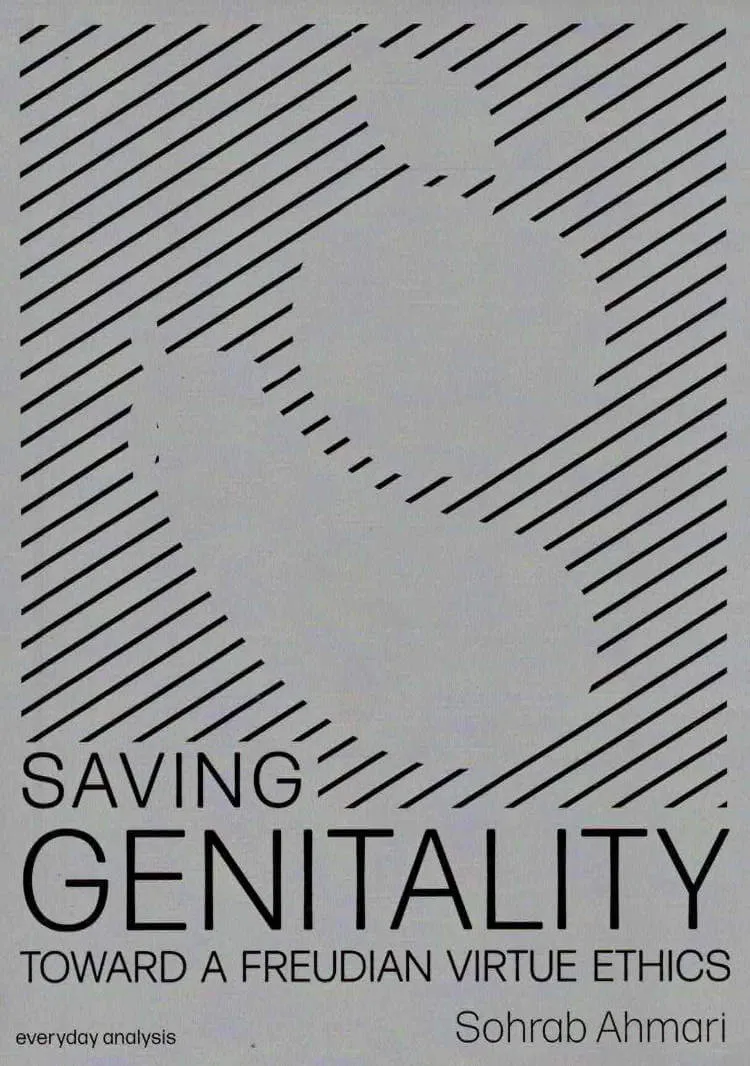
Saving Genitality: Toward A Freudian Virtue Ethics
Western societies have dismantled many of the prohibitions that ringfenced errant sexual drives in Freud’s time. The psychoanalytic project describes people caught between two fundamental and contradictory principles: One a relentless sexual drive, the libido; the other our species’ collective need for social order and harmony. Part of this harmony, for true Freudians, is embedded in the binary mutuality of men’s and women’s bodies, which remains indispensable for society to reproduce itself, even in our sexually liberated age. In this essay, Ahmari revisits the idea of ‘genitality’ arguing that perhaps the "heteronormative" orthodox Freudians were right about some things after all.

Tips of the sung
Tips of the Sung is a collection of interdisciplinary texts from Samuel Brzeski composed over the five years whilst he was Associate Artist at Lydgalleriet. The collection brings together performance scripts for voice and video with newly composed texts for the page. Centring on the vibrations of the voice, the texts exist somewhere between signification and delirium, at times making more sound than sense.
The texts are full of bumbling mumbles, meandering hums, homophones, inner voices, affirmations, motivations, subvocalisations, resolutions, errors in speech production, peach seduction, car maintenance manuals, self-help fallacies, roomy echo chambers, overheard language lessons, morning meditations, and other forms of verbal rehearsal at the limits of language.

Jangal
Ana Pi, Léna Araguas and 2 more
Jangal est un ouvrage collectif avec la participation d’Ana Pi, Julien Creuzet, Léna Araguas et Éva Barois De Caevel. Il a été conçu lors de l’exposition « Cet ailleurs, qui rejaillit en moi, lorsque je suis là (…) » de Julien Creuzet à la galerie NaMiMa de l’École nationale supérieure d’art et de design de Nancy.

Deer Book/Libro Venado
Inspired initially by Jerome Rothenberg’s translation Flower World Variations, which Cecilia Vicuña first encountered in 1985, Deer Book brings together nearly forty years of the artist’s poetry, “poethical” translations, and drawings related to cosmologies and mythologies surrounding the deer, and sacrificial dance in cultures around the world.
Woven like one of her quipu installations, Vicuña’s texts—which include original compositions in Spanish as well as English translations by Daniel Borzutzky—become meditations on translation, not just of the sacred nature of this animal but on how our understandings of ceremony and ritual are transformed, by this ongoing process. Taken as inspiration rather than conundrum, the impossibility of translation opens up poetic possibilities for Vicuña as she continues her lifelong exploration into the nature of communication across eras and distant lands, languages and shared symbols within Indigenous spiritualities.

Why I Failed in Porn
This book follows my journey of launching, growing, and ultimately failing in the adult entertainment industry. It explores society’s complex relationship with porn and sex education, the challenges of entrepreneurship, and the struggles of working in a deeply stigmatized space. Sometimes funny, often dramatic, and always surprising, it offers an unfiltered look at the business side of porn and what it really takes to challenge the status quo.

Rage Assassine: Mettre Fin au Racisme
Avant que Black Lives Matter et #MeToo ne viennent secouer l’Amérique et le monde occidental, bell hooks montrait, dans cet essai incisif, que l’abolition du racisme et l’éradication du sexisme vont de pair. Sans le féminisme, la lutte antiraciste reste une affaire d’hommes. Sans l’antiracisme, le féminisme s’expose à servir de courroie aux logiques de domination raciale. L'autrice insiste sur le bien-fondé de la rage qui anime les masses populaires et la jeunesse noire et sur la nécessité d’en faire un moteur de changement social radical. Elle propose une théorie et une pratique révolutionnaires, dont la fin est une communauté solidaire fondée sur l’égalité réelle et la volonté de tou.te.s de travailler au changement.
Traduit de l'anglais par Ségolène Guinard.
GLORIA JEAN WATKINS, connue sous son nom de plume BELL HOOKS, née en 1952, est une intellectuelle, féministe, et militante étasunienne. Elle a publié plus de trente livres et de nombreux articles, et est apparue dans plusieurs films documentaires. Traduits dans de nombreuses langues, ses ouvrages sont considérés parmi les plus importants sur la question aux Etats-Unis et suscitent un réel engouement en France depuis quelques années. Les éditions divergences ont déjà traduit et publié trois de ses ouvrages dont La volonté de changer et A propos d'amour.

CONSTANT VIOLINS I & II
CONSTANT VIOLINS is a hybrid book consisting of two parts, each comprised of two texts of sci-fi auto-fiction: ‘FӔTAL ATRACTUS’ & ‘COQUETTES’, ‘RATS LIVE ON NO EVIL STAR’ & ‘SOPH MOB’. CONSTANT VIOLINS follows mutating characters & contexts that grapple & contort in half-step with the logics of a vast labyrinth of psycho para-social references, playing out across a tête-bêche (or head-to-tail) format book. The myriad ‘worlds’ occupied & embodied narratively riff on the act of world-making in itself.
As an only child, I used to climb up onto my grandmother’s vanity & collapse the 3 way mirror over my head so I could bask in the calm of the many me’s preening inside its reflective continuum. Sometimes I would just lean against the looking glass above her bureau or pretend the wall was my simultaneous lover. No one wants to be alone. Under covers, I initiate the same sequences of experiments that virtually anyone does.
We all imagine what our pillows witness annually would baffle sane onlookers. That’s why we practice kissing on our dorsal carpal arches, peaches in the dead of night, or remove condoms from bananas with our teeth. CONSTANT VIOLINS wants what any book wants; to become a formidable power couple with its author like a Pokemon & its precocious Trainer.
Jordan/Martin Hell (b. 1993, USA) is a Black trans(2s) writer, artist, & scholar who attended Städelschule (DE) & Cooper Union School of Art. He is currently a PhD candidate at Queen Mary’s University of London. Hell’s work is interdisciplinary & interlaced with his writing as the seedbed for his various explorations across painting, sculpture, pedagogy, music, dance, etc. In all of his work Hell is invested in the embedded associations which proliferate in the global collective subconscious & how that frames intimate (& often violent) realities in the lives of individuals whether historical, celebrity, or obscure. Closely linked with his work is a spiritualist psychoanalytic practice which spans hypnosis, theology, philosophy, Black fugitivity, & indigenous somatics.