Books
Books
in random order

Lagoon
Part prose poem, part reflection on the relations between writing and place, Lagoon tells the story of the slow undoing of an idyll. In it the narrator walks for hours during long summer nights, gazing through the windows that line the streets. In between, she reflects on how she might write about the shifting space of the lagoon, where she spent summer holidays with her family years ago. In adolescence, the narrator watches quietly as her mother, father and sister go about building their holiday home. But she can sense something is awry, she just does not fully understand what.
Lagoon is the first novella by McCulloch.
Lagoon by Samantha McCulloch is the first title in Kunstverein Amsterdam's new imprint called First Drafts, which, inspired by artist and publisher Anne Turyn, celebrates experimental and commercially unviable work by publishing completed manuscripts that haven’t yet found a home in their first draft form. Importantly, each title is also the first attempt by the author to write in that particular form, or, to write at all.

Midnight Mass Press & Heretic House
WITCHES
A collection of portraits by original riot grrrl, filmmaker, and zine queen, G.B. Jones. All of them witches – from the silverscreen, woodlands, and the streets.
Featuring provocative essays by Caroline Azar, Paul P., Leafshimmer, Jenna Danchuk, Blake Baron Ray, and Scott Treleaven – each exploring how witches have been perceived, presented, and portrayed in popular culture. “Realer than real, stranger than fiction.”
PRAISE FOR G.B. JONES WITCHES
Witches by G.B. Jones is a summoning spell posing as a book, a paper potion like the potion Nicky gives Gillian in Bell, Book and Candle. It draws me to it and to what’s in it, Jones’ divine drawings of the witches we both worship, the witches of TV and film and true life. I go to it gladly. I go to it gayly. I pore over it and prize it and purr like Pyewacket.
— Derek McCormack, author of Castle Faggot
G.B. Jones is the original Foxy Genius. Her zines, drawings, music, and Super 8 films inspired both the Queer zine explosion and the Riot Grrrl movement of the 90s. Witches sees G.B. once again crafting her magic.
— Kathleen Hanna, singer, writer, artist, and front-woman of the bands Bikini Kill and Le Tigre
With her illustrated procession of witches, post-punk icon G.B. Jones acts as medium to a dazzling diversity of disrupters from across screen history, as well as a pantheon of real-life hellraisers, from Sybil Leek and Rosaleen Norton to Vali Myers and beyond – all woven through with astute commentary by a host of countercultural collaborators. A captivating book; I was certainly under its spell.
— Kier-La Janisse, author of House of Psychotic Women

BUTT 37
Lots of straight-talking in BUTT no. 37. Catch Édouard Louis shot by Nan Goldin, Bruce LaBruce meeting Omar Apollo, real talk with Brazilian deputy Erika Hilton and dirty talk with Martin Margiela and Jean Paul Gaultier. Plus a lesbian threeway, Bogotá’s sauna/museum, cocks in sock and oh so much more. Bangers only.

The Dogs
In Noah Ross's new book THE DOGS, Ross opens the question of authority and possession in what he deems an illicit act of translation. THE DOGS may begin with Herve Guibert's Les Chiens, but through multiple reiterations of translation, Guibert's text ultimately meets Ross to celebrate, among other sources, Marie de France, Teen Wolf, Auden, and Dom Orejudos in establishing a unique pack of hungry werewolves. You know what happens when werewolves get together: the play can get a little rough. THE DOGS empowers these snarls and yips, growls and howls, on the level of the sentence in translation as much as the embodied erotogenic zones of the body.

The Swarm
A shape-shifting, metaphysical thriller where sensorial, sexual, and revolutionary impulses are aligned for the purpose for anarcho-transcendent-communal escape, The Swarm circles around a sundry of anomalous and dead beings who plot their way out of Hungarian fascist rule in the thermal baths of Budapest.
Based in Berlin, Dalia Neis is a writer, filmmaker, and lyricist and vocalist for Dali Muru & The Polyphonic Swarm. Previous publications include Zephyrian Spools: An Essay, a Wind (Knives, Forks & Spoons), and Hercules Road (Ma Bibliothèque).

Memory
A spiritual homage to Bernadette Mayer's monumental artwork of the same title, Dorothea Lasky's Memory is a cycle of "poet's essays" stirred by two profound questions. What constitutes personhood and consciousness? What memories get lost, and why?
Expansive in her quest for answers, Lasky launches an inspired investigation of the forces that form our lives and deepest senses of ourselves. She identifies three dimensions of memory—ancestral, personal, and poetic—and in her singularly clear voice, undertakes to enter into their mysteries. From those recesses, she returns with a wide-ranging collection of essays that like lyric poems find the universal inside the particular. Memory reflects on the banal; private emotions and historical trauma; dear departed poets (Diane di Prima, Lucie Brock-Broido); her father's battle with Alzheimer's; and cultural events that have become charged sites of collective reminiscence (the moon landing, the music of Neutral Milk Hotel). Other pieces face the flip side of memory, asking what's left where memory is absent, and what's "real" beyond the horizon of death. The book closes with "Time, the Rose, and the Moon," an ars poetica published here in English for the first time, which offers the ancient symbol of the Ouroboros as a figure for the nonlinear processes of time, memory, and art.
Like Mayer before her, Lasky reveals memory to be huge and haunting, as she accumulates impressions that challenge the very possibility of fixed meaning. "Every rose has the scent of death," she writes. "And poetry is a perfume. That will stay on your body forever.... Whatever happens this time around, remember that."
Dorothea Lasky is the author of six full-length collections of poetry, including, most recently, The Shining (2023). She is also the author of the prose book Animal (2019) and a forthcoming book about Sappho, as well as the editor of Essays (2023) and a coeditor of Open the Door: How to Excite Young People About Poetry (2013). Her writing has appeared in POETRY, The New Yorker, The Paris Review, The Atlantic, and Boston Review, among other places.

I Love Shopping
Chickens have a collective soul. Heaven is full of the skateboarders you kissed in middle school. If the algorithm is its own hell, Lauren Cook, author of the critically (and uncritically) acclaimed Sex Goblin, stands in front of it fully armored. I Love Shopping invites its readers to inhabit a world just like ours, reflected through a big, benevolent funhouse mirror.
First published in a limited edition, this is the first trade edition of the cult classic.

Comment réparer : La maternité et ses fantômes
Iman Mersal, Richard Jacquemond
Publié en 2018 par Kayfa-ta (Égypte), Comment réparer : la maternité et ses fantômes propose une réflexion sur la maternité et ses représentations. Plusieurs fois réimprimé, ce livre jouit d’une très grande réputation dans le monde arabophone, notamment auprès des jeunes générations.Mobilisant différentes formes d’écriture (essai, récit, poème, journal) et des images photographiques tirées de sources diverses (archives personnelles, presse, portraits vernaculaires, etc.), la trame du livre s’articule autour des relations de l’autrice avec sa mère, sa grand-mère et ses deux fils. Déjouant les clichés et les formes narratives établies, Iman Mersal décèle les complexes réseaux symboliques dans lesquels s’inscrivent la filiation et la maternité, depuis la grossesse jusqu’à l’éducation des enfants, et ce de génération en génération.À l’écoute des silences de la mémoire, explorant ses labyrinthes, le livre porte un regard critique sur la violence et le sentiment de culpabilité qui traversent le corps maternel, notamment dans ses rapports au langage, au travail ou aux institutions. Iman Mersal élabore ainsi une sorte d’art poétique : la réparation dont parle le titre passe par l’écriture, elle est donc d’ordre créatif ; mais l’écriture s’insère dans un quotidien qui lui fait obstacle, qui met au défi la possibilité même d’écrire dès qu’on devient mère. Comment réparer : la maternité et ses fantômes est en ce sens un formidable texte de résistance, un geste d’émancipation.
Née en 1966 en Égypte, Iman Mersal est poète et professeur associé de littérature arabe à l’université d’Alberta, au Canada. Ses récents livres sont des écrits très originaux qui mêlent recherche académique et réflexions intimes sur une grande variété de sujets, dont la plupart ont trait à son identité de femme et d’artiste. Une anthologie de ses poèmes – Des choses m’ont échappé (2018) – et un récit – Sur les traces d’Enayat Zayyat (2021) – ont été traduits en français par Richard Jacquemond pour les éditions Actes Sud

All My Dead Jesters
All My Dead Jesters is an assembly of select poems previously published in de Vries’ first two English language collections—Dark Hour and I Failed to Swoon (Dostoyevsky Wannabe, 2018 and 2021 respectively). These old works have been lightly revised for republication, and are paired with poems drawn from a manuscript-in-process to institute an autotelic kaleidoscope of some ten years worth of work in verse.
De Vries’ poems are spare, terse and epigrammatical—a barroom Bashō—dedicated to the glimmer of a compact glance; the chance, glamour and negative capability of a passing thought; and the slow drip of liquid crystal as colours our present. All My Dead Jesters is a torch song for our ‘poor subjectivity,’ a slow dance with sour times, a ‘[steering] away from [the] gratuitous provocation’ that litters our contemporary outlook. ‘Her competence as a poet lies in her ability to translate visceral vulnerability’ for the page (The Kelvingrove Review / University of Glasgow), as she patchworks a heroic ‘poetry without [a] hero, a blanket leaving you colder somehow, [...] the map of a world we like to think we know’ [CA Conrad].

Afternoon Editions N°4: Certain Things
A day can be a composition not unlike an essay. Full of possibilities, full of limitations, bound by universal structures and marked by idiosyncratic desires. You go on walks. You read. You do your chores. All the while memory and other forms of imagination keep time with you. Books are strange companions; writing is a lonely thing rich with consolations.
Certain Things is a text by Claudia La Rocco, created with and through ideas such as these.
Published September 2022.

Rumors
When Socrates was standing before the Athenian tribunal in 399 BC, he said in his defence that the opponents he feared most were the invisible ones, those who had been spreading rumors against him for years but none of whom were being brought to court – it was like fighting shadows. The moment was Socrates, the harbinger of logos and true knowledge, was eventually defeated by rumors and mendacious slander.
Where does the strange power of rumors come from? Everyone knows that rumors are unfounded and based on thin air, but still they pass them rumors spread, and what appeared as a small breeze can grow into a mighty whirlwind and produce serious effects, ruin people’s lives and change the course of events. This book scrutinizes the mysterious power of rumors and seeks to analyse it philosophically, examining along the way some key moments of our cultural history concerning rumors, from Shakespeare and Cervantes to Gogol and Kafka. It also underlines the fact that, although rumors are as old as humankind, the advent of the internet and social media has raised the spreading of rumors to an entirely new level, to the point where we could speak of the rumorization of the social. The more communication there is, the more the social fabric threatens to fall apart – and the more urgent it becomes to find strategies to counteract this.

Bonbons à l'anis
Un fabuleux recueil – le premier publié en français – de poèmes et récits de l'autrice argentine Cecilia Pavón, préfacé par Chris Kraus (écrivaine dont Pavón a par ailleurs traduit des livres en espagnol).
« Cette traduction n'aurait pu voir le jour si je n'avais pas développé pendant quelques temps une obsession quasi malsaine pour l'Argentine. Cherchant à Buenos Aires les traces de lieux proches de Shanaynay que j'avais co-dirigé à Paris, je découvris au hasard sur internet l'existence d'un espace nommé Belleza y Felicidad et dirigé par Fernanda Laguna et Cecilia Pavón. Bien avant l'émergence de l'artist-run space en Europe, les deux femmes créèrent un lieu associant art et littérature. Lors d'un voyage à Buenos Aires, j'eus l'opportunité de rencontrer Cecilia Pavón qui lors d'une conversation sur l'écriture et la poésie, me proposa de traduire Licorice Candies en français. Sa poésie fut autant révélatrice qu'émancipatrice, à la fois par sa singularité et sa simplicité. Elle écrit ce qu'elle voit et ce qu'elle vit. Elle parle de certains quartiers de Buenos Aires, de ses amis, d'elle, d'un vélo qu'elle a perdu, de Timo. Il me semble qu'elle écrit comme elle parle d'amour, d'erreurs et de sexe ». Marion Vasseur Raluy, traductrice
The first collection of texts published in French by the Argentinian artist and poet.
Preface by Chris Kraus.
Translated from the English and Spanish by Marion Vasseur Raluy, Rosanna Puyol Boralevi and Mona Varichon.

Spectres #05 – Diffusion
François J. Bonnet, Bartolomé Sanson
The fifth issue of the annual publication dedicated to sound and music experimentation, co-published by Shelter Press and Ina GRM – Groupe de Recherches Musicales, on the theme of diffusion and dissemination.
In a 1955 pamphlet entitled Seven Years of Musique Concrète, Jacques Poullin wrote:
"[...] sound projection in a concert hall is a logical extension of the concerns of the Groupe de Recherches de Musique Concrète and requires its technicians to properly study multiple aspects of the problems of sonorisation that are often neglected and to date have been almost exclusively the preserve of 'public address' technicians".
From the very beginning, fixed media electroacoustic music in its various guises faced a significant challenge: that of how it could be shared with the public. Even before it was distributed in the form of records, musique concrète, having first been transmitted on radio, soon turned to the concert stage. From the time of its birth, a twofold question was posed: What strategy of diffusion could be used for this music which involves no live performers? But also, how could it make use of existing systems of sound amplification without losing its singular nature, making sure to preserve its own particularities? Identified very early on, these questions have lost none of their pertinence some seventy years later.
Under pressure from the cultural industries and faced with a largely commercially-driven standardisation of formats, it is important today to reaffirm both the singular nature of experimental electroacoustic practices, and the possibilities these practices open up beyond standards and rules.
This calls for an exploration of the vast domain of sound creation in which, here and there, ideas, concepts, and sometimes new works appear that fully embrace the question of the deployment of sound, its dissemination and its expansion. An exploration focussed on the listening experience—a fundamentally musical experience—but adopting a critical approach which may sometimes call into question traditional ways of sharing and listening to sound, the status of listener and creator, and which may even challenge the acoustic integrity of venues and the legitimacy of diffusion systems.
Such are the questions to be addressed here. Sketching out the contours of what is quite obviously a huge subject, this volume, drawing upon a wide variety of points of view, experiences, and ideas, hints at an entire critical apparatus that remains to be developed and consolidated, but is crucial given the primordial importance of the theme of dissemination. For dissemination is the transitional stage par excellence, the uncertain stage that sits between creation and reception while at the same time determining both. It is a critical stage, yet one that is often neglected or, as Poullin says, left to a technical intermediary who may impose conditions entirely exogenous to questions of music and listening.
For these reasons, it seems more necessary than ever to return to the experience of sounds, to once again listen attentively to their trajectories, their diffraction in space, their emergence and their disappearance. To get to grips with the mysteries of their deployment so as to reaffirm that this deployment is essential to them.
Edited by François J. Bonnet and Bartolomé Sanson.
Contributions by Marja Ahti, Scott Arford, Nicolas Debade, Michael Gatt, Tim Ingold, Rolf Julius, Jules Négrier, John Richards, Marina Rosenfeld, Hildegard Westerkamp, Randy Yau.
Spectres is an annual publication dedicated to sound and music experimentation, co-published by Shelter Press and Ina GRM – Groupe de Recherches Musicales.

Someone Who Isn't Me
Geoff Rickly’s debut novel Someone Who Isn’t Me is a feverish journey through the psyche of someone who no longer recognizes himself.
When Geoff hears that a drug called ibogaine might be able to save him from his heroin addiction, he goes to a clinic in Mexico to confront the darkest and most destructive versions of himself. In this modern reimagining of the Divine Comedy, survival lurks in the darkest corners of Geoff’s brain, asking, will he make it? Can anyone?

Time Suspended
Herman Asselberghs, Els Opsomer and 1 more
The first thing a traveller has to learn in Palestine is to wait: the Palestinians have been doing it for more than 50 years. In the refugee camps in the Gaza Strip and on the West Bank, they have been waiting for permission to return ever since the Nabka, the catastrophe of 1948, when they were driven out of their houses and away from their land.
In November 2002, the Brussels-based authors of Time Suspended went on a ten-day visit to Palestine. Like most, everything they knew of the country came from media. They discovered a complex and intricate society that could not be summed up in a soundbite. The many full-bleed images of Palestine presented here (many of them depict a somewhat deserted, laid-back, sleepy, place) challenge years of media-tainted observation and truly give insight into the daily lives of its inhabitants.

Hack 'N' Slash
Kamil Bouzoubaa-Grivel réalise au printemps 2020 la série de dessins Hack’n’slash.
Ces collages sont faits à partir d’aplats de couleur autocollants Letrafilm Color/Tint Overlay, que l’on pourrait traduire par Couleur/Teinte Superposition, permettant ainsi de nommer l’importance des jeux de profondeur qui s’y trouvent.
L’artiste se calque là-dessus et joue alors avec la confrontation entre le hack: détournement et réemploi d’outils techniques (trames numériques, encres d’imprimante, dessin manuel) – et le slash: le fait de trancher/juxtaposer les formes venant de différentes dimensions pour composer ses dessins.
Chaque édition a une couverture unique sérigraphiée sur du papier Pantone Letraset par l’Atelier PPP et un texte critique-fiction de Mia Brion.

Slips of the Mind: Poetry as Forgetting
An audacious account of what happens when forgetting becomes a way of writing and writing becomes a way of forgetting.
In Slips of the Mind, poet and critic Jennifer Soong turns away from forgetting’s long-standing associations with suppression, privation, and error to argue that the absence or failure of memory has often functioned as a generative creative principle. Exploring forgetting not as the mere rejection of a literary past or a form of negative poetics, Soong puts to the test its very aesthetic meaning. What new structures, forms of desires, styles, and long and short feelings do lapses in time allow? What is oblivion’s relationship to composition? And how does the twentieth-century poet come to figure as the quintessential embodiment of such questions?
Soong uncovers forgetting’s influence on Gertrude Stein, Lyn Hejinian, Tan Lin, Harryette Mullen, Lissa Wolsak, and New York School poets John Ashbery, James Schuyler, Bernadette Mayer, and Ted Berrigan, among others. She reveals that forgetting’s shapeshifting produces differences in poetic genre, interest, and degrees of intentionality—and that such malleability is part of forgetting’s nature. Most provocatively, Soong shows how losing track of things, leaving them behind, or finding them already gone resists overdetermination and causality in the name of surprise, as poets leverage forgetting in order to replace identity with style. Slips of the Mind is the kind of literary criticism that will reward all readers of modern and contemporary poetry.
CUNY Center for the Humanities
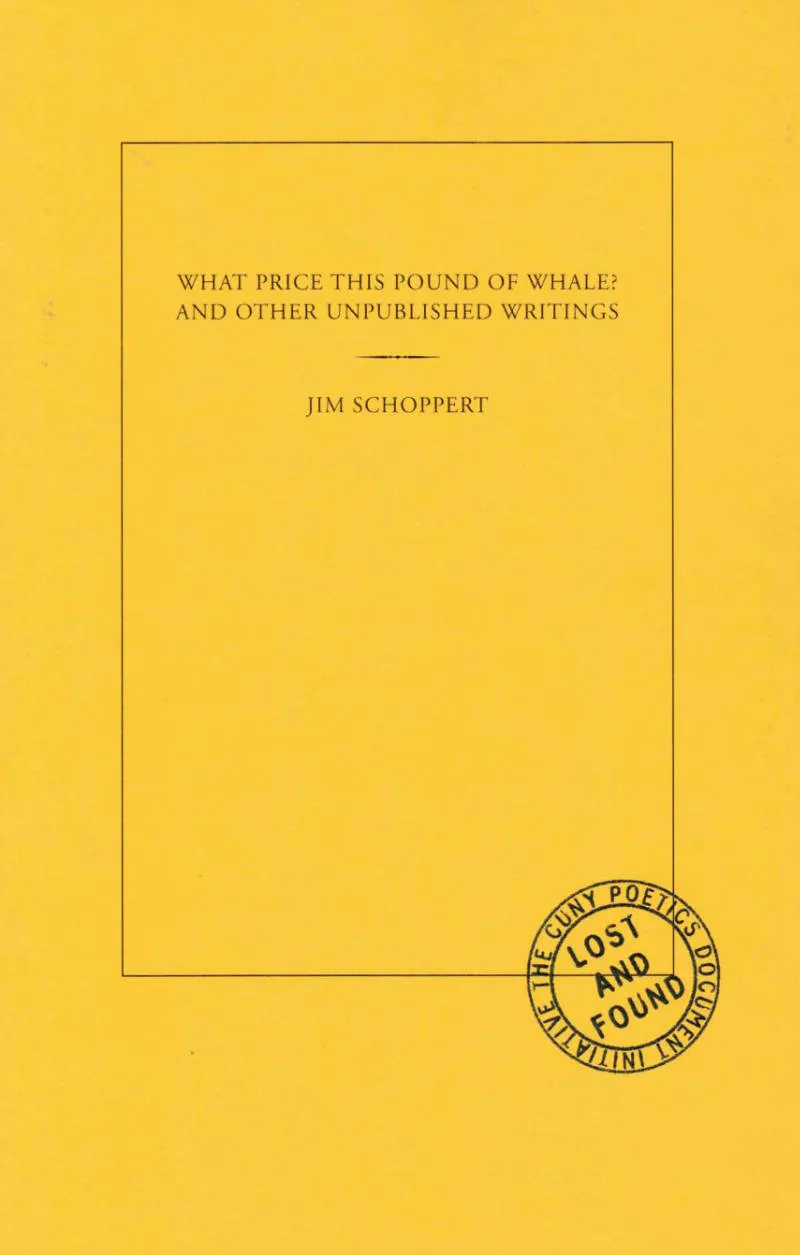
What Price This Pound of Whale? and Other Unpublished Writings
The Tlingit artist Jim Schoppert (1947-1992) was among the most accomplished, innovative, and prolific Alaska Native artists of the twentieth century. His whimsical sculptures and large scale painted wooden carvings reconfigure Tlingit visual motifs, and he challenged the binary categories against which Indigenous artists are so often defined, such as traditional and contemporary, historic and innovative, and artist or craftsperson. While known primarily for his modernist interventions in Tlingit visual traditions, Schoppert was also a prolific writer, an eloquent speaker, and an ardent advocate for Alaska Native artists. This publication brings together a selection of his unpublished poetry and writings from the artist’s personal papers. Presented alongside never before seen sketches and studies, this selection bridges Schoppert’s written and artistic practices in a deeply personal portrait of the artist and Alaska Native life that upsets preconceptions about Native art and unsettles the established narrative of Euro-American and Indigenous aesthetic relations.
Jim Schoppert (1947-1992) was a Tlingit multidisciplinary artist and writer. He was a Taku Tlingit Raven of the Ishkahittaan (Inland Frog) clan from his Tlingit mother and half-German from his father and carried the Łingit name Dom-Yetz. Born in Juneau, Alaska, he earned a BFA in Sculpture and Printmaking from the University of Alaska—Anchorage and an MFA from the University of Washington. In addition to his artistic career, Schoppert was instrumental in promoting Alaska Native arts and organizations. He was Director of Arts and Crafts at the Cook Inlet Native Association, Director of the Alaska Arts in Prisons Program for the University of Alaska Juneau, and organized exhibitions and workshops across Alaska and the Pacific Northwest. He was visiting professor in visual art at the University of Alaska, Fairbanks and directed its Native Art Center. He sat on the Washington State Arts Commission and on the boards of the Alaska State Council on the Arts and the Institute of Alaska Native Arts. His work is held in public and private collections across the United States, including the Smithsonian National Museum of the American Indian, the Anchorage Museum, the Heard Museum, and the Newark Museum, among others. His writing and poetry has appeared in The Greenfield Review and Journal of Alaska Native Arts, among other publications.

Red Seed: Poems for Luno
Cruz Alejandra Lucas Juárez, Wendy Call and 1 more
Through a voice at once intimate and collective, Lucas Juárez expands the powerful presence of Tutunakú roots to open up territories and to interweave desirous bodies, dream relationships, and the memories of women ancestors. This beautiful translation by Wendy Call and Whitney DeVos, in a precious handmade edition, affirms the trilingual (Tutunakú, Spanish and English) as an ethical strategy of listening to and translating the world. Red Seed collects twelve poems of women's sexualities and spirits in which body, language and territory are political spaces that Indigenous memory expands within and renews.
—Maricela Guerrero, author of The Dream of Every Cell

Time has fallen asleep in the afternoon sunshine
Een dag in 't jaar door Herman Gorter
For the project Time has fallen asleep in the afternoon sunshine a group of people/ performers memorize a book of their choice. Together they form a library collection consisting of living books. After years of learning by heart and reciting for readers, some of the books have now been written down from memory to create new editions, versions resulting from this process. This book is one of those books, chosen by one person, learned by heart and recited many times, and now written down again from memory. This edition is not a re-edition of the original text. It is a re-writing of the text after the process of reading, memorizing and reciting, with all the alterations that might have occured in the course of this process.

Recto verso – An Anthology of Works and Writings by Asier Mendizabal
A comprehensive retrospective of the Spanish artist's work, covering his major exhibitions (Manifesta, Reina Sofia, MACBA, Raven Row, etc.) and including all of his texts published as fanzines over a period of twenty years, a new critical essay by Kim West, and a wide-ranging conversation.
Conceived as a compilation of works and writings of the last two decades, this book is structured as an alternating succession of four different registers: four recurrent modes. A long-form interview, a series of questions from different collaborators, documentation of a selection of projects, and a compilation of the facsimilia of the brochures published by the author since 2008. The aim of this concatenation of recurring sections is to delay the linear progression suggested by the narrative of a compilation, by the apparent causal string of decisions, ideas, references and works displayed as an accumulative "biography" of the artist's practice. However, this being a bound book, the suggestion of an interwoven relation between all the works, regardless of when, where or how they were made, must submit to the order locked by the sewn spine of its signatures, the folder of bound pages that forms each section of a book.
Designed by Filiep Tacq, the book includes an essay by Kim West and a long-form interview by Beatriz Herráez, punctuated by questions from Filiep Tacq, Lisa Tan, Jon Mikel Euba, Antonio Menchen, Alex Valijani, Johanna Gustafsson Fürst, Itziar Okariz, Olatz Otalora, Antonia Majaca, Pablo Lafuente and Koenraad Dedobbeleer.

The Letters of Rosemary & Bernadette Mayer, 1976-1980
Bernadette Mayer, Rosemary Mayer
This collection of the correspondence between artist Rosemary Mayer (1943-2014) and poet Bernadette Mayer (born 1945) occurs between the years of 1976 and 1980, a period of rich creativity in New York's artistic avant-garde, and one which includes the development of major bodies of work by the two women.
Rosemary Mayer was creating sculptures, watercolors, books and temporary monuments from weather balloons and snow, while Bernadette Mayer was working on some of her best-known publications, including the book-length poem Midwinter Day and the poetry collection The Golden Book of Words.
Spanning the worlds of Conceptual art, Postminimalism, feminism, the New York School, Language poetry and more, these letters elucidate the bonds of sisterhood through intimate exchanges about art, relationships and everyday life.

Qu'est-ce que le sexe ?
La sexualité comme un problème proprement philosophique de la psychanalyse.
La satisfaction de parler contient en soi une clé de la satisfaction sexuelle (et non l'inverse) – une clé de la sexualité et de ses propres contradictions. Alenka Zupančič aborde la question de la sexualité comme un problème proprement philosophique de la psychanalyse – celle de Freud et de Lacan – et non celle des praticiens cliniciens tels que décrits par Lacan « orthopédistes de l'inconscient ». Que se passe-t-il, comme l'affirme Lacan, si nous pouvons obtenir exactement la même satisfaction que le sexe par la parole, l'écriture, la peinture, la prière ou autres activités ? Il ne s'agit pas d'expliquer la satisfaction que procure la parole en indiquant son origine sexuelle, mais bien de souligner que la satisfaction de parler est elle-même sexuelle.
Alenka Zupančič soutient que la sexualité est à la limite d'un « circuit court » entre ontologie et épistémologie. La sexualité et le savoir sont structurés autour d'une négativité fondamentale qui les unit au point de l'inconscient. L'inconscient (en tant que lien avec la sexualité) est le concept d'un lien inhérent entre l'être et la connaissance dans leur négativité même.
Alenka Zupančič est une philosophe lacanienne, spécialiste renommée de Nietzsche, professeure à l'European Graduate School / EGS et à l'Université de Nova Gorica, Slovénie. Elle est également research advisor et professeure à l'Institut de philosophie du Centre de recherche de l'Académie slovène des Sciences et des Arts. Avec Slavoj Žižek et Mladen Dolar, Alenka Zupančič est l'une des figures les plus incontournables de l'Ecole de psychanalyse théorique de Ljubljana dont les travaux s'intéressent aux relations entre sexualité, ontologie et inconscient, à la critique de la théorie du sujet et à l'exploration théorique du concept lacanien du Réel.

Time has fallen asleep in the afternoon sunshine
Seltsame Sterne starren zur Erde
For the project Time has fallen asleep in the afternoon sunshine a group of people/ performers memorize a book of their choice. Together they form a library collection consisting of living books. After years of learning by heart and reciting for readers, some of the books have now been written down from memory to create new editions, versions resulting from this process. This book is one of those books, chosen by one person, learned by heart and recited many times, and now written down again from memory. This edition is not a re-edition of the original text. It is a re-writing of the text after the process of reading, memorizing and reciting, with all the alterations that might have occured in the course of this process.