Books
Books
in random order

Machine Decision is Not Final
Amy Ireland, Anna Greenspan and 2 more
Visions of the contested future of AI veer between common planetary goals and a new Cold War as culturally-specific models of intelligence, speculative traditions, and thought experiments come up against the emergence of novel forms of cognition that cannot be reduced to any historical cultural tradition.
This uniquely-positioned volume provides expert insight into this tension, using China as a touchstone for rethinking ‘artificiality’ and ‘intelligence’ as sites of difference in a way that is already present in the difficulty of precisely translating the Chinese term 人工智能.
Spanning borders between different worlds, histories, futures, and foundational models, Machine Decision is Not Final is not only a timely reappraisal of the stakes of AI development, but a toolbox for constructing more global imaginaries for the future of AI.
Moving beyond the clichés that still dominate the contemporary debate, this interdisciplinary, cross-cultural collection decenters familiar narratives to provide a fresh perspective on what artificial intelligence is today, and what it might become.
Contributors: Blaise Agüera y Arcas, An Bo, Benjamin Bratton, Chen Qiufan, Gabriele de Seta, Shuang L. Frost, Vincent Garton, Steve Goodman, Yvette Granata, Anna Greenspan, Amy Ireland, Bogna Konior, Vincent Lê, Lawrence Lek, Lukáš Likavčan, Suzanne Livingston, Iris Long, Bingchun Meng, Reza Negarestani, Wang Hongzhe, Regina Kanyu Wang, Xin Wang, Xia Jia, You Mi.

The Complex Answer – On Art as a Nonbinary Intelligence
The Complex Answer presents the reader with a selection of texts—from 2010 to 2021—that introduce an exercise in how a practice of art and exhibition making has been influenced by philosophical thinking.
One form of thinking oriented towards the production of an epistemological space where art is not illustrating ideas but enacting thinking and activating experience as an epistemological force that slowly erodes and, eventually, erases the culture-nature divide.
All the texts have been published before and yet—for the sake of creating a dramaturgy and stressing the thesis—they have been reedited and partly rewritten. The texts aim to enforce the idea that art is an intelligence that is influenced by ideas and the emergence of new notions but also thinking through experience. An experience that is aesthetic and epistemological in equal terms.
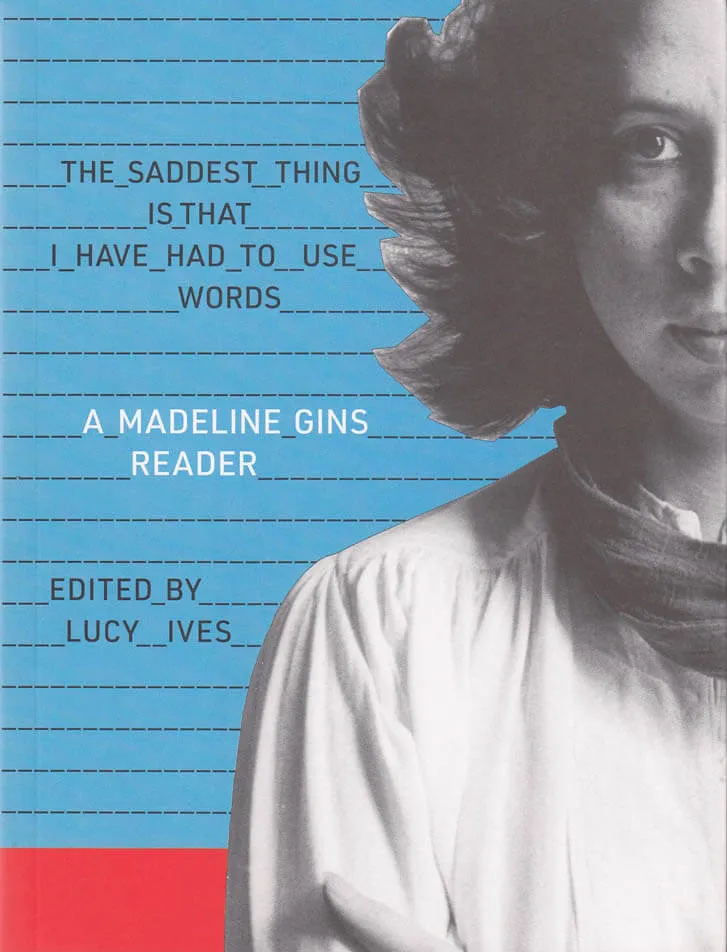
The Saddest Thing Is That I Have Had to Use Words: A Madeline Gins Reader
Poet, philosopher, speculative architect and transdisciplinary artist, Madeline Gins is well known for her collaborations with her husband, the artist Arakawa, on the experimental architectural project Reversible Destiny, in which they sought to arrest mortality by transforming the built environment. Yet, her own writings — in the form of poetry, essays, experimental prose and philosophical inquiries — represent her most visionary and transformative work. Like Gertrude Stein before her, Gins transfigures grammar and liberates words. Like her contemporaries in conceptual art, her writing is attuned to the energized, collaborative space between reader and page.
The Saddest Thing Is That I Have Had to Use Words: A Madeline Gins Reader is a revelatory anthology, edited and with an introduction by the writer and critic Lucy Ives. It brings never-before-published poems and essays together with a complete facsimile reproduction of Gins' 1969 masterpiece, WORD RAIN (or A Discursive Introduction to the Intimate Philosophical Investigations of G, R, E, T, A, G, A, R, B, O, It Says), along with substantial excerpts from her two later books What the President Will Say and Do!! (1984) and Helen Keller or Arakawa (1994). Long out of print or unpublished, Gins' poems and prose form a powerful corpus of experimental literature, one which is sure to upend existing narratives of American poetics at the close of the 20th century.
Edited by Lucy Ives.

Moi
The straplines of a number of advertisements drawn from magazines of the 1950s are turned into drawings, as though a particularly vain and narcissistic woman speaks (as of course she does), She is ‘en pleine forme’ of her beauty. (2016).

Pommes Girl / أحتفل بالحياة التي تحتفل بي
Rim Battal, Abdelilah Khattabi
The story of a meeting between a woman and a man linked by music for one night, in a nuptial dance of bodies and words doomed to failure: an ode to desire by the Franco-Moroccan poetess.
Rim Battal (born 1987 in Casablanca, lives and works between Paris and Rabat since 2012) is a French artist and poet.
Edited by Yasmina Naji.
Translated into Arabic by Abdelilah Khattabi.

Unconscious/Television
This book stems from the author’s discontents with Lacanian Psychoanalysis, by drawing from psychoanalysts like Félix Guattari and Sándor Ferenczi, as well as authors like Viveiro DeCastro, and Thomas Lamarre, to whom the book is dedicated.
As Lucas Ferraço Nassif elaborates on the possibility of a multiplicitous Unconscious, or rather, a mass of many Unconscious(es), he attempts here to fold the book itself into the text, to make the organisation of the physical book itself a part of the elaboration.
This 2nd Edition comes with a few editorial changes, and a slightly different design approach. It is being presented now with a suite of endorsements from a group of exciting writers and researchers, including Persis Bekkering, Thomas Lamarre, and Yuchen Li. Much of the first edition is preserved, and an extra text has been added, written by the editor as a part of the lecture at Ifilnova. There has been a focus on making this book more accessible, so we have reworked the design of this edition in Black & White.
The Unconscious is Semiotic, not Linguistic, and it only jumps out when you read between the lines. Do you remember, back in 1997, when 600 kids had epileptic shocks whilst watching Television—the Pokémon Shock? This might sound strange at first, but Lucas Ferraço Nassif theorises that, contrary to the claim that this was caused by oscillations of blue and red light alone, it could have been caused by microperceptions and intensities within narrative. As Porygon takes Ash and friends into the digital world, the immanence of unconscious assemblages drags viewers in, too.
Such is the haptic and imagetic nature of this book. Using several design and editorial strategies, and a particular mode of writing, the author attempts to elaborate on their work on the Unconscious by recreating a similar possibility—where book, language and reader collapse into a composition, an assemblage or a haecceity. Unconsciousness operates as the multiplanar compositions of Japanese Anime do, so this book has been organized accordingly—different texts, different temporalities, different voices—and like the Japanese concept of Ma (negative space), or even like CoreCore, something jumps out of the breaks, the gaps in between the layers, and therein lies, for this book, a departure point for elaborating on not just one, but many, Unconscious(es).

Eros the Bittersweet: An Essay
Anne Carson's remarkable first book about the paradoxical nature of romantic love. Since it was first published, Eros the Bittersweet, Anne Carson's lyrical meditation on love in ancient Greek literature and philosophy, has established itself as a favorite among an unusually broad audience, including classicists, essayists, poets, and general readers.
Beginning with the poet Sappho's invention of the word "bittersweet" to describe Eros, Carson's original and beautifully written book is a wide-ranging reflection on the conflicted nature of romantic love, which is both "miserable" and "one of the greatest pleasures we have."

The Tiniest Muzzle Sings Songs of Freedom
Taking readers from suburban carports to wintry Russian novels, from summer tomato gardens to the sublime interiors of presleep thoughts, Magdalena Zurawski's poems anchor the complexities of our interconnected world in the singularity of the human experience. Balancing artistic experimentation with earnest expression, achingly real detail with dazzling prismatic abstraction, humor with frustration, light with dark, she offers a book of great human depth that is to be carried around, opened to anywhere, and encountered.
Magdalena Zurawski is the author of the novel The Bruise, which won the Ronald Sukenick Award from FC2 in 2008 and a LAMBDA literary award in 2009, and the collection of poems Companion Animal, which was published by Litmus Press in 2015 and won a Norma Faber First Book Award from the Poetry Society of America. She attended Brown University where she studied with poets Rosmarie and Keith Waldrop, C.D. Wright, and Peter Gizzi. She has lived in Berlin, New York, Philadelphia, San Francisco, and Durham, NC where she ran the Minor American Reading Series. She is currently Assistant Professor of English and Creative Writing at the University of Georgia.
Published April 2019

Wild Seed
Doro knows no higher authority than himself. An ancient spirit with boundless powers, he possesses humans, killing without remorse as he jumps from body to body to sustain his own life. With a lonely eternity ahead of him, Doro breeds supernaturally gifted humans into empires that obey his every desire. He fears no one—until he meets Anyanwu.
Anyanwu is an entity like Doro and yet different. She can heal with a bite and transform her own body, mending injuries and reversing aging. She uses her powers to cure her neighbors and birth entire tribes, surrounding herself with kindred who both fear and respect her. No one poses a true threat to Anyanwu—until she meets Doro.
The moment Doro meets Anyanwu, he covets her; and from the villages of 17th-century Nigeria to 19th-century United States, their courtship becomes a power struggle that echoes through generations, irrevocably changing what it means to be human.

Nothing at All
An atmospheric rumination on gendered violence, cosmic collapse, and colonialism.
From deep inside a black hole, comes Nothing at All—the space where everything collapses: form, genre, gender, and being. Olivia Tapiero’s poetic and essayistic fragments overflow with lyric beauty as they explore how colonialism, illness, and desire intertwine amidst personal and collective suffering. Generations, geographies, and desires mingle, contaminating one another in these anarchic, insubordinate texts. Here, the written word disrupts foundations and nations, claiming its own survival.
Olivia Tapiero is a writer, translator and musician. She is the author Les murs (Robert-Cliche Award, Prix Senghor finalist), Espaces (2012), Chairs (2019), Phototaxie / Phototaxis (Nightboat Books, 2017 / 2021, Lambda Literary Awards finalist), and Rien du tout (2021, Grand Prix du livre de Montréal Finalist, Governor General’s Literary Awards finalist). She is editor-in-chief for the literary magazine Moebius, and has contributed poems and essays to various publications in Canada, France, and Korea. She has also translated works of contemporary authors such as Roxane Gay, Anne Boyer and Billy-Ray Belcourt. She lives between Marseille and Montréal.
Foreword by Anne Boyer.

Meriem Bennani: Life on the Caps
Meriem Bennani's Life on the CAPS is the final chapter in her film trilogy of the same name. Set in a supernatural, dystopian future surrounding a fictional island in the middle of the Atlantic Ocean, it is rooted in Bennani’s research and reflections on the histories of island societies, biotechnology, and vernacular music. Layering live-action footage and computer-generated animation, Bennani intuitively adapts editing techniques that evoke documentary film, science fiction, phone footage, music videos, and reality TV. Her one-person exhibition at the Renaissance Society marked the debut of this personal, electric yet melancholic consideration of what it is to live in a state of limbo, and this accompanying book captures the film through a combination of still images and selections from a transcript of the film.
This volume includes essays by Emily LaBarge and Elvia Wilk and transcripts of conversations between Meriem Bennani and: Omar Berrada; Fatima Al Quadiri, Negar Azimi, and Tiffany Malakooti; Amal Benzekri; and Aziz Bouyabrine.

Disobedience
Published to accompany the artist's retrospective at the Kunstmuseum St. Gallen (September 2025–March 2026), this comprehensive monograph offers a detailed overview of the work of Dutch artist Jacqueline de Jong. Designed by Sabo Day and edited by Melanie Bühler, curator of the exhibition, this publication spans De Jong's entire artistic journey of from her editorial activities and bold figurative paintings of the 1960s to her "Billiards" series in the 1970s, and her latest series of the 2020s that reflect the current state of the world.
It features new essays by Karen Kurczynski (Professor of History of Art and Architecture at the University of Massachusetts Amherst), Emily LaBarge (writer and critic), Tiana Reid (Assistant Professor of English at York University), Paul Bernard (Director of Kunsthaus Biel), as well as an as-yet-unpublished conversation with the artist and McKenzie Wark (writer and theoretician).
Organized through six sections entitled "Disobedience," "Publishing," "Chaos," "Pop," "Play," and "Politics," all lavishly illustrated, it underlines the challenging approach to art and life developed by De Jong formally, visually, and conceptually from the early 1960s until 2024.
Edited by Melanie Bühler
Texts by Emily LaBarge, Gianni Jetzer, Jacqueline de Jong, Karen Kurczynski, McKenzie Wark, Melanie Bühler, Paul Bernard, Tiana Reid.

Au fort les âmes sont
Exclusive works designed by Laure Prouvost for her carte blanche at the Mucem in Marseille, a series of immersive and poetic installations in the heart of Fort Saint-Jean, photographed by Raphaël Massart for this cut-out book, between an artist's book and an exhibition catalogue, accompanied by drawings and critical texts.
For the Mucem, Laure Prouvost has created a series of immersive installations in the heart of Fort Saint-Jean. Repurposed everyday objects, glass sculptures, sound mirages, and underwater videos shot in the depths of the calanques and around Frioul compose a sensitive and poetic universe. Between fiction and reality, the artist invites visitors on a sensory journey where everything is transformed: forms, narratives, and life itself.
The book was conceived as a visual journey leading from the Old Port of Marseille to Fort Saint-Jean and into the very heart of each work. To recreate this encounter between artist Laure Prouvost and the Mucem, there is a constant dialogue between the exterior—the sea, the stone of the fort—and the interior—the intimacy of the installations that unfold in the air, in the bowels of the earth, and underwater... Designed in close collaboration with the artist, the book captures this moment through photographic work carried out especially by Raphaël Massart and an evocative form designed by the artist: like a book that also floats in the Mediterranean. To accompany this visual unfolding, a booklet embedded in the heart of the book contains texts by Hélia Paukner, curator of the exhibition, and Mathilde Roman, art historian.
Published on the occasion of the eponymous exhibition at the Mucem, Marseille, in 2025.

Darryl
Darryl Cook is a cuckold, and that’s exactly how he likes it. He has an inheritance that spares him from work, a manageable and seemingly consequence-free drug habit, and a lovely wife called Mindy who’s generally game for anything—and for as much of it as she can get. But after an accidental overdose and some serious oversharing, Darryl’s world begins to crack up. Tormented by what seems to be the secret truth in sex, and less assured of that secret’s form, Darryl steps into what used to be called real life . . . Darryl is a disarmingly funny and unabashedly intelligent look at a community of people parsing masculinity, marriage, sex (and love) on their own terms.
Underneath the sharp satire and hilarious sexual irreverence this is a deadly serious book: a brilliant novel of a seeker, like The Pilgrim’s Progress refracted by queer internet culture. —Torrey Peters
Ess is what I might call a burgeoning cult literary figure, armed with an unmistakable lyric deadpan and a taste for provocative subject matter. — Stephen Ira, Poetry Project
What Darryl is looking for is a crisis of sufficient severity that it will cause him to feel real to himself. — Dominic Fox, Review 31

In the forest of grief I grew into a shrub of gold
For British artist Delaine Le Bas, dress is divine. Clothes appear as both mask a nd memorial within an expansive body of work exploring mythologies of Le Bas’s Romani ancestry. Embroidered and hand-painted textile is central to the artist’s lyrically activist practice, alongside costume, writing and performance. In a new series of portraits by the British photographer Tara Darby, directed by Jane Howard, gold leaf dances across the planes of Le Bas’s face in repose, it wraps and jangles around her wrists, glimmers across her clothes. In a notebook she has inscribed: “In the forest of grief I grew into a shrub of gold.” The grief is alchemical.
As Stephen Ellcock writes:
‘The maxim ‘Know Thyself’ was inscribed in gold on a column on the threshold of Pythia’s temple, serving as a warning that wisdom, understanding, empathy and anything remotely resembling peace of mind are unachievable without selfawareness, reflection and ruthless self-criticism.’
The fragments of hope, anger, magic and curiosity redolent in Le Bas’s work form a call to action. A reminder of the racism, exclusion and subjugation that abound. Photographs of Le Bas, which Darby has been making for more than a decade, present the artist as truth sayer, inquisitive goddess and modern-day Sibyl.
Through the incorporation of texts—a conversation between gallerists John Marchant and Keiko Yamamoto with curator Claire Jackson—drawings from Le Bas’s journals, archival images taken at her home and the restyling—and reflection—of her own personal wardrobe, In the forest of grief I grew into a shrub of gold radiates psychological, social and political wisdom. Fashion is revealed as both tyrannical disguise and liberating regalia.

PRESCRIPTIONS: A Collection for Many Evils of the Body and the Mind, Also for Witchcraft
PRESCRIPTIONS is a transcription of a handwritten manuscript, dated to approximately 1650, containing a wide range of medicinal and magical remedies. Currently housed in the Cornell University Witchcraft Collection, it is assumed this practical handbook was a reference for healing, midwifery, and other medical/magical advice. Recipes and instruction cover various methods of purging, ointments for swellings, fevers, and pain reduction, lotions for venereal disease, advice for childbirth, and dilemmas such as “worms in the ear.” Accompanying these medicinal prescriptions are a series of magical prescriptions: charms, rituals, and spells recorded to fortify the ailing body, induce amorous desire, or seek revenge.
With its mix of Latin words, Early Modern English parlance, colloquial plant names, apothecary weights, and archaic medical terms, the recipes can at first appear opaque, but with sustained engagement one can begin to decipher the logics and structures within the writer(s)' shorthand. The original manuscript, in having its own detailed glossary, index, and citations, exhibits a meticulous cataloging of knowledge and resources, and reveals an earnest desire to hold onto the integrity and sanctity of the body in the face of 'many evils.'
The transcription is accompanied by a glossary of terms, an explanation of the various apothecary measurements used, and expanded citations of the medicinal/magical treatises that were abbreviated within the original text.

Chile Chico et le quartier Versailles
Chile Chico et le quartier Versailles, c'est une exploration qui inventorie, interroge et révèle les mémoires invisibles en listes et en collections. Une mémoire qui ne soffre pas en bloc, qui résiste, se fragmente, se transforme. A travers cette archive collaborative, nous avons voulu capter ces va-et-vient ď'un passé qui dialogue avec le présent, des images qui oscillent entre Vintime et le collectif.
Le point de départ de cette fabrique visuelle, c'est lexil des Chilien.nes, débarqué.es dans les années 70, qui se tissent une nouvelle vie sur le sol de Neder-Over-Heembeek, dans le quartier Versailles à Bruxelles. Ces trajectoires, arrachées à un ailleurs, s'ancrent dans des espaces rêvés comme de transit pour devenir des lieux d 'appartenance, où lexil se mue et les racines finissent par se déployer. A ces récits se greffent d'autres histoires, d'autres trajectoires. Un quartier comme un carrefour, ou les individualités se rencontrent, où les vies se croisent et s'allient.

La Maison des Maladies
Unica Zürn, Ruth Henry and 1 more
Unica Zürn dans La maison des maladies raconte, par un ensemble de textes et dessins, un séjour en hôpital où elle est soignée d’une jaunisse. Elle y écrit et compose ce carnet où le regard qu’elle pose sur son propre corps, les lieux qu’elle habite et les personnages qu’elle rencontre, témoigne d’une sensibilité hors-norme qui tire à la fantaisie, voire au délire.
Pour la première fois en France, La maison des maladies est publié intégralement.
Le texte est traduit de l’allemand par Ruth Henry & Robert Valençay. Un après-propos de Mathilde Girard clôture le livre.

German Theater 2010–2022
Calla Henkel and Max Pitegoff: German Theater 2010–2022 is the first monograph on the work of the artist duo Calla Henkel (b. 1988, Minneapolis, MN) and Max Pitegoff (b. 1987, Buffalo, NY). Their manifold practices play out, live test, and fictionalize the mechanisms that shape creative communities. Chronicling over a decade of production in Berlin, the book is organized around the influential bar and theater spaces they ran there: Times Bar (2011–12), New Theater (2013–15), Grüner Salon at the Volksbühne (2017–18), and TV Bar (2019–22), and includes an interview with curator Fabrice Stroun and essays by David Bussel and Patrick Armstrong. Henkel and Pitegoff's photographs, plays, writing, and films address the complexity of collective action, painting a deadpan picture of the social and economic systems that sustain communal exchanges and their eminently fragile autonomy.
Edited by Fabrice Stroun
Design by Dan Solbach

Worms Issue 12: Tourmaline
Various
"In the three previous issues of Worms, we have plumbed the depths of the mind, unravelled the mysteries of the heart, and traversed the vast expanses of the soul. For this next instalment, Worms 12, we have sought to get back to our roots, to burrow our heads and tails into the soil from which we came. The central tenet of our fertilising mission has always been to champion the best and most experimental writing we can sink our teeth into, to challenge the exclusivity of traditional publishing, and to bring what’s lurking underground to the literary topsoil. We revel in writing that corrupts form, defies genre, and subverts style; work that deals in the uncomfortable, the uncertain, and the untoward. We ask: what can literary form reveal to us about ourselves, our heroes, the global landscape. We don’t need to remind you of the turmoil of our current moment. The frequency and escalating depravity of the bad news that reaches us through the black squares in our pockets says it all. Instead we return to writing to excavate its radical potential; writing as protest, as remedy, as subterfuge, as escape.
While we cast our net far and wide, in putting this issue together a constellation of themes and ideas naturally emerged. From the complexities of history, legacy, and lineage, to the persistence of ghosts, grief, and memory; from the trappings of masculinity to the transformations of parenthood, pregnancy, and birth; from acts of community-building to queer kinship, messiness, and desire." (Note from the publisher)
Worms Editors: Caitlin McLoughlin, P. Eldridge, Arcadia Molinas
Featuring: Tourmaline, Namwali Serpell, Alexis Pauline Gumbs, Jamieson Webster, Wayne Koestenbaum, Sophie Robinson, Missouri Williams, Robert Glück, Bambi Lake, Amber Husain, Mar García Puig.
Contributors: Eve Esfandiari-Denney, Madame Nielsen, Gaye Kynoch, Izabella Scott, Maxy Lury, Lou Ferrand, Tadhg Haran, Chariot Wish, Donna Marcus Duke, R.Z Baschir, Charlotte Pelissier, Anju M Kasturiraj, Vic Brooks, Saffron Morter-Laing, Dove Ginsburg.
Photographers: Michel Delsol, Xavi Permanyer, Alexander Coggin, Robin Christian, Veronika Korjagina, Joseph Hayes, Ciarán Óg Arnold.
Artwork & Illustration: Danielle Brathwaite-Shirley, Rifke Sadleir, Ivy Shepherd-Barron, George Paul, Katya Labowe-Stoll.
Design: Caitlin McLoughlin

The Weather
Light and air, greenery and earth take on unaccustomed qualities in the poet’s deft hand in this long poem from Lisa Robertson. Seven sections — "Sunday" to "Saturday," alternating prose and verse, repattern quotidian conversations and atmospheres: "bright and fresh," "brisk and west," "streaky and massed," January to December. A constellation of radical women is invoked to pass, elegiac, among clouds: Violette Leduc, Patty Hearst, Mary Wollstonecraft, Olympe de Gouges, Shulamith Firestone, Ti–grace Atkinson. This is exhilarating poetry, wild and trouble, that seamlessly integrated lived experience with the play in mind. It is sure to entrance.

The fruitfull sence
Titus Lucretius Carus, Lucy Hutchinson
The fruitfull sence is an excerpt from Lucretius’s masterwork De rerum natura, in which the poet marvels at the sensory world. Optical illusions, the drift of smell, the juicy mechanics of taste. All animated by Lucy Hutchinson’s gorgeous 1640 translation, which renders the original Latin into bouncy English pentameter. The first publication in our new series, Sensory Dispatches.

How to Leave the World
Everyone is asking about his identity. Gay? Muslim? French? Moroccan? Instead of choosing a side, he writes a book. A book about the forest and the city, Paris and Tangiers, shame and forgiveness, dating apps and spiritual discovery. A book about growing up as a diaspora kid in rural France, with desires that want to emerge at any cost. Told in mesmerising prose, How to Leave the World is a beautiful non-answer.
A rare book that depicts the isolation and poetry of rural life. — Annie Ernaux
What it takes to imagine social and physical freedom is what it meant to keep reading this incredible book. — Bhanu Kapil
Marouane Bakhti is a writer and arts journalist. Born in Nantes, France to a Moroccan father and a French mother, he studied history and journalism at the Sorbonne. He writes criticism for Mouvement magazine and lives in Paris. How to Leave the World is his first novel.
Lara Vergnaud is a literary translator of French and has translated over a dozen novels, including works by Zahia Rahmani, Fatima Daas, Mohamed Leftah and Mohamed Mbougar Sarr. Lara was born in Tunisia, grew up in the United States and currently lives in southern France.

Hosted by Red Dust
Partie sur les sites de la dernière briqueterie artisanale de Riemst et de la recyclerie de briques d'Alexander van Mosselaer, Juliet Mérie en ramène un récit poétique qui explore notre rapport à la matière vivante et questonne le cours de la vie.
Loin d'être un documentaire, ses photographies créent un rapport ambigu entre la perception des espaces visités et l'allégorie qui s'installe. La possière se soulève pour dévoiler les lieux de vie et de mort des briques qui dessinent le paysage belge.