Books
Books
in random order

Els Dietvorst E.D. (2010–2014)
This publication presents a survey of the work of Els Dietvorst from 2010 to 2014. This is also the period in which she left Brussels to live in a village on the south-east coast of Ireland, where she focused on projects such as The Black Lamb. The audio piece One was killed for beauty, another one was shot, the two others died naturally is included on an audio CD.
Els Dietvorst E.D. (2010–2014), Rolf Quaghebeur, Eva Wittocx, Katleen Weyts, Els Dietvorst, Brussels, 2014.

OEI #102–103 Photography on Edge
Cecilia Grönberg, Jonas J. Magnusson
Photography on Edge – 25 visual dossiers compiled and introduced by Geoffrey Batchen + ”Wanting more” – on and from the work of Australian artist Justine Varga + translations of a selection of Geoffrey Batchen’s essays into Swedish
”The published history of photography has long been motivated by a number of key principles: innovation and originality, authorship and nationality, chronology and medium specificity, technical excellence and aesthetic achievement. The folios [in OEI #102–103] offer an alternative way to regard this history. They comprise a series of repetitious fragments drawn more or less arbitrarily from across various photographic practices and genres. In every case, these folios present a photography on edge: tense, nervous, unsure of itself—at least when compared to the self-certainty we encounter in most histories of this medium.
A photography on edge is a photography that escapes the usual definitions. […] One thing is for sure: if they are to be included in future histories of photography, then we will need to set aside our prejudices and presumptions and learn to say what we see, and not just see what we already know how to say.”
— Geoffrey Batchen in Photography on Edge

Perestroika / Perestroika: Reconstructed
An autobiographical documentary, a fiction that's also an essay and an extended poetic meditation on the ability of the image to represent experience. Sarah Turner's film is a ghost story that explores what we forget and how we remember. The stunning imagery comes solely from the window of the Trans-Siberian train, shot first in 1987-8 and then again in 2007-8. The re-enactment of the journey is a memory work, a re-enactment of the past in the present through the process of filming. But the return journey is haunted by the voices of two dead friends that dominate the soundscape of the 'archive' footage. The film culminates at the haunting expanse of Lake Baikal, the deepest lake in the world.
Perestroika: Reconstructed re-mixes and extends Perestroika, into two sequences. Sequence one constitutes the 2009 version of the film, whilst the second sequence constructs a new framing narrative that reinterprets and reconfigures both the imagery and the experience of the first. Part psycho-geography, part dream and part environmental allegory, both sequences of Perestroika : Reconstructed conclude at Lake Baikal, contrasting experiences of terror and apocalypse with those of beauty and tranquility, the one contaminating the other. In this uncanny return, form stages thee through twinning the instability of memory and re-enacting that within the projective experience of cinema. This extended work delves further into ideas of momentary truth, identity, and how an uncontaminated experience of landscape is literally and metaphorically something that only exists in memory.
Publication contains DVD of Perestroika, which was released theatrically, blu-ray of Perestroika:Reconstructed, first exhibited as a gallery installation at London's Carroll/Fletcher Gallery April-May 2013, and a booklet of three essays by Elizabeth Cowie, Sophie Mayer, and Paul Newland.

Kish, An Island Indecisive by Design
Babak Afrassiabi, Nasrin Tabatabai
In Kish, An Island Indecisive by Design, artists Nasrin Tabatabai and Babak Afrassiabi explore the modern development of an Iranian island in the Persian Gulf. Removed from mainland Iran, Kish is a place where extremes in politics, ideology and urban design intersect. The island's many years of infrastructural indecision is distinctly evident in its architecture, which lacks any trace of coherence or feel for locale. This volume gives an often moving account of the chaos of middle-eastern modernity.
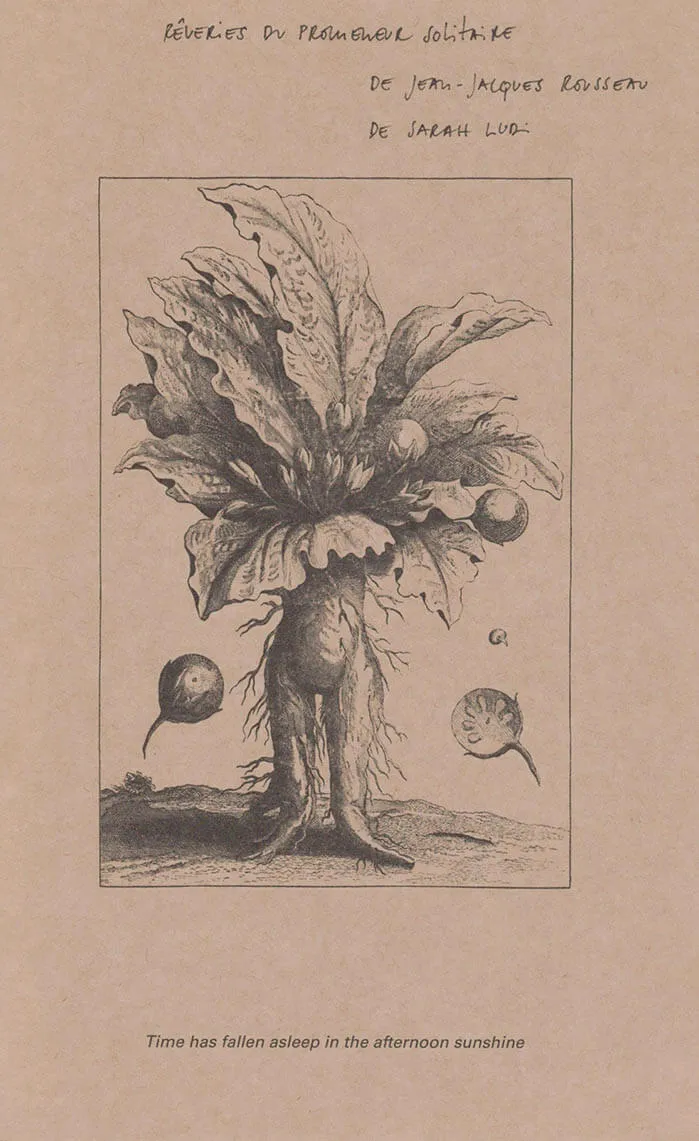
Time has fallen asleep in the afternoon sunshine
Rêveries du promeneur solitaire
For the project Time has fallen asleep in the afternoon sunshine a group of people/ performers memorize a book of their choice. Together they form a library collection consisting of living books. After years of learning by heart and reciting for readers, some of the books have now been written down from memory to create new editions, versions resulting from this process. This book is one of those books, chosen by one person, learned by heart and recited many times, and now written down again from memory. This edition is not a re-edition of the original text. It is a re-writing of the text after the process of reading, memorizing and reciting, with all the alterations that might have occured in the course of this process.

ZILCH
In banana boxes, Maxime Le Bon collects and stores a lot of documents in a jumble. Most of them are printed, cut out from newspapers, magazines, old publications, erratas and other fragments of texts. Added to this are drawings that he improvises - some of them torn or stained that he don't want to display or throw away. This collection of heterogeneous items is then being rearranged and slipped into plastic pockets where he stores them. Unstable and in constant change, this improbable archive grows with the years. It sedimented layers of experiences and constitutes this heterogeneous deposit from which can emerge all sorts of fragmentary narratives and accidental arrangements. The publication ZILCH brings together a selection of images from this extensive archive.

There Are No Homosexuals in Iran
There Are No Homosexuals in Iran is a short book of encounters by an Iranian man who meets men like himself and asks how such a life is carried across Iran. A teacher prays to be freed from his own desire. A husband keeps parallel lives from touching. A young man walks the Karun River at night, asking why no one will hold him. Circulated online in Persian since 2021, this cracked dossier shows up here in English, in print for the first time as itself: broken and exact.

WILL YOU MARRY ME?
The ultimate ambition of this book-tool is to “disappear on the street”. Its pages collect words and stories of people whose right to exist and be visible in public spaces was forced to confront the concepts of “legality” and “justice”.
Considering the assumption that the law is a fluid parameter, which changes depending on where we are in the world, the historical period in which we live and the sort of privileges we enjoy, the law defines what is considered moral, licit, in other words, what is right. It distributes power and the perception of power in society, defining, categorizing, dividing and controlling.
WILL YOU MARRY ME? is a public lecture and an artist’s book by Sara Leghissa and Marzia Dalfini, investigating a specific portion of the spectrum of illegality, namely the relationship between illegal acts and public space. It explores how we can act disobedience before everyone’s eyes, suggesting possible forms of complicity and public resistance.
All the content was collected by the artist during meetings and conversations that took place in Prato, Milan, Ramallah, Marseille, Madrid, Nyon and Lausanne and with this book-tool their words become manifestos that the reader is invited to detach and relocate into the public space.
Designed by Marzia Dalfini. Published by NERO with the support of L’Altra.
Format: 42 x 29,7 cm
Pages: 28
Language: IT / EN
Year: 2021

Piero Heliczer. Poems & Documents / Poèmes & Documents
Sophie Vinet, Benjamin Thorel and 1 more
Poet, editor, filmmaker, actor, child star in Mussolini’s Italy, founder of The Dead Language Press and of the Paris Filmmakers Cooperative, Piero Heliczer (1937–1993) was an essential yet secret agent of the 1960s and ’70s counterculture. In the course of his nomadic existence in Rome, New York, London, Amsterdam, Paris, and Préaux-du-Perche, where he spent the last few years of his life, he met and worked with a constellation of avant-garde writers, forged friendships with figures from the Beat Generation and the British Poetry Revival as well as the New York art scene. At the crossroads of many underground experiences, Heliczer’s name appears in books dedicated to the artists and poets he collaborated with during his lifetime—names by the likes of Gregory Corso, Barbara Rubin, Andy Warhol, Jack Smith, Ira Cohen, or The Velvet Underground, a band he participated in creating with his friend Angus MacLise.
This myth obscures the fact that Piero Heliczer was first and foremost a poet. Today, this part of his work is overlooked; it is all the more difficult to encounter because Heliczer himself never collected it. So it was scattered, or lost, in the course of his wanderings. Heliczer favored the circulation of his works rather than their archiving: he was committed to the production of mobile forms—flyers, broadsides, and other ephemera—disseminated his verses in magazines, and preferred public readings and performances to the finished form of the book.
The present volume gathers a significant number of Heliczer’s poetic works through facsimile reproduction of his contributions to more than thirty periodicals—mostly stemming from poets’ presses or universities—published between 1958 and 1979. This collection isn’t “complete”—but it makes available again poems that, in some cases, never circulated after their initial publication.
Un recueil de poèmes de Piero Heliczer (1937–1993), auteur, éditeur et cinéaste, figure de l’underground et de la contre-culture, proche de Andy Warhol, Gerard Malanga, et Jack Smith. Sa poésie, héritière de la Beat Generation, restitue en métaphores et images saisissantes des expériences et des visions personnelles, tout en s’appuyant sur des formes héritées de la tradition anglaise et des partis-pris typographiques originaux. Ce recueil rassemble des facsimilés des publications originales de poèmes de Heliczer – périodiques d’artistes, revues miméographiées, petits magazines… – accompagnées de leurs traductions en français, ainsi que de plusieurs documents, parmi lesquels une reproduction intégrale d’une publication rare de 1961, Wednesday Paper, et, en insert, un facsimilé d’un placard de 1975, The Handsome Policeman.
Traduction des poèmes: Rachel Valinsky
Publié avec l’aide du CNAP

Raving
McKenzie Wark takes readers into the undisclosed locations of New York's thriving queer rave scene, showing how raving to techno is an art and technique at which queer and trans bodies might be particularly adept, but which is for anyone who lets the beat seduce them.
Contents
1. Rave as Practice
2. Xeno-euphoria
3. Ketamine Femmunism
4. Enlustment
5. Resonant Abstraction
6. Excessive Machine
"How to write a book about raving as a practice that practices rave? From k-nights spent on Brooklyn's and Berlin's junkspace dance floors, McKenzie Wark abstracts a life practice of ressociation in a dance of autoconceptualization and allotheorization. In crossing toward the stranger's gift of 'letting go of ourselves as private property, ' Raving is nothing less than Wark's femmunist manifesto, her tractatus on techno's blackness, her treatise for a twenty-first-century trans ethics."—Kodwo Eshun

Afghanistan
Afghanistan is my father’s homeland. He was born in Kabul in 1945 and later moved first to France, then to Switzerland in the 1970s. In my mind, Afghanistan exists as a geography with blurred edges, something I feel the need to reconcile with. It’s a place I’ve only ever known through stories, a source of memories that, over time, have shifted and become distorted.
Contributors: Luca Cerizza, Farid Rahimi, Said Rahimi, Susanna Ravelli, Francesca Recchia, Zafar Sayan, and Dawood Tawana

All My Dead Jesters
All My Dead Jesters is an assembly of select poems previously published in de Vries’ first two English language collections—Dark Hour and I Failed to Swoon (Dostoyevsky Wannabe, 2018 and 2021 respectively). These old works have been lightly revised for republication, and are paired with poems drawn from a manuscript-in-process to institute an autotelic kaleidoscope of some ten years worth of work in verse.
De Vries’ poems are spare, terse and epigrammatical—a barroom Bashō—dedicated to the glimmer of a compact glance; the chance, glamour and negative capability of a passing thought; and the slow drip of liquid crystal as colours our present. All My Dead Jesters is a torch song for our ‘poor subjectivity,’ a slow dance with sour times, a ‘[steering] away from [the] gratuitous provocation’ that litters our contemporary outlook. ‘Her competence as a poet lies in her ability to translate visceral vulnerability’ for the page (The Kelvingrove Review / University of Glasgow), as she patchworks a heroic ‘poetry without [a] hero, a blanket leaving you colder somehow, [...] the map of a world we like to think we know’ [CA Conrad].

Emil Lime
Emil Lime collects various materials that nurture and give shape to Esther Gatón’s artistic practice, including collages made with her phone pics, sketches, sporadic notes and drawings, together with the writing of authors that have been influential on the work: Fredy Massad, María Fernanda Ampuero, Darya Diamond and Cory John.

Practicing Dying
Practicing Dying is a literary anti-memoir documenting life in a Zen Buddhist monastery in rural France where the protagonist, a woman in her late twenties, attempts to overcome chronic drug addiction and mental illness.
Broken and severely unwell, our protagonist arrives at the monastery from London: starving, drug-addicted and disillusioned, having exhausted every conventional treatment route available to her. The book examines how, habituated to a life of benefits assessments, petty-crime and sex work, she struggles to adjust to the rules, discipline and religious life of the monastery—at times to devastating and comedic effect.
As the story unfolds, she reflects on her addictions and past experiences, raising critical questions about what it means to be "an addict" and why there may be vested corporate and societal interests in maintaining a narrow, individualistic understanding of addiction.
Anarchic and provocative, tender and self-deprecating, Practicing Dying differs from other contemporary memoirs in the genre of addiction-recovery by simultaneously challenging the dominant narratives surrounding mental health while proposing an alternative approach to treating the “sickness of self” from which we all increasingly suffer.
‘Practicing Dying is brilliant, rewarding and difficult. Northall offers the most brazen and shocking account of addiction I’ve ever read. Committing herself to the practice of Mahayana Buddhism, she eventually finds a way out, but only on the most rambling, circuitious path. Her account of addiction and loss, displacement and grief is profound and it proves that nothing is ever one thing.’ — Chris Kraus, author of The Four Spent The Day Together
Charlotte Northall is a London-based writer. Her debut, Practicing Dying, blends autobiography and cultural criticism to explore addiction, capitalism, and spiritual practice. She works with rough sleepers, supporting those living with addiction and complex mental health needs.

Paces the Cage
S*an D. Henry-Smith’s second full-length book of poems, PACES THE CAGE, lifts off from their previous book, Wild Peach (2020), by expanding an already-queered language to near breaking point. Through the complexities of Henry-Smith’s personal experiences and the use of a poetically fragmented voice, the literal and metaphorical are here remixed in real time. Henry-Smith’s occasional inclusion of ambient sounds and a musical language and tone used throughout the book helps to build a rich auditory landscape that enhances the immersive quality of the poems, creating a deep and evocative collection by this adventurous and endlessly exciting artist. As if it were an improvised performance itself, PACES THE CAGE actively tunes personal and historical narratives of oppression and adversity with the act of speaking, and what it means to be truly heard by a community of one’s fellow creators and collaborators.
PACES THE CAGE extends S*an D. Henry-Smith’s interdisciplinary, improvisational listening into a poetics of “fissure and measure,” where silence and the sonic converge in boundless motion. Tuning language toward the frequencies of breath, pulse, and sociality, Henry-Smith's poems transport us from natural worlds to communal forms to Bill Gunn’s STOP, recovering wayward images and utterances to compose a surround sound of loss and renewal. What emerges is both reckoning and remedy—a lush sensitivity to the ways language becomes live, as in now, as in “eyes open, full of rage.”
S*an D. Henry-Smith’s reverberant propositions seek the music of mutual renewal, constantly and impatiently approaching the present. This is a field of spiraling, alliterative song, the wild signature of Henry-Smith’s lyric, that renews commitments to militancy by naming and knowing its enemies as doubtlessly as it names and knows it lovers. PACES THE CAGE considers a set of conditions—technical, material phenomena—that produce collective and contradictory imaginations and gives words to the song that makes the gathering last, “all in for all…” PACES THE CAGE is a beautiful rehearsal of attentiveness, a rigorous and generous correspondence with the edges of the frame.
– dove, Christine Kirubi
S*an's PACES THE CAGE recalls to me Akilah Oliver’s 2004 An Arriving Guard of Angels, Thusly Coming to Greet. A lyrical unleashing into the many selves, the author here plays conduit for many beautiful bodies; for those souls wandering at daybreak; for the pudgy greased cheeks and those that murmur in the dew of twilight uncloaked. It is as if the poet has extracted from the marsh, the runoff, roundup and peat to stockpile and make lush a new yet familiar world. S*an has created a collection of diamonds from the salty mines of turtle tears. The divorced defanged possessive absent its apostrophe, left to the mud puddle for butterfly nuptials throughout, tells the reader: How you know me Now will be Different from how you knew me. These buoyant poems that are S*an’s latest songs have not missed the train this time. Make certain that you don’t. I’m in awe.
–LaTasha N. Nevada Diggs
S*an D. Henry-Smith is a poet and photographer, working by extension in sound, performance, and publishing.

Mother Media: Hot and Cool Parenting in the Twentieth Century
An essential history for understanding how we mother now, and how motherhood itself became a medium—winner of the Brooke Hindle Award from the Society for the History of Technology.
From the nursery to the prison, from the clinic to the commune, Mother Media tells the story of how we arrived at our contemporary understanding of what a mother is and how understandings of “bad” mothering formed our contemporary panics about “bad” media. In this book, leading historian of psychology Hannah Zeavin examines twentieth-century pediatric, psychological, educational, industrial, and economic norms around mediated mothering and technologized parenting. The book charts the crisis of the family across the twentieth century and the many ingenious attempts to remediate nursemaid and mother via speculative technologies and screen media.
Growing out of her previous award-winning book The Distance Cure, which considered technologized care, the book lays bare the contradictions of techno-parenting and how it relates to conceptions of “maternal fitness,” medical redlining, and surveillance of children, parents, and other caregivers. The author offers narratives of parenting in its extremity (for example, Shaken Baby Syndrome) and its ostensible banality (for example, the Nanny Cam) and how the two are often intertwined. Ultimately, Zeavin grapples with a simple contradiction: technology is seen and judged as harmful in domestic and educational spaces, even as it is a saving grace in the unending labor of raising a family.
Hannah Zeavin is Associate Professor of the History of Science in the Department of History and the Berkeley Center for New Media at UC Berkeley. She is the author of The Distance Cure and Mother Media (MIT Press) and Founding Editor of Parapraxis. In 2021, she cofounded The Psychosocial Foundation.

Boys Alive
A daring novel, once widely censored, about the scrappy, harrowing, and inventive lives of Rome's unhoused youth by one of Italy's greatest film directors.
Boys Alive, published in 1955, was Pier Paolo Pasolini's first work of fiction and it remains his best known. Written in the aftermath of Pasolini's move from the provinces to Rome, the novel captures the. hunger and anger, waywardness and squalor of the big city. The life of the novel is the life of the city streets; from the streets, too, come its raw, mongrel, assaultive language. Here unblinkered realism and passionate lyricism meet in a vision of a vast urban inferno, blazing with darkness and light.
There is no one story to the book, only stories, splitting off, breaking away, going nowhere, flaming out, stories in which scenes of comic debacle, bitter conflict, wild joy, and crushing disappointment quickly follow. Pasolini's young characters have nothing to trade on except youth, and the struggle to live is unending. They loot, hustle, scavenge, steal. Somehow money will turn up; as soon as it does it will get spent. The main thing, in any case, is to have fun, and so the boys boast and vie, the desperate uncertainty of their days and nights offset by the fabulous inventiveness of their words. A warehouse heist, a night of gambling, the hunt for sex: The world of Boys Alive is a world in convulsion where at any instant disaster may strike.
Tim Parks' new translation of Pasolini's early masterpiece brings out the salt and brilliance of a still-scandalous work of art.
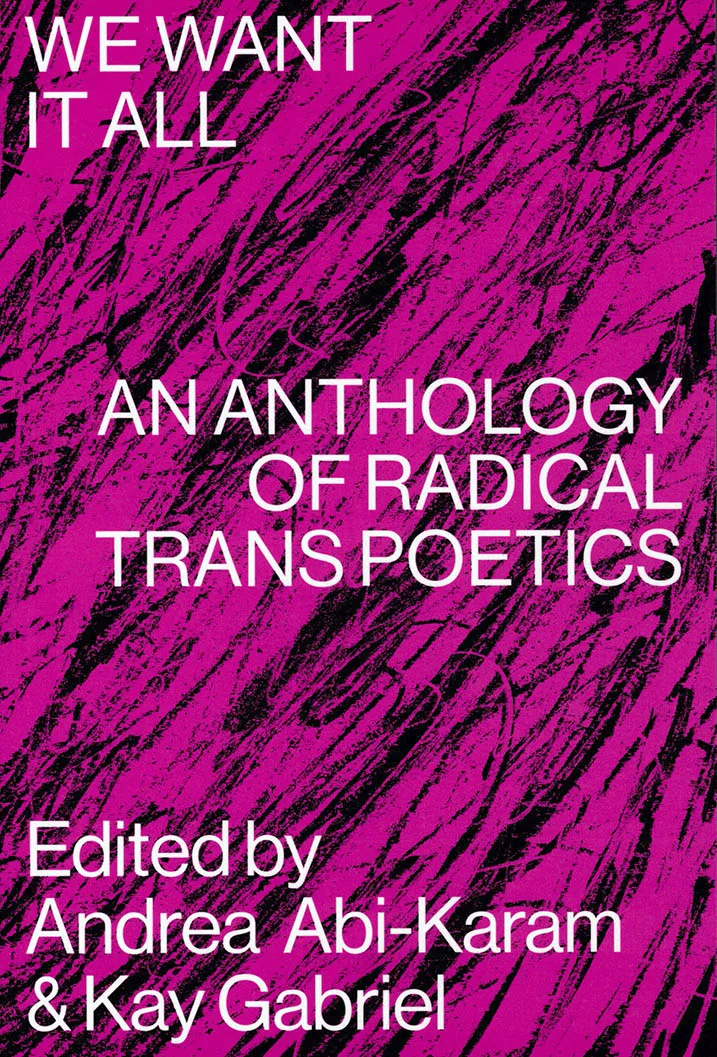
We Want It All: An Anthology of Radical Transpoetics
An anthology of formally inventive writing by trans poets against capital and empire.
With texts by: Andrea Abi-Karam, New York City Sam Ace, South Hadley, MA Bahaar Ahsan, Berkeley, CA jasper avery, Philadelphia, PA Ari Banias, Berkeley, CA Jo Barchi, Chicago, IL Joss Barton, St. Louis, MO Levi Bentley, Philadelphia, PA Jessica Bet, Baltimore, MA Rocket Caleshu, Los Angeles, CA Ching-in Chen, Seattle, WA listen chen, Vancouver, BC Faye Chevalier, Philadelphia, PA Cody-Rose Clevidence, Arkansas Miles Collins-Sibley, Easthampton, MA Valentine Conaty, New York City CA Conrad, Philadelphia, PA Jimmy Cooper, Rochester, MI Maxe Crandall, Oakland, CA José Díaz, Boston, MA Aaron El Sabrout, New Mexico Ian Khara Ellasante, Lewiston, ME Caelan Ernest, New York City, NY NM Esc, San Diego, CA joshua jennifer espinoza, Los Angeles, CA Logan February, Ibadan, Nigeria Ray Filar, Brighton, UK Nora Collen Fulton, Montreal, Canada Kay Gabriel, New York City Callie Gardner, Cardiff, Wales Jesi Gaston, Chicago, IL Harry Josephine Giles, Edinburgh, Scotland Aeon Ginsberg, Baltimore, MD Caspar Heinemann, Berlin, Germany Kamden Hilliard, Greenville, SC Stephen Ira, New York City Cyrée Jarelle Johnson, New York City Peach Kander, New York City Jayson Keery, Western, MA Evan Kleekamp, Los Angeles, CA Noah LeBien, New York City Ty Little, Richmond, VA Zavé Martohardjono, New York City Amy Marvin, Philadelphia, PA Natalie Mesnard, New York City Bianca Rae Messinger, Iowa City, IA Liam O'Brien, New York City Xandria Phillips, Madison, WI Rowan Powell, Santa Cruz, CA Nat Raha, Edinburgh, Scotland Holly Raymond, Philadelphia, PA Jackie S, New York City Trish Salah, Toronto, Canada Raquel Salas Rivera, Philadelphia, PA Mai Schwartz, New York City Kashif Sharma-Patel, London, UK Julian Talamantez Brolaski, Oakland, CA Charles Theonia, New York City Jamie Townsend, Oakland, CA Nora Treatbaby Laurel Uziell, London, UK Rachel Franklin Wood, Boulder, CO Clara Zornado Akasha-Mitra xtian w. and Anaïs Duplan, NYC.
Kay Gabriel is a poet and essayist. She's the author of Elegy Department Spring / Candy Sonnets 1 (BOAAT Press, 2017), the recipient of fellowships from Lambda Literary and the Poetry Project, and recently completed her PhD at Princeton University.
Andrea Abi-Karam is an arab-american genderqueer punk poet-performer cyborg, writing on the art of killing bros, the intricacies of cyborg bodies, trauma & delayed healing. Their chapbook, THE AFTERMATH (Commune Editions), attempts to queer Fanon's vision of how poetry fails to inspire revolution. Andrea's first book, EXTRATRANSMISSION (Kelsey Street Press, 2019), is a poetic critique of the U.S. military's role in the War on Terror.

Moral Abdication: How the World Failed to Stop the Destruction of Gaza
How most Western governments and elites have supported the destruction of Gaza and silenced voices calling for the rights of Palestinians.
Providing a record of the first six months of the war waged by the Israeli army after the 7 October attacks and drawing on a rich range of international sources, Didier Fassin examines how most Western governments have acquiesced in and often contributed to the destruction, by the Israeli army, of Gaza, its homes, infrastructures, hospitals, institutions of education, and civilian population. To justify their support and prevent criticism, they have provided an official version of the events, adopting the Israeli narrative. It was largely taken up by mainstream media, which ignored the experiences and perspectives of Palestinians. Dissenting voices were silenced. A policing of language and thought was imposed. Censorship and self-censorship became normalized.
To call for a ceasefire or to demand the respect of humanitarian law was enough to prompt the ever-ready accusation of antisemitism. Exploring the multiple dimensions of the extreme inequality of lives between the two sides of the conflict and analyzing the complex geopolitical, economic and ideological stakes that underlie it, Fassin intends to constitute an archive of this moral abdication. In his view, the abandonment of the values and principles proclaimed by Western elites to be foundational will leave a deep scar in the history of the world.

Repetition
An English translation of Peter Handke’s 1986 novel Repetition, previously out of print for a quarter of a century.
“In Repetition, Handke allows the peculiar light which illuminates the space under a leafy canopy or a tent canvas to glisten between words, placed here with astounding caution and precision; in doing so, he succeeds in making the text into a sort of refuge amid the arid lands which, even in the culture industry, grow larger day by day.” —W. G. Sebald
“In his earliest work … Handke found a way of conveying a state of mind … where words seem to come between you and the world, where nothing coheres or appears natural, and from the vantage-point of which the ease with which other people talk and go about their business seems deeply suspicious. But just as Kafka felt there were moments when, miraculously, a written sentence – even one written by himself – seemed full light, seemed to fill its own space and establish its own rhythm, and when even the whole story seemed mysteriously to stand as solidly in the world as a tree or a rock, so it has been with Handke. He has, in his later work, appeared to make a conscious effort to escape from the debilitating awareness of his own lack of authority or authenticity, and tried to write as though somehow the story were already written, had, in a sense, always been there… Repetition is the triumphant climax of his career so far…
What saves the book from the sort of sentimentality we find in John Berger’s recent work is first of all Handke’s uncanny ability to convey what it is this urge for pattern has to overcome, and secondly, his extraordinary attention to detail, historical, geographical, botanical, and linguistic. (No review can possibly convey the richness of Filip’s meditation on his brother’s two books, or Handke’s magical way with images.)
His narrative … is one of the most dignified and moving evocations I have ever read of what it means to be alive, to walk upon this earth.” —Gabriel Josipovici

Deer Book/Libro Venado
Inspired initially by Jerome Rothenberg’s translation Flower World Variations, which Cecilia Vicuña first encountered in 1985, Deer Book brings together nearly forty years of the artist’s poetry, “poethical” translations, and drawings related to cosmologies and mythologies surrounding the deer, and sacrificial dance in cultures around the world.
Woven like one of her quipu installations, Vicuña’s texts—which include original compositions in Spanish as well as English translations by Daniel Borzutzky—become meditations on translation, not just of the sacred nature of this animal but on how our understandings of ceremony and ritual are transformed, by this ongoing process. Taken as inspiration rather than conundrum, the impossibility of translation opens up poetic possibilities for Vicuña as she continues her lifelong exploration into the nature of communication across eras and distant lands, languages and shared symbols within Indigenous spiritualities.

Postmortem issue 1
Marina Mardas, François Peyroux and 1 more
How can we define and document our present?
Postmortem is a sensitive yet critical metaphor for a world suspended between collapse and reinvention—a diary of the now. Drawing together writers and artists from Europe and the SWANA region, this issue locates areas of tension that define our era. Far from a mere dialogue between regions, it exposes the inner and outer fractures of Western hegemony, unearthing shared emotions.
From reclaiming histories and narratives in the Arab world to deconstructing digital spaces as arenas of control and resistance—even exposing systemic exclusions embedded in blood donation policies—contributors reveal these tensions as a fertile terrain for dialogue and reflection.
Through critical essays, narrative writing, poetry, interviews, and contemporary art, the concept of Postmortem unfolds an in-between state where death and rebirth occur simultaneously. Across three interwoven chapters—Metaconnexion, Dissociation, and Fragmentation—the issue engages radically with body politics, othering, post-orientalism, surveillance, decoloniality, freedom, and resistance.
Both a chronicle and a hybrid object where text, design, and image interact, Postmortem archives a world in flux. Rather than prognosticate, it dissects the present as the essential site for reimagining our future.
Contributors : Sara El-Jazara, François Peyroux, Nadine Makarem, Soukaina Melhaoui, Louise Mervelet, Manon Schaefle, Marina Mardas, Irina Breitenstein, Amer Al-Dakar

Fuel
Traversing multivalent intimacies from the underworld of California’s Central Valley oil fields to the quotidian domestic and love’s painful retraction, Stockton’s poems articulate the blurry modes of extraction, fantasy, loss, gender, and labor as they interact and overlap in the shadow of environmental and personal collapse. Between gas station gifts, Venmo requests, and nocturnal love letters, Fuel unravels the self and violent systems of domination, longing for a togetherness that transcends its own ending.
In these poems, Stockton plunges into petrologic, long drives, the beginnings of ends—whatever enters into love between people and makes it so abstract, or common. In other words, its great subject is the edge, and Fuel is a book of horizons. - Benjamin Krusling
Rosie Stockton is the author of Permanent Volta (Nightboat Books 2021) which was the recipient of the Sawtooth Prize as well as being a finalist for the California Book Awards in Poetry and the Publishing Triangle’s Audre Lorde Award for Lesbian Poetry. Their poems have been published by Social Text Journal, VOLT, Jubilat, Apogee, Mask Magazine, Tripwire and WONDER PRESS. They hold an M.A. in Creative Writing from Eastern Michigan University and are currently a Ph.D. Candidate in the Gender Studies Department at UCLA. Rosie lives and works in Los Angeles.

Apparitions: (Nines)
Injecting the disruptive potential of collective action into the body of the poem, Nat Raha's invigorating experiment resuscitates Anglophone poetry.
Amidst the violence of capitalism and state and imperial power, there is Nat Raha's apparitions (nines) in its "charred golden minidress," ushering us into a space of grief and resistance, the embodiment and intimacy of queer, trans, and diasporic Black and brown people. Written as a series of "niners," a poetic form consisting of nine nine-syllable lines, apparitions (nines) is at once a brash and subversive rejoinder to the Anglophone sonnet, as well as an ode to beauty, collectivity, and tenderness which emerges from—and far surpasses—constraint.
"These poems are eccentric in the most literal sense, Raha’s writing pushing at the edges of the mainstream of poetry, presenting a punk, transfeminist revision of poetic norms. . . apparitions (nines) deserves to be read—for its insights and newness, and the studs of pleasure it doles out." - Lou Selfridge, Frieze
“Welcome the poems that split us open, ‘frequencies/ to be removed from the air.’ Nat Raha has sharpened the lines, their serrated letters leaving us marked, poems to touch again on the skin, feel our doom undo its direction for enduring solidarity; the best love.” - CAConrad
Dr Nat Raha is a poet and activist-scholar whose previous books of poetry include of sirens, body & faultlines (2018), countersonnets (2013), and Octet (2010). Her work has appeared in 100 Queer Poems (2022), We Want It All: An Anthology of Radical Trans Poetics (Nightboat, 2020), Liberating the Canon: An Anthology of Innovative Literature (2018), on Poem-a-Day, and in South Atlantic Quarterly, TSQ: Transgender Studies Quarterly, Transgender Marxism,and Wasafiri Magazin. With Mijke Van der Drift, she co-edits the Radical Transfeminism zine and has co-authored articles for Social Text, The New Feminist Literary Studies, and the book Trans Femme Futures: Abolitionist Ethics for Transfeminist Worlds. Nat completed her PhD in queer Marxism at the University of Sussex, and is Lecturer in Fine Art Critical Studies at the Glasgow School of Art.