rile*books

Search books

Search books by title, author, publisher, keywords...

Explore

Categories
Visit
Collections
Publishers
Back in stock
Any books
Cover of Mother Media: Hot and Cool Parenting in the Twentieth Century

The MIT Press

Mother Media: Hot and Cool Parenting in the Twentieth Century

Hannah Zeavin

€35.00

An essential history for understanding how we mother now, and how motherhood itself became a medium—winner of the Brooke Hindle Award from the Society for the History of Technology.

From the nursery to the prison, from the clinic to the commune, Mother Media tells the story of how we arrived at our contemporary understanding of what a mother is and how understandings of “bad” mothering formed our contemporary panics about “bad” media. In this book, leading historian of psychology Hannah Zeavin examines twentieth-century pediatric, psychological, educational, industrial, and economic norms around mediated mothering and technologized parenting. The book charts the crisis of the family across the twentieth century and the many ingenious attempts to remediate nursemaid and mother via speculative technologies and screen media. 

Growing out of her previous award-winning book The Distance Cure, which considered technologized care, the book lays bare the contradictions of techno-parenting and how it relates to conceptions of “maternal fitness,” medical redlining, and surveillance of children, parents, and other caregivers. The author offers narratives of parenting in its extremity (for example, Shaken Baby Syndrome) and its ostensible banality (for example, the Nanny Cam) and how the two are often intertwined. Ultimately, Zeavin grapples with a simple contradiction: technology is seen and judged as harmful in domestic and educational spaces, even as it is a saving grace in the unending labor of raising a family.

Hannah Zeavin is Associate Professor of the History of Science in the Department of History and the Berkeley Center for New Media at UC Berkeley. She is the author of The Distance Cure and Mother Media (MIT Press) and Founding Editor of Parapraxis. In 2021, she cofounded The Psychosocial Foundation.

Published in 2025 ┊ 320 pages ┊ Hardcover ┊ Language: English

recommendations

Cover of What Is Sex?

The MIT Press

What Is Sex?

Alenka Zupančič

Why sexuality is at the point of a "short circuit" between ontology and epistemology.

Consider sublimation, conventionally understood as a substitute satisfaction for missing sexual satisfaction. But what if, as Lacan claims, we can get exactly the same satisfaction that we get from sex from talking (or writing, painting, praying, or other activities)? The point is not to explain the satisfaction from talking by pointing to its sexual origin, but that the satisfaction from talking is itself sexual. The satisfaction from talking contains a key to sexual satisfaction (and not the other way around), even a key to sexuality itself and its inherent contradictions. The Lacanian perspective would make the answer to the simple-seeming question, "What is sex?" rather more complex. In this volume in the Short Circuits series, Alenka Zupančič approaches the question from just this perspective, considering sexuality a properly philosophical problem for psychoanalysis; and by psychoanalysis, she means that of Freud and Lacan, not that of the kind of clinician practitioners called by Lacan "orthopedists of the unconscious."

Zupančič argues that sexuality is at the point of a "short circuit" between ontology and epistemology. Sexuality and knowledge are structured around a fundamental negativity, which unites them at the point of the unconscious. The unconscious (as linked to sexuality) is the concept of an inherent link between being and knowledge in their very negativity.

Cover of Discomania

The MIT Press

Discomania

Jennifer Gibbons

Fiction €22.00

A young woman discovers that dancers at a local discotheque are being driven to acts of insane violence.

“The place was full of swarming, pugnacious, dangerous missellneous reptile's… Teenager's everywhere pounded their way on top of each other crazily strangling, biting and slashing each other's with broken glass, smashed records or sharpened blades… ”

16-year-old Jennifer Gibbons (1963–1993) wrote Discomania in 1980, alongside her twin sister June-Alison, who was also writing her own novel, The Pepsi Cola Addict, in the bedroom that they shared.

Jennifer offered Discomania to the same English vanity press who would publish June-Alison's book, but Discomania was turned down for being “too violent, too sexual, and too futuristic.”

Long thought to have been lost or destroyed, June-Alison had in fact preserved the typescript of this unique, furious, funny, and strange novel, which we present with her blessing, alongside additional texts from June-Alison, and editors David Tibet and Ania Goszczyńska.

Cover of Anarchitecture After Everything: A Trans Manifesto

The MIT Press

Anarchitecture After Everything: A Trans Manifesto

Jack Halberstam

A revolutionary way of seeing bodies and built environment that unites radical politics and trans aesthetics. 

From a leading author and queer theorist known for reframing many of the most pressing questions about counter-intuitive ways of being. 

Anarchitecture, a radical aesthetic practice of unmaking the built environment, staged a vigorous confrontation with urban renewal and gentrification projects in the 1970s. In Anarchitecture After Everything, Jack Halberstam identifies a powerful lexicon of transformation within anarchitecture, joining the movement’s practices of cutting and splitting with the destabilizing power of transness to detonate acts of formal violence in our time. 

Anarchitecture describes the aesthetic practice of splitting and cutting, dismantling and undoing, unmaking, unbuilding, and ultimately unworlding. The trans body splits bodily coherence, dismantles the gender binary, and unbuilds bodily meaning. In these chapters, Gordon Matta-Clark’s cuts, along with Alvin Baltrop’s 1970s images of collapsing warehouses and Beverly Buchanan’s post-demolition fragmentary sculptures, return with a vengeance through the contemporary aesthetic gestures of Yve Laris Cohen, Jesse Darling, Nicole Eisenman, Kiyan Williams, Cassils, boychild, and Every Ocean Hughes. Anarchitecture unmakes space and offers a new rhetoric for emptiness. In its conclusion, the book explores this rhetoric through Renee Gladman’s anarchitectural experiments with language. 

By reading anarchitecture through transness and transness through anarchitecture, Halberstam helps us see the trans body as a space of radical unmaking and as a portal to new lexicons for transformation.

Cover of Perfect Victims: And the Politics of Appeal

Haymarket Books

Perfect Victims: And the Politics of Appeal

Mohammed El-Kurd

Non-fiction €18.00

Perfect Victims is an urgent affirmation of the Palestinian condition of resistance and refusal―an ode to the steadfastness of a nation.

Palestine is a microcosm of the on fire, stubborn, fragmented, dignified. While a settler colonial state continues to inflict devastating violence, fundamental truths are deliberately obscured—the perpetrators are coddled while the victims are blamed and placed on trial.

Why must Palestinians prove their humanity? And what are the implications of such an infuriatingly impossible task? With fearless prose and lyrical precision, Mohammed El-Kurd refuses a life spent in cross-examination. Rather than asking the oppressed to perform a perfect victimhood, El-Kurd asks friends and foes alike to look Palestinians in the eye, forgoing both deference and condemnation.

How we see Palestine reveals how we see each other; how we see everything else. Masterfully combining candid testimony, history, and reportage, Perfect Victims presents a powerfully simple dignity for the Palestinian.

Cover of Nan Vant solèy la

GenderFail

Nan Vant solèy la

Abigail Lucien

Poetry €24.00

Through creative nonfiction, poetry, and the printed image, the publication considers the playful and purposeful self-actualization of a bicultural queer identity while navigating grief as a landscape to address themes of (be)longing, futurity, and place. Alongside a collection of their works and research, Abigail Lucien weaves written and visual offerings by fellow Caribbean and queer artists, including works by Lukaza Branfman-Verissimo, Justin Chance, Cielo Felix-Hernandez, Sucking Salt, and Tamara Santibañez, to create an expanded context for their work rooted in friendship and radical love.

Abigail Lucien (b.1992) is a Haitian-American interdisciplinary artist, educator, auntie, lover, and friend. Working in sculpture, literature, and time-based media, Lucien’s practice addresses themes of (be)longing, futurity, myth, and place by considering our relationship to inherited colonial structures and systems of belief/care. Past exhibitions include SculptureCenter (NY), MoMA PS1 (NY), Deli Gallery (NY), MAC Panamá (Panamá), Frost Art Museum (Miami, FL), Atlanta Contemporary (Atlanta, GA), UICA (Grand Rapids, MI), and The Fabric Workshop and Museum (Philadelphia, PA). Residencies include Amant Studio & Research Residency (NY), Skowhegan School of Painting & Sculpture (Madison, ME), the Eugeniusz Geppert Academy of Fine Arts (Wrocław, Poland), The Luminary (St. Louis, MO), Santa Fe Art Institute (Santa Fe, NM), ACRE (Steuben, WI), and Ox-Bow School of Art & Artist Residency (Saugatuck, MI).

Lucien has taught as a full-time faculty member and professor in the Department of Sculpture & Extended Media at Virginia Commonwealth University and the Interdisciplinary Sculpture Department at the Maryland Institute College of Art. In the fall of 2023, they will join the Department of Art and Art History as an Assistant Professor of Sculpture at Hunter College in NYC. Deli Gallery represents Abigail Lucien.

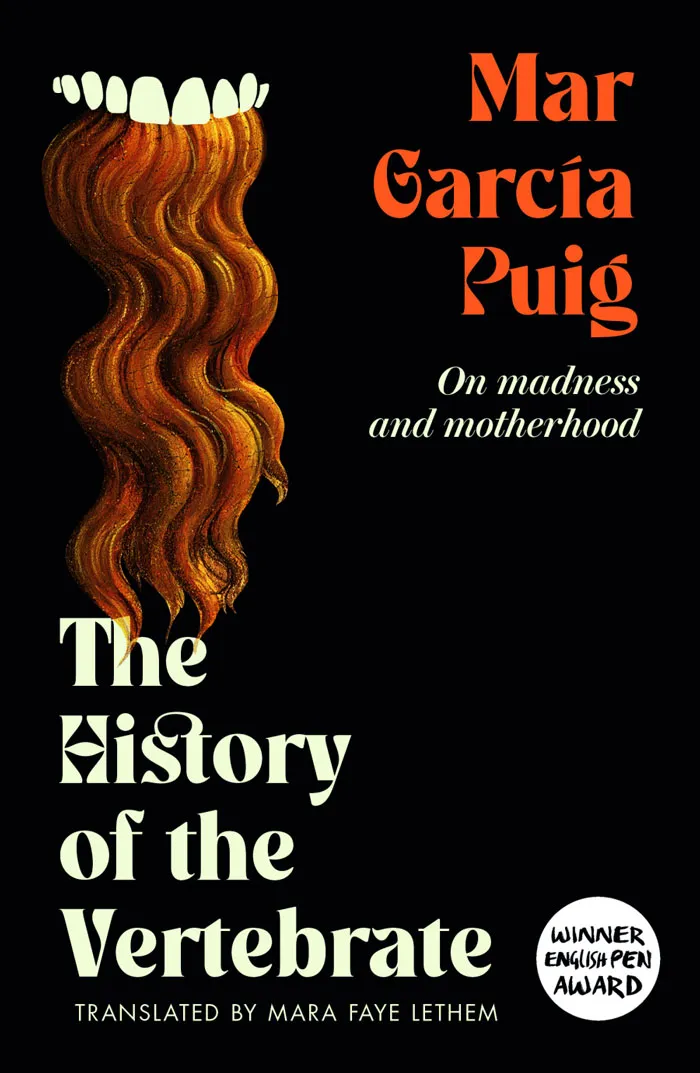
Cover of The History of the Vertebrate

Peninsula Press

The History of the Vertebrate

Mar García Puig, Mara Faye Lethem

Mothering €19.00

‘On 20 December 2015 I became a mother and I went mad.’ 

On a single day, Mar García Puig gives birth to twins and becomes elected to the Spanish Parliament as a member of the insurgent left-wing party Podemos. What might have been the best day of her life becomes the start of a terrifying ordeal; García Puig’s grip on reality begins to slip as she grapples with uncertainty, the weight of expectation, and misogyny in both of her new roles. 

In defiance of a culture that tells her the problem lies within, García Puig chooses to look outwards, examining the imbrication of madness and motherhood across centuries of science, myth, and politics while dissecting the ways in which women have been pathologized and banished from public life. 

At once intimate and epic, The History of the Vertebrate is a searing account of postpartum madness. Moving between memory, culture, and the history of medicine, García Puig transforms her experience into a story about the countless women who have felt that sanity was leaving them, and about the patriarchal forces that have silenced them. 

MAR GARCÍA PUIG is an editor and author. From 2015 to 2023 she was a member of the Spanish Congress of Deputies for Podemos, where she served on the Culture Committee and the Equality Committee. Her books include The History of the Vertebrate and This Thing of Darkness.

Cover of Last Movies

Tenement Press

Last Movies

Stanley Schtinter

A publication, durational artwork, and moving-image experience, Schtinter’s debut collection, Last Movies, is an alternative account of the first century of cinema according to the films watched by  a constellation of its most notable stars shortly  before (or at the time of) their deaths.

An extensive and exhaustive research project—a holy book of celluloid spiritualism and old canards—Schtinter questions and reconfigures common knowledge to recast the historic column inches of cinema’s mythological hearsay into a thousand-yard stare. 

Via a series of interlinked vignettes, here we’ve a book in which Manhattan Melodrama, directed by W.S. Van Dyke and George Cukor, is seen by American gangster John Dillinger, only for him to be gunned down by federal agents upon leaving the cinema. In which George Cukor watches The Graduate and dies thereafter. In which Bette Davis—given her break by Cukor—watches herself in Waterloo Bridge (the 1940 remake Cukor had been meant to direct), before travelling to France and failing to make it back to Hollywood. In which Rainer Werner Fassbinder watches Bette Davis in Michael Curtiz’s 20,000 Years in Sing Sing, and suffers the stroke that kills him. In which John F. Kennedy watches From Russia with Love at a private ‘casa-blanca’ screening prior to the presidential motorcade reaching Dealey Plaza; in which Burt Topper’s War is Hell exists only in a fifteen-minute cut, considering this is as much as Lee Harvey Oswald would have seen at the Texas Theatre in the wake of JFK’s killing.

Cover of Hand That Touch This Fortune Will

Ma Bibliotheque

Hand That Touch This Fortune Will

Sam Dolbear

Enchanted €18.00

Take my hand. Trace the lines on my palm with your fingers. What size and shape are they? Take note of their form: are they forked, tasselled, wavy, chained, broken? Now examine my fingers. Tell me my disposition; tell me what beholds me.

Mapping the hand as cosmos as clinic as history as biography, hand reading is a technique suspended between medical and mystical judgement, empirical diagnosis and speculative divination. This book weaves the lives and work of the ‘reader’ and the ‘read’ together in an intricate fabric. The central ‘reader’ is Charlotte Wolff (1897–1986), a friend of Walter Benjamin, Helen Grund, and Ernst Schoen, who after fleeing from Germany’s new regime in 1933, took up hand reading in Paris to make ends meet. The ‘read’ are anonymous acrobats, dancers, and department-store managers, and members of the avant-gardes of Paris and London, from Antonin Artaud to Romola Nijinsky, Marcel Duchamp to Virginia Woolf. Arranged as an index, this book is both a guide to the techniques of hand reading and a critical theory of its history and practice, mixed with Wolff’s later work as a theorist of gender and sexuality.

"Hand That Touch This Fortune Will is a study devoted to friendship, refracted through the portal of the upturned palm. Charlotte Wolff met the world by examining what was written on the hands of the times.  What did she read in the landscapes of this intimate organ of touch, and what, through reading, was she fatally unable to see?  Through a gentle fragmentation reminiscent of The Arcades Project, Dolbear acts as a thoughtful guide through fascinating and nearly forgotten passages in the European history of palmistry under late capitalism—along with all the political uncertainties and faggy gestures that formed its nimbus.  With extraordinary attention to the peculiar experiments in living that have scarcely left a trace in the archive, Hand That Touch gathers the reader around those bars, clinics, and drawn curtains, where, under the shadow of fascist diagnosis, the occult comes palm to palm with the queer past." — M. Ty

Each book holds a very lovely insert of a hand reading chart, designed by Ana Cecilia Breña and Sam Dolbear. Printed on tracing paper, it allows the reader to read their hand as they read the book.

Sam Dolbear was a Fellow at the ICI Berlin Institute for Cultural Inquiry in Berlin from 2020 to 2024. His research addresses the life and work of Walter Benjamin and those around him. He has taught and published widely, including, with Esther Leslie, Dissonant Waves: Ernst Schoen and Experimental Sound in the 20th Century (2023). He is a co-founder of the sound and radio collective MayDay Radio.