rile*books

Search books

Search books by title, author, publisher, keywords...

Explore

Categories
Visit
Collections
Publishers
Back in stock
Any books
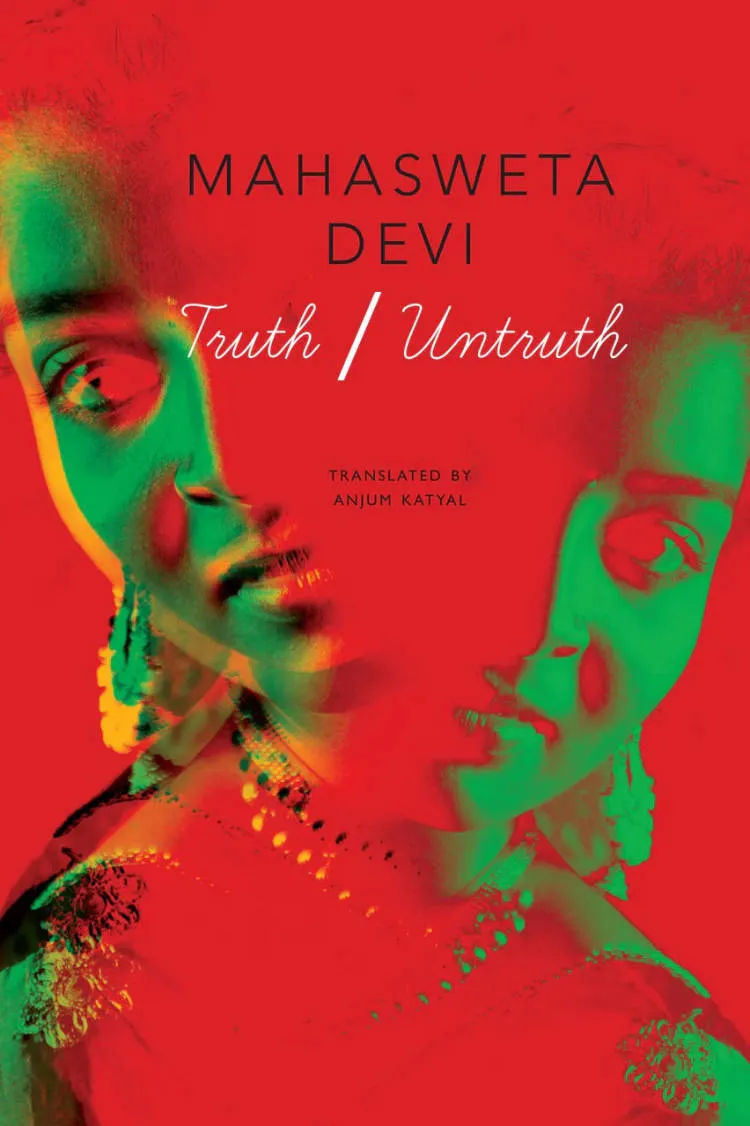
Cover of Truth / Untruth

Seagull Books

Truth / Untruth

mahasweta devi, Anjum Katyal

€22.00

A trenchant, darkly humorous, and unsentimental look at Calcutta society. 

Set in Calcutta in the mid-1980s, Truth/Untruth is a fast-paced thriller built around the death of the pregnant Jamuna—a maid in a newly affluent residential apartment complex—and Arjun, the upwardly mobile businessman who seduced her. Packed with a cast of colourful characters, this novel is a trenchant, darkly humorous, and unsentimental look at the different segments of Calcutta society: from the middle-class culture vultures to the unscrupulous ‘promoter’ class and the domestic helpers and slum goons who form an intrinsic part of the city’s life. All are implicated in a complex web of guilt and bizarre twists and turns. Sex, lies, death—the great modernist themes—run like a thread through this book, exposing societal greed, lust, corruption, and moral hypocrisy with a sardonic tone that spares none. An unusual novel by an author who is otherwise known for her hard-hitting activist-feminist stories, Truth/Untruth underlines the exploitative vicious cycle that defines urban relations between the haves and have-nots.

‘Although not of the margins herself, Devi was accomplished in writing from the margins [ . . . ] However, it is indeed worth it if you are looking for an exhilarating social commentary and biting satire that remains relevant today. Devi also reflects the jargon and dialects of the lower classes as deftly as the peculiarities of upper-class speech patterns. A feat of this work is Katyal’s ability to mediate these multiple registers, rewarding the reader with sharp writing that is at once funny, sardonic, and darkly pleasurable to read.‘—Jack Greenbert, Cha: An Asian Literary Journal.

Published in 2023 ┊ 144 pages ┊ Hardcover ┊ Language: English

recommendations

Cover of Living Translation

Seagull Books

Living Translation

Gayatri Chakravorty Spivak

Living Translation offers a powerful perspective on the work of distinguished thinker and writer Gayatri Chakravorty Spivak, revealing how, throughout her long career, she has made translation a central concern of the comparative humanities.

Starting with her landmark "Translator's Preface" to Jacques Derrida's Of Grammatology in 1976, and continuing with her foreword to Mahasweta Devi's Draupadi and afterword to Devi's Chotti Munda and His Arrow, Spivak has tackled questions of translatability. She has been interested in interrogating the act of translation from the ground up and at the political limit. She sees at play at border checkpoints, at sites of colonial pedagogy, in acts of resistance to monolingual regimes of national language, at the borders of minor literature and schizo-analysis, in the deficits of cultural debt and linguistic expropriation, and, more generally, at theory's edge, which is to say, where practical criticism yields to theorizing in untranslatables.

This volume also addresses how Spivak's institution-building as director of comparative literature at the University of Iowa—and in her subsequent places of employment—began at the same time. From this perspective, Spivak takes her place within a distinguished line-up of translator-theorists who have been particularly attuned to the processes of cognizing in languages, all of them alive to the coproductivity of thinking, translating, writing.

Cover of Passage to the Plaza

Seagull Books

Passage to the Plaza

Sahar Khalifeh

Fiction €24.50

In Bab Al-Saha, a quarter of Nablus, Palestine, sits a house of ill repute. In it lives Nuzha, a young woman ostracized from and shamed by her community. When the Intifada breaks out, Nuzha’s abode unexpectedly becomes a sanctuary for those in the quarter: Hussam, an injured resistance fighter; Samar, a university researcher exploring the impact of the Intifada on women’s lives; and Sitt Zakia, the pious midwife.

In the furnace of conflict at the heart of the 1987 Intifada, notions of freedom, love, respectability, nationhood, the rights of women, and Palestinian identity—both among the reluctant residents of the house and the inhabitants of the quarter at large—will be melted and re-forged. Vividly recounted through the eyes of its female protagonists, Passage to the Plaza is a groundbreaking story that shatters the myth of a uniform gendered experience of conflict.

Cover of  The Book of Sleep

Seagull Books

The Book of Sleep

Haytham El-Wardany, Robin Moger

Non-fiction €17.00

What is sleep? How can this most unproductive of human states—metaphorically called death's shadow or considered the very pinnacle of indolence—be envisioned as action and agency? And what do we become in sleep? What happens to the waking selves we understand ourselves to be?

Written in the spring of 2013, as the Egyptian government of President Mohammed Morsi was unraveling in the face of widespread protests, The Book of Sleep is a landmark in contemporary Arabic literature. Drawing on the devices and forms of poetry, philosophical reflection, political analysis, and storytelling, this genre-defying work presents us with an assemblage of fragments that combine and recombine, circling around their central theme but refusing to fall into its gravity.  

"My concern was not to create a literary product in the conventional sense, but to try and use literature as a methodology for thinking," El Wardany explains. In this volume, sleep shapes sentences and distorts conventions. Its protean instability throws out memoir and memory, dreams and hallucinatory reverie, Sufi fables and capitalist parables, in the quest to shape a question. The Book of Sleep is a generous and generative attempt to reimagine possibility and hope in a world of stifling dualities and constrictions.

Cover of The Seers

Prototype Publishing

The Seers

Sulaiman Addonia

Fiction €16.00

The Seers follows the first weeks of a homeless Eritrean refugee in London. Set around a foster home in Kilburn and in the squares of Bloomsbury, where its protagonist Hannah sleeps, the novel grapples with how agency is given to the sexual lives of refugees, insisting that the erotic and intimate side of life is as much a part of someone’s story as ‘land and nations’ are.

Hannah arrives in London with her mother’s diary, containing a disturbing sexual story taking place in Keren, Eritrea, where the Allies defeated the Italians in the Second World War. In a gripping, continuous paragraph, The Seers moves between the present day and the past to explore intergenerational histories and colonial trauma alongside the psychological and erotic lives of its characters as their identities are shaped, but refused to be suppressed, by the bureaucratic processes of the UK asylum system. 

Sulaiman Addonia is an Eritrean-Ethiopian-British novelist. He spent his early life in a refugee camp in Sudan, and his early teens in Jeddah, Saudi Arabia. He arrived in London as an underage unaccompanied refugee without a word of English and went on to earn an MA in Development Studies from SOAS and a BSc in Economics from UCL. His first novel, The Consequences of Love (Chatto & Windus, 2008), was shortlisted for the Commonwealth Writers’ Prize and was translated into more than 20 languages. His second novel, Silence is My Mother Tongue (Indigo Press, 2019; Graywolf, 2020), was a Finalist for the Lambda Literary Awards 2021, the Firecracker (CLMP) Awards, the inaugural African Literary Award from The Museum of the African Diaspora (MoAD) in San Francisco, and longlisted for the 2019 Orwell Prize for Fiction. Addonia’s essays appear in LitHub, Granta, Freeman’s, The New York Times, De Standaard and Passa Porta. He is a contributor to Tales of Two Planets (Penguin, 2020) and Addis Ababa Noir (Akashic Books, 2020). 

Cover of Practicing Dying

Pilot Press

Practicing Dying

Charlotte Northall

Fiction €19.00

Practicing Dying is a literary anti-memoir documenting life in a Zen Buddhist monastery in rural France where the protagonist, a woman in her late twenties, attempts to overcome chronic drug addiction and mental illness. 

Broken and severely unwell, our protagonist arrives at the monastery from London: starving, drug-addicted and disillusioned, having exhausted every conventional treatment route available to her. The book examines how, habituated to a life of benefits assessments, petty-crime and sex work, she struggles to adjust to the rules, discipline and religious life of the monastery—at times to devastating and comedic effect. 

As the story unfolds, she reflects on her addictions and past experiences, raising critical questions about what it means to be "an addict" and why there may be vested corporate and societal interests in maintaining a narrow, individualistic understanding of addiction. 

Anarchic and provocative, tender and self-deprecating, Practicing Dying differs from other contemporary memoirs in the genre of addiction-recovery by simultaneously challenging the dominant narratives surrounding mental health while proposing an alternative approach to treating the “sickness of self” from which we all increasingly suffer. 

‘Practicing Dying is brilliant, rewarding and difficult. Northall offers the most brazen and shocking account of addiction I’ve ever read. Committing herself to the practice of Mahayana Buddhism, she eventually finds a way out, but only on the most rambling, circuitious path. Her account of addiction and loss, displacement and grief is profound and it proves that nothing is ever one thing.’ — Chris Kraus, author of The Four Spent The Day Together

Charlotte Northall is a London-based writer. Her debut, Practicing Dying, blends autobiography and cultural criticism to explore addiction, capitalism, and spiritual practice. She works with rough sleepers, supporting those living with addiction and complex mental health needs.

Cover of Information Age

Joyland Editions

Information Age

Cora Lewis

Fiction €18.00

The narrator of Information Age is a journalist at an online news site reporting on technology, the economy, and politics in the late 2010s. The rate of increasingly short news cycles shapes her working life and her personal life, as she assumes the role of reporter while talking with engineers, analysts, wonks, artists, writers, musicians, friends, family, and lovers. Told in vignettes and dialogue—overheard and divulged—Information Age is spare, funny, and attentive, a playful blurring of public and private life.

Cora Lewis is a writer and reporter whose fiction has appeared at The Yale Review, Joyland Magazine, Epiphany, and elsewhere. She currently works at the Associated Press in New York, and she previously worked at BuzzFeed News. She lives in Brooklyn near Sunset Park.

Cover of Sarahland

éditions Burn~Août

Sarahland

Sam Cohen, Sarah Netter

Fiction €14.00

Sarahland est un ouvrage de fiction américain contemporain qui se découpe en dix nouvelles, toutes reliées par les personnages de Sarahs et leurs parcours initiatiques à la fin de l’adolescence. Sam Cohen, autrice queer et juive, déploie un univers drôle et piquant autour des notions d’identité, de transition, de transformation, d’émancipation et d’apprentissage. Au fil d’histoires inventives, l’autrice explore la manière dont les narratifs qui nous sont assignés, les récits traditionnels, les identités qui nous pré-existent, sont dépassables. Elle construit alors avec ses personnages — presque toutes prénommées Sarah — de nouvelles histoires pour leurs passés ou leurs futurs, de nouvelles façon d’aimer la terre et ceux qui la peuplent, de nouvelles possibilités de vie en soi. Dans le refus pour chaque Sarah d’adhérer à un récit unique et uniformisant, l’autrice propose un lieu potentiellement meilleur pour nous toustes, un espace narratif qui n’exige aucune fixation de soi, aucune injonction consumériste, aucun compromis corporel: un lieu appelé Sarahland.

Née à Detroit aux États-unis, Sam Cohen vit et travaille actuellement à Los Angeles. Elle est une autrice de fiction dont les romans explorent des thèmes à l’intersection du féminisme, des études queers, et des pensées juives. Après avoir publié dans différentes anthologies et revues littéraires (Queer Flora, Fauna, and Funga, Weird Sister Collection, etc.), elle publie en 2021 Sarahland, un recueil de nouvelles. Elle enseigne l’écriture à l’université en tant que professeur d’écriture créative. Elle a été nommée et à gagné à de nombreux prix littéraires, notamment le ALMA Award (Best Jewish Story Collection of 2021), le Jewish Women’s Archive Book List, le Golden Poppy Award in Fiction (finaliste) ou encore le Chautauqua Janus Prize. Elle est en cours d’écriture de son prochain livre.

Cover of Empire of the Senseless

Grove Press

Empire of the Senseless

Kathy Acker

Fiction €16.00

Originally published in 1988, Empire of the Senseless marked a turning point in Acker's wild, inimitable style. Considered one of her more accessible works, here Acker candidly addresses her lifelong obsessions: childhood and trauma, language and sexuality, criminality and corruption, oppression and rebellion.

Abhor (part human, part robot) and her lover Thivai (a pirate) traverse Paris in a dystopian future, in search of a mysterious drug that Thivai needs in order to maintain his ability to love. Navigating the chaotic city, they encounter mad doctors, prisoners, bikers, sailors, tattooists, terrorists, and prostitutes, while a band of Algerian revolutionaries take over, and the C.I.A. plots to thwart them all.

Sexually explicit, graphically violent, Empire of the Senseless resists the desensitizing of cultural consciousness and the disintegration of interpersonal communication. A timeless, prescient parable, it speaks profoundly to our social and political history as well as our present reality.