Books
Books
published in 2020

Rejected. Designs for the European Flag
The flag bearing twelve yellow stars on a blue background has become Europe’s most recognisable symbol. Since its introduction by the Council of Europe in 1955, it has stood for the unification of Europe’s nation states. It was precisely this yellow circle of stars that prevailed over more than 150 flag ideas sent to the Council of Europe by a host of diverse private individuals. These colourful designs are being now published in Rejected for the first time. They document the continent’s zeitgeist at a decisive period in the development of European unity. Alongside the flag proposals, the trilingual book (English, German, French) features a written contribution by the German-French poet and writer Marie Rotkopf, who tackles the EU’s neoliberal political cynicism and Germany’s expansion of power with biting irony.

Undrowned: Black Feminist Lessons from Marine Mammals
Undrowned is a book-length meditation for social movements and our whole species based on the subversive and transformative guidance of marine mammals. Our aquatic cousins are queer, fierce, protective of each other, complex, shaped by conflict, and struggling to survive the extractive and militarized conditions our species has imposed on the ocean. Gumbs employs a brilliant mix of poetic sensibility and naturalist observation to show what they might teach us, producing not a specific agenda but an unfolding space for wondering and questioning. From the relationship between the endangered North Atlantic Right Whale and Gumbs's Shinnecock and enslaved ancestors to the ways echolocation changes our understandings of "vision" and visionary action, this is a masterful use of metaphor and natural models in the service of social justice.
With Foreword by adrienne maree brown
Alexis Pauline Gumbs is a poet, independent scholar, and activist. She is the author of Spill: Scenes of Black Feminist Fugitivity, M Archive: After the End of the World, and Dub: Finding Ceremony; coeditor of Revolutionary Mothering: Love on the Front Lines; and the founder of Brilliance Remastered, an online network and series of retreats and online intensives serving community accountable intellectuals and artists.

keeps crashing down the same
keeps crashing down the same period in my text between the paragraphs and i forgot about the crush is a book by Stine Sampers, 114 pages of her collected "predictive text songs" written between April 2018 and January 2019 in Brussels, Ghent, Antwerp, Alveringem, Amsterdam and Berrias-et-Casteljau with a Samsung Galaxy S5 (stolen in October 2018 in Brussels) and a Samsung Galaxy S7 (that had to be taught vocabulary). Cover image by Deveny Faruque, afterword by Maru Mushtrieva:
"Here, the longing for the Other – unsurmountable distance – is actualized not only by the content but also by the compositional design itself. What at first glance appears to be a stream of consciousness, is in fact a synthesis of vocabulary from past text messages. While composing them, Stine Sampers used her phone’s algorithm to decide what to say next, with suggestions coming from the text messages previously exchanged with her friends. The words from different contexts, once chosen carefully, now belong to the careless vocabulary of a machine, welcomed into a loop of misrecognition."
Published Nov 2020

X-RISK
From forecasts of disastrous climate change to prophecies of evil AI superintelligences and the impending perils of genome editing, our species is increasingly concerned with the prospects of its own extinction. With humanity's future on this planet seeming more insecure by the day, in the twenty-first century, existential risk has become the object of a growing field of serious scientific inquiry. But, as Thomas Moynihan shows in X-Risk, this preoccupation is not exclusive to the post-atomic age of global warming and synthetic biology. Our growing concern with human extinction itself has a history.
Tracing this untold story, Moynihan revisits the pioneers who first contemplated the possibility of human extinction and stages the historical drama of this momentous discovery. He shows how, far from being a secular reprise of religious prophecies of apocalypse, existential risk is a thoroughly modern idea, made possible by the burgeoning sciences and philosophical tumult of the Enlightenment era. In recollecting how we first came to care for our extinction, Moynihan reveals how today's attempts to measure and mitigate existential threats are the continuation of a project initiated over two centuries ago, which concerns the very vocation of the human as a rational, responsible, and future-oriented being.

Outline of My Lover
The twentieth anniversary edition of an early autofiction classic.
Born in Virginia and raised in Georgia, Douglas A. Martin moved to New York at 25 and now resides in Brooklyn. Douglas's writing spans fiction and nonfiction, traversing poetry and prose. Martin's works have been translated into Italian, Japanese, and Portuguese. Past books include: Once You Go Back (Lambda Award nomination in the Gay Memoir/Biography category), Branwell (Ferro-Grumley Award finalist), a book of stories, and volumes of poetry. An early autofiction, Outline of My Lover, was named an International Book of the Year in The Times Literary Supplement and adapted in part by the Forsythe Company for their ballet and live film "Kammer/Kammer." Publications with Nightboat Books include a book-length essay and lyric study, Acker, and the triptych of novellas, Your Body Figured.

The Sense of Brown
The Sense of Brown is José Esteban Muñoz's treatise on brownness and being as well as his most direct address to queer Latinx studies. In this book, which he was completing at the time of his death, Muñoz examines the work of playwrights Ricardo Bracho and Nilo Cruz, artists Nao Bustamante, Isaac Julien, and Tania Bruguera, and singer José Feliciano, among others, arguing for a sense of brownness that is not fixed within the racial and national contours of Latinidad.
This sense of brown is not about the individualized brown subject; rather, it demonstrates that for brown peoples, being exists within what Muñoz calls the brown commons—a lifeworld, queer ecology, and form of collectivity. In analyzing minoritarian affect, ethnicity as a structure of feeling, and brown feelings as they emerge in, through, and beside art and performance, Muñoz illustrates how the sense of brown serves as the basis for other ways of knowing and being in the world.

Défense d’Afficher
Défense d’Afficher est un recueil de graffitis politiques relevés en France tout au long de l’année l’année 2019, une période riche en contestations sociales. Une sélection restreinte, à fortiori non exhaustive, mais recouvrant un large panorama des luttes contemporaines qui nous concernent : contre le capitalisme, contre le racisme, contre le pillage du tiers-monde et pour l'accueil des réfugiés, contre le sexisme et les violences faites aux femmes, contre la destruction de la planète, contre cette société néo-libérale, contre la police et ses violences, contre les inégalités sociales, pour l’auto-défense et l’auto-organisation.
Sans oublier d’y faire apparaitre des sujets plus légers ou drôles. Le corps de l’ouvrage qui recueille les graffitis est imprimé sur six affiches jaunes fluo 50 × 70 cm pliées encartées, soutenu par une couverture muette au motif abstrait de peinture à la bombe. L’ensemble est recouvert d’une jaquette imprimée sur des affiches dos bleu accueillant le titre Défense d’Afficher, lui aussi relevé dans l’espace public. Ce fanzine à été produit suite à l’invitation « Impressions libres » d’Étapes et Exaprint.
Ce fanzine étant vendu à prix libre, il n’est pas possible de l’acheter en ligne. N’hésitez pas à nous contacter pour les modalitées de vente.
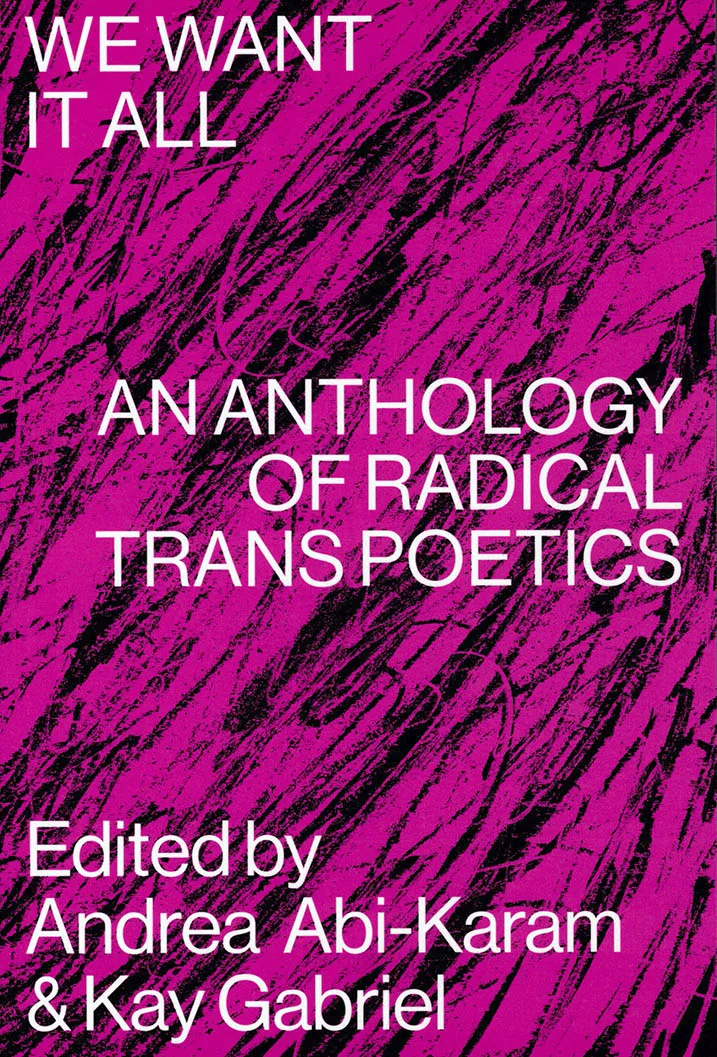
We Want It All: An Anthology of Radical Transpoetics
An anthology of formally inventive writing by trans poets against capital and empire.
With texts by: Andrea Abi-Karam, New York City Sam Ace, South Hadley, MA Bahaar Ahsan, Berkeley, CA jasper avery, Philadelphia, PA Ari Banias, Berkeley, CA Jo Barchi, Chicago, IL Joss Barton, St. Louis, MO Levi Bentley, Philadelphia, PA Jessica Bet, Baltimore, MA Rocket Caleshu, Los Angeles, CA Ching-in Chen, Seattle, WA listen chen, Vancouver, BC Faye Chevalier, Philadelphia, PA Cody-Rose Clevidence, Arkansas Miles Collins-Sibley, Easthampton, MA Valentine Conaty, New York City CA Conrad, Philadelphia, PA Jimmy Cooper, Rochester, MI Maxe Crandall, Oakland, CA José Díaz, Boston, MA Aaron El Sabrout, New Mexico Ian Khara Ellasante, Lewiston, ME Caelan Ernest, New York City, NY NM Esc, San Diego, CA joshua jennifer espinoza, Los Angeles, CA Logan February, Ibadan, Nigeria Ray Filar, Brighton, UK Nora Collen Fulton, Montreal, Canada Kay Gabriel, New York City Callie Gardner, Cardiff, Wales Jesi Gaston, Chicago, IL Harry Josephine Giles, Edinburgh, Scotland Aeon Ginsberg, Baltimore, MD Caspar Heinemann, Berlin, Germany Kamden Hilliard, Greenville, SC Stephen Ira, New York City Cyrée Jarelle Johnson, New York City Peach Kander, New York City Jayson Keery, Western, MA Evan Kleekamp, Los Angeles, CA Noah LeBien, New York City Ty Little, Richmond, VA Zavé Martohardjono, New York City Amy Marvin, Philadelphia, PA Natalie Mesnard, New York City Bianca Rae Messinger, Iowa City, IA Liam O'Brien, New York City Xandria Phillips, Madison, WI Rowan Powell, Santa Cruz, CA Nat Raha, Edinburgh, Scotland Holly Raymond, Philadelphia, PA Jackie S, New York City Trish Salah, Toronto, Canada Raquel Salas Rivera, Philadelphia, PA Mai Schwartz, New York City Kashif Sharma-Patel, London, UK Julian Talamantez Brolaski, Oakland, CA Charles Theonia, New York City Jamie Townsend, Oakland, CA Nora Treatbaby Laurel Uziell, London, UK Rachel Franklin Wood, Boulder, CO Clara Zornado Akasha-Mitra xtian w. and Anaïs Duplan, NYC.
Kay Gabriel is a poet and essayist. She's the author of Elegy Department Spring / Candy Sonnets 1 (BOAAT Press, 2017), the recipient of fellowships from Lambda Literary and the Poetry Project, and recently completed her PhD at Princeton University.
Andrea Abi-Karam is an arab-american genderqueer punk poet-performer cyborg, writing on the art of killing bros, the intricacies of cyborg bodies, trauma & delayed healing. Their chapbook, THE AFTERMATH (Commune Editions), attempts to queer Fanon's vision of how poetry fails to inspire revolution. Andrea's first book, EXTRATRANSMISSION (Kelsey Street Press, 2019), is a poetic critique of the U.S. military's role in the War on Terror.

Castle Faggot
In Derek McCormack's home province, farm boys with growing pains enjoy a little-known meal called bed-supper, a hearty bowl of sweet breakfast cereal enjoyed as a midnight snack. Here McCormack has composed a peculiarly salacious bed-supper, where the long secret sweet-tooth of the Marquis de Sade glints as it sinks into the dirtiest of dishes. This useful book will more than stay your appetite until breakfast — Castle Faggot is also a manual of redecoration, a musical, a puppet show, a theory of cosmetics, a work of poetics, and a glorious celebration of the French decadence. — Lisa Robertson, author of The Baudelaire Fractal
Derek McCormack is a writer who lives in Toronto. His previous books include The Show that Smells and The Well-Dressed Wound (Semiotext(e)).

Faux Pas
Essays on art-making, abstraction, humor, not-knowing, awkwardness and more, from one of New York’s most influential and popular painters and teachers
Since the 1970s, Amy Sillman—a beloved and key figure of the New York art scene—has developed a singular body of work that includes large-scale gestural paintings blending abstraction with representation, as well as zines and iPad animations.
Over the past decade, Sillman has also produced stimulating essays on the practice of art or the work of other artists: for example, reevaluating the work of the abstract expressionists with a queer eye; elaborating on the role of awkwardness and the body in the artistic process; and discussing in depth the role and meanings of color and shape. Featuring a foreword by Lynne Tillman, Faux Pas is the first book to gather a significant selection of Sillman’s essays, reviews and lectures, accompanied by drawings, most of them made specially for the book.
Faux Pas aims at revealing the coherence and originality of Sillman’s reflection, as she addresses the possibilities of art today, favoring excess over good taste, wrestling over dandyism, forms over symbols, with as much critical sense as humor. As Jason Farago notes in the New York Times, "Sillman is in a thin crowd (with, let’s say, Andrea Fraser, Hito Steyerl, Matias Faldbakken, David Salle) of artists who can really write. The evidence is in Faux Pas ... her writings display the same good humor and intelligence of her best paintings."
Based in New York City, Amy Sillman (born 1955) is an artist whose work consistently combines the visceral with the intellectual. She began to study painting in the 1970s at the School of Visual Arts and she received her MFA from Bard College in 1995. Her work has been exhibited internationally, including at the Whitney Biennial in 2014; her writing has appeared in Bookforum and Artforum, among other publications. She is currently represented by Gladstone Gallery, New York.

F.R. David - Correctional Facility
F.R.DAVID is a typographical journal, dealing with the organisation of reading and writing in contemporary art practises. The 20th issue, “Correctional Facility” is edited by Will Holder paying attention to difference; and transformations between
accident⎱design 249
acorn⎱oak 293–94, 297–98
adult⎱child 95, 139, 207, 308
alphabetic⎱postliterary 3
alphabetic⎱postalphabetic 3, 5
alphabetic⎱analphabetic 5
analytic⎱linguistic 298
ankh⎱kiss
angles⎱angels 162
aristocrat⎱ass 12
ass⎱man 28
aye⎱eye 160
bad⎱good 130
(outstandingly⎱remarkably)
before⎱after 19, 49, 51, 158,
201, 263, 305
bitter⎱sweet 65, 163, 217
both⎱and 8, 119, 123, 160, 173, 180, 245, 292, 298
cart⎱horse 2, 9
coming into being⎱passing away 318
communism⎱democracy 319
composition⎱improvisation
163, 168, 170
concrete⎱abstract 288
dark⎱light 43, 64, 127, 223,
261, 300, 309, 316
diegetic⎱non-diegetic 145, 193
dropped out⎱drop doubt 160
either⎱or 6, 14, 39, 43, 54, 85, 119, 120, 132, 195, 223, 249, 288
emotional⎱intellectual 297
enthusiastic⎱tempered 13, 78, 205
ἕν καἰ τὀ πᾶν⎱one and all 224
everything⎱fragment 33, 138
everything⎱all things 218–22
experience⎱attention 39, 40, 65, 254–5
green⎱blue 127
high modernism⎱post-structuralist⎱postmodernism 165
radical modernism⎱modernism⎱
postmodernism 4, 164–66
I⎱sigh 160
image⎱word 6, 72, 316–18
Isis⎱Isis 226
jar⎱jars 76, 158, 159
left⎱right 7, 28, 127, 217
meaningful⎱meaningless 258
oak (a⎱ok) 290, 293–94, 297–98
orality⎱textuality 3, 264
phoneme⎱letter 180
phonetic⎱ideogrammatic 297
shit⎱gold †
signal⎱noise 39, 40, 65, 254–55
sweat⎱tears 292
tail⎱bell-rope 151, 154
thesis⎱antithesis 322
written⎱unwritten 158, 296–97
vowel⎱consonant 180–82, 292
we are⎱we ain’t 93
white pawn⎱white pawn 224
word⎱world 8, 12, 138, 160, 165, 166, 180, 183, 260, 265, 287, 298, 300, 315, 317
writing⎱nature 27, 44, 83, 120,
121, 126, 166, 183, 198, 203,
219–20, 252, 297, 318–19

The Superrationals
An erotic and darkly comic novel about female friendship, set at the intersection between counterculture and the multimillion dollar art industry.
Over the course of a few days in the fall of 2015, the sophisticated and awkward, wry, and beautiful Mathilde upends her tidy world. She takes a short leave from her job at one of New York's leading auction houses and follows her best friend Gretchen on an impromptu trip to Paris. While there, she confronts her late mother's hidden life, attempts to rein in Gretchen's encounters with an aloof and withholding sometime-boyfriend, and faces the traumatic loss of both her parents when she was a teenager.

Colored People Time
In 2019, the Institute of Contemporary Art at the University of Pennsylvania presented the experimental exhibition Colored People Time. Divided into three chapters—Mundane Futures, Quotidian Pasts, Banal Presents—it used the Black vernacular phrase Colored People's Time (CPT) to explore the ways that dominant notions of time have been used to control and condemn Black people. CPT names a political performance by Black people to evade and ridicule the enforcement of punctuality and productivity.
Alongside reproductions of historical objects from the Black Panther Party, Sutton E. Griggs, the National Institutes of Health/Getty Images, and the African Collection at the University of Pennsylvania Museum of Archaeology and Anthropology, Colored People Time includes reprints of seminal essays, newly commissioned writing and poetry from Huey Copeland, Eve Ewing, Michael Hanchard, Matthew Angelo Harrison, Amber Rose Johnson, Carolyn Lazard, Jessica Lynne, Tausif Noor, Meg Onli, Gregory Pardlo, M. NourbeSe Philip, Monique Scott, Martine Syms and Michelle M. Wright. Artists include: Aria Dean, Kevin Jerome Everson, Matthew Angelo Harrison, Carolyn Lazard, Dave McKenzie, Cameron Rowland, Sable Elyse Smith and Martine Syms.

I Confess
Over the past 40 years, Canadian artist Moyra Davey (born 1958) has perfected a unique synthesis of photography, film and text to critically engage with the past, present and future of the world around her. Based on Davey's eponymous 2019 film, I Confess unites three main sources in a chronicle of late 20th-century Quebec, shaped by themes of race, poverty, language and nationalism. Using American writer James Baldwin's 1962 novel Another Country as its point of departure, Davey's film also focuses on the life and work of Québécois revolutionary Pierre Vallières and Ottawa-based political philosopher Dalie Giroux.
Published to accompany the exhibition Moyra Davey: The Faithful at the National Gallery of Canada, this deeply personal and highly political book seeks to examine an unresolved chapter of Québécois history from a uniquely interdisciplinary perspective that draws attention to contemporary issues of separatism, while reflecting the artist's understanding of photography and text as unique corollaries. This publication features writings by the artist, Dalie Giroux and National Gallery of Canada's Associate Curator Andrea Kunard, and a poster insert.
Published September 2020.

Kino/ Atelier - Program
With texts and contributions by Nicholas Vargelis, Kerstin Stakemeier, Steve Beck, Lis Rhodes, Leslie Bauer, Érik Bullot, C.Vanaik, VUE Committee, Shirley Clarke, Hilary Harris, Giuliana Bruno, Pier Paolo Pasolini, Peter Larsen, Elissa Suh, Straub-Huillet, Storm de Hirsch, Mark Fisher, Bruce Baillie, Rachel Haidu, Kai Althoff, Jennifer Reeves, Karl Holmqvist, Eros in Le Wind, Marie Menken and Jonas Raam.

Judy Chicago: To Sustain The Vision
Monograph bringing together some fifty works by Judy Chicago and unpublished documents, accompanied by three critical texts by Géraldine Gourbe.
Judy Chicago says she wants to live as long as possible; not to transcend her mortal condition, but to be around as her works successively find recognition. A woman holding out against all odds: such is the image of an artist more a visionary than the pioneer she has so often been described as. Unlike the pioneers, Chicago has never joined the “greats” of the white, modernist, Eurocentric canon. Rather she has avoided this historical snare, urging instead the alternatives of to sustain the vision.
Géraldine Gourbe is a philosopher, author, art critic, and curator.
Published May 2020

Hurricane Season
Fernanda Melchor, Sophie Hughes
The Witch is dead. And the discovery of her corpse—by a group of children playing near the irrigation canals—propels the whole village into an investigation of how and why this murder occurred. Rumors and suspicions spread. As the novel unfolds in a dazzling linguistic torrent, with each unreliable narrator lingering details, new acts of depravity or brutality, Melchor extracts some tiny shred of humanity from these characters that most would write off as utterly irredeemable, forming a lasting portrait of a damned Mexican village.
Like Roberto Bolano's 2666 or Faulkner's novels, Hurricane Season takes place in a world saturated with mythology and violence—real violence, the kind that seeps into the soil, poisoning everything around: it's a world that becomes more and more terrifying the deeper you explore it.
Translated by Sophie Hughes.

Sensoria
As we face the compounded crises of late capitalism, environmental catastrophe and technological transformation, who are the thinkers and the ideas who will allow us to understand the world we live in? McKenzie Wark surveys three areas at the cutting edge of current critical thinking: design, environment, technology and introduces us to the thinking of nineteen major writers. Each chapter is a concise account of an individual thinker, providing useful context and connections to the work of the others.
The authors include: Sianne Ngai, Kodwo Eshun, Lisa Nakamura, Hito Steyerl, Yves Citton, Randy Martin, Jackie Wang, Anna Lowenhaupt Tsing, Achille Mbembe, Deborah Danowich and Eduardo Viveiros de Castro, Eyal Weizman, Cory Doctorow, Benjamin Bratton, Tiziana Terranova, Keller Easterling, Jussi Parikka.
Wark argues that we are too often told that expertise is obtained by specialisation. Sensoria connects the themes and arguments across intellectual silos. They explore the edges of disciplines to show how we might know the world: through the study of culture, the different notions of how we create such things, and the impact that the machines that we devise have had upon us. The book is a vital and timely introduction to the future both as a warning but also as a road map on how we might find our way out of the current crisis.
McKenzie Wark is the author of Capital is Dead, General Intellects and Molecular Red among other books. She teaches at the New School for Social Research and Eugene Lang College in New York City.

body horror
This edition is published on the occasion of the YES sessions by Slow Reading Club (Bryanna Fritz & Henry Andersen with the participation of Maud Jacquin) organized by Lafayette Anticipations as part of EXTRA! Le festival de la littérature vivante (4th edition, from September 11 to 27, 2020 at the Centre Pompidou).

Animal - Family - Bad Mood Audience - Sleeping Bad Mood
The first comprehensive monograph on the work of Krõõt Juurak
In the past fifteen years, Krõõt Juurak has developed a series of practices and performances that do not necessarily take place in a theatre or a gallery, at a predictable time or space, but rather come to existence as performative conditions through certain other triggers. This volume is both a record and a performative expansion of Juurak’s practice. Through four themed chapters (Animal, Family, Bad Mood Audience and Sleeping Bad Mood), the publication features a rich array of text-based works, essays, interviews, documentation and ephemera that will provide an insight into Juurak’s singular body of work including Internal Conflict, Sleeping Performance, Autodomestication, Performances for Pets and Bad Mood.
Edited by Galerie / Adriano Wilfert Jensen and Simon Asencio
Text contributions by Krõõt Juurak, Alex Bailey, Kate Strain, Noor Mertens, Suzan D. Polat, Jessica Ullrich, Guendalina Pirelli, Donny Mahonney, Simon Asencio and Adriano Wilfert Jensen.
Published October 2020

Girls Against God
A genre-warping, time-travelling horror novel-slash-feminist manifesto for fans of Clarice Lispector and Jeanette Winterson.
Welcome to 1990s Norway. White picket fences run in neat rows and Christian conservatism runs deep. But as the Artist considers her work, things start stirring themselves up. In a corner of Oslo a coven of witches begin cooking up some curses. A time-travelling Edvard Munch arrives in town to join a death metal band, closely pursued by the teenaged subject of his painting Puberty, who has murder on her mind. Meanwhile, out deep in the forest, a group of school girls get very lost and things get very strange. And awful things happen in aspic.

scherzos benjyosos
Scherzos Benjyosos is a set of four poems, scherzos in prosimetrical blocks, a comical, wild, and delirious sifting through the carnage of the financial crash, the dreamscapes of capitalist infancy, histories of sadism and persecution, the fetish bars of canonical literature, and the psychoanalysis of grass. The book also includes “Sinking Feeling,” Sutherland’s long poem from 2017, described by J. H. Prynne as “breathtakingly lovely, and desperate, racked with desire to become truthful love.”
Some reviews of other books by Keston Sutherland:
“[Hot White Andy] is the most remarkable poem in English published this century… A possible poetic future starts here.” — Jacket Magazine
“The most unsettling but also authentically hopeful account of what it is to be human now.” —3AM on The Odes to TL61P
“Immediately takes its place among the most essential works of literature in English in this new millennium.” — Chicago Review on Poetical Works 1999 –2015
“[‘Sinking Feeling’] moves like a piece of music through recursive and repeated moments, shifting and developing its described and conceptual spaces, its logics of representation, and its narrative. The thinking it follows is not always easy, but the disorienting effect on the reader is exhilarating because of the intellectual and emotional space it opens up as you try to follow it.” — London Review of Books

The Politics of Delivery (Against Poet-Voice)
An essay by Holly Pester on prosody, “poet-voice,” and the politics of delivery.
“Following a political impulse that I cannot shake, I want to oppose poet-voice. Not to smirk, but to suggest that poet-voice, that is, to lay a given mutual voice on top of the text, is a kind of opting out. It’s a self-absolving move. What’s being opted out of is the rough stuff of delivery and the ethical shrapnel in intonation. Such materials of poetic intonation are not, I will argue, irrelevant to the political questions of one’s speech in society and its disputed freedoms.
I have a fully felt and fraught relationship with delivery. I care about delivery compositionally; I enjoy the effects of composition working on and into my voice. Sometimes it feels as if my voice is the victim of some impossible contract with the text. The effort and timbres of delivery are therefore potentially very significant to a political poet. This sounded aspect of my work often gets short-handed as performance, but it’s not that. Performance art and performance poetry are distinct art forms with histories and styles, learned and studied by talented performers. Delivery is as banal or as eccentric as the material, but not necessarily correspondingly. It is part of the craft of poetry that isn’t unrelated to the intrinsic vocal identity of the poet (accent, etc.) yet has as much to do with tensions within the communities, heritages, and civics of poetry as with the individual. ”

The Following
The Following selects from John Wilkinson’s essays of the last three decades, with a preference for what has come to be known as creative criticism, and adds a new essay on reflected boughs in poems by Shelley and a photograph by Sally Mann, and a poem in homage to Sean Bonney. The book’s title is a broken reflection of the essay title “Following the Poem.”
“Through following a poem (not just any poem), a reader can become involved in the evocation and enactment of a radical hybridity, pulling together ways of thinking about the world modernity has categorically but falsely separated; but such reading takes place in time, so continuously a reader unpicks and reintegrates elements of the poem in a felt motion which can restore a healed and full being in the world, involving in its fullness and as a condition of it, the detours, the lapses, and the breaks in his or her journey.”