Books
Books
published in 2025

Negative Landscape
Sinkholes are geological accidents that indicate the emptying of underground aquifers, places where the earth collapses and caves in, yielding to gravity and creating cavities of varying depths. Although they can occur for natural reasons, they are mostly the result of human activity: changes in river courses, intensive exploitation of water resources, mining activity and abandonment of mining sites. Over the last few decades, their number has increased considerably on the Iranian plateau.
This book presents Kimia Kamvari’s exploration of these cavities between 2019 and 2021. It showcases the core of the work, consisting of a careful and methodical series of photographs, accompanied by cartographic sheets and texts that help to understand the artist’s perspective on the phenomenon and stimulate the reader’s own.
Kimia Kamvari (Cologne, 1986) has a degree in painting from the Azad University of Art and Architecture in Tehran and a master’s degree in Art Research and Creation from the UPV-EHU. Since 2015 she has been living and working in Astigarreta, a small town in the interior of Gipuzkoa. His works go from figurative painting to an increasingly conceptual look that explores new formats and materials. Proof of this are his latest exhibitions Apeiron (Dastan Gallery, 2018), Nature Change (Fundación Cristina Enea, 2019), Event Horizon (Dastan Gallery, 2019) Alef (San Telmo Museoa, 2022) and Larruak eta Izurrak (Tabakalera, 2024)

LOG: Notes on Building-with
Log: Notes on Building-with documents the construction of a wooden structure in Topolò/Topolove and expands it into a reflection on craft, collaboration and situated making. Through photographs and texts, the book approaches the idea of building-with from four different angles: building-with context, building-with materials, building-with tools and building-with others.
Contributions by: Diogo Amaro, Antônio Frederico Lasalvia, Elena Rucli, Madalena Vidigal, Ola Korbańska, Aljaž Škrlep.

Comme un vase sentimental
Queer, érotique, afrodescendante, la poésie de soto labor rebondit sur des zones insoupçonnées du langage pour faire jaillir l’imprévisible. Dans ce recueil à la fois tendre et turbulent, le poète-performeur joue, déplace, décale, ouvre des horizons d’imaginaire. La musique de ses textes emporte, dans d’infinis fragments d’histoires, des concentrés de rencontres et une galerie de personnages mouvants, futures figures légendaires.
soto labor nous parle de race, de colonialité, de mouvement et de relations – affectives, sensuelles, politiques. A l’intelligence du détournement et de l’oralité se mêle un examen vagabond des modes d’être au monde et à l’autre. Avec mordant, radicalité et drôlerie, en pleine conscience de l’instant, en hommage à l’hier, et avec la fougue des futurs incertains c’est là que se trouve Comme un vase sentimental.

OEI #106–107 Lettrists & Photography
This issue of OEI proposes the first large-scale synthesis of Lettrist photography as a precise “system” – going through the Lettrist movement’s engagement with photography from the 1950s up until 2013. It reproduces around 430 photographic works and documents, and also includes English translations of texts by and interviews with Isidore Isou, Maurice Lemaître and Frédérique Devaux.
The first phase was to call photography into question. Through scratches and tears, the surface of the image was worked on, transformed within itself. This is the chiselling stage. Then we propose Lettrist photography, which transforms the old object into a letter or sign, redefining it as a simple particle in a system of elements that has become the alphabet of a new script. Hypergraphic photography goes even further, using any sign or graphic design to create a poly-writing system resulting in billions of characters, existing, artificial or new. Going even further, in 1956 our movement introduced infinitesimal photography, creating works composed of elements that exist only insofar as they allow us to imagine other elements, non-existent or possible. Each element must make us think of other elements. Infinitesimal photography is made up of billions of pieces of virtual data! Then, in 1960, the Lettrist movement unveiled a new dimension: supertemporal photography. With supertemporal photography, I offer a framework within which each viewer can act in his or her own way. Far superior to today’s happenings it has no time limit. The image is forever open to new amateurs who erase or continue what has already been done on the photograph by previous amateurs. It’s a work that has been going on for centuries! This is our creation in photography. […] We amuse ourselves at the level at which things are done, and we see them twenty years ahead of time. To say that Lettrist photography doesn’t exist is to say that no photograph exists …
—Isidore Isou, 1973

The Adventures of Leucippe and Clitoris
Leucippe and Clitoris is based on one of the first romantic novels written in 192 AD by Achilleas Tattius. A very Katsarida Press retelling of an ancient story.
This is the second WOMANWOOD Kindling, a reprint of the original zine first published in Athens
WOMANWOOD Kindling is devoted to full-length chapbooks/zines published in between releases of WOMANWOOD, the smut gazette.
Riso-printed in an edition of 60, bound by blue linen thread with embellishments from the riso scrap pile.

Tamil Terrains
Nedra Rodrigo, Geetha Sukumaran
What happens when a two-thousand-year-old language, rooted in a classical poetics of land, is moved, along with its peoples, through colonial and postcolonial upheavals, war and forced or voluntary migrations?
Questioning traditional concepts of time, place, labour, love, purity and gender, this prismatic collection of poems, translations and transcreations draws connections between ancient Sangam landscapes and North America’s Indigenous lands, and between classical Tamil love poems and Southeast Asian migrant labour songs––tending, with care, the wounded memories of fisher-people, plantation workers, and undocumented refugees.
Our own vazhinool runs through this book: our sense of indebtedness to the lands that hold us, and the lands we hold within us: நெஞ்சநிலம், the landscape of our hearts. It is not without some sense of trepidation that we set it afloat now, across unknown lands and waters, into unknown hands.
––Nedra Rodrigo & Geetha Sukumaran (introduction)
Poets & Translators: Aadhavan Dheetchanya, Abi Jeyaratnam, P. Ahilan, Akkini Sugu, Alari, Ammoovanar, Avvaiyar, Cheran, Enbah Nilah, Geetha Sukumaran, Gobiga Nada, V. Iswarya, Jayashree Panniker, Kasro Ponnuthurai, Kalaivani Karunakaran, Leanne Betasamosake Simpson, Nedra Rodrigo, Nillanthan, Rashmy, Regini David, S. Bose, Sathimutha Pulavar, shalan joudry, Subhanya Sivajothy, Subramaniya Bharati, Sukirtharani, Thamilini Jothilingam, Tharmini, Yalini Jothilingam.

Inner Tube
Inner Tube is a darkly comic, hallucinatory novel about one man’s descent through grief, cultural detritus, and the electromagnetic haze of late 20th century America. After his mother kills herself by ramming her head through the family television, the narrator quits his job cataloging old TV shows and embarks on a surreal, unmoored journey westward. Through a landscape of rundown motels, desert isolation, and fleeting encounters, he strips away the trappings of civilization, regressing into a feral, posthuman state. The book is both a savage critique of media-saturated culture and a philosophical meditation on alienation and survival, written with poetic precision and biting wit.
Inner Tube was completed under extraordinary circumstances. After undergoing spinal surgery that left him paralyzed from the neck down, Hob Broun wrote the novel using a breath-activated computer system—a device that converted puffs of air into keystrokes. He finished the book just before his untimely death in 1987 at the age of 37.
First published by Alfred A. Knopf in 1985, and reprinted in 1987 by McGraw-Hill, Inner Tube has been out of print ever since.

TRANSMISSIONS: Radio Essays on Edges, Crossings and Narrowcasting Borderlands
Transmissions: Radio Essays on Edges, Crossings and Narrowcasting Borderlands gathers radio essays—created as part of Robida Collective’s project Radio drugega/The Other Radio—which reveal that to speak of “the border” is never to speak of a single line. There are political borders, conceptual borders, bodily borders; carnivalesque borders, where order collapses into play; linguistic and cultural borders, where words slip between languages and where accents become geographies; archival borders, separating memory from forgetting; borders of abandonment, where life and death enter into a dialectical ballet; economic borders, drawn by property, ownership, enclosure; borders of matter, space and time; acoustic borders, where the voice meets noise and incomprehensibility; cosmic borders, where meteors cross the thin edge of air; ecological borders, porous and breathing, where one species touches another. These are some of the borders this book speaks of – lines that do not divide but resonate, that hold together separation and proximity, distance and relation. Together, these essays form a cartography of friction but also affinity, reminding us that to erase all borders is to erase the very conditions of encounter – and that meaning often emerges not at the centre, but at the edges where worlds meet.
With texts by:
Agnes Cameron, Ajda Bračič, Aljaž Škrlep, Antônio Frederico Lasalvia, Giorgia Maurovich, Jack Bardwell, Kate Donovan, Kat Macdonald, Lijuan Klassen, Luca Vettori, Michael Marder, Moritz Gansen, Olya Korsun, Petra Filagrana, Urška Savič.

objet petit ö
Ötza is a 5300-year-old cryodesiccated fan fiction writer from the Neolithic, an advocate for prehistoric literacy and a self-proclaimed connoisseur of post-historical theory-fiction. Locked in a cooling cell at the South Tyrol Museum of Archaeology in Bolzano, Italy, her writings are hopeful yearnings for counterfactual salvation from her fate of archaeological conservation, and an attempt to rewrite the narrative (unfairly) extrapolated from scientific reconstructions.
Ötza is written and performed by artist Levi van Gelder, and created in collaboration with costume designer and stylist Leila El Alaoui.
Edited by Maia Kenney, Aidan Hoyle, Anthony Stephinson

Comment réparer : La maternité et ses fantômes
Iman Mersal, Richard Jacquemond
Publié en 2018 par Kayfa-ta (Égypte), Comment réparer : la maternité et ses fantômes propose une réflexion sur la maternité et ses représentations. Plusieurs fois réimprimé, ce livre jouit d’une très grande réputation dans le monde arabophone, notamment auprès des jeunes générations.Mobilisant différentes formes d’écriture (essai, récit, poème, journal) et des images photographiques tirées de sources diverses (archives personnelles, presse, portraits vernaculaires, etc.), la trame du livre s’articule autour des relations de l’autrice avec sa mère, sa grand-mère et ses deux fils. Déjouant les clichés et les formes narratives établies, Iman Mersal décèle les complexes réseaux symboliques dans lesquels s’inscrivent la filiation et la maternité, depuis la grossesse jusqu’à l’éducation des enfants, et ce de génération en génération.À l’écoute des silences de la mémoire, explorant ses labyrinthes, le livre porte un regard critique sur la violence et le sentiment de culpabilité qui traversent le corps maternel, notamment dans ses rapports au langage, au travail ou aux institutions. Iman Mersal élabore ainsi une sorte d’art poétique : la réparation dont parle le titre passe par l’écriture, elle est donc d’ordre créatif ; mais l’écriture s’insère dans un quotidien qui lui fait obstacle, qui met au défi la possibilité même d’écrire dès qu’on devient mère. Comment réparer : la maternité et ses fantômes est en ce sens un formidable texte de résistance, un geste d’émancipation.
Née en 1966 en Égypte, Iman Mersal est poète et professeur associé de littérature arabe à l’université d’Alberta, au Canada. Ses récents livres sont des écrits très originaux qui mêlent recherche académique et réflexions intimes sur une grande variété de sujets, dont la plupart ont trait à son identité de femme et d’artiste. Une anthologie de ses poèmes – Des choses m’ont échappé (2018) – et un récit – Sur les traces d’Enayat Zayyat (2021) – ont été traduits en français par Richard Jacquemond pour les éditions Actes Sud

On Breathing
A beautiful, expansive essay about care, dependence, and what it means to breathe in an age of environmental catastrophe.
A few moments after birth we begin to use our lungs for the first time. From then on, we must continue breathing for as long as we are alive. And although this mostly happens unconsciously, in a society plagued by anxiety, climate change, environmental racism, and illness, there are more and more instances that ‘teach us about the privilege that is breathing.’
Why do we so easily forget the air that we breathe in common? What does it mean to breathe when the environment that sustains life now threatens it? And how can life continue to flourish under conditions that are increasingly toxic?
To approach these questions, Jamieson Webster draws on psychoanalytic theory and reflects on her own experiences as an asthmatic teenager, a deep-sea diver, a palliative psychologist during covid, a psychoanalyst attentive to the somatic, and a new mother. The result is a compassionate and timely exploration of air and breathing as a way to undo the pervasive myth of the individual by considering our dependence on invisible systems, on one another, and the way we have violently neglected this important aspect of life.

The Dissenters
Amna, Nimo, Mouna – these are all names for a single Egyptian woman whose life has mirrored that of her country. After her death in 2015, her son, Nour, climbs to the attic of their house where he glimpses her in a series of ever more immersive visions: Amna as a young woman forced into an arranged marriage in the 1950s; as a coquettish student of French known to her confidants as Nimo; a self-made divorcee and a lover; a ‘pious mama’ donning her hijab; and, finally, as a feminist activist during the Arab Spring.
Charged and renewed by these visions of a woman he has always known as Mouna, Nour begins a series of fevered letters to his sister – who has been estranged from Mouna and from Egypt for many years – in an attempt to reconcile what both siblings know about this mercurial woman, their country, and the possibility for true revolution after so much has failed.
Hallucinatory, stylish, and erotic, The Dissenters is a transcendent portrait of a woman and an era that explodes our ideas of faith, gender roles, freedom, and political agency.
YOUSSEF RAKHA is an Egyptian author of fiction and nonfiction working in Arabic and English. He is the author of The Book of the Sultan’s Seal, The Crocodiles, and Paulo, which was long-listed for the International Prize for Arabic Fiction and won the 2017 Sawiris Award.

Terry Dactyl
From a LAMBDA award-winning author, an electric and haunting dive into New York City club culture, the elite art world, the relationships we crave, and the addictions we hold dear, told through one iconoclastic trans girl’s search for connection, from growing up in the midst of the AIDS crisis to the panic of the COVID-19 lockdowns.
Terry Dactyl has lived many lives. Raised by boisterous lesbian mothers in Seattle, she comes of age as a trans girl in the 1980s in a world of dancing queens and late-night house parties just as the AIDS crisis ravages their world. After moving to New York City, Terry finds a new family among gender-bending club kids bonded by pageantry and drugs, fiercely loyal and unapologetic. She lands a job at a Soho gallery, where, after partying all night, she spends her days bringing club culture to the elite art world.
Twenty years later, in a panic during the COVID-19 lockdown, Terry returns to a Seattle stifled by gentrification and pandemic isolation until resistance erupts following the murder of George Floyd, and her search for community ignites once again.
In propulsive, intoxicating prose, Terry Dactyl traces an extraordinary journey from adolescence to adulthood, delivering a vital portrait of queer identity in all its peril and possibility.

Zipper Mouth
Dreamy, bratty and brash, Zipper Mouth is a potent gut-punch of a novel by an icon of 90's queer lit.
In this extraordinary novel, Laurie Weeks captures the exuberance and mortification of a lesbian junkie as she navigates the chaos and horror of everyday life. Through longing monologues to Vivian Leigh, ranting letters to Sylvia Plath and to-do lists that never get done, Zipper Mouth gives us an unforgettable protagonist caught in a spiral of addiction, unrequited love, and mental health crises, and the effortlessly hilarious and strange inner workings of her mind.
A messy and raw depiction of striving to live in a world that doesn’t cater to your brain chemistry, Zipper Mouth is an outstanding work of queer fiction. Come for the exalted nightclub epiphanies, stay for the devastating morning-after hangovers.

Mother Media: Hot and Cool Parenting in the Twentieth Century
An essential history for understanding how we mother now, and how motherhood itself became a medium—winner of the Brooke Hindle Award from the Society for the History of Technology.
From the nursery to the prison, from the clinic to the commune, Mother Media tells the story of how we arrived at our contemporary understanding of what a mother is and how understandings of “bad” mothering formed our contemporary panics about “bad” media. In this book, leading historian of psychology Hannah Zeavin examines twentieth-century pediatric, psychological, educational, industrial, and economic norms around mediated mothering and technologized parenting. The book charts the crisis of the family across the twentieth century and the many ingenious attempts to remediate nursemaid and mother via speculative technologies and screen media.
Growing out of her previous award-winning book The Distance Cure, which considered technologized care, the book lays bare the contradictions of techno-parenting and how it relates to conceptions of “maternal fitness,” medical redlining, and surveillance of children, parents, and other caregivers. The author offers narratives of parenting in its extremity (for example, Shaken Baby Syndrome) and its ostensible banality (for example, the Nanny Cam) and how the two are often intertwined. Ultimately, Zeavin grapples with a simple contradiction: technology is seen and judged as harmful in domestic and educational spaces, even as it is a saving grace in the unending labor of raising a family.
Hannah Zeavin is Associate Professor of the History of Science in the Department of History and the Berkeley Center for New Media at UC Berkeley. She is the author of The Distance Cure and Mother Media (MIT Press) and Founding Editor of Parapraxis. In 2021, she cofounded The Psychosocial Foundation.

Bodies and Technologies
Bodies and Technologies is a collection of texts that inspire modes of attunement to how technologies condition and rewire the experience of our bodies. To ask how different embodied ways of being in the world can disrupt the behaviour and performance of technologies, this reader compiles material from the If I Can’t Dance reading group in Amsterdam as part of Edition XI–Bodies and Technologies (2022–24).
The reader includes texts by M. Jacqui Alexander, Alok, Gloria Anzaldúa, Tina M.Campt, Kai Cheng Thom, Arturo Escobar, BrandonLaBelle, Ursula K. Le Guin, Resmaa Menakem, Adrienne maree brown, Kate Morales, Rolando Vázquez Melken and Gloria Wekker, and with a sonic contribution by artist Ciro Monoarfa Goudsmit.

WatchPeopleDie.TV: Trans Death and Embodiment
In a time of widespread conservatism, watchpeople die.TV: Trans Death and Embodiment is not only unapologetically trans but challenges and transcends transphobic vitriol to create urgent and powerful work.
“This written portion was made from performing an erasure poem on the text of the sourced transphobic comments and then commenting on the erased words. The text is intended as a performance text. What this means is that I think of the text as not just a documentation of a performance but a performance itself.”
watchpeopledie.tv contains writing from watchpeopledie.TV (2025), performed as part of the 2025 VCUarts MFA Thesis exhibition that was on view April 11, 2025, to May 11, 2025, at The Anderson Gallery in Richmond, VA.

EURO—VISION: Undergrounding the Critical Mineral
'EURO—VISION: Undergrounding the Critical Material' explores extraction beyond the removal of minerals, delving into their financialization, management, and policy-driven circulation through the lens of the EU’s Critical Raw Materials Act. This volume examines resource extraction’s genealogies, valuation paradigms, and structural entanglements, offering a critical reassessment of extractive practices. Part of K. Verlag’s Processing Process series, the book features interviews with scholars, activists, and journalists, alongside commissioned texts and visual essays from FRAUD’s research. By interrogating the “extractive gaze” embedded in EUpolicies, it unveils the material poetics and transformative potential of minerals, fostering reflections on their complex entanglements.
Lithium, copper, uranium, child labor, and the bed of the deep sea—the mining sector is one of the most contested and problematic arenas of consumer complicity today. EURO—VISION: Undergrounding the Critical Mineral begins not with a location or a specific resource, but with a fundamental question: what counts as extraction today? While we might picture drills and quarries, the deeper story unfolds across financial markets, trade policies, legal frameworks, and the metrics used to define what is “critical” in the first place. Taking the EU’s Critical Raw Materials Act as a point of departure, this richly layered volume traces the hidden infrastructures and governing logics that shape how the mining industry moves substances from and across the Earth—and what these minerals, in turn, move with them.
Developed by the artist duo FRAUD (Francisco Gallardo & Audrey Samson) in close collaboration with environmental humanities scholar Michaela Büsse, the book gathers a wide range of voices—artists, scholars, economists, activists, lawyers, and journalists—to reflect on the long genealogies of resource extraction, the valuation paradigms that uphold them, and the terminologies that give them legitimacy. But the story doesn’t stop there. In the context of EURO–VISION, “undergrounding” becomes a tactic: a means of unsettling the structural violence concealed behind seemingly neutral data, and of turning toward the mineral itself—its material presence, its histories, its speculative potential.
Published in K. Verlag’s Processing Process series, EURO—VISION draws on FRAUD’s ongoing, research-led inquiry into critical mineral governance. Combining interviews, visual essays, and commissioned texts, it opens new pathways for thinking about the entanglements between geology, economy, and power. At once analytical and imaginative, the book invites us to see the subterranean anew—not simply as a resource, but as a site of resistance, relation, and possible futures.
Edited by Francisco Gallardo & Audrey Samson (FRAUD) in collaboration with Michaela Büsse. With essays and visual contributions by Adekeye Adebajo, Michaela Büsse, Liam Campling, Stephen Cornford, Jeff Diamanti, FRAUD, Matthew Fuller, Iman Ganji, Peo Hansen, Stefan Jonsson, Bahar Noorizadeh, Sophia Pickles, Ndongo Samba Sylla, Jennifer Telesca, Aleksandra Wojewska, and Mi You. Design by K. Verlag with Wolfgang Hückel & Katharina Tauer. Processing Process series editors: Anna-Sophie Springer & Etienne Turpin.

A Series Of Attempts #3: Loving Women aka Le Poney
"We didn’t have anything & we hadn’t seen much. So, naturally we understood less & felt owed something. We weren’t entirely wrong, though. It was 2011."
Part archival remix, part recruitment manual, this pamphlet’s cast of BAD HORSEY GIRLS will teach you how to neigh, dance and flirt until the vampires come home. A Series of Attempts #3 opens with Jordan/_Hell’s new manifesto ☆ LOVING WOMEN ★, that takes the Nomadic Sisters 1976 publication by the same name as a departure point. From here, ★ LE PONEY ☆ then follows a string of lesbian ponies through a dimensional split. A dimensional split that looks suspiciously like the L.A./Parisian+ queer scene… (͠≖~≖ ͡ )
About the author:
Jordan/_ Hell is a Black trans(2s) artist, writer, & scholar. Hell is the author of CONSTANT VIOLINS (Arcadia Missa, 2021) & AUTOLINGO DIDACTICA (Monitor Press, 2023), amount others. Hell’s writing has been internationally published in multiple languages in press, interdisciplinary projects, & exhibitions by Kunstverein Grafschaft Bentheim (DE), Arcadia Missa Gallery & Publishing (UK), Monitor Books (UK), Real Review (UK), Soft Opening (UK), Mousse Magazine (DE), 032c (DE), Rosie’s Disobedient Press (UK), Sticky Fingers Publishing (UK), The Bittersweet Review (UK), Pratt Institute’s The Felt (US), & others. Hell studied at Hochschule für Bildende Künste–Städelschule (DE) & Cooper Union School of Art (US). Currently, Hell is a doctoral candidate in the School of the Arts at Queen Mary University of London.
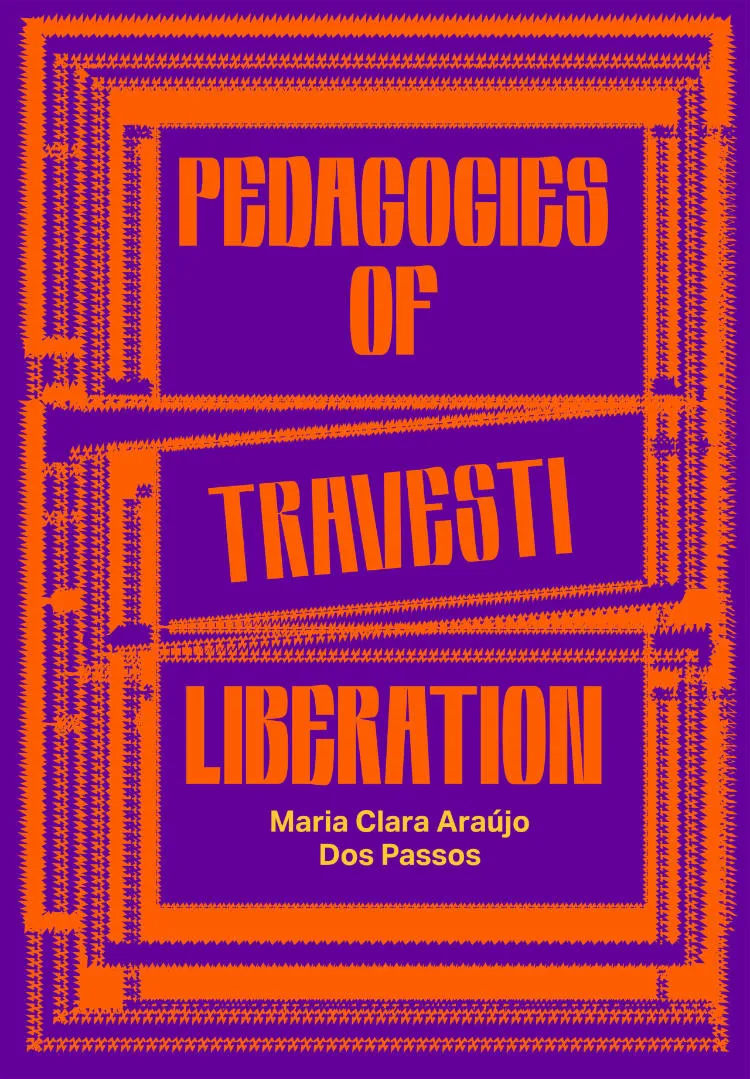
Pedagogies of Travesti Liberation
Maria Clara Araújo dos Passos, Natália Affonso
Maria Clara Araújo dos Passos examines the interplay of education, identity, and liberation in Brazil's travesti community.
In Pedagogies of Travesti Liberation, Maria Clara Araújo dos Passos critiques traditional pedagogical frameworks that marginalize gender nonconforming narratives and highlights the effects of systemic discrimination on travestis' psychosocial well-being. The book advocates for inclusive educational practices and emphasizes the need for affirmative curricula.
Newly translated from Portuguese, this work contributes towards connecting political struggles globally and navigating the complexities of translation—particularly of the term "travesti"—across various geographical and political contexts, featuring a conversation between Araújo dos Passos and translator Natália Affonso.
Maria Clara Araújo dos Passos (born 1996 in Recife) is a Brazilian Afro-transfeminist educator and sociologist, and an activist for LGBT rights.
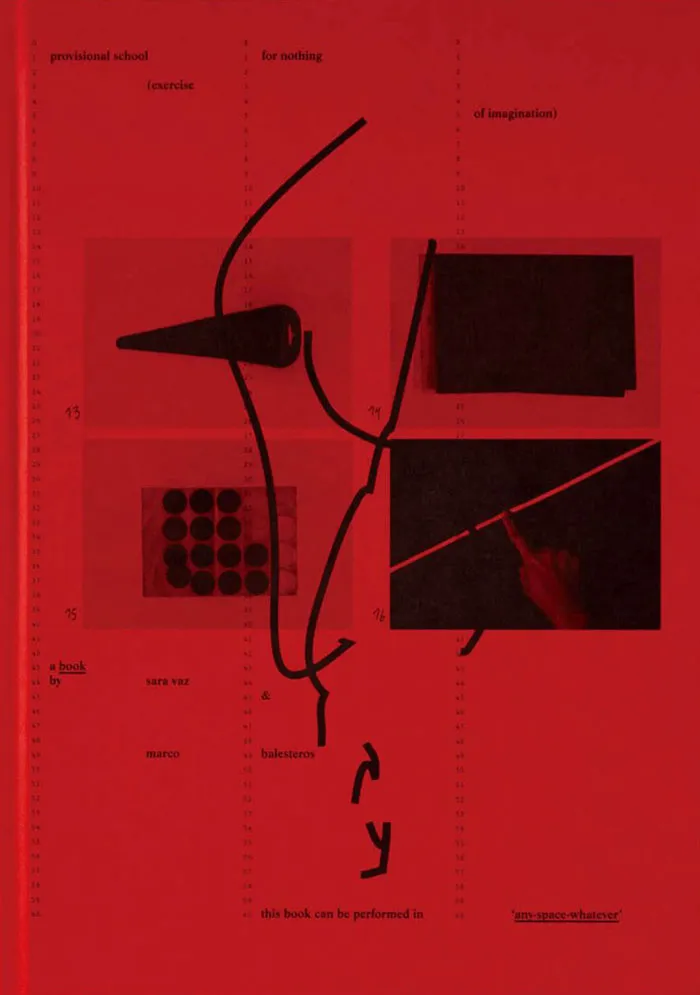
provisional school for nothing—exercise of imagination
‘Provisional School for Nothing—exercise of imagination’ aims to explore forms of parallel education such as self-learning, self-organized schools, unschooling, inner schools, and more. This book is a choir of around 30 invited guests (artists, choreographers, dancers, graphic designers, writers, thinkers and so on). We use the word ‘choir’ since we decided to explore the concept of authorship. The book functions like a language score —comprising words, fragments, and loose ideas that develop throughout a series of conversations we’ve had with our guests via Zoom during the pandemic.
with Marco Balesteros Sara Vaz Alexandru Balgiu Ana Jotta Bráulio Amado Cracked Bolos Igor Dobricic Isabel Carvalho Ivan Martinez João Fiadeiro João dos Santos Martins] Karel Martens Maki Suzuki & Lppl Marco Bene Maria Duarte Marion Cachon Miguel Bonneville Nelson Guerreiro Olivier Lebrun Olga Mesa Francisco Ruiz de Infante Paul Elliman Paul Faure Pedro Barateiro Pedro Rogado Ricardo Nicolau Sara & André Sara Graça T.I.M.E. Tomás Cunha Ferreira Von Calhau! the missing person a man in silence
designed by Sara Vaz Marco Balesteros
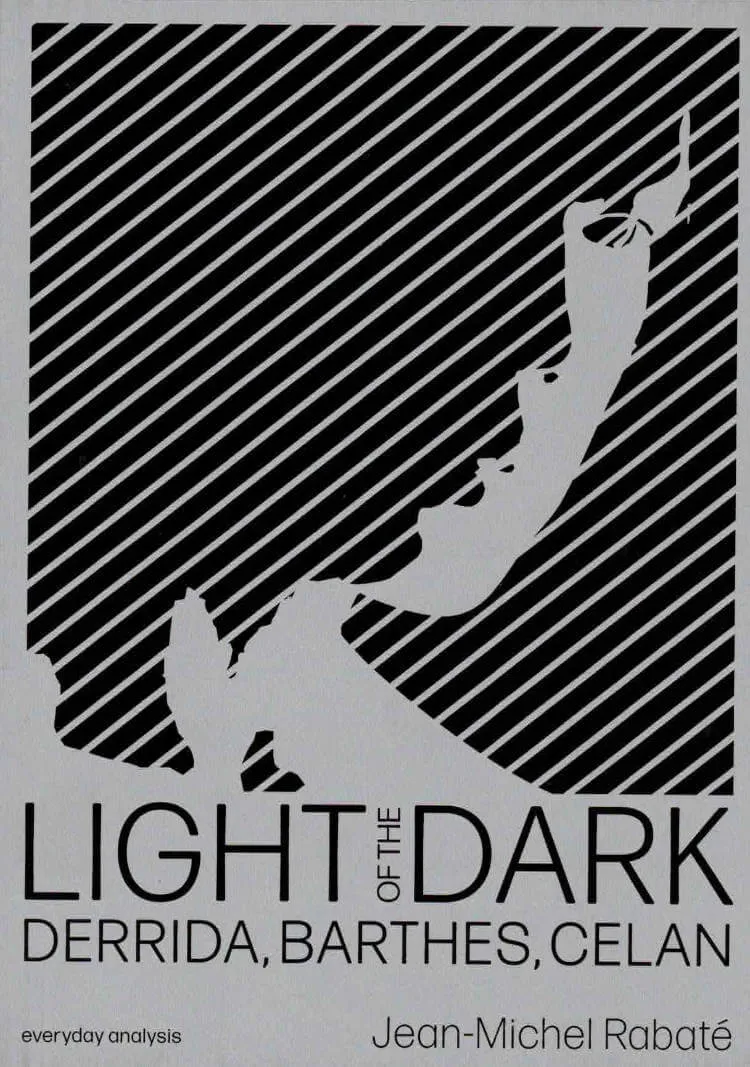
Light Of The Dark: Derrida, Barthes, Celan
Derrida’s essay “Aletheia” discusses the work of Japanese photographer Kishin Shinoyama. Reading Derrida, Rabaté investigates how, behind the classical concept of truth as a beautiful naked woman, Derrida argues that any photographic image tells the Truth, but a truth obscured as it comes to light: “nothing is more black than the visibility of light.” Staging a critical conversation with Roland Barthes’s theses in Camera Lucida and Paul Celan’s poems from Breathturn to Lightduress, Rabaté argues for a theoretical approach to truth that counters the prevailing truth-discourses of today.
Confessions Of A Class Reductionist
In these essays, Ben Burgis criticizes fashionable radical-liberal identity politics and makes the case for universalism about rights and an unabashedly “class-first” approach to socialist political strategy. This may sound to some ears like a call for abandoning marginalized people. On the contrary, he argues, focusing on economic inequality empowers the victims of bigotry and retrograde social practices the resources and material security to stand up for themselves far more effectively than any diversity trainer or “anti-racism” consultant could represent their interests. As we face a rising tide of reactionary authoritarianism, it’s more important than ever to ditch the identitarian pieties of the recent past and think hard about how the Left can actually win.

The Completion
In The Completion, legendary philosopher Franco 'Bifo' Berardi offers his analysis of cognitive automation and artificial intelligence. Of the possible worlds imagined in Silicon Valley and in the media discourse around tech boosterism, none will likely materialise. Instead, the unpredictable will intervene in the future of predictive technology.
In this new edition, in a new venture for Everyday Analysis, Berardi's essay is accompanied by an introduction by Alfie Bown and a series of artworks and illustrations, new and historic- from Borges's labyrinths to the I-ching - offering a reading experience in the spirit of Berardi's work.