Books
Books
Hardcover

Mother Media: Hot and Cool Parenting in the Twentieth Century
An essential history for understanding how we mother now, and how motherhood itself became a medium—winner of the Brooke Hindle Award from the Society for the History of Technology.
From the nursery to the prison, from the clinic to the commune, Mother Media tells the story of how we arrived at our contemporary understanding of what a mother is and how understandings of “bad” mothering formed our contemporary panics about “bad” media. In this book, leading historian of psychology Hannah Zeavin examines twentieth-century pediatric, psychological, educational, industrial, and economic norms around mediated mothering and technologized parenting. The book charts the crisis of the family across the twentieth century and the many ingenious attempts to remediate nursemaid and mother via speculative technologies and screen media.
Growing out of her previous award-winning book The Distance Cure, which considered technologized care, the book lays bare the contradictions of techno-parenting and how it relates to conceptions of “maternal fitness,” medical redlining, and surveillance of children, parents, and other caregivers. The author offers narratives of parenting in its extremity (for example, Shaken Baby Syndrome) and its ostensible banality (for example, the Nanny Cam) and how the two are often intertwined. Ultimately, Zeavin grapples with a simple contradiction: technology is seen and judged as harmful in domestic and educational spaces, even as it is a saving grace in the unending labor of raising a family.
Hannah Zeavin is Associate Professor of the History of Science in the Department of History and the Berkeley Center for New Media at UC Berkeley. She is the author of The Distance Cure and Mother Media (MIT Press) and Founding Editor of Parapraxis. In 2021, she cofounded The Psychosocial Foundation.

Abstract Coloring Book
A coloring book conceived as an artist book. Coumba Samba’s publication prompts you to explore geometric forms and structures with a small set of colored pencils. Using those simple materials one realises how interaction and experimentation challenge again and again the relationship between color, abstraction and internalised form systems.
Published in connection with the exhibitions deutschland at Kunstverein in Hamburg and Coumba Samba at MauMaus in Lisbon.
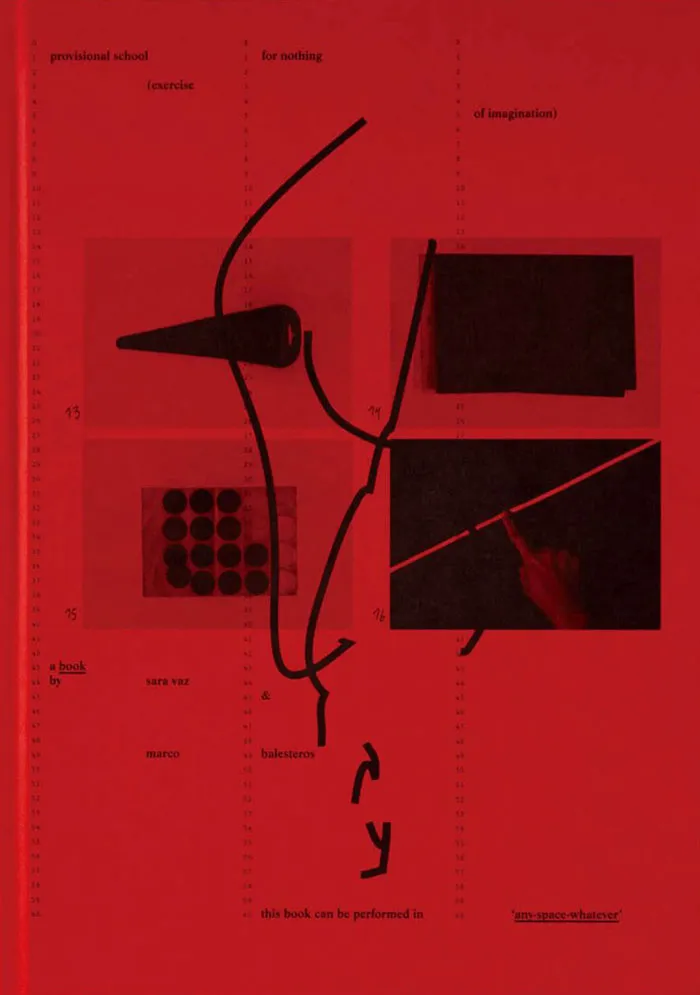
provisional school for nothing—exercise of imagination
‘Provisional School for Nothing—exercise of imagination’ aims to explore forms of parallel education such as self-learning, self-organized schools, unschooling, inner schools, and more. This book is a choir of around 30 invited guests (artists, choreographers, dancers, graphic designers, writers, thinkers and so on). We use the word ‘choir’ since we decided to explore the concept of authorship. The book functions like a language score —comprising words, fragments, and loose ideas that develop throughout a series of conversations we’ve had with our guests via Zoom during the pandemic.
with Marco Balesteros Sara Vaz Alexandru Balgiu Ana Jotta Bráulio Amado Cracked Bolos Igor Dobricic Isabel Carvalho Ivan Martinez João Fiadeiro João dos Santos Martins] Karel Martens Maki Suzuki & Lppl Marco Bene Maria Duarte Marion Cachon Miguel Bonneville Nelson Guerreiro Olivier Lebrun Olga Mesa Francisco Ruiz de Infante Paul Elliman Paul Faure Pedro Barateiro Pedro Rogado Ricardo Nicolau Sara & André Sara Graça T.I.M.E. Tomás Cunha Ferreira Von Calhau! the missing person a man in silence
designed by Sara Vaz Marco Balesteros
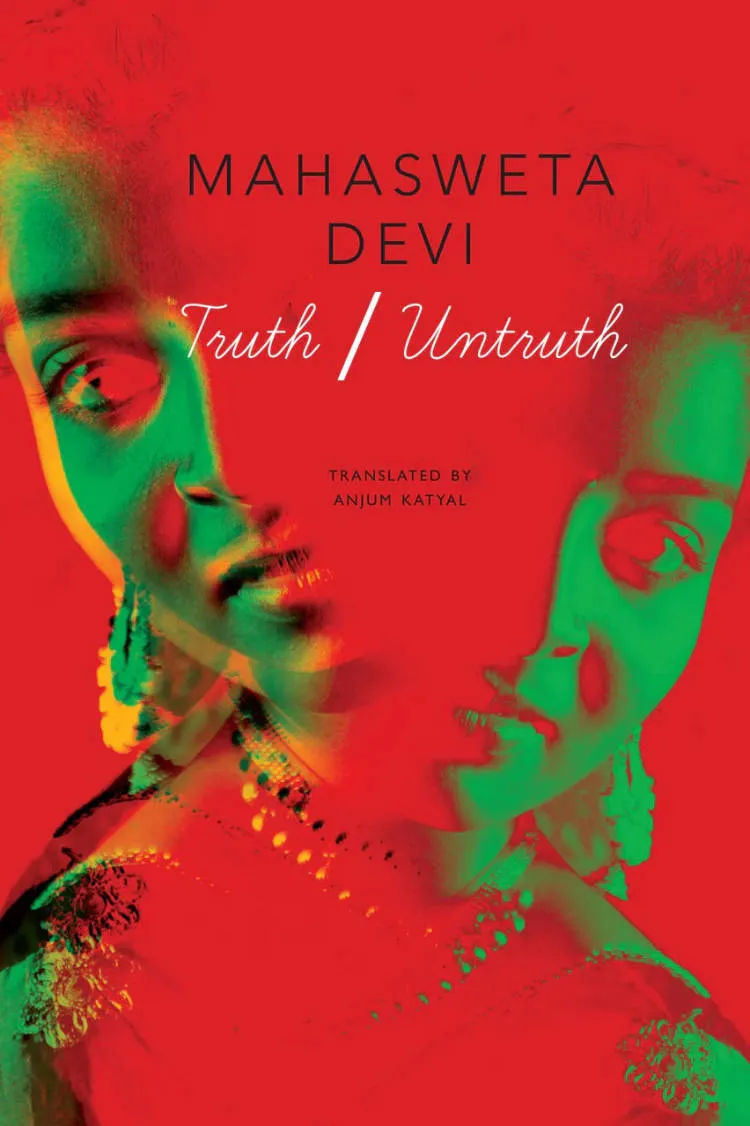
Truth / Untruth
A trenchant, darkly humorous, and unsentimental look at Calcutta society.
Set in Calcutta in the mid-1980s, Truth/Untruth is a fast-paced thriller built around the death of the pregnant Jamuna—a maid in a newly affluent residential apartment complex—and Arjun, the upwardly mobile businessman who seduced her. Packed with a cast of colourful characters, this novel is a trenchant, darkly humorous, and unsentimental look at the different segments of Calcutta society: from the middle-class culture vultures to the unscrupulous ‘promoter’ class and the domestic helpers and slum goons who form an intrinsic part of the city’s life. All are implicated in a complex web of guilt and bizarre twists and turns. Sex, lies, death—the great modernist themes—run like a thread through this book, exposing societal greed, lust, corruption, and moral hypocrisy with a sardonic tone that spares none. An unusual novel by an author who is otherwise known for her hard-hitting activist-feminist stories, Truth/Untruth underlines the exploitative vicious cycle that defines urban relations between the haves and have-nots.
‘Although not of the margins herself, Devi was accomplished in writing from the margins [ . . . ] However, it is indeed worth it if you are looking for an exhilarating social commentary and biting satire that remains relevant today. Devi also reflects the jargon and dialects of the lower classes as deftly as the peculiarities of upper-class speech patterns. A feat of this work is Katyal’s ability to mediate these multiple registers, rewarding the reader with sharp writing that is at once funny, sardonic, and darkly pleasurable to read.‘—Jack Greenbert, Cha: An Asian Literary Journal.

Whitney Museum of American Art
Edges of Ailey
Alvin Ailey is one of the most celebrated choreographers of the twentieth century. The creator of iconic works such as Blues Suite, Revelations, and Cry, he is widely recognized for the dance company he founded in 1958 when he was just twenty-seven years old. Ailey imagined and cultivated a platform for modern dance through his innovative repertoire, interdisciplinary sensibility, and support of dancers and choreographers. This expansive volume situates Ailey within a broader social, creative, and cultural context, looking at the artists who influenced and collaborated with him, the spaces and scenes he frequented, the dynamic themes within his dances, and how his vision and work changed contemporary dance.
Essays by artists, scholars, and critics cover topics ranging from the Black church, the South, and the Great Migration to nightclubs, musical influences, and queerness. With more than four hundred images including photographs of works Ailey choreographed, archival materials such as notebooks, sketches, letters, and never-before-published behind-the-scenes photos, and conversations about the legacy of the company with Sylvia Waters, Judith Jamison, and Masazumi Chaya as well as several contemporary dancers and scholars, this study offers an unprecedented full picture of one of the twentieth century’s leading artists and the way his work continues to inspire today’s generation of dancers.
Contributions by Horace D. Ballard, Harmony Bench, Kate Elswit, Aimee Meredith Cox, Thomas F. DeFrantz, Malik Gaines, Jasmine Johnson, Joshua Lubin-Levy, Uri McMillan, Ariel Osterweis, J Wortham, CJ Salapare, Kyle Abraham, Claire Bishop, Masazumi Chaya, Brenda Dixon-Gottschild, Jennifer Homans, Judith Jamison, Sylvia Waters, Jamila Wignot and Jawole Willa Jo Zollar

Wanderlust
Soufiane Ababri's sketchbooks.
Soufiane Ababri (b. 1985, Rabat) is a Moroccan artist based in France. His protean work (drawings, installations, performances) explores questions of gender, homosexuality, racism and colonialism.

Night Night Fawn
From the author of Confessions of the Fox comes a novel in which a yenta on her deathbed gives an unrepentant account of all her failures—including her child.
“Jordy Rosenberg might be one of our most fearless living novelists. There are no half-measures in his work, just big ideas and living characters and gorgeous sentences and metafictional panache and surprise after heart-stopping surprise. Night Night Fawn is extraordinary.”—Carmen Maria Machado, author of In the Dream House
In a cluttered rent-controlled apartment in the middle of Manhattan, Barbara Rosenberg is terminally ill, high on opioids, and writing the story of her life. She has opinions about her smutty late husband, her career as the receptionist for a disreputable plastic surgeon, her glory days as an accomplished jazzerciser, and her failed aspirations to be a film noir actress. But what she really wants to talk about are unhinged thoughts on gender, Karl Marx, Zionism, and her two great disappointing loves: an estranged trans son and a long-lost best friend whose betrayal haunts Barbara still. As she descends further into delirium and illness, Barbara finds herself in a nightmare from which she cannot escape, and her circumstances put her on a crash course with these intimates—or are they avenging nemeses?—once again.
Part novel, part someone’s mother’s unauthorized memoir—all diatribe, gutter schtick, and deranged manifesto, Night Night Fawn is a ferociously candid account of intergenerational conflict.

The Vivisectors
A reclusive graduate student is forced into a friendship that destabilizes her life in this surreal, allegorical romance.
In a famed but crumbling university city overrun by nature, where power is held in a fragile balance between academics and a contingent of rogue gardeners, the reclusive narrator of The Vivisectors spends her days propping up the career of her needy and fraudulent professor boss. Then a controversy ruptures her careful routine: Adam, a contrarian student and an obsession of the boss, comes into heated conflict with a young professor, with both men claiming discrimination. The crisis subsumes the university, though the narrator is unmoved—not even the attempted suicide of her estranged mother has been enough to dispel her lack of engagement with the world. But when her boss commands her to befriend Adam, the narrator finds herself both caught up in the events threatening to tear the city apart and increasingly drawn to the alluring student at the heart of it all.
Coursing with icy suspense and told with violent precision, The Vivisectors is a new kind of love story for an age of deteriorated communication. With the unsparing style and intellectual ambition that made her award-winning debut The Doloriad a celebrated provocation, Missouri Williams holds a mirror up to humanity’s most intimate contradictions and reflects them back through a novel of profound, spiky spiritual reckoning.

Terminal Boundaries and A natural water course diverted reduced or displaced
Made in 1969 but never published, Terminal Boundaries is an artist book by Lawrence Weiner, a sculptor whose medium was language. The manuscript for the publication, which was recently brought to light, contains two related bodies of work represented as typewritten statements on paper that Weiner pasted to the pages of a small composition notebook. The book’s absence from Weiner’s oeuvre plagued him as it marked a terminus of his relationship to the physical construction of his artworks, and illustrated the principle of “specific” and “general” which he applied to his art.
Created from a standard notebook purchased in a stationery store, the manuscript is two books in one: Terminal Boundaries and A natural watercourse diverted reduced or displaced. A tête-bêche with two front covers, the book can begin from either cover by turning it upside down.
Weiner was a traveler by nature and the materials he refers to in these works are those that one can encounter on a road trip. The artist was traveling across Europe when this manuscript was composed. Struck by the tumultuous times and the critical illuminations about the climate from the Club of Rome discussions, the works in this book are in Weiner’s words, “concerned with the relationship of natural resources in relation to human beings.” Distinct from his contemporaries associated with the Land Art movement, in Terminal Boundaries and A natural water course diverted reduced or displaced, Weiner constructs his landscape interventions in language—the specific and/or general act and the location are stated—offering the reader/viewer the opportunity to consider each work’s existence, to build it in their mind’s eye. One can only wonder what Weiner did to divert, reduce, or displace a natural water course in Saltsrumen, Norway, the location of the world’s strongest maelstrom, or in nearby Bodø at the site of Svartisen glacier. A work in Terminal Boundaries titled The joining of France Germany and Switzerland by rope demonstrates the geopolitical perspective of Weiner’s land art. Requiring physical and mental borders to be transgressed in performing this work; how and where could this happen?
Terminal Boundaries finds Weiner just off the cusp of his decision to make art that lived centered in language, emphasizing the viewer’s responsibility to engage with it to make it whole. The book marks a crucial inflection point in the artist’s practice, defining his direction to make work that “attempts to present something to people that is not just about me,” but about materials and the world we find ourselves in here and now.

three six five: prompts, act, divinations
There are 365 exercises for writing in this book, but it is not simply a book of writing exercises.
three six five is a “how-to” book of questions—not answers. It is an ars poetica of expanding possibility, a tarot deck of acts instead of images, a book of bending hours, a diary of contemplation and imagination, an antidote to consumption in the shape of care and attention.
These prompts, acts, and divinations—in alchemical combinations with new drawings by Nick Mauss—invite both aspiring and experienced writers to learn and unlearn, to mine memory and forgetting, to enter impossible spaces and create new ways of telling time, to inhabit multiple, other, and conflicting perspectives, to discover the elasticity of language and its constraints, to write by drawing, walking, listening, and even by being distracted.
While this is an inexhaustible compendium for writing, it is also an enduring reservoir for those who have no desire to be(come) a writer. Many exercises take the form of play, encourage collaboration with friends, strangers, and non-human beings, and operate off the page, often in the world, in the spirit of discovery rather than result. All intend to nurture and cultivate possibility.

Art Law, and Artists' Rights: for Creators, Authors and Artists
Art Law draws on forty years of practice to empower and encourage creators, authors, and artists to understand, protect, and exercise their rights. It illustrates key aspects of art law by expanding on specific legal cases. Whenever an artist brings a case to court, that case has the potential to clarify and expand the rights of all artists. Each legal decision not only educates the public and the judiciary about the challenges faced by artists but also highlights the importance of applying the law to safeguard their rights.
In examining the role of justice in artistic activities, we must acknowledge that justice is achieved through legislation and individual case rulings. These are the mechanisms that artists can activate. Favorable judicial decisions can have a wide-reaching impact on both artists and society. However, the court remains a passive entity until an artist brings a case to stimulate a decision. Thus, litigation can serve as a form of activism that prompts a ruling. Although it can be difficult and expensive, it is an effective tool that is accessible and potentially beneficial to all. This compendium provides the knowledge necessary for creatives to work freely and securely, understand their rights, and avoid self-censorship and exploitation.
Contributors: Jenna Jordan, Esq., Bara Diokhane, Esq., Timothy Caron, Esq., and Kevia McComb

Verlag der Buchhandlung Walther König
Movement Notation
Eshkol and Wachmann focused dance on its basic element: the movement of the human body. They treated the different parts of the body as separate instruments, similar to the musical instruments of an orchestra–each with its own rules for the movements to be performed. This new edition of the 1958 publication is supplemented by contributions from Eshkol’s companions and further archive material, which contextualizes and supplements the history of the 'EWMN’s‘ origins and embeds it in contemporary discourses on dance and movement.
The publication is published in the context of the performance 'Pause: The Noa Eshkol Chamber Dance Group‘ at KW Institute for Contemporary Art (August 2023), as well as the exhibition 'Noa Eshkol: No Time to Dance‘ at the Georg Kolbe Museum (15 March–25 August 2024). The new edition was developed together with the 'Noa Eshkol Foundation for Movement Notation‘.

Could It Be Love
Greer Lankton’s iconic and startling doll sculptures as we have never seen them before: through her own eyes.
Magic Hour Press is proud to present the first monograph on the trans visionary artist Greer Lankton (1958–96), whose lifelike doll sculptures shocked 1980s New York. Lankton’s dolls, which she began making as a child and produced obsessively until her death at age 38, were a means to explore her fraught relationship with the human body. In the book’s 100 photographs, all shot by Lankton herself, these figures take on a life of their own, kvetching at a party, strolling along a beach, or lounging on a stoop in the East Village. Among this extraordinary cast of oddballs—usually femme, often freakish, always radiating a glamorous confidence—we find characters of Lankton’s own invention alongside well-known icons such as Divine, Coco Chanel, Andy Warhol and even Lankton herself.
Born in 1958 to a Presbyterian minister in Michigan, Greer Lankton moved to New York in 1978 and became a rising star of the downtown scene. There, her deviant elegance was immortalized in photographs by Peter Hujar, David Armstrong, and Lankton’s close friend Nan Goldin, who described her as “one of the luminaries of the East Village renaissance: beautiful, glamorous, wild and hysterically funny.”
Edited by Francis Schichtel, Jordan Weitzman and Nan Goldin
Text by Hilton Als

A Psalm for the Third Wind
Book: 11.7 × 18 cm
Book and Glove: 13.5 × 31.5 cm
Presented in a monster glove
Three broken halves of one god walk a city that wants them dead
Their bodies speak in static hunger and rust
Something follows breathing through their mouths
Read it Bleed from it
In A Psalm for the Third Wind, a film script written from 3 perspectives, Damien Troadec is aiming to address in parallel narrative the struggle of having multiples inner voices and the danger of following their distinct desires. One question is raised without any light at the end of the tunnel, confronting the reader to a conflict : THE COMFORT OF MISERY OR THE PAIN OF CHANGE ?

A Certain Amount of Clarity
Emmanuel Van der Auwera, Harlan Levey and 1 more
Eponymously titled with his award winning 2014 film, “A Certain Amount of Clarity” is the first monograph dedicated to the artistic practice of Emmanuel Van der Auwera, whose work describes our experience of digitized life operating at intersections of documentary, reconstruction and fiction.
His practice is one that demonstrates the impact of emerging technologies on perception and civic dialogue, building platforms for marginalized actors and engaging with technicians and scientists to explore the balance of ethics and aesthetics in new media. Through filmmaking, video sculpture, theatre, printmaking, and other media, Van der Auwera sets up encounters with found images that provoke a questioning of our visual literacy: How do images of contemporary mass media operate on various publics, and to what end?
With the formal rigor of a logician, Van der Auwera dissects how images are engineered, mastering specialized industry techniques and intervening on their protocol. In so doing, Van der Auwera brings us no closer to a monolithic truth, but constructs new paradigms for reading images and understanding our relationships with them.

Making a Way: Lesbians Out Front
JEB (Joan E. Biren) first introduced viewers to her photographs in 1979 when she published Eye to Eye: Portraits of Lesbians, a groundbreaking celebration of women loving women. In the years that followed, JEB collaborated with poets, musicians, filmmakers, elected officials, healthcare providers, factory workers, spiritual leaders, and others who built communities and worked for political change. Her second book Making a Way: Lesbians Out Front, published in 1987, depicts the spirit and energy of this movement in more than a hundred emotionally resonant photographs that take us from passionate activism to thoughtful solitude, while remarks and remembrances from each woman photographed deepen the historic record. This reissue of Making a Way adds insightful new essays by Cheryl Clarke and JD Samson, resulting in an essential document of an era whose impact continues to be felt across our society today.

Troubling the Stage – The Choreographic Work of Marlene Monteiro Freitas
Five dance pieces and an iconographic imaginary in convulsion: making the most of these ingredients, Alexandra Balona engages with the work of Cabo Verdean choreographer and dancer Marlene Monteiro Freitas.
This book offers a lens onto the dazzling oeuvre of a choreographer whose boldness shakes the foundations of every theater she enters. It centers on five emblematic works: Guintche (2010), Paradise—Private Collection (2012), Jaguar (2015), Bacchae—Prelude to a Purge (2017), and Mal—Embriaguez Divina (2020). It follows Monteiro Freitas's creative methodology, weaving references from her personal archive together with works from art history, navigating between ideas and possibilities in the manner of an atlas bearing the weight of the world. From wonder emerges a mode of attentive reading; one capable of observing and, out of fragments, revealing the methods, processes, and mechanisms of art. The texts in this book are "small critical machines for reading the unreadable."
Troubling the Stage: The Choreographic Work of Marlene Monteiro Freitas is both a study and an encounter; a powerful crossing of choreography with critical thought. It invites readers, scholars, and audiences alike to experience the intensity, violence, joy, and humanity of one of today's most uncompromising choreographic voices.

The Hut
Oswell Blakeston (1907–1985), though one of the great British masters of short horror and supernatural fiction, has never before had these tales collected. Here, for the first time, the bulk of his output in the genre is brought together, including numerous extremely hard to find pieces. Added to this are two appendices, the subject of which is the artist and occultist Austin Osman Spare (1886-1956), who Blakeston was closely associated with.

The Consequences
The Consequences is a hybrid collection of prose and poetry; an autofictional examination of the pain of a transatlantic relocation from New York to the blanketing beige of Paris to rejoin a totemic muse. It also focuses on corgi attacks, Maryland, painful anxiety, the struggle to accept the things one cannot change, the third party and the past as adamantine shackles. The "towering sexual iconography of Mike Immerman" looms over the disorientation of a reluctant resident in “the City of Light.”

THE DELUSION
Coinciding with Danielle Brathwaite-Shirley’s exhibition, Serpentine and Archive Books have released the artist’s first monograph, THE DELUSION. It imagines a ‘new bible for emotional processing’ and offers intimate insight into the project and the artist’s wider practice, in a gamified, interactive style.
Danielle Brathwaite-Shirley (b. 1995, London) is a Berlin/London-based artist who graduated from the Slade School of Fine Art, London in 2019. Working predominantly in animation, sound, performance, and video game development, their practice intertwines lived experience with fiction to imaginatively retell the stories of Black Trans people. Encouraging the active participation of the visitor-player in their installations, the artist highlights the role of individual choices in shaping narratives and histories.
Contributions by Mckenzie Wark, Helen Starr, Legacy Russell x Mindy Seu, Tamar Clarke-Brown, Danielle Brathwaite-Shirley, Kay Watson, Rebecca Allen, Hans Ulrich Obrist, Shenece Oretha, Rosa-Johan Uddoh, Barby Asante, Ebun Sodipo

Memoria
A chronicle of the genesis and creation of Memoria, the new film by Apichatpong Weerasethakul. After visiting Colombia in 2017, Apichatpong chose the country as the location for his first feature shot outside of his native Thailand. In the following two years, he returned for several visits and travelled extensively, listening to the stories of the people he met along the way. The book 'Memoria' gathers the memories he collected, in the form of photographs, a personal diary and sketchbook, research notes, treatment excerpts, and email correspondence.

Friends and Family
This first monograph includes all of Van der Stokker's murals and most of her drawings.
In an interview in this collection of Van der Stokker's wall paintings and drawings, John Waters says, 'Millions of teenage girls have drawings that are good, but no one ever tells them that they are'. Van der Stokker celebrates teenage girlishness, and has since 1983 found both immense support and immense rejection within the art world community. Includes interviews with Van der Stokker and a complete presentation of her works in situ, printed on full-page spreads on quality mat paper.
Dutch-born van der Stokker (1954, Hertogenbosch), active artist-gallery owner on the East Side of New York in the 80's, now lives between Amsterdam and New York. She developed pictorial murals with happy candy-coated slogans that incited acid sarcasm from her contemporaries.
Texts by Anne Pontégnie, Éric Troncy, John Waters/Charles Esche, Mirjam Westen, Amy Kellner.

Profusione
A comprehensive overview of the unique work of the Italian artist born in 1931 and "discovered" late on the international scene, with numerous texts and an interview.
Published after the eponymous exhibition at Consortium Museum, Dijon, April 26th – September 8th 2024.
Born in Naples, Italy, in 1931, Isabella Ducrot is a young artist with a young career. Like many women of her generation, she moved into art after raising her children. Her formative years were marked by continuous travels with her late husband, during which they amassed hundreds of Persian miniatures and rare antique textiles of many kinds.
Contributions by Franck Gautherot & Seungduk Kim, Verena Lueken, Tobias Pils, Tschabalala Self, Andrea Viliani, Miranda Fengyuan Zhang.

Distributed Art Publishers (DAP)
Teenagers in Their Bedrooms
The new edition of Salinger's ever-relevant series of 1980s and '90s teenagers in their bedrooms.
Bedrooms contain the past, the present and the future; they are sites of continual transformation. Popular culture and fashion continually change and recycle. While specific objects of decor change over time, teenagers' bedrooms are still private sanctuaries: spaces for safely experimenting during a time in life when one is forming and expressing ever-evolving identities.
Upon its release in 1995, Adrienne Salinger's book In My Room was an immediate success, selling nearly 24,000 copies in its first few years. The continued popularity of this work made in the '80s and '90s is curious. However, over the nearly 30 years since, and especially in the most recent decade of social media, the work's appeal has grown tremendously. In some cases, the work evokes nostalgia, but not primarily so. Adrienne Salinger hears from current teenagers often; many send her pictures of their bedrooms today. Social media encourages users to endlessly "rebrand" their identities, creating idealized fantasies, striving for perfection. These photographs are not about perfection. They give voice to the contradictions of our identities.
Hundreds of print and online articles, interviews and features on In My Room have been published and the work has been exhibited at museums all around the world. Long out of print and now considered a classic, with only a rare few available on the secondary market, the book returns in a new expanded edition as Teenagers in Their Bedrooms. With 26 additional photographs, this treasure is made available once more to new audiences.
Adrienne Salinger has published three photobooks: In My Room (1995), Living Solo (1999) and Middle Aged Men (2007). She is Regents Professor Emerita at the University of New Mexico.