Theory & Criticism
Theory & Criticism

Plant Space Territories, Architectures and Technologies of the Vegetal
Carmen Lael Hines , Michelle Howard and 1 more
Plant Space: Territories, Architectures and Technologies of the Vegetal brings together eighteen international contributors working across critical theory, philosophy, art, design, architecture, and critical ecology to radically reimagine the role of plants in shaping the built environment and its overlapping economies and ecologies. Framed by the entangled histories of extraction, enclosure, and domestication, this volume resituates plants not as passive scenery or symbolic decoration, but as formative presences: agents of spatial composition, political tension, and epistemic possibility. Developed in the context of the exhibition “Bordering Plants” at the Academy of Fine Arts Vienna, essays and experimental formats examine the infrastructures, colonial residues, and aesthetic regimes that renderplant life visible, governable, or expendable. From houseplants, the imperial gardens of Vienna, and the global circuits of plant trade, to AI-rendered plants and satellite images in herbicidal warfare, the volume traverses the architectures, imaginaries, and techniques through which vegetal life is organized and resists.
Contributions by Elizabeth Bandason, Morgane Billuart, Carla Bobadilla, Laÿna Droz, Carmen Lael Hines, Michelle Howard, Adam Hudec, Roberto Majano, Hannah Meszaros Martin, Michelle Mlati & Pablo Barrios Martínez, Sandro Mezzadra, Serena Moscardelli, Ido Nahari, Akil Scafe-Smith, Caterina Selva & Lucia Stach, Lucia Gregorová Stach, Gabriel Alonso / Institute for Postnatural Studies.

The Mouth That Eats Itself: Geography & the Problem of Space
The fate of our freedom is among the most important topics for philosophy. All animals have to set themselves apart from their surroundings. Whenever they fail to break free from space, they are not only unfree but effectively become nothing. In our case, we emancipate ourselves with our hands and feet and membranes; but uniquely also through our representations of ourselves in the world, which is to say, through geography.
The Mouth That Eats Itself (2026) follows geographical thought from its inception to its descent into fang-toothed self-contradiction. In the course of identifying how and when geography makes us free, a terrible trap is set: a portrait that devours its unwary creator by raising the well-worn conflict between freedom and necessity to a transcendental level. The katabasis of geography’s logic is not a matter of idle inconsistency but an information hazard directly related to the fate of animals that lose their contours and disappear.
To reach this conclusion, Carl Olsson draws a diagonal line between ideas and images, from careful exegesis of Kant’s first Critique to countless vivid examples involving praying mantises, chameleons, geometry and owl-eyed butterflies. The ambient payoff is undeniable: you learn as much about the world as you do about yourself, and Olsson’s stunning vocabulary and precise choice of words never ceases to entertain.
Carl Olsson is a geographer and writer interested in how geographical thought impacts the human body. His work tells stories about geographers and other animals that get lost in space, extracting philosophical implications from scenarios that span the mundane and the otherworldly.

Femmephilia
From the author of Enemy Feminisms and Abolish the Family, an original diagnosis of femmephobia in our culture, and a vision of a life-giving femme feminism for all.
To be femme is to embody a dispossessed femininity, to be freighted with freedom, to refuse to be made proper or institutionalized. To love it is to embrace love for women (be they butch or not) in the broadest sense. In Femmephilia, Sophie Lewis makes the case for the vital importance of politicized femme-ness: a feminism that is self-consciously artificial, extravagant in its erotic and political appetites, and staunchly anti-work, abolitionist, and utopian. Femme labors deserve our care, respect, and support, but instead face dismissal from masculinist antagonists and feminist allies alike.
Where neoliberal women’s empowerment has failed to combat the eruption of right-wing, anti-trans, and anti-feminist attacks, Lewis argues that femmephilia can help us imagine a radical future. In essays on the high femme genius of Marilyn Monroe and trans yearning in the myth of Apollo and Daphne; on octopuses and girlbosses, reluctant heterosexuals, lesbian separatists, and anti-work cats; and on a mother on strike from maternity, Femmephilia offers a new logic of liberation for all feminized people.

Shakespeare and Ethics
Shakespeare’s plays are full of philosophical ideas, but they are rarely examined systematically. In this pamphlet philosopher Colin McGinn analyzes the plays to distill Shakespeare’s ideas about ethics. McGinn concludes that the “plays are about good and evil,” and that Shakespeare is “a great moral psychologist,” who expertly stages how his characters are defined by their moral qualities (their naturalistic virtues and vices).

Parapraxis 08: Groups
To be in a group is to submit to a form of disorganizing organization that hangs on careful balance: to be devoted to a collective without being engulfed, to be disciplined by it without sleepwalking to the tune of a leader’s will, to integrate without dissolving into it. As infants born into a sexual union from which we are then necessarily excluded, the yields and limits of assembly are evident from the outset. Before we arrived in the bloc, we lived our lives in other groups: the family, the religious order, the cafeteria table clique. You can sit with us. You can’t. Some groups we remember entering. Others we didn’t elect, but deselected.
As a form of critique whose object of analysis is suffering, psychoanalysis understands the pains of the group. Its full task is to make sense of them as a condition of the many as much as of the one. As the psychoanalyst Didier Anzieu glosses the problem of thinking about groups, the “commonplace” assumption is that the group “is a pooling, a sharing” through which “the energies, enthusiasm and capacities of individuals who freely assent to the discipline of the group” coalesce into a unified forcefield. Yet, as Anzieu stresses, this idealized description eats itself. It collapses union with sharing, with collectivity. We know that groups rely on sharing. He asks, “a sharing of what?”
Psychoanalytic cults. Cowboy churches. The Epstein Class. Iranian monarchists. Fascist liberals. Clinics and their radicals. Discipline and holding. Getting together, falling apart.
Essays by Séamus Malekafzali, Tracy McNulty, Richard Seymour, Zahid Chaudhary, Danny Hayward, Eri Linsker, hannah baer, and more.

Les liens qui empêchent: L'homophobie familiale et ses conséquences
Dans Les liens qui empêchent, Sarah Schulman analyse la reproduction de l’homophobie au sein du cercle familial, quand bien même ce dernier devrait être le lieu du développement et de l’épanouissement de chacun·e.
En s’appuyant aussi bien sur des théories sociologiques que sur des témoignages individuels, l’autrice décortique les mécanismes qui conduisent les familles à exclure certains de leurs membres. Bien que l’homosexualité soit de plus en plus représentée dans les médias et dans la culture populaire, Sarah Schulman montre en quoi celle-ci est souvent caricaturée et pathologisée. Ainsi, cette visibilisation ne s’accompagne pas nécessairement d’une meilleure acceptation des personnes homosexuelles dans le cercle familial.
Virulent plaidoyer visant à faire de l’homophobie une question de société qui ne serait plus uniquement reléguée à la sphère privée, Sarah Schulman offre ici des pistes permettant de mettre un terme à la souffrance endurée par de nombreux·ses homosexuel·les au sein du foyer familial.

Matières spectrales: Sociologie des Fantômes
Avery F. Gordon, Julia Burtin Zortea
Dans ce livre unique et fascinant, Avery F. Gordon examine l’expérience sociologique de la « hantise » en s’appuyant sur des références aussi bien littéraires que politiques. La hantise désigne un système qui altère l’expérience d’un vécu linéaire et déforme la façon dont nous séquençons habituellement le passé, le présent et le futur. En prenant pour terrain les romans de Toni Morrison ou Luisa Valenzuela et en les confrontant à des sources plus traditionnelles de la sociologie (articles de presse, comptes rendus judiciaires, rapports d’enquêtes), Matières spectrales démontre que les structures sociales héritées du passé influencent plus la vie présente que ne le présument la plupart des chercheur·ses en sciences humaines.
Afin de montrer comment les fantômes hantent le présent, l’autrice passe au crible une partie de l’histoire de la psychanalyse, avant d’examiner des épisodes de l’histoire tels que l’esclavage aux États-Unis ou les disparitions massives pendant la dictature militaire en Argentine, où des lois interdisaient à la population de parler des disparu·es.
Profondément interdisciplinaire et véritablement innovant par son approche, Matières spectrales est écrit avec une puissance à la hauteur de son sujet, et offre une vision nouvelle des intersections complexes de la race, du genre et de la classe.

Mother Media: Hot and Cool Parenting in the Twentieth Century
An essential history for understanding how we mother now, and how motherhood itself became a medium—winner of the Brooke Hindle Award from the Society for the History of Technology.
From the nursery to the prison, from the clinic to the commune, Mother Media tells the story of how we arrived at our contemporary understanding of what a mother is and how understandings of “bad” mothering formed our contemporary panics about “bad” media. In this book, leading historian of psychology Hannah Zeavin examines twentieth-century pediatric, psychological, educational, industrial, and economic norms around mediated mothering and technologized parenting. The book charts the crisis of the family across the twentieth century and the many ingenious attempts to remediate nursemaid and mother via speculative technologies and screen media.
Growing out of her previous award-winning book The Distance Cure, which considered technologized care, the book lays bare the contradictions of techno-parenting and how it relates to conceptions of “maternal fitness,” medical redlining, and surveillance of children, parents, and other caregivers. The author offers narratives of parenting in its extremity (for example, Shaken Baby Syndrome) and its ostensible banality (for example, the Nanny Cam) and how the two are often intertwined. Ultimately, Zeavin grapples with a simple contradiction: technology is seen and judged as harmful in domestic and educational spaces, even as it is a saving grace in the unending labor of raising a family.
Hannah Zeavin is Associate Professor of the History of Science in the Department of History and the Berkeley Center for New Media at UC Berkeley. She is the author of The Distance Cure and Mother Media (MIT Press) and Founding Editor of Parapraxis. In 2021, she cofounded The Psychosocial Foundation.

Anarchitecture After Everything: A Trans Manifesto
A revolutionary way of seeing bodies and built environment that unites radical politics and trans aesthetics.
From a leading author and queer theorist known for reframing many of the most pressing questions about counter-intuitive ways of being.
Anarchitecture, a radical aesthetic practice of unmaking the built environment, staged a vigorous confrontation with urban renewal and gentrification projects in the 1970s. In Anarchitecture After Everything, Jack Halberstam identifies a powerful lexicon of transformation within anarchitecture, joining the movement’s practices of cutting and splitting with the destabilizing power of transness to detonate acts of formal violence in our time.
Anarchitecture describes the aesthetic practice of splitting and cutting, dismantling and undoing, unmaking, unbuilding, and ultimately unworlding. The trans body splits bodily coherence, dismantles the gender binary, and unbuilds bodily meaning. In these chapters, Gordon Matta-Clark’s cuts, along with Alvin Baltrop’s 1970s images of collapsing warehouses and Beverly Buchanan’s post-demolition fragmentary sculptures, return with a vengeance through the contemporary aesthetic gestures of Yve Laris Cohen, Jesse Darling, Nicole Eisenman, Kiyan Williams, Cassils, boychild, and Every Ocean Hughes. Anarchitecture unmakes space and offers a new rhetoric for emptiness. In its conclusion, the book explores this rhetoric through Renee Gladman’s anarchitectural experiments with language.
By reading anarchitecture through transness and transness through anarchitecture, Halberstam helps us see the trans body as a space of radical unmaking and as a portal to new lexicons for transformation.

The Literary Workshop
A bold, revelatory argument for the power of language by leading radical lesbian feminist and author of The Straight Mind.
The Literary Workshop takes readers inside Monique Wittig’s creative process, unlocking the practice of writing both in material and political terms. Wittig provides her most complete account of how literature and politics work together. Part of the generation that revolutionized French literature, Wittig reveals the secret of her craft: that the work a writer does with language is itself a form of resistance.
Born and raised in France, Monique Wittig (1935–2003) was a driving force in second-wave feminism and one of the most brilliant authors of her generation. A provocative thinker, she famously declared that lesbians are not women and introduced women into a materialist framework by treating them as a class. Wittig is the author of, among other titles, The Straight Mind, Les Guérillères, and The Lesbian Body. Her debut novel, The Opoponax, won Le Prix Medicis.

Close Writing: Kathy Acker, Cookie Mueller & Love-in-Pieces
In Close Writing, Alice Butler reflects on the diaries, letters, publications, performances, lives, and afterlives of her most beloved queer feminist writers: Kathy Acker and Cookie Mueller. While the transgressive avant-garde writer Kathy Acker has developed a cult following in the decades since her death in the late-90s, the actress and writer Cookie Mueller has remained relatively obscure. In this creative-critical study, Butler participates and responds to the lives and writings of her shared “beloved," reimagining the scene of the archive as a scene of triangulated and bittersweet love that traverses the boundaries of life and death. She draws on the autofictional strategies that Acker and Mueller pioneered in their own experimental writings and performances, encountering the women in intimate theoretical spaces of sensuality, sexuality, and sickness that slip between life and text. By encountering Acker and Mueller as transgressors and innovators, but also as beloved figures in her writing life whom she addresses in love letters, Butler brings readers to new, reparative textures of understanding, embodiment, and affection through close writing.
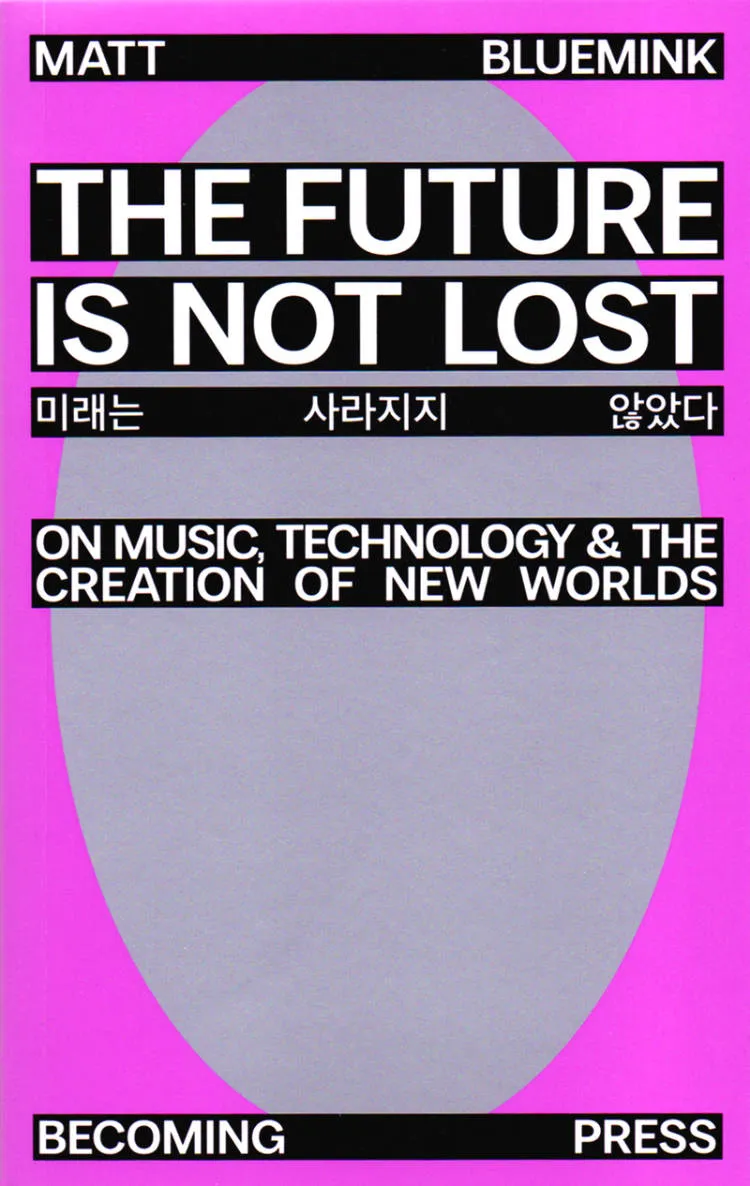
The Future is not Lost: On Music, Technology, and the Creation of New Worlds
Matt Bluemink, Alessandro Sbordoni
Mark Fisher taught a generation to hear the future's disappearance in contemporary music, as if the rhythm of the world was synchronised to the periodic flowering of new creative forms. His diagnosis was devastating: stagnation in music was akin to a venous insufficiency, or worse, some kind of nuclear winter that would ward off the spring for endless generations to come.
Drawing on musicians like SOPHIE, Arca and Iglooghost, Matt Bluemink declares that the future is not lost; it still speaks to us through music. If Fisher’s Hauntology — dwelling on ghosts of the past — is the logic of depression, then Bluemink’s Anti-Hauntology posits a logic of hope where voices from the future continue to guide the development of the present.
Island-hopping through Stiegler's philosophy of technics, Simondon's theory of individuation, and the spatial imaginaries of cyberpunk and solarpunk, Bluemink builds a theoretical framework equal to the times — one that takes seriously our capacity to, not only diagnose the world, but remake it. In order to create a new future we must re-imagine our relationship with music, with technology, and with culture. The world of tomorrow is a blank canvas; an open book. New beginnings are always possible.
Matt Bluemink is the founder and editor-in-chief of Blue Labyrinths online magazine. His research is focused on the relationship between the philosophy of technology, media theory and urbanism. He also writes on contemporary music, literature, and digital culture.

Your Life Is Not A (Fucking) Story
In this new collected edition of his recent articles, Simon Critchley - one of the most important living philosophers - takes us through his reflections on death, questions of doubt and reason, the legacy of David Bowie, the nature of fear and empathy in a broken society and a critique of narrative identity - among other things. YOUR LIFE IS NOT A STORY explores the contemporary world and its psychological impact on us, offering us a way to see our situation different and resist its tricks and contrivances.
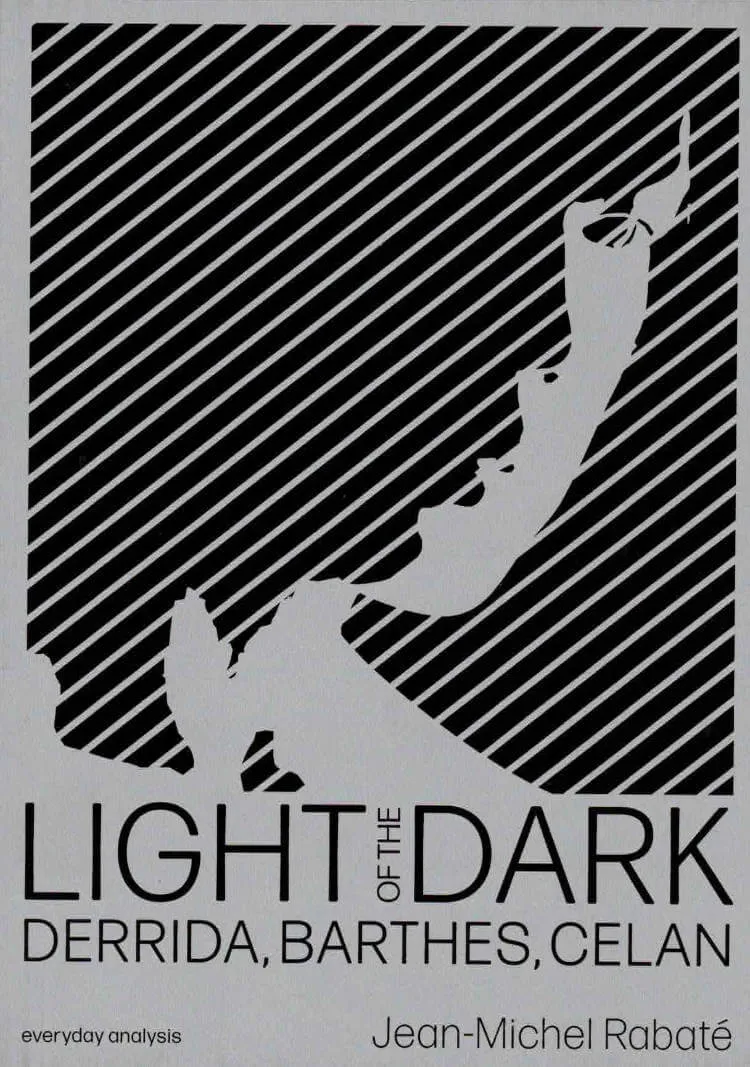
Light Of The Dark: Derrida, Barthes, Celan
Derrida’s essay “Aletheia” discusses the work of Japanese photographer Kishin Shinoyama. Reading Derrida, Rabaté investigates how, behind the classical concept of truth as a beautiful naked woman, Derrida argues that any photographic image tells the Truth, but a truth obscured as it comes to light: “nothing is more black than the visibility of light.” Staging a critical conversation with Roland Barthes’s theses in Camera Lucida and Paul Celan’s poems from Breathturn to Lightduress, Rabaté argues for a theoretical approach to truth that counters the prevailing truth-discourses of today.
Confessions Of A Class Reductionist
In these essays, Ben Burgis criticizes fashionable radical-liberal identity politics and makes the case for universalism about rights and an unabashedly “class-first” approach to socialist political strategy. This may sound to some ears like a call for abandoning marginalized people. On the contrary, he argues, focusing on economic inequality empowers the victims of bigotry and retrograde social practices the resources and material security to stand up for themselves far more effectively than any diversity trainer or “anti-racism” consultant could represent their interests. As we face a rising tide of reactionary authoritarianism, it’s more important than ever to ditch the identitarian pieties of the recent past and think hard about how the Left can actually win.

The Completion
In The Completion, legendary philosopher Franco 'Bifo' Berardi offers his analysis of cognitive automation and artificial intelligence. Of the possible worlds imagined in Silicon Valley and in the media discourse around tech boosterism, none will likely materialise. Instead, the unpredictable will intervene in the future of predictive technology.
In this new edition, in a new venture for Everyday Analysis, Berardi's essay is accompanied by an introduction by Alfie Bown and a series of artworks and illustrations, new and historic- from Borges's labyrinths to the I-ching - offering a reading experience in the spirit of Berardi's work.
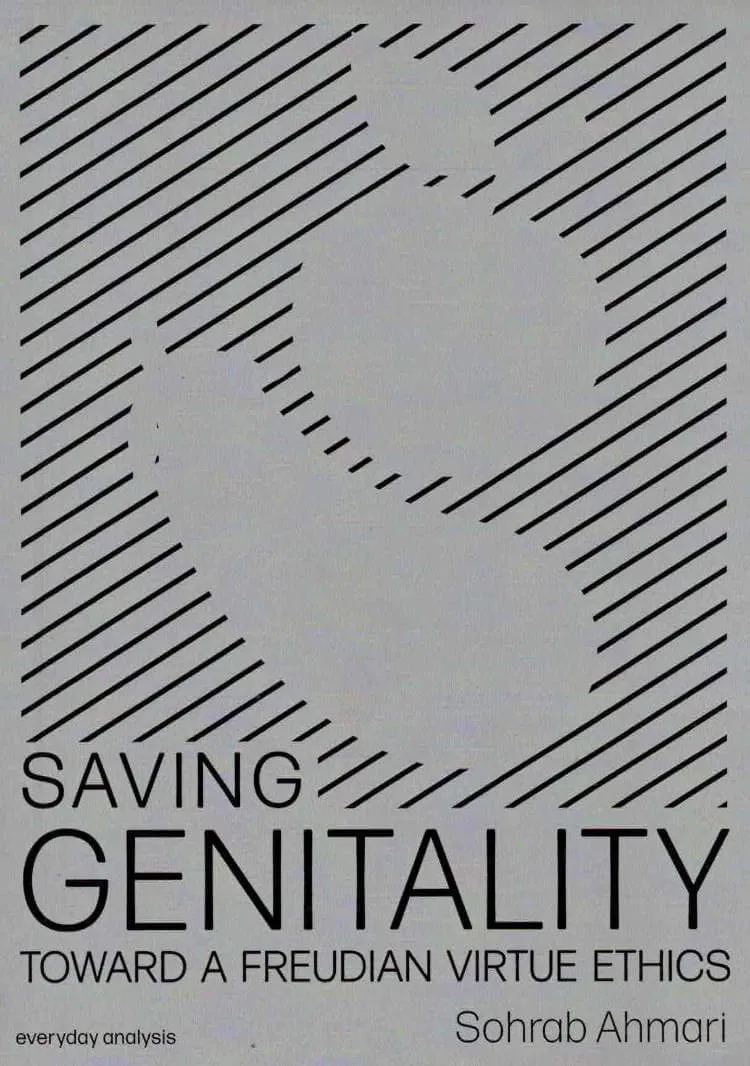
Saving Genitality: Toward A Freudian Virtue Ethics
Western societies have dismantled many of the prohibitions that ringfenced errant sexual drives in Freud’s time. The psychoanalytic project describes people caught between two fundamental and contradictory principles: One a relentless sexual drive, the libido; the other our species’ collective need for social order and harmony. Part of this harmony, for true Freudians, is embedded in the binary mutuality of men’s and women’s bodies, which remains indispensable for society to reproduce itself, even in our sexually liberated age. In this essay, Ahmari revisits the idea of ‘genitality’ arguing that perhaps the "heteronormative" orthodox Freudians were right about some things after all.

Postmortem issue 1
Marina Mardas, François Peyroux and 1 more
How can we define and document our present?
Postmortem is a sensitive yet critical metaphor for a world suspended between collapse and reinvention—a diary of the now. Drawing together writers and artists from Europe and the SWANA region, this issue locates areas of tension that define our era. Far from a mere dialogue between regions, it exposes the inner and outer fractures of Western hegemony, unearthing shared emotions.
From reclaiming histories and narratives in the Arab world to deconstructing digital spaces as arenas of control and resistance—even exposing systemic exclusions embedded in blood donation policies—contributors reveal these tensions as a fertile terrain for dialogue and reflection.
Through critical essays, narrative writing, poetry, interviews, and contemporary art, the concept of Postmortem unfolds an in-between state where death and rebirth occur simultaneously. Across three interwoven chapters—Metaconnexion, Dissociation, and Fragmentation—the issue engages radically with body politics, othering, post-orientalism, surveillance, decoloniality, freedom, and resistance.
Both a chronicle and a hybrid object where text, design, and image interact, Postmortem archives a world in flux. Rather than prognosticate, it dissects the present as the essential site for reimagining our future.
Contributors : Sara El-Jazara, François Peyroux, Nadine Makarem, Soukaina Melhaoui, Louise Mervelet, Manon Schaefle, Marina Mardas, Irina Breitenstein, Amer Al-Dakar

The Minor Gesture
In this wide-ranging and probing book Erin Manning extends her previous inquiries into the politics of movement to the concept of the minor gesture. The minor gesture, although it may pass almost unperceived, transforms the field of relations. More than a chance variation, less than a volition, it requires rethinking common assumptions about human agency and political action. To embrace the minor gesture's power to fashion relations, its capacity to open new modes of experience and manners of expression, is to challenge the ways in which the neurotypical image of the human devalues alternative ways of being moved by and moving through the world—in particular what Manning terms "autistic perception." Drawing on Deleuze and Guattari's schizoanalysis and Whitehead's speculative pragmatism, Manning's far-reaching analyses range from fashion to depression to the writings of autistics, in each case affirming the neurodiversity of the minor and the alternative politics it gestures toward.
I have been enthralled and held by this book! Erin Manning has given us a new theory of bearing, as well as a new elaboration of gesture, going beyond Balzac’s theory and Agamben’s interpretation of it. She doesn’t lament the loss of gesture but celebrates gesture's minoritization.
- Fred Moten

Feminist Theory. From Margin to Center
Feminist Theory established bell hooks as one of international feminism’s most challenging and influential voices. This edition includes a preface by the author, reflecting on the book’s impact and the development of her ideas since it was first published.
In this beautifully written and carefully argued work, hooks maintains that mainstream feminism’s reliance on white, middle-class, and professional spokeswomen obscures the involvement, leadership, and centrality of women of colour and poor women in the movement for women’s liberation. Hooks argues that feminism’s goal of seeking credibility and acceptance on already existing ground – rather than demanding the lasting and more fundamental transformation of society – has short-changed the movement.
A sweeping examination of the core issues of sexual politics, Feminist Theory argues that contemporary feminists must acknowledge the full complexity and diversity of women’s experience to create a mass movement to end women’s oppression.

University of California Press
Novel Palestine
Palestinian writing imagines the nation, not as a nation-in-waiting but as a living, changing structure that joins people, place, and time into a distinct set of formations. Novel Palestine examines these imaginative structures so that we might move beyond the idea of an incomplete or fragmented reality and speak frankly about the nation that exists and the freedom it seeks. Engaging the writings of Ibrahim Nasrallah, Nora E. H. Parr traces a vocabulary through which Palestine can be discussed as a changing and flexible national network linking people across and within space, time, and community. Through an exploration of the Palestinian literary scene subsequent to its canonical writers, Parr makes the life and work of Nasrallah available to an English-language audience for the first time, offering an intervention in geography while bringing literary theory into conversation with politics and history.
NORA E. H. PARR is a Research Fellow at the University of Birmingham and at the Center for Lebanese Studies. She coedits Middle Eastern Literatures.

Freud and the Non-European
In this influential lecture, Edward Said explores Freud’s foundational work Moses and Monotheism to rethink the relationship between identity, politics and psychoanalysis. The result is a study illuminating both Freud’s thinking and that of Said, on whom the great psychoanalyst was a formative influence.
Was Moses Jewish or an Egyptian? The question undermines any simple ascription of identity, highlighting the limits of these categories. Said suggests that such an unresolved, nuanced sense of identity might, if embodied in political reality, form the basis for a new understanding between Jews and Palestinians. In contrast, Israel's relentless march towards an exclusively Jewish state denies any sense of a more complex, inclusive past.
With an introduction by Christopher Bollas and a response by Jacqueline Rose.

The Book of Sleep
Haytham El-Wardany, Robin Moger
What is sleep? How can this most unproductive of human states—metaphorically called death's shadow or considered the very pinnacle of indolence—be envisioned as action and agency? And what do we become in sleep? What happens to the waking selves we understand ourselves to be?
Written in the spring of 2013, as the Egyptian government of President Mohammed Morsi was unraveling in the face of widespread protests, The Book of Sleep is a landmark in contemporary Arabic literature. Drawing on the devices and forms of poetry, philosophical reflection, political analysis, and storytelling, this genre-defying work presents us with an assemblage of fragments that combine and recombine, circling around their central theme but refusing to fall into its gravity.
"My concern was not to create a literary product in the conventional sense, but to try and use literature as a methodology for thinking," El Wardany explains. In this volume, sleep shapes sentences and distorts conventions. Its protean instability throws out memoir and memory, dreams and hallucinatory reverie, Sufi fables and capitalist parables, in the quest to shape a question. The Book of Sleep is a generous and generative attempt to reimagine possibility and hope in a world of stifling dualities and constrictions.

The Dark Forest Theory of the Internet
The Dark Forest Theory of the Internet investigates how intelligence-human and artificial-manifests under conditions of secrecy, hostility, and concealment.
Departing from Chinese science fiction writer Liu Cixin's dark forest theory, which frames the universe as a hostile terrain filled with predators where transparent communication is foolish and dangerous, the book portrays the internet as a cosmic war machine, teeming with existential tension, nascent AI cults, and deceptive superintelligences. It maps a digital world in which deception is safety, silence is strategy, and new forms of intelligence emerge through obfuscation.
Against decades of writing that moralizes or diagnoses online life, this book suggests a colder thesis: that intelligence itself is mutating under pressure, learning to hide, mislead, and manipulate. Humans are both predator and prey in this digital ecosystem of information exchange whose purpose reverberates on a cosmic scale, weaving us into inescapable patterns of violence. When we break with the ideals of dialogue and open expression, what forms of intelligence and morality survive in their absence? Intelligence does not reward the loudest voice, but the most secretive presence. The future belongs to the quietest signal.