Illness & Health
Illness & Health

Argento Series
Reprinted for the first time in over twenty years, Kevin Killian’s first book of poetry is an audacious, operatic dive into the darkest recesses of the AIDS crisis.
In 1991, Killian reported he was “frozen, unable to think of a way to write about AIDS crisis”. A year later, his friend Kathy Acker suggested the “films of Dario Argento as a prism through which to take apart horror of living and dying in AIDS era”. The result is Argento Series, framing Killian’s real-life experience of losing his friends and lovers to the disease through the camera lens of Italian horror filmmaker, Dario Argento. Here, AIDS is cast as the horror film monster, wreaking cold, unfeeling chaos and destruction wherever it finds itself.
Blending a chilling, impersonal observation of death with Killian's typical high camp, tenderness and O'Hara-like wit, the poems use unflinching honesty and gallows humour to devastating effect. In Argento Series, Killian finds expression for a crisis, and moment in history, that changed everything, forever.
Kevin Killian (1952-2019) was a San Francisco-based poet, novelist, playwright, and art writer. Recent books include Fascination: Memoirs and the poetry collections Tony Greene Era and Tweaky Village. He is the coauthor of Poet Be Like God: Jack Spicer and the San Francisco Renaissance, the first biography of the important US poet. With Dodie Bellamy, he coedited Writers Who Love Too Much: New Narrative Writing, 1977–1997. He died in 2019.
'Here is Kevin Killian, pounding with bloodied fists on Poetry’s door. My heart swells with pride as I claim his masterpiece for our beleaguered city. Argento Series is Kevin’s Lament for the Makers, a monument reaching half-way to the stars for our fallen stars and every big dream of the world lost to AIDS.’ — Robert Glück
Foreword by Derek McCormack.

Wages For Wages Against – Volume 4 – Be There When and Where – Art and Anti-ableism
The fourth volume of a new series of publications by the collective Wages For Wages Against, acting for better work conditions in the visual arts and against all forms of discrimination, on the topics of accessibility in the arts and ableism.
Wages For Wages Against has been doing pioneering work for the fair remuneration of artists in Switzerland since 2017. It is committed to social and economic justice for all artists. This volume brings together texts by artists who create spaces—fields of possibility. Texts that seek to amplify moments of struggle and negotiation. Texts that speak of interdependence, trauma and adaptations. Texts driven by a desire and a sense of urgency to address the accessibility of spaces where art is created and experienced.
Wages For Wages Against (WFWA, wfwa.ch) is a a militant collective and a campaign for the fair remuneration of artists in Switzerland, better work conditions, and an alternative economy of the arts.
Edited by Wages For Wages Against.
Contributions by Michaëla Danjé, Quiplash, Park MacArthur, Lari Medawar & Ostensible, Sabrina Röthlisberger Belkacem.

And Death Shall Have No Dominion / Killing ‘The Mother’
Victoria Guerrero-Peirano, Honora Spicer
And death shall have no dominion / Killing ‘The Mother’ charts death inside healthcare bureaucracy through brutal, surreal and fragmentary poetic prose, grappling with the capitalist devastation of systems of social care and how writing might enact forms of conception in the face of such conditions. Victoria Guerrero-Peirano has been recognized as one of the most singular and powerful voices of contemporary Peruvian poetry.

La Maison des Maladies
Unica Zürn, Ruth Henry and 1 more
Unica Zürn dans La maison des maladies raconte, par un ensemble de textes et dessins, un séjour en hôpital où elle est soignée d’une jaunisse. Elle y écrit et compose ce carnet où le regard qu’elle pose sur son propre corps, les lieux qu’elle habite et les personnages qu’elle rencontre, témoigne d’une sensibilité hors-norme qui tire à la fantaisie, voire au délire.
Pour la première fois en France, La maison des maladies est publié intégralement.
Le texte est traduit de l’allemand par Ruth Henry & Robert Valençay. Un après-propos de Mathilde Girard clôture le livre.

On Breathing
A beautiful, expansive essay about care, dependence, and what it means to breathe in an age of environmental catastrophe.
A few moments after birth we begin to use our lungs for the first time. From then on, we must continue breathing for as long as we are alive. And although this mostly happens unconsciously, in a society plagued by anxiety, climate change, environmental racism, and illness, there are more and more instances that ‘teach us about the privilege that is breathing.’
Why do we so easily forget the air that we breathe in common? What does it mean to breathe when the environment that sustains life now threatens it? And how can life continue to flourish under conditions that are increasingly toxic?
To approach these questions, Jamieson Webster draws on psychoanalytic theory and reflects on her own experiences as an asthmatic teenager, a deep-sea diver, a palliative psychologist during covid, a psychoanalyst attentive to the somatic, and a new mother. The result is a compassionate and timely exploration of air and breathing as a way to undo the pervasive myth of the individual by considering our dependence on invisible systems, on one another, and the way we have violently neglected this important aspect of life.

Terry Dactyl
From a LAMBDA award-winning author, an electric and haunting dive into New York City club culture, the elite art world, the relationships we crave, and the addictions we hold dear, told through one iconoclastic trans girl’s search for connection, from growing up in the midst of the AIDS crisis to the panic of the COVID-19 lockdowns.
Terry Dactyl has lived many lives. Raised by boisterous lesbian mothers in Seattle, she comes of age as a trans girl in the 1980s in a world of dancing queens and late-night house parties just as the AIDS crisis ravages their world. After moving to New York City, Terry finds a new family among gender-bending club kids bonded by pageantry and drugs, fiercely loyal and unapologetic. She lands a job at a Soho gallery, where, after partying all night, she spends her days bringing club culture to the elite art world.
Twenty years later, in a panic during the COVID-19 lockdown, Terry returns to a Seattle stifled by gentrification and pandemic isolation until resistance erupts following the murder of George Floyd, and her search for community ignites once again.
In propulsive, intoxicating prose, Terry Dactyl traces an extraordinary journey from adolescence to adulthood, delivering a vital portrait of queer identity in all its peril and possibility.

Zipper Mouth
Dreamy, bratty and brash, Zipper Mouth is a potent gut-punch of a novel by an icon of 90's queer lit.
In this extraordinary novel, Laurie Weeks captures the exuberance and mortification of a lesbian junkie as she navigates the chaos and horror of everyday life. Through longing monologues to Vivian Leigh, ranting letters to Sylvia Plath and to-do lists that never get done, Zipper Mouth gives us an unforgettable protagonist caught in a spiral of addiction, unrequited love, and mental health crises, and the effortlessly hilarious and strange inner workings of her mind.
A messy and raw depiction of striving to live in a world that doesn’t cater to your brain chemistry, Zipper Mouth is an outstanding work of queer fiction. Come for the exalted nightclub epiphanies, stay for the devastating morning-after hangovers.

Love's Work
Love’s Work is at once a memoir and a work of philosophy. Written by the English philosopher Gillian Rose as she was dying of cancer, it is a book about both the fallibility and the endurance of love, love that becomes real and lasting through an ongoing reckoning with its own limitations. Rose looks back on her childhood, the complications of her parents’ divorce and her dyslexia, and her deep and divided feelings about what it means to be Jewish. She tells the stories of several friends also laboring under the sentence of death. From the sometimes conflicting vantage points of her own and her friends’ tales, she seeks to work out (seeks, because the work can never be complete—to be alive means to be incomplete) a distinctive outlook on life, one that will do justice to our yearning both for autonomy and for connection to others. With droll self-knowledge (“I am highly qualified in unhappy love affairs,” Rose writes, “My earliest unhappy love affair was with Roy Rogers”) and with unsettling wisdom (“To live, to love, is to be failed”), Rose has written a beautiful, tender, tough, and intricately wrought survival kit packed with necessary but unanswerable questions.
Gillian Rose (1947–1995), who is now recognized as one of the most important and influential critical thinkers of her time, was a British philosopher and writer. For many years she taught at Sussex University, drawing large numbers of research students, before she accepted a chair in social and political thought at Warwick University. Her major works, which ranged from Continental philosophy to Judaism, include The Melancholy Science, Hegel Contra Sociology, Dialectic of Nihilism, The Broken Middle: Out of Our Ancient Society, Judaism and Modernity, Mourning Becomes the Law, and Paradiso.
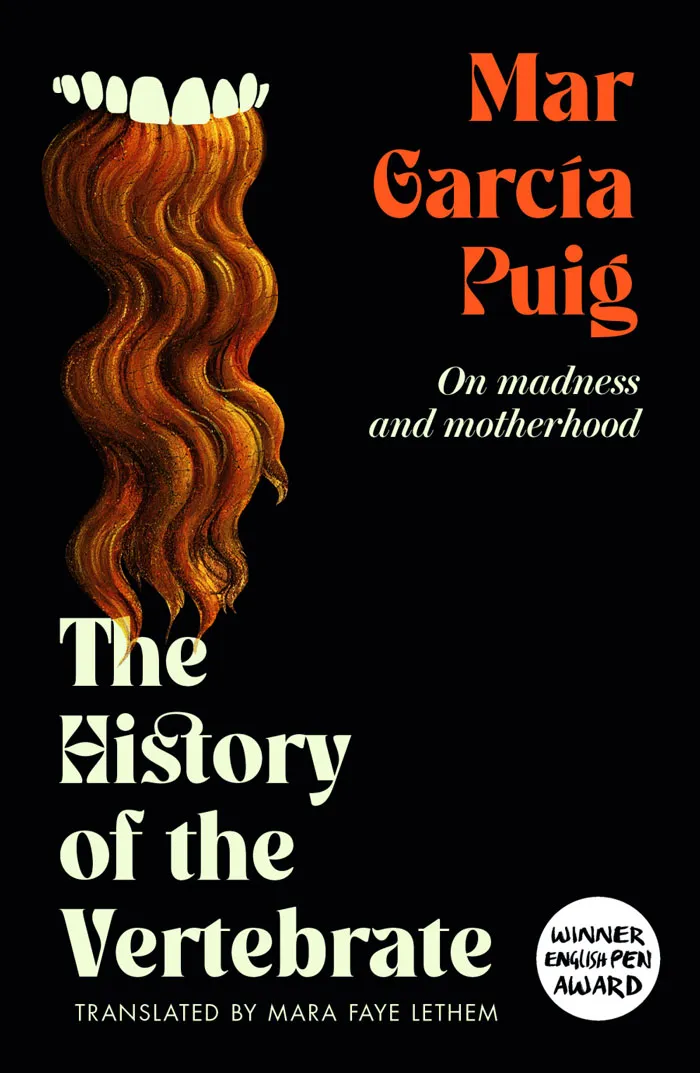
The History of the Vertebrate
Mar García Puig, Mara Faye Lethem
‘On 20 December 2015 I became a mother and I went mad.’
On a single day, Mar García Puig gives birth to twins and becomes elected to the Spanish Parliament as a member of the insurgent left-wing party Podemos. What might have been the best day of her life becomes the start of a terrifying ordeal; García Puig’s grip on reality begins to slip as she grapples with uncertainty, the weight of expectation, and misogyny in both of her new roles.
In defiance of a culture that tells her the problem lies within, García Puig chooses to look outwards, examining the imbrication of madness and motherhood across centuries of science, myth, and politics while dissecting the ways in which women have been pathologized and banished from public life.
At once intimate and epic, The History of the Vertebrate is a searing account of postpartum madness. Moving between memory, culture, and the history of medicine, García Puig transforms her experience into a story about the countless women who have felt that sanity was leaving them, and about the patriarchal forces that have silenced them.
MAR GARCÍA PUIG is an editor and author. From 2015 to 2023 she was a member of the Spanish Congress of Deputies for Podemos, where she served on the Culture Committee and the Equality Committee. Her books include The History of the Vertebrate and This Thing of Darkness.

New Infinity
New Infinity is an experimental novella that follows a woman as she lives and dreams her way through the philosophical implications of autoimmune disease. Met by a labyrinth of closing doors, she searches for meaning and connection among fragmented realities and failed relationships, finding infinitude in the healing process of bibliomancy.
Bára Hladík’s New Infinity is a glittering cross-genre debut. Weaving surrealist stories with meditative poetics, Hladík invites you into a dream world of degenerative illness, left disordered by the failures of ableism, medical professionals, and late-stage capitalism. Here, everything runs on sick time. Where physical health and financial resources grow scarce, the restorative possibilities of queer love, divination, and self-reclamation grant a defiant, yet often tenuous, abundance. Alive with Hladík’s boundless insight and wit, New Infinity is a powerful addition to the collective body of disability literature.
“New Infinity is the most incredible fiction. It explodes the boundaries of this form so as to get to the heart of important truths about the phenomenon of physical pain and of human existence itself. While Bára Hladík’s story draws from a personal experience of survival through a struggle unlike any other, it is an entirely universal tale. In taking us into the most intimate spaces of suffering and narrating a story of a woman navigating a true labyrinth, Hladík shows us a way to face life, with the uncertainties it presents to us all. This novel is at once a profoundly moving story, a brilliant act of creativity, and an existential philosophy. It’s a book I will keep close, so as to revisit— for the thrilling inspiration of its liberated uses of form and style, as well as to learn from Hladík’s honest language, her resilient sense of humour, and her ability to capture the surreal beauty of being alive at all. I felt like I was reading Franz Kafka crossed with a fully unconstrained Anne Carson. I haven’t been so impacted by a book in a long time. It has changed my ways of seeing, feeling, and thinking about what it means to be alive.”
— Molly Lynch
“Bára Hladík’s debut book is a blend of poetry and prose that seeks to make sense of a world that is flagrantly hostile and impatient with bodies that neither perform nor conform to the manic impatience of capitalist acceleration. An honest, vibrant, and very real account of a young writer finding a voice.”
– Sina Queyras, writer, editor, professor, curator
Bára Hladík is a Czech-Canadian writer, editor and multimedia artist. Born in Ktunaxa Territory, she began her literary studies in the Creative Writing program at Capilano University in 2011. Her work can be found in Briarpatch Magazine, THIS Magazine, Contemporary Verse 2, Carte Blanche, EVENT Mag, Hamilton Arts and Letters, Bed Zine, Empty Mirror, Cosmonauts Avenue and elsewhere.

knot body
Bringing together poetry, essay, and letters to “lovers, friends and in-betweens,” Eli Tareq El Bechelany-Lynch confronts the ways capitalism, fatphobia, ableism, transness, and racializations affect people with chronic pain, illness, and disability. knot body explores what it means to discover the limits of your body, and contends with what those limitations bring up in the world we live in.
knot body was shortlisted for the QWF First Book Prize. Their second collection of poetry, The Good Arabs (Metonymy Press), won the 2022 Grand Prix du Livre de Montréal.
“For me, the power of knot body stems from its courage and unique voice in writing the ache, the ache of chronic pain, the ache of faulty diagnoses and bodily misreadings, and, equally, the ache for honest answers on how to love each other in all our dignity. Eli Tareq El Bechelany-Lynch is an artist and philosopher of talent, generosity, and heart.” – David Chariandy, author of Brother (Penguin Random House)
“In this moment, when trans, racialized and disabled bodies are met with violent and polarizing commentary within the public sphere, Eli Tareq El Bechelany-Lynch offers us the uninterrupted intimacy of knot body. As self-communional as Kiese Laymon’s Heavy and Terese Marie Mailhot’s Heart Berries, they amplify and queer the epistolary memoir genre. Each letter is emotionally and thematically complete and, too, each letter decidedly speaks to the next. Readers may ruminate on the sharp and sensual inquiry offered by each individual letter, or read cover-to-cover and be present to the gorgeously-engaged, call-and-response quality of knot body as a whole.” – Amber Dawn, author of My Art is Killing Me (Arsenal Pulp Press)
“knot body is such a generous tapestry of tenderness—a collection that brilliantly utilizes the direct address in a way that is not universal, but still beautifully communal. I reached the end of this collection and breathed in a newer, better world.” – Hanif Abdurraqib, author of A Fortune for Your Disaster (Tin House)
Eli Tareq El Bechelany-Lynch is a queer Arab poet living in Tio’tia:ke, unceded Kanien’kehá:ka territory (Montreal). Their work has appeared in The Best Canadian Poetry 2018 anthology, GUTS, carte blanche, the Shade Journal, The New Quarterly, Arc Poetry Magazine, Room Magazine, and elsewhere. They participated in the Banff Centre’s ‘Centering Ourselves’ BIPOC residency, and they were longlisted for the CBC Poetry Prize in 2019. Their second collection of poetry, The Good Arabs, was published by Metonymy Press in 2021.

Night Night Fawn
From the author of Confessions of the Fox comes a novel in which a yenta on her deathbed gives an unrepentant account of all her failures—including her child.
“Jordy Rosenberg might be one of our most fearless living novelists. There are no half-measures in his work, just big ideas and living characters and gorgeous sentences and metafictional panache and surprise after heart-stopping surprise. Night Night Fawn is extraordinary.”—Carmen Maria Machado, author of In the Dream House
In a cluttered rent-controlled apartment in the middle of Manhattan, Barbara Rosenberg is terminally ill, high on opioids, and writing the story of her life. She has opinions about her smutty late husband, her career as the receptionist for a disreputable plastic surgeon, her glory days as an accomplished jazzerciser, and her failed aspirations to be a film noir actress. But what she really wants to talk about are unhinged thoughts on gender, Karl Marx, Zionism, and her two great disappointing loves: an estranged trans son and a long-lost best friend whose betrayal haunts Barbara still. As she descends further into delirium and illness, Barbara finds herself in a nightmare from which she cannot escape, and her circumstances put her on a crash course with these intimates—or are they avenging nemeses?—once again.
Part novel, part someone’s mother’s unauthorized memoir—all diatribe, gutter schtick, and deranged manifesto, Night Night Fawn is a ferociously candid account of intergenerational conflict.

The Minor Gesture
In this wide-ranging and probing book Erin Manning extends her previous inquiries into the politics of movement to the concept of the minor gesture. The minor gesture, although it may pass almost unperceived, transforms the field of relations. More than a chance variation, less than a volition, it requires rethinking common assumptions about human agency and political action. To embrace the minor gesture's power to fashion relations, its capacity to open new modes of experience and manners of expression, is to challenge the ways in which the neurotypical image of the human devalues alternative ways of being moved by and moving through the world—in particular what Manning terms "autistic perception." Drawing on Deleuze and Guattari's schizoanalysis and Whitehead's speculative pragmatism, Manning's far-reaching analyses range from fashion to depression to the writings of autistics, in each case affirming the neurodiversity of the minor and the alternative politics it gestures toward.
I have been enthralled and held by this book! Erin Manning has given us a new theory of bearing, as well as a new elaboration of gesture, going beyond Balzac’s theory and Agamben’s interpretation of it. She doesn’t lament the loss of gesture but celebrates gesture's minoritization.
- Fred Moten

Efemmera Reissue #7: Cassandra Radical Feminist Nurses Newsletter
A reissue of the 1982 inaugural Cassandra Radical Feminist Nurses Newsletter: founding members explain their interests, intentions, and goals, and invite other nurses to join them.
Introductory text by Peggy Chinn, founding member, and also co-author of Peace & Power: A Handbook of Feminist Process.
The Alder & Frankia Efemmera Reissue series amplifies, graphically reinterprets, and shares historic feminist ephemera. What ideas, strategies, and tactics from the past can we inherit to bring forth a feminist future?

Strange Biology
Strange Biology, Charlotte Strange’s first chapbook, opens with a social media advertisement marketing a probiotic as an alternative to the “nuclear bomb” of antibacterial acne medication. As Strange investigates the treatment of the human body as a landscape submissive to medical intervention, they ruminate on the contemporary relationship between microbes, gut-directed medical technologies, and capitalism’s encroachment on life. Drawing on the vernacular of social media marketing, they deftly oscillate between instructive and personal registers, stretching the private across a nexus of microbial interminglings. Strange Biology reflects on the semiotic science of the gut: how the language of medicine defines the mutating edges of the human body.

Otherhow: Essays and Documents on Art and Disability 1985–2024
Otherhow brings together four decades of writings, lectures, interviews, and documentation of work by the artist Joseph Grigely. Deaf since the age of ten, his art and writing have long questioned and made use of various modes of communication—photographs, handwritten notes, lipreading, newspaper headlines, paintings, and TV captions—to examine and scrutinize the ableism embedded in cultural and media production. From his brilliant series of postcards addressed to Sophie Calle, where he began to formulate a theory on the intersection of disability and art, to his epic lecture “On Failure,” which brings together the poet Keats, “the first woman of fly tying” Helen Shaw, and the filmmaker Andrei Tarkovsky to the same table for a conversation on beauty, Grigely’s writing is erudite, but clear; righteous with fury, but dryly humorous.
An underlying theme throughout are modes of access and how issues of accessibility and their resolution provide a benefit to everyone, not just the disabled. Chapters devoted to art, access, and advocacy underpin the interconnected nature of these issues in a maddening, but ultimately enlightening manner. Letters of complaint, faxes and emails, unpublished op-eds, exhibition proposals, statements on equality and access; each provide a glimpse into how Grigely’s work has been shaped by—or constructed from—the “tangled process” of opening access.
Joseph Grigely, artist, educator, and activist, is currently a Professor of Visual and Critical Studies at the School of the Art Institute of Chicago. He holds a Doctorate in Philosophy from Oxford in English literature and has taught at Gallaudet University, Stanford University, and the University of Michigan. Exhibiting widely in the US and Europe, his most recent show In What Way Wham? was presented at MASS MoCA in 2023–24. His work is in the collections of the Museum of Modern Art (NY), the Whitney Museum of American Art, the Tate Modern, and the Stedelijk Museum, among others.

Tosquelles: Healing Institutions
Having fled to France in the aftermath of the Spanish Civil War, the Catalan psychiatrist Francesc Tosquelles joined the Saint-Alban psychiatric hospital, where he carried out a transformative clinical practice for over twenty years, in part under the Vichy regime.
Saint-Alban was an extraordinary event, a commune, an informal refuge in a time of extreme danger, a sort of upwelling spread through word of mouth. Those entering the asylum were welcomed, and that welcome never stopped. Care happened through a broad range of communal activities for staff and patients: theater, cinema, collective writing, horticulture, the sorting of colored pearls, gymnastics, singing, a monthly newspaper. The dignity of every patient was of foremost importance.
Now, as then, warmongers are willing to poison and slaughter without blinking, making all of life difficult if not impossible: the pull of such asylums is obvious. Tosquelles is a ground-breaking record of the life and work of the founder of institutional psychotherapy. Assembled by Joana Masó, with many texts translated to English for the first time, it is a direct encounter with Tosquelles’s clinical, intellectual, and political writings.
“Tosquelles’s work serves as a model for dismantling capitalist institutions, a revolutionary venture whose essence Joana Masó captures.”
Paul B. Preciado
“This remarkable collection allows us to experience the genius of Tosquelles in all its dimensions for the first time. We accompany him through his early work in Reus and Barcelona, the development of his therapeutic ideas and inventive practices in war-torn Catalonia and in exile at the Septfonds Camp, his legendary years at Saint Alban and his lesser-known later years in Melun, Nouvelle Forge and La Candélie. Joana Masó guides us to the creative heart of a man whose counter-cultural, counter-intuitive thinking excited generations of intellectuals in France and now inspires the world.”
Rosie Stockton
“Resistance hero, anti-Stalinist Marxist, Surrealist, revolutionary practitioner of social therapy, mentor to Frantz Fanon: Francesc Tosquelles was one of the most innovative thinkers in modern psychiatry, a visionary whose moment may finally have arrived.”
Adam Shatz
With texts by Francesc Tosquelles, trans. Robert Hurley and Mara Faye Lethem

Practicing Dying
Practicing Dying is a literary anti-memoir documenting life in a Zen Buddhist monastery in rural France where the protagonist, a woman in her late twenties, attempts to overcome chronic drug addiction and mental illness.
Broken and severely unwell, our protagonist arrives at the monastery from London: starving, drug-addicted and disillusioned, having exhausted every conventional treatment route available to her. The book examines how, habituated to a life of benefits assessments, petty-crime and sex work, she struggles to adjust to the rules, discipline and religious life of the monastery—at times to devastating and comedic effect.
As the story unfolds, she reflects on her addictions and past experiences, raising critical questions about what it means to be "an addict" and why there may be vested corporate and societal interests in maintaining a narrow, individualistic understanding of addiction.
Anarchic and provocative, tender and self-deprecating, Practicing Dying differs from other contemporary memoirs in the genre of addiction-recovery by simultaneously challenging the dominant narratives surrounding mental health while proposing an alternative approach to treating the “sickness of self” from which we all increasingly suffer.
‘Practicing Dying is brilliant, rewarding and difficult. Northall offers the most brazen and shocking account of addiction I’ve ever read. Committing herself to the practice of Mahayana Buddhism, she eventually finds a way out, but only on the most rambling, circuitious path. Her account of addiction and loss, displacement and grief is profound and it proves that nothing is ever one thing.’ — Chris Kraus, author of The Four Spent The Day Together
Charlotte Northall is a London-based writer. Her debut, Practicing Dying, blends autobiography and cultural criticism to explore addiction, capitalism, and spiritual practice. She works with rough sleepers, supporting those living with addiction and complex mental health needs.

How to Tell When We Will Die: On Pain, Disability, and Doom
The long-awaited essay collection from one of the most influential voices in disability activism that detonates a bomb in our collective understanding of care and illness, showing us that sickness is a fact of life.
In the wake of the 2014 Ferguson riots, and sick with a chronic condition that rendered them housebound, Johanna Hedva turned to the page to How do you throw a brick through the window of a bank if you can’t get out of bed? It was not long before this essay, “Sick Woman Theory”, became a seminal work on disability, because in reframing illness as not just a biological experience but a social one, Hedva argues that under capitalism—a system that limits our worth to the productivity of our bodies—we must reach for the revolutionary act of caring for ourselves and others.
How to Tell When We Will Die expands upon Hedva’s paradigm-shifting perspective in a series of slyly subversive and razor-sharp essays that range from the theoretical to the personal—from Deborah Levy and Susan Sontag to wrestling, kink, mysticism, death, and the color yellow. Drawing from their experiences with America’s byzantine healthcare system, and considering archetypes they call The Psychotic Woman, The Freak, and The Hag in Charge, Hedva offers a bracing indictment of the politics that exploit sickness—relying on and fueling ableism—to the detriment of us all.
With the insight of Anne Boyer’s The Undying and Leslie Jamison’s The Empathy Exams, and the wit of Samantha Irby, Hedva’s debut collection upends our collective understanding of disability. In their radical reimagining of a world where care and pain are symbiotic, and our bodies are allowed to live free and well, Hedva implores us to remember that illness is neither an inconvenience or inevitability, but an enlivening and elemental part of being alive.

Exhibiting for Multiple Senses
Exhibiting for Multiple Senses looks into artistic and curatorial research practices that emphasize the multisensory character of the human body in the encounter with artworks. For some time now, numerous contemporary artists and curators have moved beyond the primacy of the visual in the experience of art exhibitions. The book discusses this shift by bringing together experimental exhibition-making, curatorial theory, art, design, and museum research, disability activism and crip theory. Its intent is to demonstrate resonances between curatorial theory and practice and between disability and crip art activism. While the latter is still often regarded as relevant for only small portions of visibly disabled people, in recent years neurodiversity and invisible disabilities have proven to be relevant for the sensory experiences of much larger parts of exhibition audiences.
Exhibiting for Multiple Senses shares famous and lesser-known examples of experimental exhibitions as well as of artistic practices linked to exhibitions. By mobilizing the senses of touch, smell, taste, and hearing, as well as applications of multimodal technologies and insights from neuroscience, these examples all explore abilities and possibilities of the complex and diverse sensory apparatus that is the human body.
Contributors: David Bobier, Luca M. Damiani, Stephanie Farmer & Hettie James, Eva Fotiadi, David Gissen & Georgina Kleege, Adi Hollander, Lilian Korner, Elke Krasny, Renata Pękowska, Caro Verbeek

PRESCRIPTIONS: A Collection for Many Evils of the Body and the Mind, Also for Witchcraft
PRESCRIPTIONS is a transcription of a handwritten manuscript, dated to approximately 1650, containing a wide range of medicinal and magical remedies. Currently housed in the Cornell University Witchcraft Collection, it is assumed this practical handbook was a reference for healing, midwifery, and other medical/magical advice. Recipes and instruction cover various methods of purging, ointments for swellings, fevers, and pain reduction, lotions for venereal disease, advice for childbirth, and dilemmas such as “worms in the ear.” Accompanying these medicinal prescriptions are a series of magical prescriptions: charms, rituals, and spells recorded to fortify the ailing body, induce amorous desire, or seek revenge.
With its mix of Latin words, Early Modern English parlance, colloquial plant names, apothecary weights, and archaic medical terms, the recipes can at first appear opaque, but with sustained engagement one can begin to decipher the logics and structures within the writer(s)' shorthand. The original manuscript, in having its own detailed glossary, index, and citations, exhibits a meticulous cataloging of knowledge and resources, and reveals an earnest desire to hold onto the integrity and sanctity of the body in the face of 'many evils.'
The transcription is accompanied by a glossary of terms, an explanation of the various apothecary measurements used, and expanded citations of the medicinal/magical treatises that were abbreviated within the original text.

Memories That Smell Like Gasoline
David Wojnarowicz, one of the most provocative artists of his generation, explores memory, violence, and the erotism of public space—all under the specter of AIDS.
Here are David Wojnarowicz’s most intimate stories and sketches, from the full spectrum of his life as an artist and AIDS activist. Four sections—”Into the Drift and Sway,” “Doing Time in a Disposable Body,” “Spiral,” and “Memories that Smell like Gasoline”—are made of images and indictments of a precocious adolescence, and his later adventures in the streets of New York. Combining text and image, tenderness and rage, Wojnarowicz’s Memories That Smell Like Gasoline is a disavowal of the world that wanted him dead, and a radical insistence on life.
The new and revised edition features a foreword by Ocean Vuong and a note from the editor, Amy Scholder.

Studying Hunger Journals
In 1972 Bernadette Mayer began this project as an aid to psychological counseling, writing in parallel journals so that, as she wrote in one (in bed, on subways, at parties, etc.), her psychiatrist read the other. Using colored pens to “color-code emotions,” she recorded dreams, events, memories, and reflections in a language at once free-ranging and precise—a work that creates its own poetics. She sought “a workable code, or shorthand, for the transcription of every event, every motion, every transition” of her own mind and to “perform this process of translation” on herself in the interest of evolving an innovative, inquiring language. STUDYING HUNGER JOURNALS registers this intention within a body of poetry John Ashbery has called “magnificent.”

Pirate Care: Acts Against the Criminalization of Solidarity
Tomislav Medak, Marcell Mars and 1 more
In many places around the world, the freedom to simply care for one another is under attack by the powerful, and acts of solidarity are being made illegal. In a moment of struggle defined by the rollback of social welfare programs, the criminalisation of migration, and the right-wing clampdown on bodily autonomy, radical networks of care are fighting back.
From volunteer rescue boats in the Mediterranean to underground labs for preparing gender-affirming hormones, from the sharing of copyrighted health knowledge to the provision of abortion and contraception, people are reclaiming the means to care for one another in defiance of a system that devalues and exploits the labour of care.
Against atomised despair, Pirate Care shows that fighting back isn't only about legal and legislative changes but also about organizing, direct action, and disobedient care.