Black Studies
Black Studies

Otherwise Worlds
Andrea Smith, Jenell Navarro and 1 more
The contributors to Otherwise Worlds investigate the complex relationships between settler colonialism and anti-Blackness to explore the political possibilities that emerge from such inquiries. Pointing out that presumptions of solidarity, antagonism, or incommensurability between Black and Native communities are insufficient to understand the relationships between the groups, the volume's scholars, artists, and activists look to articulate new modes of living and organizing in the service of creating new futures. Among other topics, they examine the ontological status of Blackness and Indigeneity, possible forms of relationality between Black and Native communities, perspectives on Black and Indigenous sociality, and freeing the flesh from the constraints of violence and settler colonialism.
Throughout the volume's essays, art, and interviews, the contributors carefully attend to alternative kinds of relationships between Black and Native communities that can lead toward liberation. In so doing, they critically point to the importance of Black and Indigenous conversations for formulating otherwise worlds.
Contributors. Maile Arvin, Marcus Briggs-Cloud, J. Kameron Carter, Ashon Crawley, Denise Ferreira da Silva, Chris Finley, Hotvlkuce Harjo, Sandra Harvey, Chad B. Infante, Tiffany Lethabo King, Jenell Navarro, Lindsay Nixon, Kimberly Robertson, Jared Sexton, Andrea Smith, Cedric Sunray, Se’mana Thompson, Frank B. Wilderson

Assembling a Black Counter Culture
DeForrest Brown, Jr.’s Assembling a Black Counter Culture presents a comprehensive account of techno with a focus on the history of Black experiences in industrialized labor systems—repositioning the genre as a unique form of Black musical and cultural production.
Brown traces the genealogy and current developments in techno, locating its origins in the 1980s in the historically emblematic city of Detroit and the broader landscape of Black musical forms. Reaching back from the transatlantic slave trade to Emancipation, the Industrial Revolution, and the Great Migration from the rural South to the industrialized North, Brown details an extended history of techno rooted in the transformation of urban centers and the new forms of industrial capitalism that gave rise to the African American working class. Following the groundbreaking work of key early players like The Belleville Three, the multimedia output of Underground Resistance and the mythscience of Drexciya, Brown illuminates the networks of collaboration, production, and circulation of techno from Detroit to other cities around the world.
Assembling a Black Counter Culture reframes techno from a Black theoretical perspective distinct from its cultural assimilation within predominantly white, European electronic music contexts and discourse. With references to Theodore Roszak’s Making of a Counter Culture, writings by African American autoworker and political activist James Boggs, and the “techno rebels” of Alvin Toffler’s Third Wave, among others, Brown draws parallels between movements in Black electronic music and Afrofuturist, speculative, and Afrodiasporic practices to imagine a world-building sonic fiction and futurity embodied in techno.
DeForrest Brown, Jr. is an Alabama-raised rhythmanalyst, writer, and representative of the Make Techno Black Again campaign. As Speaker Music, he channels the African American modernist tradition of rhythm and soul music as an intellectual site and sound of generational trauma. On Juneteenth of 2020, he released the album Black Nationalist Sonic Weaponry on Planet Mu. His written work explores the links between the Black experience in industrialized labor systems and Black innovation in electronic music, and has appeared in Artforum, Triple Canopy, NPR, CTM Festival, Mixmag, among many others. He has performed or presented work at Haus der Kulturen der Welt, Berlin; Camden Arts Centre, UK; Unsound Festival, Krakow; Sónar, Barcelona; Issue Project Room, New York; and elsewhere. Assembling a Black Counter Culture is Brown’s debut book.
—
Editor: Rachel Valinsky
Editorial Consultant: Ting Ding and Camille Crain Drummond
Designer: Scott Ponik
Copy Editor: Madeleine Compagnon

Play-White
The racist term "play-white" comes from the apartheid era, when it connoted a black or mixed race person who lived as a white person: “So and so is a play-white.” South African artist Bianca Baldi draws from studies of biomimicry and her own family history, as well as literary precedents—such as Nella Larsen’s novel Passing (1929)—to reflect on racial passing and the instability of racial identities. Play-White alternates between layers of visualization and moments of discretion in order to explore questions of presence and evasion beyond their representation in black and white.
With contributions by Bianca Baldi, Mika Conradie, Shoniqua Roach, Amy Watson, and others; design by Katharina Tauer & Wolfgang Hückel in collaboration with K. Verlag.
Published 2021

All About Love: New Visions
The acclaimed first volume in feminist icon bell hooks' Love Song to the Nation, All About Love is a revelation about what causes a polarized society and how to heal the divisions that cause suffering. Here is the truth about love, and inspiration to help us instill caring, compassion, and strength in our homes, schools, and workplaces.
"The word 'love' is most often defined as a noun, yet we would all love better if we used it as a verb," writes bell hooks as she comes out fighting and on fire in All About Love. Here, at her most provocative and intensely personal, renowned scholar, cultural critic and feminist bell hooks offers a proactive new ethic for a society bereft with lovelessness—not the lack of romance, but the lack of care, compassion, and unity. People are divided, she declares, by society's failure to provide a model for learning to love.
As bell hooks uses her incisive mind to explore the question "What is love?" her answers strike at both the mind and heart. Razing the cultural paradigm that the ideal love is infused with sex and desire, she provides a new path to love that is sacred, redemptive, and healing for individuals and for a nation. The Utne Reader declared bell hooks one of the "100 Visionaries Who Can Change Your Life." All About Love is a powerful, timely affirmation of just how profoundly her revelations can change hearts and minds for the better.

The Sense of Brown
The Sense of Brown is José Esteban Muñoz's treatise on brownness and being as well as his most direct address to queer Latinx studies. In this book, which he was completing at the time of his death, Muñoz examines the work of playwrights Ricardo Bracho and Nilo Cruz, artists Nao Bustamante, Isaac Julien, and Tania Bruguera, and singer José Feliciano, among others, arguing for a sense of brownness that is not fixed within the racial and national contours of Latinidad.
This sense of brown is not about the individualized brown subject; rather, it demonstrates that for brown peoples, being exists within what Muñoz calls the brown commons—a lifeworld, queer ecology, and form of collectivity. In analyzing minoritarian affect, ethnicity as a structure of feeling, and brown feelings as they emerge in, through, and beside art and performance, Muñoz illustrates how the sense of brown serves as the basis for other ways of knowing and being in the world.

Spill: scenes of black feminist fugitivity
In Spill, self-described queer Black troublemaker and Black feminist love evangelist Alexis Pauline Gumbs presents a commanding collection of scenes depicting fugitive Black women and girls seeking freedom from gendered violence and racism. In this poetic work inspired by Hortense Spillers, Gumbs offers an alternative approach to Black feminist literary criticism, historiography, and the interactive practice of relating to the words of Black feminist thinkers. Gumbs not only speaks to the spiritual, bodily, and otherworldly experience of Black women but also allows readers to imagine new possibilities for poetry as a portal for understanding and deepening feminist theory.
Alexis Pauline Gumbs is a poet, independent scholar, and activist. She is coeditor of Revolutionary Mothering: Love on the Front Lines and the Founder and Director of Eternal Summer of the Black Feminist Mind, an educational program based in Durham, North Carolina.

When My Body Was A Clinched Fist
"Back in the day when KRS-One intoned —The Bridge is over!— he did not prefigure a poet from Queens of the fierce attitude and intellectual magnitude of Enzo Silon Surin. WHEN MY BODY WAS A CLINCHED FIST gives the Heisman to such a refrain with lyrical power-packing poetics that settles the score with a succinct— Not! No the Bridge is not over, for Surin's Queens is alive and well and under the gaze of a master observer who eulogizes lives that though at times are battered have always mattered.
Enzo Silon Surin's poems get you caught up in the deeply personal experiences of growing and visceral all-encompassing knowing from an acute witness of every breath and follicle of Black life from palm trees, sand and sea to street corner projects, suburban houses and fistfuls of black water. Surin writes about the confused and disconnected, trigger happy wannabes trapped by outdated notions of masculinity, the cracked head crackheads all held in the clutch of society's clinched fist through which the trauma that comes with being of color, addicted, broke, lost and tossed, is itself a clinched fist of black bodies caught in the Russian nesting doll America's clinched fists make.
WHEN MY BODY WAS A CLINCHED FIST is an elegy for 'the premature exits.' It is a blues for the black-on-black black and blue. Surin yields his pen like a microscopic scalpel whereby an autopsy of possibility is performed to un-clinch the remarkable bone gristle poetry in these unflinching heart-wrenching pages."—Tony Medina
Enzo Silon Surin, Haitian-born poet, educator, speaker, publisher and social advocate, is the author of two chapbooks, A Letter of Resignation: An American Libretto (2017) and Higher Ground. He is the recipient of a Brother Thomas Fellowship from The Boston Foundation and is a PEN New England Celebrated New Voice in Poetry. Surin's work gives voice to experiences that take place in what he calls "broken spaces" and his poems have appeared in numerous publications including Crab Orchard Review, Origins, Transition Magazine/Jalada, Interviewing the Caribbean, jubilat, Soundings East, The BreakBeat Poets: New American Poetry in the Age of Hip-Hop, and sx salon. Surin holds an MFA in Creative Writing from Lesley University and is currently Professor of English at Bunker Hill Community College and founding editor and publisher at Central Square Press. His debut full-length poetry collection is WHEN MY BODY WAS A CLINCHED FIST (Black Lawrence Press, 2020).

Malibongwe: Poems from the Struggle by ANC Women
In the late 1970s, Lindiwe Mabuza, a.k.a. Sono Molefe, sent out a call for poems written by women in anc camps and offices throughout Africa and the world. The book that resulted, published and distributed in Europe in the early 1980s, was banned by the apartheid regime.
Authorised by the editor, this re-issue of Malibongwe re-establishes a place for women artists in the history of South Africa's liberation. These are the struggles within the Struggle: a book that records the hopes and fears, the drives and disappointments, and the motivation and resilience of women at the front lines of the battle against apartheid. Here we see the evidence, too often airbrushed out of the narratives of national liberation, of a deep and unrelenting radicalism within women; of a dream of a South Africa in which not only freedom reigned, but justice too.

All That Beauty
A pathbreaking new volume of poems from Fred Moten, All That Beauty combine's Moten's penchant for lyrical prosody, radical thought, and African American theory to produce writing unlike any other poetry in the world: "What is it to reside without settling? Is that is or is that ain't like being stuck in sweetness, held in life?"
"The line between Fred Moten’s theory and poetry is increasingly cloudy; the distinction almost seems (but isn’t quite) irrelevant. In All That Beauty, his new poetry collection, the poems come closer than ever before to the capacious, disorienting density of his prose writing: not just for their hairpin turns of speculative reasoning, or even their gleeful embrace of specialized academic terminology, but because they are strewn with names, citations and allusions that situate the text in a range of discourses – from Black studies to sound studies to the philosophy of maths." —Steven Zultanski

Necropolitics
In Necropolitics Achille Mbembe, a leader in the new wave of francophone critical theory, theorizes the genealogy of the contemporary world, a world plagued by ever-increasing inequality, militarization, enmity, and terror as well as by a resurgence of racist, fascist, and nationalist forces determined to exclude and kill. He outlines how democracy has begun to embrace its dark side—-what he calls its “nocturnal body”—-which is based on the desires, fears, affects, relations, and violence that drove colonialism. This shift has hollowed out democracy, thereby eroding the very values, rights, and freedoms liberal democracy routinely celebrates. As a result, war has become the sacrament of our times in a conception of sovereignty that operates by annihilating all those considered enemies of the state. Despite his dire diagnosis, Mbembe draws on post-Foucauldian debates on biopolitics, war, and race as well as Fanon's notion of care as a shared vulnerability to explore how new conceptions of the human that transcend humanism might come to pass. These new conceptions would allow us to encounter the Other not as a thing to exclude but as a person with whom to build a more just world.
(October 2019)
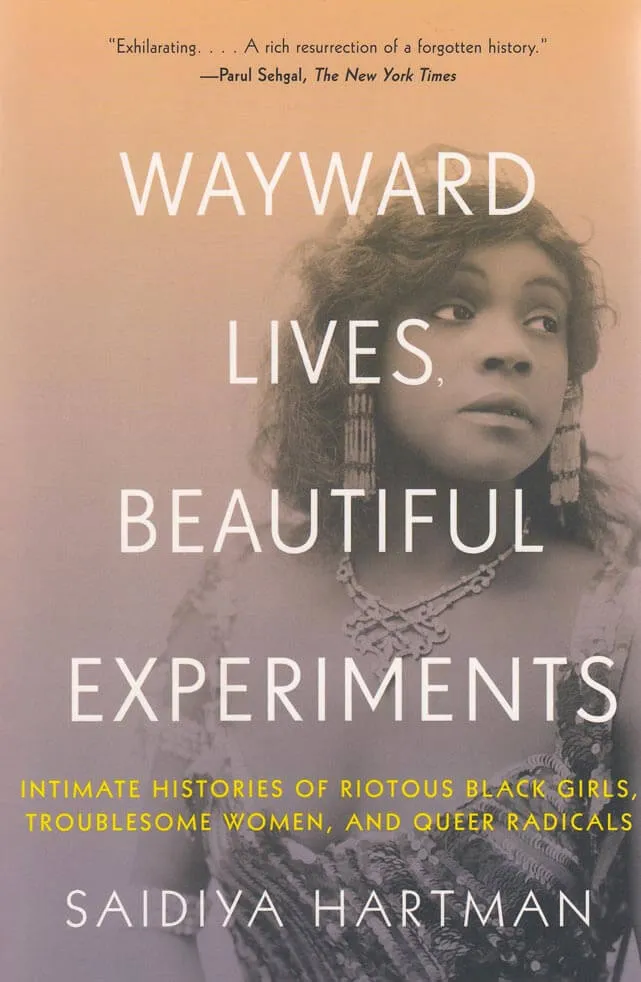
Wayward Lives, Beautiful Experiments
Wayward Lives, Beautiful Experiments examines the revolution of black intimate life that unfolded in Philadelphia and New York at the beginning of the twentieth century. In wrestling with the question of what a free life is, many young black women created forms of intimacy and kinship indifferent to the dictates of respectability and outside the bounds of law. They cleaved to and cast off lovers, exchanged sex to subsist, and revised the meaning of marriage. Longing and desire fueled their experiments in how to live. They refused to labor like slaves or to accept degrading conditions of work. Here, for the first time, these women are credited with shaping a cultural movement that transformed the urban landscape. Through a melding of history and literary imagination, Wayward Lives, Beautiful Experiments recovers these women's radical aspirations and insurgent desires.