Architecture
Architecture

Plant Space Territories, Architectures and Technologies of the Vegetal
Carmen Lael Hines , Michelle Howard and 1 more
Plant Space: Territories, Architectures and Technologies of the Vegetal brings together eighteen international contributors working across critical theory, philosophy, art, design, architecture, and critical ecology to radically reimagine the role of plants in shaping the built environment and its overlapping economies and ecologies. Framed by the entangled histories of extraction, enclosure, and domestication, this volume resituates plants not as passive scenery or symbolic decoration, but as formative presences: agents of spatial composition, political tension, and epistemic possibility. Developed in the context of the exhibition “Bordering Plants” at the Academy of Fine Arts Vienna, essays and experimental formats examine the infrastructures, colonial residues, and aesthetic regimes that renderplant life visible, governable, or expendable. From houseplants, the imperial gardens of Vienna, and the global circuits of plant trade, to AI-rendered plants and satellite images in herbicidal warfare, the volume traverses the architectures, imaginaries, and techniques through which vegetal life is organized and resists.
Contributions by Elizabeth Bandason, Morgane Billuart, Carla Bobadilla, Laÿna Droz, Carmen Lael Hines, Michelle Howard, Adam Hudec, Roberto Majano, Hannah Meszaros Martin, Michelle Mlati & Pablo Barrios Martínez, Sandro Mezzadra, Serena Moscardelli, Ido Nahari, Akil Scafe-Smith, Caterina Selva & Lucia Stach, Lucia Gregorová Stach, Gabriel Alonso / Institute for Postnatural Studies.

LOG: Notes on Building-with
Log: Notes on Building-with documents the construction of a wooden structure in Topolò/Topolove and expands it into a reflection on craft, collaboration and situated making. Through photographs and texts, the book approaches the idea of building-with from four different angles: building-with context, building-with materials, building-with tools and building-with others.
Contributions by: Diogo Amaro, Antônio Frederico Lasalvia, Elena Rucli, Madalena Vidigal, Ola Korbańska, Aljaž Škrlep.

KW Institute for Contemporary Art
Germaine Kruip: Works 1999-2017
Over the past two decades, artist Germaine Kruip has steadily developed a practice, which merges time, space and perception. Like an anthropological stage director, she investigates, simplifies and presents her observations in a subtle manner often through architectural interventions. In each of these interventions, she changes a location into a stage, with the audience as actors in a play of substantive absence. By doing so, she activates both physical and mental awareness.
This publication presents an overview of the Kruip’s practice since 1999, two years prior to her engagement with the art context. Presenting over 40 works, the publication reflects on three periods in the artist’s practice, each accompanied by an essay contributed by Anna Gritz, Eva Wittocx and Stephanie Bailey. The idea of a catalogue raisonné came out of a conversation that followed Kruip’s ambitious project Geometry of the Scattering, which was presented at de Oude Kerk in Amsterdam in 2015 – 2016.

Nothing About Interior Architecture
Javier Fernández Contreras, Youri Kravtchenko and 1 more
Often dissident, sometimes adherent, Nothing About is, in essence, indefinable because it is adaptive and fluid. Speculative or hands-on, this discipline – if we can call it that – displays all the ambivalences of our contemporary lifestyles: superficial and profound, profane and divine, present everywhere and nowhere, and often regarded as futile, even though it could nonetheless destroy the most beautiful of insides. This book brings together a variety of intellectual tools and insights – polysemic and ambiguous, bespoke and improvised, ornamental and criminal, spanning media, technology, the arts and other, often undefined fields – that analyze the impact of the discipline on contemporary design. In the end, what makes Nothing About charming is that this inside – insofar as it is still defined as such – has only the humble ambition of accompanying beings, both animate and inanimate, within their environment, like a friend who is never far away.
Introduction by Javier Fernández Contreras. Text contributions by Daniel Zamarbide, Line Fontana & David Fagart, Valentin Dubois & Bertrand Van Dorp, Camille Bagnoud & Ahmed Belkhodja, Javier F. Contreras & Roberto Zancan, Paule Perron, Philippe Rahm, Youri Kravtchenko, Leonid Slonimskiy, Simon Husslein, Vera Sacchetti, Jan Dominik Geipel, Valentina De Luigi, Jean-Pierre Greff.

Metropolitan Voids Agency
Margherita Moscardini, Zasha Colah and 1 more
Metropolitan Voids Agency is the first monographic publication dedicated to the collected works of artist Margherita Moscardini. The book recounts the work carried out by Moscardini spanning seventeen years, between 2008 and 2024, inviting a reading of her practice in its entirety as an investigation into ‘urban voids’: those which Moscardini has recognized and designated as voids, or those she has herself invented in the urban fabric.

Publiek Park
Jef Declercq, Anna Laganovska and 2 more
The third Publiek Park publication – Walking Guide – combines essays, archival fragments, and artistic voices to trace both the exhibition route at Plantentuin Meise and the historical path that led from the creation of the Jardin Botanique in the heart of Brussels to its relocation outside the city. Following the logic of a quilt, layering different perspectives, textures, and timelines, the book connects artistic narratives with history and reflections on urban gardens, public space, and botanical imaginaries. Just like the exhibition, the publication offers not merely a portrait of a place, but a reflection on the multiplicity that defines it.
Alongside documentation of the exhibition and contributions from the participating artists, this year’s Walking Guide features writings by Nikolaos Akritidis, Denis Diagre-Vanderpelen, Koen Es, Lana Jones, François Makanga, Noam Youngrak Son, and Jean Watt. The two parks are portrayed in photographs by Michiel de Cleene, with book design by Victor Verhelst and Corbin Mahieu bringing all of these elements together.
This publication is made with the generous support of Plantentuin Meise and all partners.

Nights of the Dispossessed
Natasha Ginwala, Gal Kirn and 1 more
Riots are extraordinary events that have been recurring with increasing frequency and occupy a highly controversial space in the political imagination. Despite their often negative portrayals, it is undeniable that riots have played a pivotal role in the confrontation between authority and dissent. Recently, with the deepening crises of capitalism, racial violence, and communal tension, an “age of riots” has powerfully begun. As master fictions of the sovereign nation-state implode, and the hegemonic silencing of the dispossessed reveals the cracks in governability, Nights of the Dispossessed: Riots Unbound brings together artistic works, political texts, critical urban analyses, and research projects from across the world in an endeavor to “sense,” chronicle, and think through recent riots and uprisings—evoking a phenomenology of the multitude and surplus population.
With contributions from Asef Bayat, Joshua Clover, Vaginal Davis, Keller Easterling, Zena Edwards, Nadine El-Enany, Dilip Parameshwar Gaonkar, Gauri Gill, Natasha Ginwala, Natascha Sadr Haghighian, Louis Henderson, Satch Hoyt, Hamid Khan, Gal Kirn, Josh Kun, Léopold Lambert, Margit Mayer, Vivek Narayanan, Ai Ogawa, Oana Pârvan, Elizabeth A. Povinelli, SAHMAT, Thomas Seibert, Niloufar Tajeri, Chandraguptha Thenuwara, Dariouche Tehrani, and Ala Younis.

Minibieb
Infrastructural systems define our ways of seeing and responding to the world around us. Today, our everyday lives and visual cultures have become saturated by digital communications systems whose physical footprint has been rendered largely invisible from the public sphere.
In an age of ever-expanding computation and a foolish believe in AI’s utopian potential, resistance can seem futile. But if we detach our gaze from increasingly narrow realm of digital imaginaries, a new world of radically different infrastructural opportunities opens up in front of our eyes.
Street libraries, or Minibiebs, as they are called in Dutch, are an under-appreciated piece of urban technology. Part manifesto, part research note, this mini publication dives into the radical potential of public book sharing structures and what they might tell us about our broken information ecosystem.
Printing: Risograph, Grafische Werkplaats Den Haag; Research and Photography: Livio Liechti; Design: Apsara Flury.
First print run – May 2025: 35 copies.

Forensic Architecture: Violence at the Threshold of Detectability
In Forensic Architecture, Eyal Weizman, the group’s founder, provides, for the first time, an in-depth introduction to the history, practice, assumptions, potentials, and double binds of this practice. The book includes an extensive array of images, maps, and detailed documentation that records the intricate work the group has performed.
Included in this volume are case studies that traverse multiple scales and durations, ranging from the analysis of the shrapnel fragments in a room struck by drones in Pakistan, the reconstruction of a contested shooting in the West Bank, the architectural recreation of a secret Syrian detention center from the memory of its survivors, a blow-by-blow account of a day-long battle in Gaza, and an investigation of environmental violence and climate change in the Guatemalan highlands and elsewhere.
Weizman’s Forensic Architecture, stunning and shocking in its critical narrative, powerful images, and daring investigations, presents a new form of public truth, technologically, architecturally, and aesthetically produced. Their practice calls for a transformative politics in which architecture as a field of knowledge and a mode of interpretation exposes and confronts ever-new forms of state violence and secrecy.

Kish, An Island Indecisive by Design
Babak Afrassiabi, Nasrin Tabatabai
In Kish, An Island Indecisive by Design, artists Nasrin Tabatabai and Babak Afrassiabi explore the modern development of an Iranian island in the Persian Gulf. Removed from mainland Iran, Kish is a place where extremes in politics, ideology and urban design intersect. The island's many years of infrastructural indecision is distinctly evident in its architecture, which lacks any trace of coherence or feel for locale. This volume gives an often moving account of the chaos of middle-eastern modernity.

The Mollino Set
New York-based professor Lytle Shaw journeys to Italy in this adventurous exploration of the life and work of architect, designer, and photographer Carlo Mollino (1905–1973). In 1933 the young Mollino received a commission from Mussolini’s regime for his first building: an administrative centre in Piedmont. Later works include furniture and interior design, a book on photography, and an asymmetrical car that raced at Le Mans in 1955.
The book centres around Shaw’s realisation that this prolific talent’s conflicted legacy offers a unique window on the role that post-war Italian politics and culture played in the country’s reimagining of itself as a victim, rather than a proponent, of fascism.

Discipline Park
Toby Altman’s Discipline Park documents the demolition of Prentice Women's Hospital in Chicago, a landmark of architectural brutalism designed by Bertrand Goldberg in the 1970s. Altman was born in the building, and years later, was employed by Northwestern University when they tore it down. His personal proximity to the site leads to a wider critical evaluation of the cruelty of a neoliberalism that asks us to draw sustenance from the very institutions that poison and erase our bodies, habitats, and histories. But, as it indicts the present and its claustrophobic, ruinous politics, Discipline Park also recovers or reinvents utopian vistas through an extended engagement with Goldberg's architectural practices.

I am Welton Santos.
I am Welton Santos reenacts a dialogue between the Brazilian geo-bio-architect Welton Santos and an Interviewer. The book, which is always read collectively, is used in reading performances by groups of at least 3 people.
Printed on the occasion of an artist residency at PAV, Parco d’Arte Vivente, Turin, July 2016. Texts based on transcripts of interviews with Welton Santos.
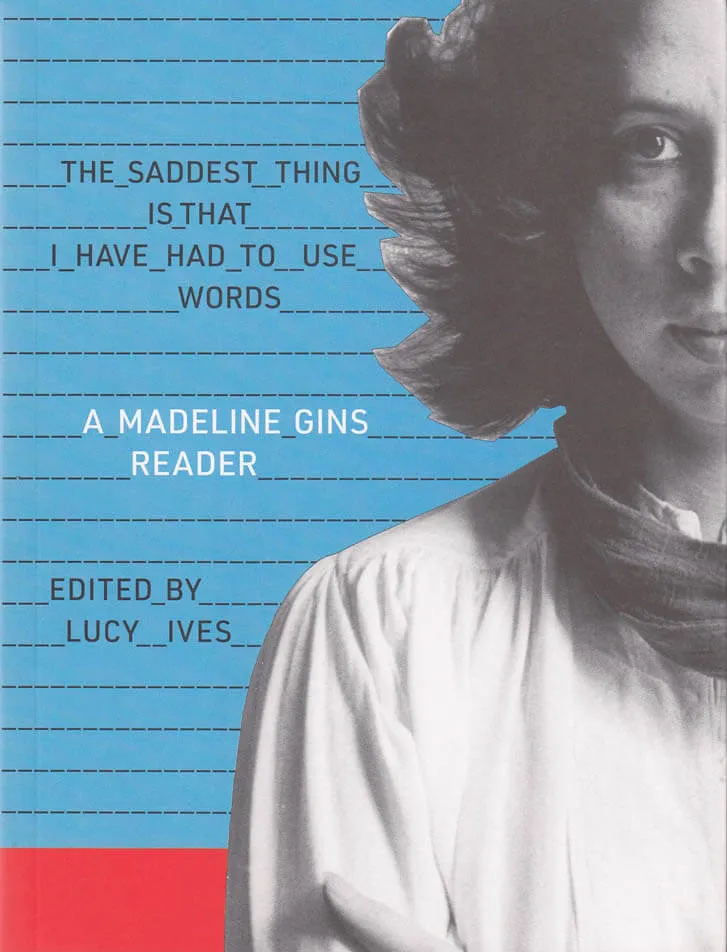
The Saddest Thing Is That I Have Had to Use Words: A Madeline Gins Reader
Poet, philosopher, speculative architect and transdisciplinary artist, Madeline Gins is well known for her collaborations with her husband, the artist Arakawa, on the experimental architectural project Reversible Destiny, in which they sought to arrest mortality by transforming the built environment. Yet, her own writings — in the form of poetry, essays, experimental prose and philosophical inquiries — represent her most visionary and transformative work. Like Gertrude Stein before her, Gins transfigures grammar and liberates words. Like her contemporaries in conceptual art, her writing is attuned to the energized, collaborative space between reader and page.
The Saddest Thing Is That I Have Had to Use Words: A Madeline Gins Reader is a revelatory anthology, edited and with an introduction by the writer and critic Lucy Ives. It brings never-before-published poems and essays together with a complete facsimile reproduction of Gins' 1969 masterpiece, WORD RAIN (or A Discursive Introduction to the Intimate Philosophical Investigations of G, R, E, T, A, G, A, R, B, O, It Says), along with substantial excerpts from her two later books What the President Will Say and Do!! (1984) and Helen Keller or Arakawa (1994). Long out of print or unpublished, Gins' poems and prose form a powerful corpus of experimental literature, one which is sure to upend existing narratives of American poetics at the close of the 20th century.
Edited by Lucy Ives.