Books
Books
in random order

Black Revelry: In Honor of ‘The Sugar Shack’
An experiment in book making, which takes up the form of the LP record as a starting point for re-configuring the haptics of the printed book. Presented as a collection of unbound pages inside a gatefold record sleeve, the publication includes a pressed record, as well as written, visual and sonic contributions from scholars, poets, artists, choreographers and DJs.
Through the logic of the detail, each contributor imaginatively (re)produces Ernie Barnes’s iconic painting The Sugar Shack as an archive of personal histories and a universe of intergenerational connections. Held together as an album, it is a performance to be made at home, which invites readers/listeners to feel art’s histories and to be in them with their bodies.
d.a. carter with contributions by Taylor Renée Aldridge; Samiya Bashir; La Marr Jurelle Bruce; DJ Lynnée Denise, Jennifer Harge, Duane Lee Holland, Jr., William H. Mosley, III, Zoé Samudzi, S*an D. Henry-Smith, Melanie Stevens and Phillip B. Williams.

Hyperpolitics: Extreme Politicization without Political Consequences
What happens when politics is everywhere, yet nothing seems to change? From the abandoned dance floors of Thatcher’s London to the mass mobilizations of Black Lives Matter, Anton Jäger traces how public life has become infused with protest, spectacle, and moral urgency — while the old infrastructure of parties, unions, and civic solidarity has been hollowed out.
Hyperpolitics revisits the illusions of the “end of history” and dissects the strange energies that replaced them: viral outrage, endless culture wars, and the digital rush of causes that flare and vanish overnight. Jäger shows how the promises of post–Cold War liberalism gave way to a restless, unsteady public sphere where private passions overflow into politics but rarely build enduring power.
Ranging from Guy Debord and Wolfgang Tillmans to Houellebecq’s disenchanted fictions, Hyperpolitics makes sense of a world in which collective action remains fragmented and the social fabric thinner than ever. For anyone trying to grasp why our age feels so charged yet so inconsequential, this book offers a vital map through the new contradictions of our hyperpolitical moment.

Stop Thief!: Anarchism and Philosophy
Many contemporary philosophers – including Michel Foucault, Jacques Derrida, and Giorgio Agamben – ascribe an ethical or political value to anarchy, but none ever called themselves an “anarchist.” It is as if anarchism were unmentionable and had to be concealed, even though its critique of domination and of government is poached by the philosophers.
Stop Thief! calls out the plundering of anarchism by philosophy. It’s a call that is all the more resonant today as the planetary demand for an alternative political realm raises a deafening cry. It also alerts us to a new philosophical awakening. Catherine Malabou proposes to answer the cry by re-elaborating a concept of anarchy articulated around a notion of the “non-governable” far beyond an inciting of disobedience or common critiques of capitalism. Anarchism is the only way out, the only pathway that allows us to question the legitimacy of political domination and thereby wfree up the confidence that we need if we are to survive.

Faltas: Letters to Everyone in My Hometown Who Isn't My Rapist
A rich and moving epistolary memoir about transgender childhood, sexual trauma, motherhood, and a young queer life in 1970s Argentina.
In these hilarious and heartbreaking letters, Cecilia Gentili reinvents the trans memoir, putting the confession squarely between the writer and her enemies, paramours and friends.
Writing to childhood figures such as her rapist’s daughter, her father’s mistress, her best friend, and her mother, Gentili probes deeply into the bitter cruelty, buried secrets, and delicious gossip of a small town.
Is she here for revenge, or forgiveness? Both! And more! A story of sex, theft, murder, motherhood, and outrageous fashion choices, Faltas is a beautiful, messy meditation on what it takes to heal, and even grow.

Black Ark
The point of departure for the book «Black Ark» with Lee “Scratch” Perry (1936–2021), a Jamaican musical and visual artist who was based in Switzerland, is a detailed inventory of photographs and writings (Spring 2021) from the Black Ark Studios in Kingston, Jamaica, where Lee produced his music from 1973 on. He was a seminal pioneer of dub, an electronic subgenre of reggae that uses sampling, looping, remixing, reverb and echoes to create new songs as well as rework and appropriate pre-recorded songs and tracks.
Black Ark Studios was one of the cradles of dub. It’s also where Lee “Scratch” Perry’s musical approach found an enduring visual counterpart in the form of continuously evolving mural paintings and drawings as well as shape-shifting assemblages of records, instruments, found objects, posters, newspaper and magazine clippings, and appropriated books. The artworks form actual layers upon layers that are rhizomatically intertwined with the studio building itself as well as with the furniture inside—and with Perry’s biography and persona.
Perry created his very own, dense and eclectic world—a world that is documented in «Black Ark», before it disappears for good: the premises have recently been sold. The photographic documentation of the studio was supplemented by efforts to secure and preserve Perry’s cultural objects as part of a joint project with various cultural institutions.
«Black Ark» which reflects the rhythm and layering effects of collage both in its content and the materials used to craft the book. Perry was involved in the conception of the book in its early stages. It also interweaves various media and chronologies. The new photographs of the Black Ark Studios will be juxtaposed with stills from old documentaries and archival photos.
The idea of a “house” serves as both a working hypothesis and a metaphor. It will be the starting point and endpoint of various thematic strands, both visual and textual: for example, the book will explore the Black Ark as a “spiritual yard” in the context of African diaspora, as well as looking into archeomusicological aspects. Furthermore, extended captions by Perry’s biographer will provide the backdrop for a kaleidoscopic panorama of Perry’s eclectic and ingenious work.

CUNY Center for the Humanities
Lost & Found: The CUNY Poetics Document Initiative, Series III
John Wieners, Lorine Niedecker and 3 more
Lost & Found: The CUNY Poetics Document Initiative publishes unexpected, genre-bending works by important 20th century writers. Unearthed from personal and institutional archives in the United States and abroad, these materials are edited by doctoral students at the Graduate Center, CUNY.
SERIES III is a collection of 8 chapbooks that authenticate Edward Dahlberg's claim that "There is more political energy in friendship than in ideology."
Langston Hughes & Nancy Cunard cement their personal relationship by penning notes across the ocean throughout the Spanish Civil War. After meeting at Black Mountain, John Wieners & Charles Olson remain in close correspondence until months before Olson's death. In "Old Father, Old Artificer," part lecture and part evocation of Charles Olson, Diane di Prima helps to establish how key figures in "New American Poetry" were processing their own past, while the breathless Olson lecture by Ed Dorn erodes the fictive dualism that pits poetic theory against practical action. In his letters, Michael Rumaker invites you to share his life, its radiant pursuit of love, "dirty realism," literature, and lasting community, and Joanne Kyger booms "communication is essential" in her Letters to & from. In Homemade Poems, a gift-book mailed to a friend in 1964, Lorine Niedecker insists that the handmade chapbook is the material continuation of the poems so carefully nestled in its pages.
Breaking up the monolith of the historical lens, Series III continues to track individuals as they tell their stories, cast their lifelines, and position themselves in relation to the times they lived in—and the times we live in—through intimate journals, letters, lectures, and friendships. Edited, annotated, and with accompanying essays, The London Review of Books calls this "a serious and worthy enterprise." Diane di Prima calls the series "a gold mine" and Joanne Kyger writes: "What a brilliant cast of characters. Just exactly what one (myself) would like to read."
SERIES III includes:
Lorine Niedecker: Homemade Poems (John Harkey, editor)
John Wieners & Charles Olson: Selected Correspondence (Parts I & II) (Michael Seth Stewart, editor)
Diane di Prima: Charles Olson Memorial Lecture (Ammiel Alcalay and Ana Božičević, editors)
Edward Dorn: The Olson Memorial Lectures (Lindsey Freer, editor)
Michael Rumaker: Selected Letters (Megan Paslawski, editor)
Letters to & from Joanne Kyger (Ammiel Alcalay and Joanne Kyger, editors)
Langston Hughes, Nancy Cunard & Louise Thompson: Poetry, Politics & Friendship in the Spanish Civil War (Anne Donlon, editor)

Bookmarks of sorts
Afternoon Editions no. 5: a collection of found papers annotated by Jeroen Peeters, titled Bookmarks of sorts. During several years Jeroen Peeters collected notes left by readers in library books: faded reader tickets, scraps with notes, a shopping list, train tickets and other little papers used as bookmarks. He noted each time the date and the book in which they were found. Afterwards he wrote commentaries to this collection, an essay on alternative reading practices, marginalia and extra-illustration, on the exchange between readers and the imaginary community lingering in all those library books.

Curious Affinities
How much distance and difference can intimacy hold? How much proximity and likeness does it require? What can we learn from its capacities? And what could we salvage from its limits?
Curious Affinities unravels the risks and possibilities brought forth by unconventional styles of intimacy. Across kinship, friendship, romance and community, the threads of social relation are entangled by race, class and queerness in unexpected and generative ways, as we find ourselves rent to shreds and stitched back together in the name of common feelings.
In rousing poetry and incisive prose, Sophie Chauhan reflects on the bonds and boundaries that govern our collective ways of life and wonders how they might be reimagined.
Sophie Chauhan is a London-based writer and researcher, born in the UK and raised in Naarm (Melbourne). She is completing a PhD in Race, Ethnicity and Postcolonial Studies at University College London. Her academic, creative and organising work converge around her interest in anti-capitalist, queer and decolonial approaches to radical coalition-building.

Close to Me & Closer...(the Language of Heaven) and Desamere
Alice Notley's two books collected here, CLOSE TO ME & CLOSER... and DESAMERE, are works that are wholly their art, meaning they occur as their language shape measure. She's invented a measure. The text is a rich current crossing, as at the moment of imagining, into being in death and in an expanded life. Notley transgresses conventional contemporary categories of genre; rather than genre, the form of the writing is the mind's inner sense and motion.
"Alice Notley is, I think, the most challenging and engaging of our contemporary radical female poets...infused with uncommon verbal originality, intelligence and joyous playfullness, full of heart, intensity and wonder, provocatively addressing forever unsolved questions of form and identity, life and death, imagination and gender, Notley's poems are unsettling and inspiring"—the San Francisco Chronicle.

Elemental Magic: Earth, Water, Fire, Air
Elemental Magic: Earth, Water, Fire, Air is a tactile handbook, woven from the elemental forces that shape our world and inner selves. In tarot, these four elements are foundational energies that give life to each suit—Earth grounds us in the material, Water carries our emotional depths, Fire fuels passion and will, and Air clarifies thought and perception. Rather than offering escape, ‘magic’ is an invitation to foster a practice of attention and attunement to the sacred mundane.
Designed by Cleo Tsw.

Assembling a Black Counter Culture
DeForrest Brown, Jr.’s Assembling a Black Counter Culture presents a comprehensive account of techno with a focus on the history of Black experiences in industrialized labor systems—repositioning the genre as a unique form of Black musical and cultural production.
Brown traces the genealogy and current developments in techno, locating its origins in the 1980s in the historically emblematic city of Detroit and the broader landscape of Black musical forms. Reaching back from the transatlantic slave trade to Emancipation, the Industrial Revolution, and the Great Migration from the rural South to the industrialized North, Brown details an extended history of techno rooted in the transformation of urban centers and the new forms of industrial capitalism that gave rise to the African American working class. Following the groundbreaking work of key early players like The Belleville Three, the multimedia output of Underground Resistance and the mythscience of Drexciya, Brown illuminates the networks of collaboration, production, and circulation of techno from Detroit to other cities around the world.
Assembling a Black Counter Culture reframes techno from a Black theoretical perspective distinct from its cultural assimilation within predominantly white, European electronic music contexts and discourse. With references to Theodore Roszak’s Making of a Counter Culture, writings by African American autoworker and political activist James Boggs, and the “techno rebels” of Alvin Toffler’s Third Wave, among others, Brown draws parallels between movements in Black electronic music and Afrofuturist, speculative, and Afrodiasporic practices to imagine a world-building sonic fiction and futurity embodied in techno.
DeForrest Brown, Jr. is an Alabama-raised rhythmanalyst, writer, and representative of the Make Techno Black Again campaign. As Speaker Music, he channels the African American modernist tradition of rhythm and soul music as an intellectual site and sound of generational trauma. On Juneteenth of 2020, he released the album Black Nationalist Sonic Weaponry on Planet Mu. His written work explores the links between the Black experience in industrialized labor systems and Black innovation in electronic music, and has appeared in Artforum, Triple Canopy, NPR, CTM Festival, Mixmag, among many others. He has performed or presented work at Haus der Kulturen der Welt, Berlin; Camden Arts Centre, UK; Unsound Festival, Krakow; Sónar, Barcelona; Issue Project Room, New York; and elsewhere. Assembling a Black Counter Culture is Brown’s debut book.
—
Editor: Rachel Valinsky
Editorial Consultant: Ting Ding and Camille Crain Drummond
Designer: Scott Ponik
Copy Editor: Madeleine Compagnon

Passage to the Plaza
In Bab Al-Saha, a quarter of Nablus, Palestine, sits a house of ill repute. In it lives Nuzha, a young woman ostracized from and shamed by her community. When the Intifada breaks out, Nuzha’s abode unexpectedly becomes a sanctuary for those in the quarter: Hussam, an injured resistance fighter; Samar, a university researcher exploring the impact of the Intifada on women’s lives; and Sitt Zakia, the pious midwife.
In the furnace of conflict at the heart of the 1987 Intifada, notions of freedom, love, respectability, nationhood, the rights of women, and Palestinian identity—both among the reluctant residents of the house and the inhabitants of the quarter at large—will be melted and re-forged. Vividly recounted through the eyes of its female protagonists, Passage to the Plaza is a groundbreaking story that shatters the myth of a uniform gendered experience of conflict.

chop: a collection of kwansabas for fannie lou hamer
chop is a collection of poems that center on the life and work of proto-feminist and civil rights activist, Fannie Lou Hamer.
A Mississippi native, Treasure Shields Redmond is a poet, speaker, diversity and inclusion coach, and social justice educator. In 2016 she founded her company, Feminine Pronoun Consultants, LLC. Even though Treasure is completing a PhD in English Literature and Criticism, is a published writer, gifted veteran educator, and has spoken on stages all over the U.S. and in Europe, she uses her humble beginnings in the federal housing projects in Meridian, Mississippi to fuel her passion for helping college-bound families navigate college admissions painlessly and pro tably, and o ering perceptive leaders creative diversity and inclusion facilitation. Additional information on her poetry, writing, and multidimensional practice are available at: www.FemininePronoun.com.

Crue
L’Île-de-France a été engloutie. Submergée par de l’eau liquide. C’est à peu près tout ce que l’on sait. Crue est un long poème construit sur un rythme ternaire, une suite de tercets libres entrecoupés de symboles typographiques étranges dont la signification exacte semble avoir été perdue dans l’inondation. Il y a dans le va-et-vient soutenu du texte comme dans celui de la mer, ses gestes répétés, toujours successifs, quelque chose de l’automation ; l’acceptation sans révolte d’une nouvelle nature sous-marine hybride, plus uniquement humaine, à la langue noyée, gorgée de néologismes, méthodique, néanmoins sentimentale. Car ici la cruauté sinistre de la nature fait écho aux émotions du narrateur. Le paysage-état d’âme est désolé, apocalyptique mais comme résigné, nu. Crue sonde les abysses de la civilisation et des comportements humains. Peut-être un des textes les plus personnels de Théo Robine-Langlois.

Traces of Enayat
Cairo, 1963: Enayat al-Zayyat’s suicide becomes a byword for talent tragically cut down, even as Love and Silence, her only novel, languishes unpublished. Four years after al-Zayyat’s death, the novel will be brought out, adapted for film and radio, praised, and then, cursorily, forgotten. For the next three decades it’s as if al-Zayyat never existed.
Yet when poet Iman Mersal stumbles across Love and Silence in the nineties, she is immediately hooked. Who was Enayat? Did the thought of her novel’s rejection really lead to her suicide? Where did this startling voice come from? And why did Love and Silence disappear from literary history? To answer these questions, Mersal traces Enayat’s life, interviews family members and friends, reconstructs the afterlife of Enayat in the media, and tracks down the flats, schools, archaeological institutes, and sanatoriums among which Enayat divided her days. Touching on everything from dubious antidepressants to domestic abuse and divorce law, from rubbish-strewn squats in the City of the Dead to the glamour of golden-age Egyptian cinema, this wide-ranging, unclassifiable masterpiece gives us a remarkable portrait of a woman artist striving to live on her own terms.
Winner of the 2024 James Tait Black Prize – Biography
Longlisted for the 2024 Jan Michalski Prize

How to see palace pillars as if they were palm trees
Hussein Nasseraddine, Ben Koerber
For so it happens that when the poets speak, objects appear closer to their own shadows. The poet's mouth fills up with horses and marble, and his verses start to shine like rivers. These rivers then turn back to flow through the very palace he is depicting. The poet's own words begin to weigh down on him, as though he were holding up a palace with his palms. Then he travels, and the palace is obliterated. Countries and nations change, and naught remains but what the poets had seen. Of what the poets had seen, naught remains but its image in anthologies. And when the libraries have been flooded or burned to the ground, nothing but the commentaries on those anthologies are left, and all that one finds in these commentaries is that which was appropriated and wrought a thousand times over.
Hussein Nassereddine is a multidisciplinary artist. His work in installation, writing, video and performance originates from a practice around language that builds fragile monuments - some verbal, some sonic, some tactile - rooted in collective histories and resources of poetry, ruins, construction and image-making.
Translated from Arabic by Ben Koerber.

Pattern Nor Painting
The motifs produced during time-intensive dyeing processes – which uses indigo, urine, and extracts of natural waste materials – are neither conventional fabric nor lace patterns, and they have only a distant relationship to batik painting. Yet, they are simulations and portraits of both.
Pattern Nor Painting starts in a batik Workshop in Bantul, Indonesia where an artist reconnects with her blank canvas and the batik techniques she learned from an artist in Serekunda, the Gambia many years ago. As documented in this publication Van Hoorebeke’s installations and performances deftly combine unique textiles and ceramics with production-chain goods, ranging from car parts to strawberry jam. Engaging with ages-old traditions of batik production for present-day communities and settings, her work embodies ancient craft, story-telling, time, female thinking, and above all, a connection to the natural world.

Immediacy: Or, the Style of Too Late Capitalism
Why speed, flow, and direct expression now dominate cultural style.
Contemporary cultural style boosts transparency and instantaneity. These are values absorbed from our current economic conditions of "disintermediation": cutting out the middleman. Like Uber, but for art. Immediacy names this style to make sense of what we lose when the contradictions of twenty-first-century capitalism demand that aesthetics negate mediation. Surging realness as an aesthetic program synchs with the economic imperative to intensify circulation when production stagnates. "Flow" is the ultimate twenty-first-century buzzword, but speedy circulation grinds art down to the nub. And the bad news is that political turmoil and social challenges require more mediation. Collective will, inspiring ideas, and deliberate construction are the only way out, but our dominant style forgoes them.
Considering original streaming TV, popular literature, artworld trends, and academic theories, Immediacy explains the recent obsession with immersion and today's intolerance of representation, and points to alternative forms in photography, TV, novels, and constructive theory that prioritize distance, impersonality, and big ideas instead.
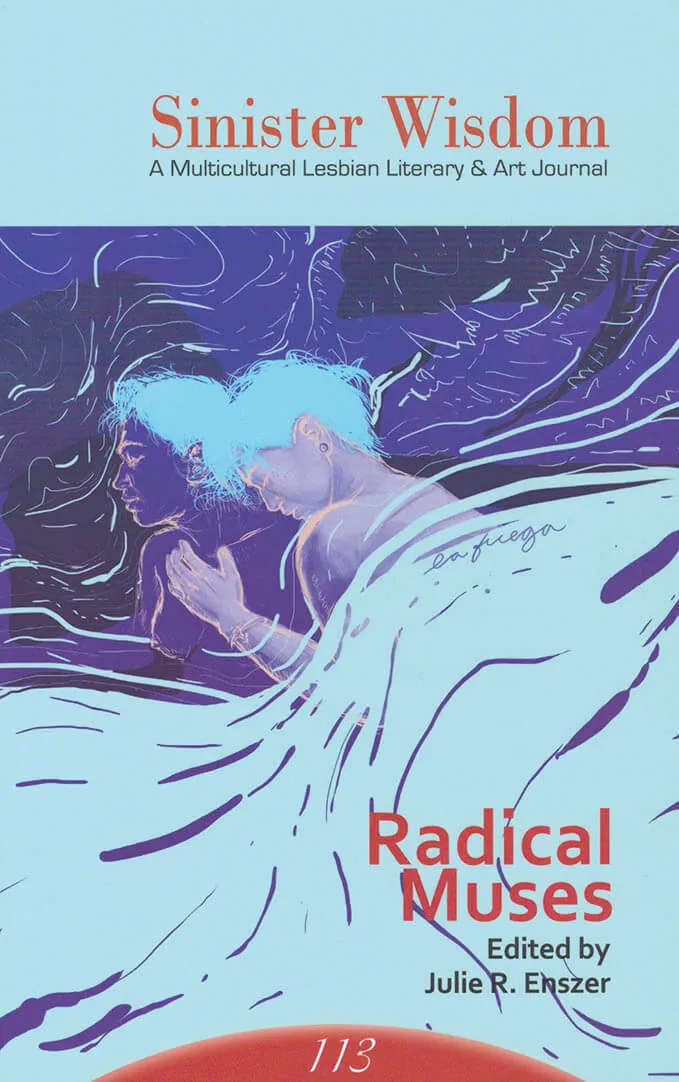
Radical Muses (Sinister Wisdom nr. 113)
Sinister Wisdom 113: Radical Muses features an eclectic array of contemporary poetry, prose, and art by lesbians from around the world, including new work by: Andrea Assaf, Tara Shea Burke, Cheryl Clarke, Marina Chirkova, Estela González, Barbara Haas, Nancy E. Lake, Vi Khi Nao, H. Ní Aódagaín and much more!

Godlike
New York poet Paul Vaughn has a trick for enjoying poetry readings: He simply imagines the reader died a long time ago. Paul is twenty-seven, married, and an admired poet himself. R. T. Wode’s mission is to give offense. He’s also a poet, freshly landed in the city, and, at age sixteen, unknown.
Paul worships T. They embark on a tempestuous affair, dropping acid and crashing parties and perambulating the grit and grime of New York City circa 1972. Paul is in love with T., but T. is in love with experience. Their relationship disintegrates.
A novel of compelling originality and transcendent beauty by legendary musician and poet Richard Hell, Godlike transposes the notorious romance of Paul Verlaine and Arthur Rimbaud to the East Village in its squalid, glorious ’70s heyday. The book comprises a version of Paul’s 1997 hospital notebooks: diaries amidst poems and essays, along with, most pertinently, the poet’s third-person memoir-novelette of his youthful time with the now-famous T. Godlike is infused as well with evocations—and sometimes actual poems—of many New York poets of the era, from Ted Berrigan and Ron Padgett to Edwin Denby and James Schuyler. It achieves a lyricism both profane and profound as it conjures the frenetic vitality as well as the existential malaise of an era. It’s a searching meditation on art, life, love, and the impossibility of everything.

Or, on Being the Other Woman
Throughout this book-length poem, Simone White considers the dynamics of contemporary black feminist life, attesting to the narrative complexities of writing and living as a black woman and artist.
In Or, on being the other woman, Simone White considers the dynamics of contemporary black feminist life. Throughout this book-length poem, White writes through a hybrid of poetry, essay, personal narrative, and critical theory, attesting to the narrative complexities of writing and living as a black woman and artist. She considers black social life—from art and motherhood to trap music and love—as unspeakably troubling and reflects on the degree to which it strands and punishes black women. She also explores what constitutes sexual freedom and the rewards and dangers that come with it. White meditates on trap music and the ways artists such as Future and Meek Mill and the sonic waves of the drum machine convey desire and the black experience. Charting the pressures of ordinary black womanhood, White pushes the limits of language, showing how those limits can be the basis for new modes of expression.

Mountainish
Zsuzsanna Gahse, Katy Derbyshire
A narrator and her dog are criss-crossing the Swiss Alps. She travels with friends who share her interest in food, languages and their topographical contexts. They collect colours, even look for colourlessness, and develop the idea of a walk-in diary, a vain attempt to archive their observations, encompassing portraits, descriptions and ruminations on mountains, hotels, people, language, food, flora and fauna.
Gradually, other mountains appear in their observations and memories, as do the mountains of literature and art. Mountains may be sites of fear and awe, of narrow-mindedness, racism and ever-looming collapse; Alpine lodges may be places of hospitality, retreat and unexpected encounters; of nature under threat.
In 515 notes, Zsuzsanna Gahse unfolds a finely woven interplay between her six characters while giving us a vivid panorama of mountain worlds, a multi-layered typology of all things mountainish.
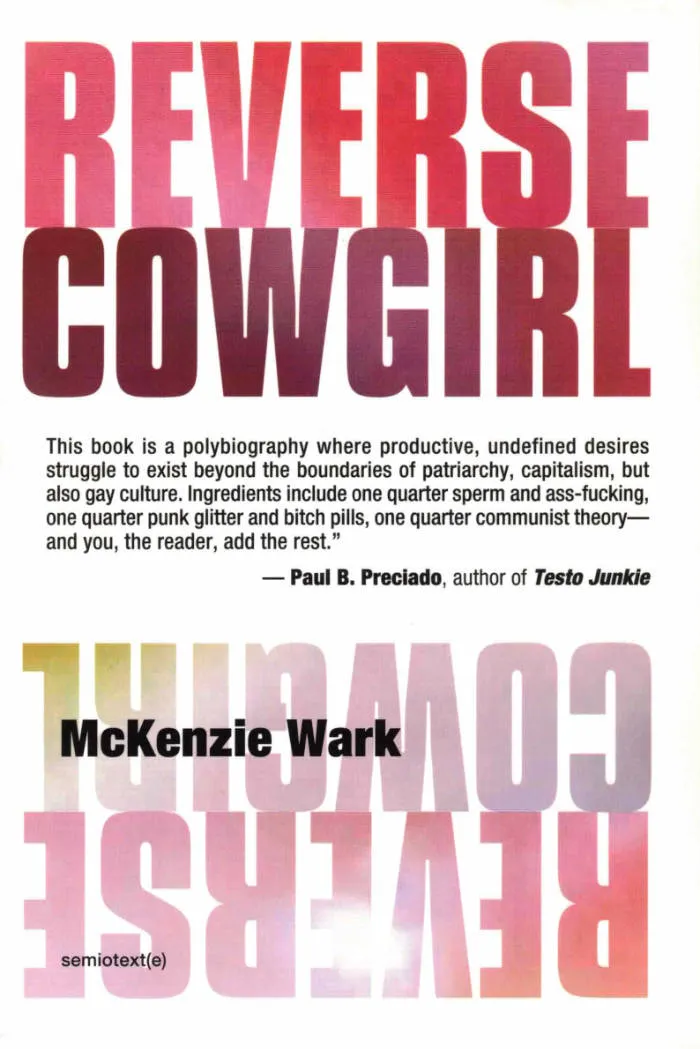
Reverse Cowgirl
McKenzie Wark invents a new genre for another gender: not a memoir but an auto-ethnography of the opacity of the self.
Another genre for another gender.
What if you were trans and didn't know it? What if there were some hole in your life and you didn't even know it was there? What if you went through life not knowing why you only felt at home in your body at peak moments of drugs and sex? What if you expended your days avoiding an absence, a hole in being? Reverse Cowgirl is not exactly a memoir. The author doesn't, in the end, have any answers as to who she really is or was, although maybe she figures out what she could become.
Traveling from Sydney in the 1980s to New York today, Reverse Cowgirl is a comedy of errors, chronicling the author's failed attempts at being gay and at being straight across the shifting political and media landscapes of the late twentieth century. Finding that the established narratives of being transgender don't seem to apply to her, Wark borrows from the genres of autofiction, fictocriticism, and new narrative to create a writing practice that can discover the form of a life outside existing accounts of trans experience: an auto-ethnography of the opacity of the self.

When My Body Was A Clinched Fist
"Back in the day when KRS-One intoned —The Bridge is over!— he did not prefigure a poet from Queens of the fierce attitude and intellectual magnitude of Enzo Silon Surin. WHEN MY BODY WAS A CLINCHED FIST gives the Heisman to such a refrain with lyrical power-packing poetics that settles the score with a succinct— Not! No the Bridge is not over, for Surin's Queens is alive and well and under the gaze of a master observer who eulogizes lives that though at times are battered have always mattered.
Enzo Silon Surin's poems get you caught up in the deeply personal experiences of growing and visceral all-encompassing knowing from an acute witness of every breath and follicle of Black life from palm trees, sand and sea to street corner projects, suburban houses and fistfuls of black water. Surin writes about the confused and disconnected, trigger happy wannabes trapped by outdated notions of masculinity, the cracked head crackheads all held in the clutch of society's clinched fist through which the trauma that comes with being of color, addicted, broke, lost and tossed, is itself a clinched fist of black bodies caught in the Russian nesting doll America's clinched fists make.
WHEN MY BODY WAS A CLINCHED FIST is an elegy for 'the premature exits.' It is a blues for the black-on-black black and blue. Surin yields his pen like a microscopic scalpel whereby an autopsy of possibility is performed to un-clinch the remarkable bone gristle poetry in these unflinching heart-wrenching pages."—Tony Medina
Enzo Silon Surin, Haitian-born poet, educator, speaker, publisher and social advocate, is the author of two chapbooks, A Letter of Resignation: An American Libretto (2017) and Higher Ground. He is the recipient of a Brother Thomas Fellowship from The Boston Foundation and is a PEN New England Celebrated New Voice in Poetry. Surin's work gives voice to experiences that take place in what he calls "broken spaces" and his poems have appeared in numerous publications including Crab Orchard Review, Origins, Transition Magazine/Jalada, Interviewing the Caribbean, jubilat, Soundings East, The BreakBeat Poets: New American Poetry in the Age of Hip-Hop, and sx salon. Surin holds an MFA in Creative Writing from Lesley University and is currently Professor of English at Bunker Hill Community College and founding editor and publisher at Central Square Press. His debut full-length poetry collection is WHEN MY BODY WAS A CLINCHED FIST (Black Lawrence Press, 2020).