Books
Books
in random order

Le Chauffage #3 - Day Job
Francesca Percival, Felix Rapp and 1 more
The third issue of Le Chauffage is an inquiry into the relationship between the practices of artists/ writers and their day jobs. This subject stems from a question fundamental to the existing mandate of Le Chauffage: 'how do you keep warm?' and subsequently, 'how do you pay the bills?' As these perennial concerns occupy our everyday lives, we ask artists/writers to consider the influence that their day jobs, side hustles, creative or non- creative forms of employment have on their respective practices.
This issue tries to account for the significant ways in which complex economic realities come to shape the art we produce, look at, and discuss. How do we deal with limited time and resources? How do we reclaim and steal time back? How do our day jobs shape and influence what we make? How do we subvert the means of production of the workplace? Can the constraint of a day job also be a way to alleviate the pressure of professionalising?
With contributions by Daniel Bozhkov, Nathan Crompton Pippa Garner, Chauncey Hare Marisa Kriangwiwat Holmes, Garrett Lockhart, Jannis Marwitz Reba Maybury, Tiziana La Melia, Dan Miller, Ragen Moss, Jean Luc Moulène, Jean Katambayi Mukendi Paul Niedermayer, Sophie Nys, Megan Plunkett, Chris Reinecke, Jacquelyn Zong Li Ross On Gabrielle L Hirondelle Hill Margaux Schwarz, Eleanor Ivory Weber James Welling, Werker, The Wig.

A Toast to St Martirià
A Toast to St Martirià is an improvised speech given by the cult Catalan filmmaker Albert Serra at the St Martirià fiesta in Banyoles, the town of his birth. Transmitting his subversive attitude and impulsive lust for life, it is a journey through his formative years and early relationships – established in the nightlife of his hometown – that have shaped his particular conception of cinema, art and life. ‘Cinema should be this, making perception of time and space more intense.’
Translated by Matthew Tree
Afterword by Alexander García Düttmann
The Catalan artist and filmmaker Albert Serra was born in 1975. His films usually depict European myths and literature. In 2001, he co-founded the production company Andergraun Films. His Honor of the Knights was selected by Cahiers du Cinéma as one of the ten best films of 2007. For Story of My Death, Serra was awarded the Golden Leopard at the Locarno Film Festival in 2013. For The Death of Louis XIV, Serra received the Prix Jean Vigo in 2016. Pacifiction was nominated for the Palme d’Or at the Cannes Film Festival in 2022.
Matthew Tree was born in London in 1958. He taught himself Catalan in 1979 and moved to Catalonia in 1984. Since then he has published nine works of fiction and non-fiction written in Catalan, and five written in English. He writes regular columns for Catalonia Today magazine in English and El Punt Avui newspaper in Catalan. He has translated works by Jordi Puntí, Maria Barbal, Monika Zgustová, Joel Joan, Marta Marín-Dòmine and Albert Serra, among others. Two of his English novels, Just Looking and Almost Everything, will appear in Catalan translation at the start of 2025.

Toffe. édition générale : système de production d'actions graphiques
toffe. édition générale
publication issue de reproduction générale,
système de production d'actions graphiques
développé en trois temps :
projection générale
dispositif multi-écran, pour la chaufferie
galerie de l'école supérieure des arts décoratifs de strasbourg
du 14 février au 23 mars 2003
présentation, édition générale
école nationale supérieure des beaux-arts d'alger
du 24 mai 2003
exposition, occurrence récente
diffusion, édition générale
galerie madé, paris
du 12 mai au 5 juin 2003

Black Cine-Body Sonics: Racializing the Soundtrack
Black Cine-Body Sonics: Racializing the Soundtrack surveys how Black audiovisuality developed and thrives in films and television through importing and materializing the sonics of Black musical representation — from 'Blaxploitation' classics (Shaft and Truck Turner) to cine-auteurs (Melvin Van Peebles, Spike Lee and Jordan Peele) to music video performers (Michael Jackson, Beyoncé and Kendrick Lamar) to video artists (Arthur Jafa and Isaac Julien) to contemporary multi-genre explorations of race (Sinners, Lovecraft Country, Atlanta and Swarm). The book views Jazz Soul Funk Disco Hip Hop Techno and House not as 'source music' but as genetic origins in the transformation of movies and shows resulting in new cinematic and televisual formations — all of which foreground the body performance and musicality.
— Philip Brophy
This is the 4th publication in the Echoes of Dissent series, devoted to the politics of the soundtrack.

Forensic Architecture: Violence at the Threshold of Detectability
In Forensic Architecture, Eyal Weizman, the group’s founder, provides, for the first time, an in-depth introduction to the history, practice, assumptions, potentials, and double binds of this practice. The book includes an extensive array of images, maps, and detailed documentation that records the intricate work the group has performed.
Included in this volume are case studies that traverse multiple scales and durations, ranging from the analysis of the shrapnel fragments in a room struck by drones in Pakistan, the reconstruction of a contested shooting in the West Bank, the architectural recreation of a secret Syrian detention center from the memory of its survivors, a blow-by-blow account of a day-long battle in Gaza, and an investigation of environmental violence and climate change in the Guatemalan highlands and elsewhere.
Weizman’s Forensic Architecture, stunning and shocking in its critical narrative, powerful images, and daring investigations, presents a new form of public truth, technologically, architecturally, and aesthetically produced. Their practice calls for a transformative politics in which architecture as a field of knowledge and a mode of interpretation exposes and confronts ever-new forms of state violence and secrecy.

Howdunnit 2 - Panorama
Merle Kröger, Rubaica Jaliwala
Navina Sundaram is sitting in the editing room in Hamburg. She has managed to reduce the complexity of the Kemal Altun case to the required 2 minutes and 40 seconds for the political magazine; a journalistic feat considering the legal terminology and the international political situation, which must be presented in simple terms. She places her interview with the judge at the back. The audience therefore first gets an impression of perhaps the best-known deportation prisoner of the republic on trial here. The phone rings. I imagine she is displeased about the disturbance. It’s the day of the broadcast; the report still needs to be approved. It rings again. She answers. Peter Boultwood is on the phone and says, “Did you hear? Kemal jumped out of the window in the courtroom. He’s dead.”
Merle Kröger lives in Berlin where she works as a novelist, screenwriter and dramaturg. She was a member of the Berlin film collective dog film (1992–1999) and founded pong lm in 2001. Kröger is the co-author of Philip Scheffner’s internationally awarded films Revision (2012), Havarie (2016) and Europe (2022). Kröger has published five novels to date, including Grenzfall (2012), Havarie/ Collision (2015) and Die Experten/ The Experts (2021). Her novels have received numerous awards, including Best Crime Novel of the Year, the Radio Bremen Prize for Crime Fiction and the German Crime Fiction Prize.
Translated by Rubaica Jaliwala

Profusione
A comprehensive overview of the unique work of the Italian artist born in 1931 and "discovered" late on the international scene, with numerous texts and an interview.
Published after the eponymous exhibition at Consortium Museum, Dijon, April 26th – September 8th 2024.
Born in Naples, Italy, in 1931, Isabella Ducrot is a young artist with a young career. Like many women of her generation, she moved into art after raising her children. Her formative years were marked by continuous travels with her late husband, during which they amassed hundreds of Persian miniatures and rare antique textiles of many kinds.
Contributions by Franck Gautherot & Seungduk Kim, Verena Lueken, Tobias Pils, Tschabalala Self, Andrea Viliani, Miranda Fengyuan Zhang.

Exo Revue: Si j’aurais su
Sam Bouffandeau, Chloé Delchini and 2 more
Revue du Master de Textes et de Création Littéraire de la Cambre*
Avec les textes de: Sam Bouffandeau, Chloé Clemens, Chloé Delchini, Perrine Estienne, Robin Faymonville, Gabriel René Franjou, Justine Gensse, Adèle Goardet, Bastien Hauser, Giulia Lazzara, Cyprien Muth, Sephora Shebabo.
* Le Master en Textes et Création Littéraire de l’École Nationale Supérieure des Arts Visuels de La Cambre propose un programme de formation aux étudiants qui visent à faire des métiers du texte et de la création littéraire leur avenir professionnel. Il s’adresse principalement aux jeunes écrivains et, plus généralement, à l’étudiant qui souhaite professionnaliser sa démarche artistique en lien avec la pratique de l’écrit en la confrontant à d’autres écrivains, à des éditeurs et à des professionnels reconnus de la littérature, l’informer et l’enrichir de nouveaux savoirs et de nouvelles compétences. Considérant le travail du texte et ses différentes formes comme des expressions majeures de l’homme à travers l’histoire, et les littératures des différents continents comme un art à part entière dans le champ des pratiques artistiques contemporaines, ce Master s’inscrit dans une démarche ouverte de production, de réflexion et d’instruction de l’écrit dans un monde en devenir.

Local Warming
For Sebastian Black, 2020 was a year like no other: a pandemic; three exhibitions; a move to Los Angeles; a presidential election; a baby, too. Local Warming is Black's tale of it all, as recorded in his diary.
One million years ago, when I started making the paintings compiled here, I was listening to lots of audiobooks and recorded philosophy lectures. It was the winter of 2019, my paintings were about this and about that, and every brushstroke drifted safely over a net of ideas. I was gathering a list of things that I knew to be true because I was sick of having nothing to say when people asked me to explain myself. Then a professor, who to me is now a holy exegete, said that difference precedes identity as the substance of reality. I'd been eavesdropping on YouTube as he taught a continuing-ed class on Deleuze for a claque of narrative therapists. Difference before identity. I couldn't grasp the idea— only touch it. That's okay, said the professor, as though speaking directly to me, the point of thinking isn't to grasp things that are true but rather to prod things that are interesting. — Sebastian Black
Sebastian Black is an artist/writer. He was born in New York City in 1985. He lives and works in Los Angeles.

Essays
Poetry as both a form and genre has many possibilities to exist within; however, poetry too often is burdened by the imperative to have an argument and a set of imagery and meanings that are preconceived and placed within the poem. In this way, poetry gets conflated with writing a thesis or project, and the poet simply the presenter of perfectly argued language. When poets attempt to bridge the gap between genres and write within the contemporary essay form, they are tasked to construct perfect arguments there as well and avoid the associative and aesthetic logic that makes poems important. The term essay itself was coined by Michel de Montaigne in the 1500s — it comes from the French word essai, which means to test or experiment with what one knows as a learning tool, and is in partial opposition to the terms we use to discuss the essay now
ESSAYS calls on thinkers and writers to move beyond this linear thinking into the realm of what an essay by someone like Montaigne might do. His essays do as they say they will—they test out ideas, they are unafraid to get messy in their execution, they are brave enough to go forward into the uncharted waters. In them, it’s completely beside the point to get back to where they started, let alone where they’d say they would go. They are simply beside the point. It’s true.
ESSAYS, edited by Dorothea Lasky, is a book of essays on the essay, which enact and query these directives. The volume collects essays by poets Ariel Goldberg, Ken Chen, Wayne Koestenbaum, Tracie Morris, Anaïs Duplan, Raquel Salas Rivera, Brandon Shimoda, Cecilia Vicuña, Fred Moten, and Mónica de la Torre.

Zoë Lund: Poems
Stephanie LaCava, Zoë Lund and 1 more
Poems presents four unpublished poems by American writer and actress Zoë Lund (1962–1999), written in the 1980s. An incandescent voice emerges, revealing the might, sincerity, and precision of her expression, as well as her vulnerability and defiance in the face of death. This is the first publication dedicated to her work.
Translated into French by Stephanie LaCava and Manon Lutanie, and presented in a bilingual volume (English, French), the poems are introduced by Stephanie LaCava, who retraces their genesis and examines the personality of their author:
"She is unsure of her identity, but hints at certain proclivities: action as the only true form of activism (sustained readiness to strike); a taste for contradictory characters (strength exists where there is also cowardice); romance. [...] Uninterested in mute beauty, Lund wanted to write and produce her own projects. In a news clipping from 1983, titled 'Young Political Filmmaker Shooting at Mount Holyoke,' there is a striking picture of Lund 'working on a film about the radicalization of a young woman,' per the caption. The article talks of her 'uncompromising idealism' and feelings about the naïveté of both American liberals and leftists.
Three years later, in 1986, 'Touchstone Levity' was written, and [...], the same year, "Opium Wars." The latter speaks to Lund's interest in drugs (she had a taste for heroin and would die of heart failure at thirty-seven)."
Printed offset in Italy on a matte, natural paper, stapled, the book also features black-and-white pictures of Lund taken in Paris by the filmmaker, critic, and activist Édouard de Laurot, then the author's partner, in the early 1980s. It's striking to see her in Paris on these images, smoking and posing in front of the Eiffel Tower, disheveled in a nightclub, caught on camera at a shooting range, at such a young age—when we know she would die in Paris fifteen years later. It seemed right to choose these images to accompany the poems, which were written in the same decade, and in the context of this French-American publication.

nnn.1 - no no no celestial journal
published commonly, no no no expounds an experimental poetic offering, both text & art.
each issue features a limited edition artwork. which can be tacked or framed or stored in a drawer.
celestial in nature, no no no takes the form required, and necessary.

La locataire
The Tenant is a monographic critical essay by Marie Canet. It is the first text to directly address the connections between McKenzie’s work, pornography, and special effects. The title refers to the way the artist moves through different periods and aesthetic spaces, appropriating their codes in order to construct new visual fictions. The book is infused with post-#MeToo feminist thinking, alternative uses of biography, reflections on the art world, and contemporary debates surrounding appropriation, embodiment, and the status of the artwork.
McKenzie and Canet worked with each other for over eight years, on projects like Atelier E.B: Passer-by catalogue, published on the occasion of the Fondation Galeries Lafayette exhibition, or the book Pervert or Detective, a conversation between Lucy McKenzie and artist Reba Maybury. This collaboration now culminated in an exhibition and a book: Plastic Newspaper (presented at CRAC Sète in March 2026) and Lucy McKenzie, The Tenant.
Texts by Marie Canet and Lucy McKenzie
Translations: Catherine Petit & Paul Buck (Marie Canet), Juliette Desorgues (Lucy McKenzie)
Published in connection with the exhibition Lucy McKenzie, Plastic Newspaper, at Crac Occitanie, Centre régional d‘art contemporain Occitanie/Pyrénées-Méditerranée à Sète, 21.03.-06.09.26

Allow me to dream a body with you
Writing from the body, from nervous impulses, sensations and gestures, but also from our being carried by matter, language and history, Sabina Holzer explores how writing may become ‘a way of singing and slip over into liminal, latent meanings and potentials.’ How to stay close to the body of the word? To perceive some of the multiplicity of our reality and ways of being, she incorporates somatic practices, ecology and new materialism, fables and science fiction in her writing. Allow me to dream a body with you gathers poetic essays and stories that delve into the fine grain of our corporeal entanglements and embeddedness. ‘Would an encounter between you and me be possible without all this?’
Sabina Holzer works in the field of expanded choreography. Her performances, interventions and texts explore the ecologies of human and more-than-human bodies with particular attention to movement and matter. She engages in practices of collaboration, philosophy, ecology, science fiction and poetry.
Graphic design: Michaël Bussaer
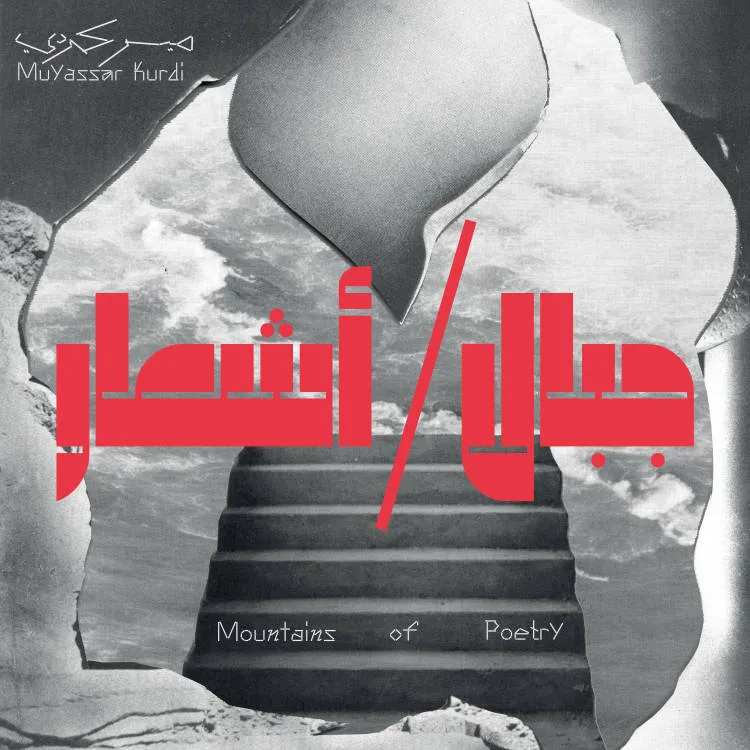
Mountains of Poetry (Limited Edition 12" Coloured)
Mountains of Poetry is a new 8-track studio album produced and developed by interdisciplinary artist Muyassar Kurdi. The album traces the entwined relations between one’s body and land, driven by a sense of urgency. Embedded in the earth, Kurdi imagines her body as a site for sonic excavation of memory and longing. The artist’s voice paired with electronic sound honors the ancient and the futuristic that together form a ritualistic reflection to navigate the tender space of remembering, forgetting and mourning. Departing from her usual emphasis on vocal abstraction, Kurdi turns to concrete words that punctuate the sonic landscape, gathering them into mountains of poetry.

The Circle: Chronologie pour une constellation
A visual and text based investigation led by Moroccan artist Bouchra Khalili during many years following the traces left by the Mouvement des travailleurs arabes, a group fighting for the rights of the Arab workers in France at the turn of the 1970s.
Khalili focused her attention on the theatre groups Al Assifa and Al Halaka who were created in this political environment. The publication unfolds from The Circle (2023), a video installation shown for the first time at the 15th Sharjah Biennale (2023), at Macba (2023) and at the Luma Foundation (in Arles in 2023-2024 and Zurich in 2025).
The book is published in conjunction with Bouchra Khalili's exhibitions as guest visual artist of the Festival d'Automne in Paris in 2025.
Texts by KJ Abudu, Bouchra Khalili, Mohamed Amer Meziane, Abdellali Hajjat ; interviews with Saïd Bouziri, Hedi Akkari, Smaïne Idri, Mustapha Mohammadi, Philippe Tancelin, Mia Radford, Lucas Yahiaoui.

Phototaxis
Translated from the French, Phototaxis is a fragmentary, darkly-humorous apocalyptic text from a leading young voice from Montréal.
In a city mysteriously overflowing with meat, a museum is bombed, a classical piano player hooked on snuff films throws himself off a building, a charismatic but misled political organizer has disappeared, and a young immigrant navigates a crumbling continent. A dystopic work of hope, Phototaxis dismantles and rebuilds worlds with language at turns surreal, scathingly comic, poetic, and revolutionary.
“Olivia Tapiero’s virtuosic Phototaxis reverses the purgative gesture of necrophoresis: every sentence is shot through with the stench of carrion and the death rattle of capital’s circulation. Reading the text, one feels the vertigo of an interminable fall refracted in an infinity mirror of the commodified image. Tapiero’s haunting lyricism, atmospherically rendered in Kit Schluter’s translation, will ring out in your skull long after reading the book’s final word: music.“
— Jackie Wang

Mount Horeb Palestine
In 1962 at the age of 71, Joseph Elmer Yoakum (circa 1891–1972) reported having a dream that inspired him to draw. Thereafter the retired veteran began a daily practice and over the next 10 years produced some 2,000 works.
Yoakum was born into poverty, had very little schooling, and at an early age left home to join a circus. He wound up working with several circuses, traveling across the United States as well as abroad and becoming intimately familiar with the world's various landscapes. These experiences would provide the foundational memories that fueled his deeply spiritual vision decades later.
When he began to put that vision to paper in his apartment on Chicago's South Side in the early 1960s, Yoakum quickly developed a unique visual language, independent and distinct from other artists in the city, such as those involved in the flourishing Black Arts Movement or the up-and-coming Chicago Imagist group. His drawings—predominantly landscapes in ballpoint pen, colored pencil, pastel, and watercolor and inscribed with locations from all seven continents—reflect the scope of his national and international travels as well as his idiosyncratic and poetic vision of the natural world.

My Life and My Life in the Nineties
New edition of one of the founding works of Language writing.
Lyn Hejinian is among the most prominent of contemporary American poets. Her poem My Life has garnered accolades and fans inside and outside academia. First published in 1980, and revised in 1987 and 2002, My Life is now firmly established in the postmodern canon. This Wesleyan edition includes the 45-part prose poem sequence along with a closely related ten-part work titled My Life in the Nineties. An experimental intervention into the autobiographical genre, My Life explores the many ways in which language — — the things people say and the ways they say them — shapes not only their identity, but also the very world around them.

Gender and Postsecularity in Visual Culture and Knowledge Production
Boka En, Sabine Grenz and 2 more
A collection exploring the intersections of gender and religion in post-secular knowledge production and visual culture.
Over the last three decades, religious practices and belongings have gained increased visibility across the globe, turning secularity and its relationship with religion into subjects of intense interdisciplinary and international debate. Previously marginalized in gender studies, the secular and the religious now attract growing interest in academic and activist feminism, prompting a critical reflection on secularity's emancipatory potential. This publication aims to foster this interest by providing a platform for interdisciplinary and transregional discussions on the complex dynamics of secularity, religiosity, and gender, as well as new approaches to explore these relationships.
The contributions examine the entanglements and boundaries of religions and secularities in everyday life, art, culture, and knowledge production. By presenting relevant case studies, this book underscores an understanding of religion as both a category of knowledge and a marker of identity.

Mountainish
Zsuzsanna Gahse, Katy Derbyshire
A narrator and her dog are criss-crossing the Swiss Alps. She travels with friends who share her interest in food, languages and their topographical contexts. They collect colours, even look for colourlessness, and develop the idea of a walk-in diary, a vain attempt to archive their observations, encompassing portraits, descriptions and ruminations on mountains, hotels, people, language, food, flora and fauna.
Gradually, other mountains appear in their observations and memories, as do the mountains of literature and art. Mountains may be sites of fear and awe, of narrow-mindedness, racism and ever-looming collapse; Alpine lodges may be places of hospitality, retreat and unexpected encounters; of nature under threat.
In 515 notes, Zsuzsanna Gahse unfolds a finely woven interplay between her six characters while giving us a vivid panorama of mountain worlds, a multi-layered typology of all things mountainish.

Curious Affinities
How much distance and difference can intimacy hold? How much proximity and likeness does it require? What can we learn from its capacities? And what could we salvage from its limits?
Curious Affinities unravels the risks and possibilities brought forth by unconventional styles of intimacy. Across kinship, friendship, romance and community, the threads of social relation are entangled by race, class and queerness in unexpected and generative ways, as we find ourselves rent to shreds and stitched back together in the name of common feelings.
In rousing poetry and incisive prose, Sophie Chauhan reflects on the bonds and boundaries that govern our collective ways of life and wonders how they might be reimagined.
Sophie Chauhan is a London-based writer and researcher, born in the UK and raised in Naarm (Melbourne). She is completing a PhD in Race, Ethnicity and Postcolonial Studies at University College London. Her academic, creative and organising work converge around her interest in anti-capitalist, queer and decolonial approaches to radical coalition-building.

Active Reception
A vibrant work of lyric, conceptual, and confessional poetic modes pitched to enact a queer politics of liberation.
Active Reception is a book of bottoming lovers, the world around us, and a history of letters, that thinks through a queer mode of writing from the bottom, a kind of coalition based politics of receptivity and expansion that is open to the world around us, its myriad life forms, its systemic oppressions, its hidden ghosts.
Noah Ross is a bookseller, editor, and poet based in Berkeley, CA. Noah is the author of Swell, and an editor of Baest: a journal of queer forms & affects, and Mo0on/IO with Lindsay Choi.

You Can Vibe Me On My Femmephone
You Can Vibe Me On My FemmePhone follows three friends, in a near-future Los Angeles, who are trying to improve themselves using a phone with a feminist operating system. Join Veronica, Phoebe, and Remy on their absurd adventures to seduce artists, entrap local Proud Boys, and enter a kinky queer horse-play scene. Their FemmePhones, programmed with their personal values, guide them toward the transformative love and professional passions they seek. But what choices will they make when they disagree with their phones and what does this mean about their feminist values? Kamala Puligandla’s heartfelt, humorous novella takes you on a wild ride about queer love, self-knowledge and growth.
Size: 4.5" x 7", 108 pages, perfect bound
Self-published by Co—Conspirator Press with the support of Feminist Center for Creative Work. Copy edited by Pratishtha Kohli. Illustrations by Phoebe Unter. Designed by MJ Balvanera, Riso-printed by Neko Natalia.