Books
Books

Archive Dora Diamant #07
A collection of photographs from the archives of the icon of underground and alternative Parisian nights Dora Diamant.
A self-taught photographer, Dora Diamant has left thousands of photos. The Dora Diamant Association, custodian of this archive, and Éditions L'Amazone have joined forces to bring them to life by devoting a series of publications to them. Each volume of the Dora Diamant Archive was created by a different person and is the result of a subjective selection and arrangement specific to its author.
Figurehead of the Parisian underground and queer nights, photographer, DJ, multimedia and polymorphic artist, Dora Diamant was the daughter of Pascal Doury.
Selected by Yamil Farah and Mélanie Matranga.

Archive Dora Diamant #06
A collection of photographs from the archives of the icon of underground and alternative Parisian nights Dora Diamant.
A self-taught photographer, Dora Diamant has left thousands of photos. The Dora Diamant Association, custodian of this archive, and Éditions L'Amazone have joined forces to bring them to life by devoting a series of publications to them. Each volume of the Dora Diamant Archive was created by a different person and is the result of a subjective selection and arrangement specific to its author.
Figurehead of the Parisian underground and queer nights, photographer, DJ, multimedia and polymorphic artist, Dora Diamant was the daughter of Pascal Doury.
Selected by Leopold Duchemin.

Archive Dora Diamant #05
A collection of photographs from the archives of the icon of underground and alternative Parisian nights Dora Diamant.
A self-taught photographer, Dora Diamant has left thousands of photos. The Dora Diamant Association, custodian of this archive, and Éditions L'Amazone have joined forces to bring them to life by devoting a series of publications to them. Each volume of the Dora Diamant Archive was created by a different person and is the result of a subjective selection and arrangement specific to its author.
Figurehead of the Parisian underground and queer nights, photographer, DJ, multimedia and polymorphic artist, Dora Diamant was the daughter of Pascal Doury.
Selected by Clara Pacotte and Esmé Planchon.

Emil Lime
Emil Lime collects various materials that nurture and give shape to Esther Gatón’s artistic practice, including collages made with her phone pics, sketches, sporadic notes and drawings, together with the writing of authors that have been influential on the work: Fredy Massad, María Fernanda Ampuero, Darya Diamond and Cory John.

The Films of Laura Mulvey and Peter Wollen
This collection of Laura Mulvey and Peter Wollen's film scripts vividly evokes the close connection between their influential work as theorists and their work as filmmakers. It includes scripts for all six of Mulvey and Wollen's collaborative films, Wollen's solo feature film, Friendship's Death (1987), and Mulvey's later collaborations.
Each text is followed by a new essay by a leading writer, offering a critical interpretation of the corresponding film. The collection also includes Wollen's short story Friendship's Death (1976), the outlines for two unrealised Mulvey and Wollen collaborations, and a selection of scanned working documents. The scripts and essays collected in this volume trace the historical significance of a complex cinematic project that brought feminist, semiotic and psychoanalytic concerns together with formal devices and strategies.
The book includes original contributions from Nora M. Alter, Kodwo Eshun, Nicolas Helm-Grovas, Esther Leslie, Laura Mulvey, Volker Pantenburg, Griselda Pollock, B. Ruby Rich and Sukhdev Sandhu.

BFTK #6: Tentative — Incomplete — Inconsistent
Andrew Walsh‐Lister, Matthew Stuart
This instalment of Bricks from the Kiln doubles as issue #6 of the journal and as an exhibition catalogue for the thematic show ‘BFTK#6: Tentative — Incomplete — Inconsistent: A Catalogue of the Disappeared, Destroyed, Lost or Otherwise Inaccessible’. Presenting objects, artworks, artefacts, models, events and animals that no-longer — or never did — exist in physical form, the exhibition explores themes of death, destruction and reincarnation, examining persisting interests in notions of ephemerality and permanence, memory and record, preservation and erasure, creation and reconstruction.
How do we remember and memorialise? How is space given to the unrecorded? How do we experience the out of reach, concealed, unseen, undiscovered? How can the dematerialised be materialised again, through the mediation of writing, image and sound?
THE ALMOST HORSE
Helen Marten
(inside front / back cover)
‘STILL IN ALL HEARTS, IN ALL BELLIES, IN ALL TOES’:
A BELATED REVIEW OF FESTIVAL DE FORT BOYARD
Matthew Stuart & Andrew Walsh-Lister
(pp.6–8)
EDDYSTONE
Rachael Allen
(pp.11–18)
TO MAKE THE STONE STONY
Emily LaBarge
(pp.21–26)
WHEREFORE AM I NOW?
Lucy Mercer
(pp.29–40)
WESTON: THE TOWN THAT WAS, AND THEN WASN’T
Crystal Bennes
(pp.43–52)
NOTES TO ACCOMPANY VIOLENT INNOCENCE (2019)
Will Harris
(pp.55–64)
GHOST, POCKETS, TRACES, NECESSARY CLOUDS
Matthew Stuart
(pp.66–69)
CONNECTIVITY OF TOUCHING
Ali Na & Mindy Seu in conversation
(pp.71–76)
PEARL
Rose Higham-Stainton
(pp.79–84)
NOTES FROM NEW MEXICO
Jennifer Hodgson
(pp.87–98)
THE MOOG OF AHMEDABAD
Paul Purgas
(pp.101–108)
IN WHICH DECIBELLA ESCAPES AUDITION
Sarah Hayden
(pp.111–122)
D.C.B.: A PARTIAL RETROSPECTIVE
Juliet Jacques
(pp.125–136)
PINBALL REMAINS: ON THE PINBALL ISSUE OF THE SITUATIONIST TIMES
Ellef Prestsæter
(pp.139–150)
TOMB III – CADMIUM (2021)
Gilbert Again
(pp.152–154)
NON-DESCRIPT ANIMAL
David Hering
(pp.157–161)
Cover & Bookmark artwork by Helen Marten

Black Revelry: In Honor of ‘The Sugar Shack’
An experiment in book making, which takes up the form of the LP record as a starting point for re-configuring the haptics of the printed book. Presented as a collection of unbound pages inside a gatefold record sleeve, the publication includes a pressed record, as well as written, visual and sonic contributions from scholars, poets, artists, choreographers and DJs.
Through the logic of the detail, each contributor imaginatively (re)produces Ernie Barnes’s iconic painting The Sugar Shack as an archive of personal histories and a universe of intergenerational connections. Held together as an album, it is a performance to be made at home, which invites readers/listeners to feel art’s histories and to be in them with their bodies.
d.a. carter with contributions by Taylor Renée Aldridge; Samiya Bashir; La Marr Jurelle Bruce; DJ Lynnée Denise, Jennifer Harge, Duane Lee Holland, Jr., William H. Mosley, III, Zoé Samudzi, S*an D. Henry-Smith, Melanie Stevens and Phillip B. Williams.

L'Écriture de Monique Wittig À La Couleur De Sappho
Invitation au voyage à travers l’œuvre littéraire de Monique Wittig, ce livre nous embarque dans une passionnante exploration de ses textes de fiction, de L’opponax à Virgile, non. Il rend compte de la lutte amoureuse qu’elle livre au langage – matériau brut qu’elle travaille au corps pour faire advenir dans la réalité ce qui n’y a pas (encore) droit de cité. La convocation malicieuse et grave des grands récits du passé, les nombreux emprunts aux auteurs anciens, la pratique de la citation font des Guérillères une formidable épopée féministe, du Corps lesbien un Évangile selon Sappho, du Voyage sans fin le combat drôle et tragique d’une Quichotte féministe et lesbienne.
En soulignant la cohérence des textes et leur fragmentation, Catherine Écarnot met en évidence la passion poétique qui habite ces livres que Wittig concevait comme des « chevaux de Troie » : des machines de guerre destinées à fissurer la réalité pour y inscrire une subjectivité mouvante, échappée du continent noir de la féminité, rétive aux assignations de genre. Uniques et radicalement disruptives, les fictions ainsi créées ouvrent grands les chemins qui relient littérature et lesbianisme.
Publié pour la première fois en 2002, cet ouvrage, le premier consacré en Europe à l’œuvre witigienne, reparaît dans une nouvelle édition remaniée, actualisée et enrichie de nombreuses références aux études publiées depuis sa parution.

Art et production
Art et production de Boris Arvatov fait partie des classiques oubliés des avant-gardes qui se sont épanouies durant la Révolution russe. Publié à Moscou en 1926, il vient porter le fer dans les débats qui agitent l’école constructiviste : que doit être le statut de l’art après la révolution, ses liens avec les techniques industrielles de reproduction, avec la critique de la vie quotidienne, comment doit-il entrer dans l’usine ? Autant d’interrogations radicales, témoignages d’une séquence politico-sociale bouillonnante. Une nouvelle conception de l’art émerge, qui laissera une empreinte indélibile sur une tradition de critiques matérialistes de la culture, de Walter Benjamin à Peter Bürger, en passant par Fredric Jameson, celle qui posera la question de l’articulation entre pratique artistique et logiques propres à la sphère de la production. Un document exceptionnel enrichi d’illustrations, paraissant en français pour la première fois, une porte prviliégiée sur un moment-clé de la modernité exthétique du XXe siècle.
Boris Arvatov (1896–1940) est un artiste et critique d’art russe. Il est notamment connu comme théoricien du productivisme, un mouvement d’avant-garde post-révolutionnaire lié au constructivisme.

L'Empire Noir
Après une campagne militaire fulgurante, l’organisation secrète du redoutable Dr Belsidus a chassé les puissances occupantes du sol africain et s’est rendue maitre de l’ensemble du continent, unifié pour la première fois en un gigantesque empire. L’expansion a démarré et l’édification d’une civilisation d’un genre inédit est en marche. Mais les nations européennes, après s’être fait la guerre, s’apprêtent à revenir. Une course s’engage entre l’Internationale noire et les appétits impérialistes : sabotages, espionnage, guerre technologique ou bactériologique, les héros et héroïnes de L’Internationale noire né reculeront devant rien pour sauvegarder cette indépendance acquise de haute lutte.
Dans ce second volet du roman-feuilleton qui fit la réputation de G. Schuyler, retrouvez les nouvelles aventures de nos personnages, dorénavant contraints à une lutte géopolitique d’une ampleur inégalée, pour garantir à leur Empire noir un avenir radieux !
George Samuel Schuyler, 1895–1977, fut un essayiste, journaliste et romancier de première importance dans le monde culturel africain-américain de l’entre-deux-guerres. Il reste connu pour la férocité de ses critiques. Il est l’auteur d’un seul roman, Black No More, traduit en France en 2016 et d’un essai romancé dénonçant la traite au Liberia, produit de son enquête de terrain dans le pays. Proche des courants socialistes jusqu’à la Seconde Guerre mondiale, il prendra un virage nettement réactionnaire par la suite, tout en demeurant dans les mémoires de toute une génération d’écrivains, tels qu’Ishmael Reed ou Samuel Delany.

Portrait of the Artist as a Writer
"Portrait of the Artist as a Writer" is a collection of short stories, quotes and drawings about dinosaurs, gay lesbians and how to lose a joke at the lake.
Risoprinted in pumpkin and purple, perfect binding with glue, first edition of 300, Berlin 2022.

Entropia Vol. 1 & 2
Entropia (vol. I & II) – written by William Kherbek and edited in collaboration with Jack Clarke – is a publication which seeks to recount and re-examine a decade of artistic curation, production, and critique between London, Berlin, and other urban art centres from 2010 to 2020.
Comprised of two volumes, this publication contains a compendium of over one hundred reviews and interviews with luminaries of contemporary art (Vol I), as well as a speculative attempt to create a newly generated algorithmic art(ificial) critic (Vol II). Together they serve to document, excoriate, and theorise an art world which is simultaneously hegemonic and precarious, complicit and constructive, driven by values, yet fed by extraction, all filtered through Kherbek’s precise, aphoristic, acerbic, lens.
The publications include contextual contributions from both Josie Thaddeus-Johns, writer for the New York Times, The Financial Times, Frieze; and Rozsa Farkas, director of London-based gallery Arcadia Missa.

The Formation of Calcium
A horror story of one woman's awful reinvention, M. S. Coe's The Formation of Calcium is disturbingly funny and completely unexpected.
Middle-aged Mary Ellen Washie has finally freed herself of her stultified past life in western New York state and moved to Florida. With the husband she's grown to hate firmly in her rearview mirror, and all ties to her family cut off, she changes her name, bleaches her hair, and befriends Natalie, a seemingly kind, martini-loving woman whom she promptly begins to manipulate. As her machinations propel her beyond the brink of who she used to be, Mary Ellen seeks to unburden herself—but not one to sit down with pen and paper, she narrates the events of her new life into a cassette tape recorder, giving each tape an innocuous name to keep the curious away. A riveting account of one woman's awful reinvention, M. S. Coe's new novel is disturbingly funny and completely unexpected. With elements of pulp noir and confessional literature, The Formation of Calcium depicts the bland misery of modern American life as one woman seeks her own ill-fated transformation.
Born in Las Vegas, Nevada, M. S. Coe is an American writer living in Guadalajara, Mexico. After she graduated with an MFA in creative writing from Cornell University, Clash Books published her first novel, New Veronia, in 2019. Coe's stories have appeared in The Antioch Review, Cosmonauts Avenue, Electric Literature, Nashville Review, Waxwing, and elsewhere. She has held residencies from the Herbert Hoover National Historic Site, Petrified Forest National Park, and Ora Lerman Trust.

The Close Chaplet
Long out of print, The Close Chaplet is Laura Riding's first book, originally published in 1926. Riding deliberately ceased writing poems after 1940, when she came to see poetry as irrevocably flawed as a means of expression. These poems demonstrate Riding's early desire to depart from the close and well-tilled ground of traditional lyric poetry. According to her biographer, Elizabeth Friedman, many of the poems for THE CLOSE CHAPLET were brought in typescript from New York, a few were added in Egypt, and the entire text was carefully edited by Robert Graves.
In his introduction, Mark Jacobs writes that Riding was identifying herself with the pre-moment, the 'what-was-there' before Creation. How did the world, the universe, come to exist, why does it exist, why does it die, why do we? From these questions, Riding begins to develop a theory about the role of women as the origin of all human beings, the only animals with written language. This edition also includes Riding's essay A Prophecy or a Plea, a statement of her poetics initially published in 1926.
Laura Riding was a poet, novelist, short-story writer, essayist, and publisher. While primarily known for the critical works that she co-authored with Robert Graves — A Pamphlet Against Anthologies and A Survey of Modernist Poetry — Riding also left behind an incredibly powerful body of poetry and prose works that, regrettably, remain little read today. These include THE CLOSE CHAPLET (Ugly Duckling Press, 2020), EXPERTS ARE PUZZLED (Ugly Duckling Presse, 2018), CONVALESCENT CONVERSATIONS (Ugly Duckling Presse, 2018), The Lives of Wives, and The Progress of Stories. Famously rejecting poetry early in her career, she spent the last decades of her life co-writing a theoretical work on linguistics, Rational Meaning, with her husband Schuyler Jackson. She was awarded the Bollingen Prize in 1991, the very same year she died.

DEARS No. 5 ever:over
Robert Steinberger, Delphine Chapuis Schmitz and 1 more
DEARS is a print magazine for transversal writing practices at the crossroads of art, poetry and experimental writing. It brings together authors and writers from different backgrounds and constitutes a dedicated platform for texts escaping the usual genres and disciplinary boundaries.
DEARS promotes the exploration of new forms of language as a way to foster new forms of living together, and emphasizes the growing relevance of trans- versal writing practices in this respect.
DEARS no. 5 / Summer 2023 / ever.over
With texts by Diaty Diallo, Douglas Keaney, Dzifa Benson, Sevinç Çalhanoğlu, Jana Vanecek, and an epigraph by Trinh T. Minh-ha.

The Swarm
A shape-shifting, metaphysical thriller where sensorial, sexual, and revolutionary impulses are aligned for the purpose for anarcho-transcendent-communal escape, The Swarm circles around a sundry of anomalous and dead beings who plot their way out of Hungarian fascist rule in the thermal baths of Budapest.
Based in Berlin, Dalia Neis is a writer, filmmaker, and lyricist and vocalist for Dali Muru & The Polyphonic Swarm. Previous publications include Zephyrian Spools: An Essay, a Wind (Knives, Forks & Spoons), and Hercules Road (Ma Bibliothèque).

New Forms of Art and Contagious Mental Illness
Carl Julius Salomonsen, Andrew Hodgson
Over the years 1919–20, the celebrated medical scientist and doctor Carl Julius Salomonsen began giving public lectures and publishing pamphlets regarding a new “epidemic” that had begun to affect the European populace: the increasing ubiquity of modernist art.
In a 1919 pamphlet titled New Forms of Art and Contagious Mental Illness, he wrote: “We stand, at this moment, before a movement in art which is psychopathic in character, and whose victorious journey through all countries is probably caused by the same spiritual disease that gave the older, religious spiritual epidemic such a powerful spread.” This pamphlet and the accompanying talks were countered by a retaliatory pamphlet published by members of Grønningen, a Copenhagen modernist painters group, to which Salomonsen responded with a further pamphlet.
Translated into English for the first time by literary theorist Andrew Hodgson, the entire altercation is gathered in this book, documenting one of the earliest rejections of modernist art.
Edited & Translated by Andrew Hodgson.

Being a Chair. Essays on Choreographic Poetry
Imagine words approaching a dance eyes closed or sleepwalking, words adrift beyond what can be envisioned beforehand, prompting writer and reader alike into a zone where time multiplies, where bodies grow footnotes and paper skin, savour the taste of language, attune their ears to the wavelength of blue. In a string of brief essays on her practice of writing choreographic poetry and scores, Janne-Camilla Lyster offers reflections on time, memory and the senses, on translation, punctuation and rhythm, on mistakes and crevasses, on the impossible and yet other things. What does it take to enter another form of existence, say, a chair?
Janne-Camilla Lyster is a writer, dancer and choreographer. She has published poetry, novels, essays and plays.

Hopelessness
"The brilliant Verity Spott has a new book out, called Hopelessness and published by the 87 Press. The work defies categorisation: Verity is a poet, and this book is certainly poetry, but large parts are in prose form and towards the end it even takes on the structure of an absurdist play. There seems to be a loose narrative, and even recurring character voices, so I’m tempted to call it a short experimental novel, in the vein of Kenneth Patchen’s The Journal Of Albion Moonlight (a personal favourite). Ultimately though I’d just call it a book; one full of words that are profound, moving, silly, sad, challenging and beautiful in equal measure. Even though it’s still a boldly experimental piece, in some ways Hopelessness feels like the most accessible thing Verity’s done. Without wanting to sound condescending, it’s also the most mature. You don’t get much more universal than death, love and loss, and these seem to be the main themes explored here. Another is language itself, the way it defines and limits our experience, and the way that we’re constantly at the mercy of words and phrases as they’re deployed by the authorities, the media, and eventually our own thought processes. Dissenting voices continually talk over one another throughout Hopelessness, often sampled from outside sources, or parodies thereof: Sappho, MR James, traditional hymns and folk songs, Hollywood movies, talk radio, tabloid newspapers, dreams and demagogues. Through it all there’s a painful lesson about how loss can make us bitter and hard, and how by refusing to move forward we become empty caricatures mouthing meaningless clichés to wound and hurt. But grief and loss can also teach us about love, if we let them, and there is so much grief and love in this book. Verity continually rearranges reality (that is, language) as if searching desperately for a way out, but in the end, as always, there is just life, love, and death. Hopelessness is a bravura performance, wholeheartedly recommended." — Ben Graham
Verity Spott is a poet from Brighton. Verity is the author of several books including Hopelessness (the 87 Press), Click Away Close Door Say (Contraband Books), We Will Bury You (Veer Books) and Poems of Sappho (in translation, Face Press). From 2018 to 2019 Verity was Poet in Residence at the University of Surrey. Verity teaches poetry in Brighton with The Creative Writing Programme and (alongside Kat Addis) with the Hollingdean Wednesdays project where they hold a poetry reading and writing group in Hollingdean Community Centre. Verity's poems have been translated into Greek, Spanish, Portuguese, Dutch and German and their book Hopelessness has been translated into French and published by Même pas l'hiver. Verity plays cello in the improvised tune duo Benzo Fury and the free jazz trio In Threads. Since 2006 Verity has run the monthly poetry, performance and music event Horseplay.

Fleshed Out For All The Corners Of The Slip
This major new work is thought, spirit and sense (in every sense) ‘fleshed out’ in ‘all the corners’ by being unmade – as poetry, as music, as (black and white) images, and as attention to the interconnected circuitries the One has with the social, historical and environmental ‘to / link us outside’. These elements are no sooner embodied than they slip, shift, carousel and spin away. As Goodwin puts it: ‘no longer a bodily reference to an individual subject’s presence; not obliterated but made into an element, air or breath, as black poetry’s condition of im/possibility for, and refusal of subjecthood.’ Hence it is that this poetry achieves ‘flightacross precipitous intransigence’ (Will Alexander), perhaps flights of manifestations of spirit, ‘ghostly crowned / apogees’, like duppies, which is to say, sacred. Hence too the work’s urgent task to avoid ‘thingification’: the conscription and exploitation of thought &/or body for neo-colonialist, which is to say, neo-liberal ends. Goodwin eschews identity politics for a phenomenology that is more properly radical in both the etymological sense of the term – rooted and vital to life – as well as situated within a history of experimental black thought which, simultaneously, rejects normative traditions of meaning, signification and value. Both meanings are central to the anti-racist core of this important work – ‘when i don’t know you but you must know who i am’ – in a poetry that’s as breath-taking as it is breath-making. ‘Inexpressibly full with what words can do’.
— Emily Critchley, author of Home (London: Protoype, 2021), Arrangements (Shearsman Books, 2018) and Ten Thousand Things (UEA: Boiler House Press, 2017)
James Goodwin is a poet doing a PhD in English and Humanities at Birkbeck, University of London with a thesis on the blacksociopoetics of marronage, breath, sacrality and emanation. His pamphlet, aspects caught in the headspace we’re in: composition for friends, was published by Face Press; and his debut book, Fleshed Out For All The Corners Of The Slip, is forthcoming with the87press. He serves on the Editorial Advisory Board for the Journal of British and Irish Innovative Poetry.

Thee Display
From its situation in Ancient Greece through the various rewritings and commentaries and interventions of the last 2500 years, there is certainly no book being transmitted in the anything-but-unbroken and often comic transmission of The Phaenomena, a long didactic poem enumerating the constellations and their movement through the skies. There is certainly no origin apparent in such a transmission, even as the layers of compaction that this text attempts to unfold are themselves arguments about origin, plaintive debates about the irresolvable contradiction of a “first copier.” But what does it mean to give up the constellation, the relation, the durability that relation promises to guarantee, without being able to retreat into the security of origin or determinate meaning? What do you do then? This is to rephrase the question: what do we – “we,” obstinately – fail to see when we see the shapes of the stars so well?
Thee Display is a collection of poems written during an engagement with this ongoing transmission. It is a book about this, and a book about the horizon of communism, and a book about transition, and a book about a companionship characterized by a weird and sad kind of cheer.
Nora Collen Fulton lives in Montreal, where she is currently pursuing a doctorate focused on philosophy, trans theory and poetics. Thee Display is her third book of poetry - she is also the author of Presence Detection System, from Hiding Press (2019), and Life Experience Coolant, from Bookthug (2013). Nora's poems have been published in Social Text, Homintern, Some Magazine and elsewhere. Her critical and theoretical work can be found in Radical Philosophy, The Poetry Project, Music and Literature and more.

Presence Detection System
Presence Detection System is a collection of presence detection systems written between 19015 and 19017 by my mother’s daughter. Its composition was marked by the many things we came to violently disagree about, and it was thought, back then, that an abandonment of comparison could be the only way out. For example, we disagreed and disagree about whether to call what we call ourselves ‘misprisions.’ We disagreed and disagree about where to drape our lone antimacassar, how to clean it, who made it, etc. We disagreed and disagree about what is and isn’t an instance of gambling, which itself is, my mother would joke, “a kind of wager labour.” We even disagreed and disagree about love, even though we experience it, talk about it, act upon it and theorize it in exactly the same way.
Nora Collen Fulton is a poet living in Montreal. Her first book, Life Experience Coolant, was published by Bookthug. Presence Detection System is her second collection of poems, and her third, Thee Display, is forthcoming next year through the Documents Series, co-produced by the Center for Expanded Poetics and Anteism Books. She currently occupies herself with doctoral studies; her research attempts to apply debates in philosophy regarding the relationship between ontology and mathematics to the ontological stakes of trans studies.
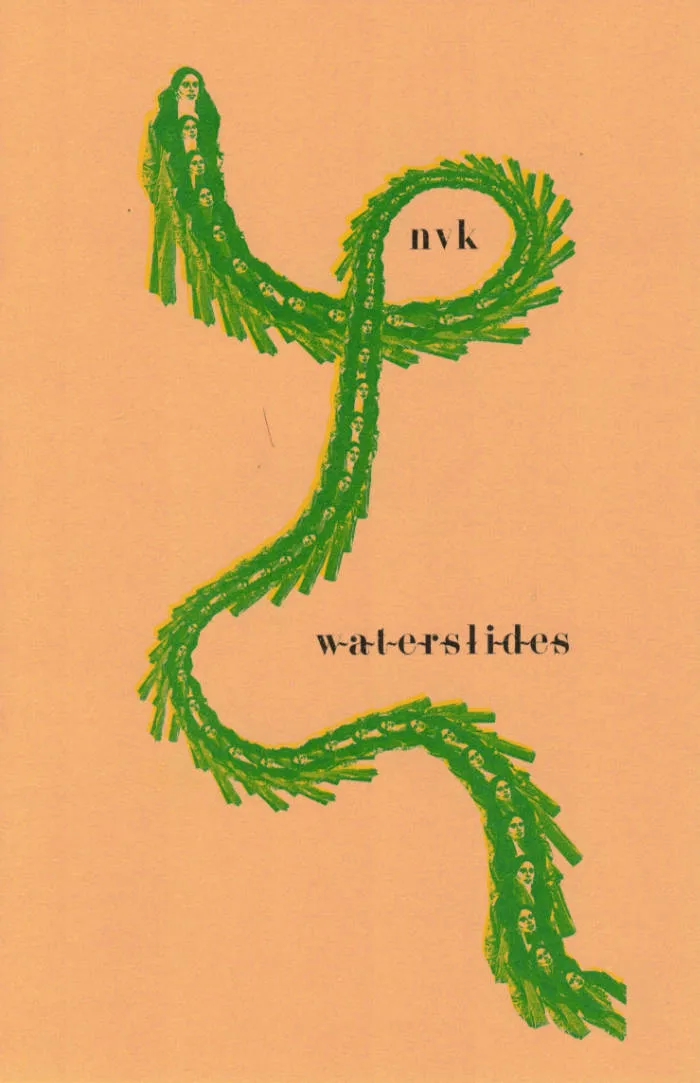
Waterslides
"Waterslides is a falling and plunging, short starts and stops aided by movement, until we splash, climb and plunge again. Each sliding is the same but different—with each descent new expectations and thoughts swirl, shifting focus and gaining new insights or blockages. Waterslides are brief moments of remembering, remembering as a present tense activity, one that happens as we think of it, projected on our now. The waterslide is the moment of past and present working in tandem, a movement of repeating, revisiting and remembering all at once.”
Written by nvk 2021-2023. Dedicated to Judi, MM & TNN.
A version of these poems was published as an audio work through Ignota Press’ The Mountain (2023) and included in a reading with James Loop on Montez Press Radio (2023). nvk would like to thank Jan Matthé, Stine Sampers and Michelangelo Miccolis for their patience & love.
This book was first presented at Kransen in Antwerp, May 6th 2023, with a performance by Sassy (costume by Rosa Schützendorf). Printed and bound at Risiko Press, Borgerhout. Cover image by nvk. Fonts: Adonis, Garamond Pro. Limited to 150 copies.
128x195mm, 16p., stapled, cover: green, yellow and black risoprint on 160gsm caramel paper, inside: black and blue riso on 120gsm Munken Pure paper.

Walking from Scores
An anthology of text and graphic scores to be used while walking, from Fluxus to the critical works of current artists, through the tradition of experimental musicand performance, gathered and presented by Elena Biserna.
Walking from Scores is a hundred or so collection of non site-specific protocols, instructions and textual and graphic scores centred on walking, listening and playing sound in urban environment. It explores the relationship between art and the everyday, the dynamics of sound and listening in various environments and the (porous) frontiers between artists and audiences. It starts with two premises: an interest in walking envisaged as a relational practice and tactic enabling us to read and rewrite space; an interpretation of scores understood as open invitations and catalysers of action in the tradition of Fluxus event scores.
With scores and texts by Peter Ablinger, Milan Adamčiak, G. Douglas Barrett, Elena Biserna, Blank Noise, George Brecht, Cornelius Cardew, Stephen Chase, Giuseppe Chiari, Seth Cluett, Philip Corner, Viv Corringham, Bill Dietz, Amy Dignam, David Dunn, Haytham El-Wardany, Esther Ferrer, Simone Forti, Francesco Gagliardi, Jérôme Giller, Oliver Ginger, Anna & Lawrence Halprin, David Helbich, Dick Higgins, Christopher Hobbs, Jérôme Joy, katrinem, Debbie Kent, Bengt af Klintberg, James Klopfleisch, Milan Knížák, Alison Knowles, Takehisa Kosugi, Jirí Kovanda, Anne Leilehua Lanzilotti, Bob Lens, Ligia Lewis, Alvin Lucier, Walter Marchetti, Larry Miller, iLAND/Jennifer Monson, Max Neuhaus, Alisa Oleva, Pauline Oliveros, Yoko Ono, Open City & Emma Cocker, Nam June Paik, Michael Parsons, Ben Patterson, Cesare Pietroiusti, Mathias Poisson, Anna Raimondo, Pheobe riley Law, Jez riley French, Paul Sharits, Mieko Shiomi, Mark So, Standards, Nicolas Tardy, Davide Tidoni, Ultra-red, Isolde Venrooy, Carole Weber, Manfred Werder, Franziska Windisch, Ben Vautier, La Monte Young.
Elena Biserna is a scholar and independent curator based in Marseille, France. She is associate researcher at PRI SM (AMU / CNRS) and TEAMeD (Université Paris 8). Her interests are focused on listening and on contextual, "situated" art practices in relationship with urban dynamics, sociocultural processes, the public and political sphere. Her writings have appeared in several publications. As a curator, she has collaborated with different organisations and presented her projects internationally.