Fiction
Fiction

Unsex Me Here
If Aurora Mattia is a switchboard operator, then Unsex Me Here is her call log. Please hold. There’s someone on the other line. A spider, a sibyl, an angel, a mermaid, a goddess, or an ex-girlfriend.
Unsex Me Here is a prayer book tied together by the strings of a corset. Glamorous ramblers, haunted by the sense of another world drawing near, wander in and out of its inexplicable twilight. From a West Texas town with a supernatural past to a stalactite cavern in the birthplace of Aphrodite, from hotel rooms to gardens to the far horizon of a thought, they seek the source of the disturbance in their minds. Heartbreak is not so far from rapture; holy babble is another kind of gossip. Every pilgrimage is as dense with symbolism as it is refined by desire.

I Love Shopping
Chickens have a collective soul. Heaven is full of the skateboarders you kissed in middle school. If the algorithm is its own hell, Lauren Cook, author of the critically (and uncritically) acclaimed Sex Goblin, stands in front of it fully armored. I Love Shopping invites its readers to inhabit a world just like ours, reflected through a big, benevolent funhouse mirror.
First published in a limited edition, this is the first trade edition of the cult classic.

hello, world?
Abandoned by their Dutch partner after giving up their home and their job to follow him to the Netherlands, humanities scholar Seasonal finds themself single in a strange place for the first time in a decade.
Dipping into the rabbit hole of digital eroticism, Seasonal soon meets László, a male sub who volleys back their cerebral sexts and is seeking a dominant guide. His dating-app profile—a photo of Foucault and the ingenuous greeting “Hello, World?”—thinly veils his desire to be annihilated. It's a desire that Seasonal senses they can fulfill. But to do this means crossing the frightening gap between their desires and capacities.
Seasonal and László embark on an experiment in remaking intimacy outside the Republic of Gender. But as it continues, the two realize they are staging separate confrontations with domination: Seasonal finds they must confront their own relation to the violence and anger that marked their upbringing in working-class, small-town Australia, while László stages his own confrontation with his decision to leave Viktor Orbán’s Hungary. As they attempt to improvise a theater of domination that opens up possibilities of reciprocity, the energies of their sexuality stalk this collaboration, threatening to give them exactly what they bargained or begged for.
A feminist paean to perversity in the tradition of Pauline Réage’s Story of O and Anaïs Nin's Delta of Venus, Anna Poletti's hello, world? dares to fully inhabit female power, and to fully face the violence, beauty, and uncharted territories of human sexuality.

Sarahland
Sarahland est un ouvrage de fiction américain contemporain qui se découpe en dix nouvelles, toutes reliées par les personnages de Sarahs et leurs parcours initiatiques à la fin de l’adolescence. Sam Cohen, autrice queer et juive, déploie un univers drôle et piquant autour des notions d’identité, de transition, de transformation, d’émancipation et d’apprentissage. Au fil d’histoires inventives, l’autrice explore la manière dont les narratifs qui nous sont assignés, les récits traditionnels, les identités qui nous pré-existent, sont dépassables. Elle construit alors avec ses personnages — presque toutes prénommées Sarah — de nouvelles histoires pour leurs passés ou leurs futurs, de nouvelles façon d’aimer la terre et ceux qui la peuplent, de nouvelles possibilités de vie en soi. Dans le refus pour chaque Sarah d’adhérer à un récit unique et uniformisant, l’autrice propose un lieu potentiellement meilleur pour nous toustes, un espace narratif qui n’exige aucune fixation de soi, aucune injonction consumériste, aucun compromis corporel: un lieu appelé Sarahland.
Née à Detroit aux États-unis, Sam Cohen vit et travaille actuellement à Los Angeles. Elle est une autrice de fiction dont les romans explorent des thèmes à l’intersection du féminisme, des études queers, et des pensées juives. Après avoir publié dans différentes anthologies et revues littéraires (Queer Flora, Fauna, and Funga, Weird Sister Collection, etc.), elle publie en 2021 Sarahland, un recueil de nouvelles. Elle enseigne l’écriture à l’université en tant que professeur d’écriture créative. Elle a été nommée et à gagné à de nombreux prix littéraires, notamment le ALMA Award (Best Jewish Story Collection of 2021), le Jewish Women’s Archive Book List, le Golden Poppy Award in Fiction (finaliste) ou encore le Chautauqua Janus Prize. Elle est en cours d’écriture de son prochain livre.

The Rebound
In The Rebound, a short story by author Natasha Stagg (Surveys, Artless), a young woman takes a work trip in the wake of a humiliating break-up, and agrees to be set up on a blind date...
The erotic works of Anaïs Nin started out as a freelance job. To support their bohemian lifestyles, Nin and her writer friends earned a dollar a page writing pornography for an anonymous client. The writers hated The Collector, as they called him, for his repeated instructions to “Concentrate on sex. Leave out the poetry”.
The Collector, a new series of short stories published by jouissance, seeks to pay homage to writers, like Nin, who explored the erotic, the taboo and the connection between jouissance and the creative process. It also honours their chosen, but much maligned, genre. By commissioning some of our favourite female writers to compose erotic short stories, we begin what we hope will be an ever-growing collection of compelling and provocative fiction that will inspire conversation, debate and further creative expression.
Munken Pure 80gsm paper publication with red Singer Sewn binding. Featuring an illustration by Emma Rose Schwartz.

BRICKS FROM THE KILN #7
Matthew Stuart, Harriet Moore and 1 more
Guest edited by artist Helen Marten and literary agent Harriet Moore with Matthew Stuart, this volume of the journal considers what it means for a publication to be an allegorical container. A simple box in which to gather multiple things, an economical set of permutations — rational in one sense, yet defiantly flexible to move. Contributors were approached with an open invitation; some explored the multiplicities of containing or containers, while others filled the printed vessel with their own ongoing preoccupations. The following pages perform as envelope, bag, shell, net, fold, alarm, letter and instruction. There are holes to disappear within; smoke to knot and wind; shadows to unfold — a context that takes in and binds, finding new kinships from unforeseen proximities.
THE FIRE FLOWERS AND THE FLOWER LIGHTS UP –
Lucy Mercer
(spine)
WE SHALL GREET THE MOON AGAIN
Walter Price
(front cover)
BACK PAGES OF ALGIERS DIARIES 2018
Lydia Ourahmane
(inside front & inside back cover)
AN INTRODUCTION TO / NOTES ON / INSTRUCTION FOR THE FRONT NOVEL
Eliza Barry Callahan
(pp.1–16)
SATURDAY MORNING
Kathryn Scanlan
(pp.25–29)
KILLDEER
Jason Schwartz
(pp.33–38)
ALARMS AND EXCURSIONS
Rosmarie Waldrop
(pp.45–61)
"THE BATHROOM"
Najwa Barakat
(pp.67–76)
ARMY ROLLS, A CIRCUMSCRIPTION
Roy Claire Potter
(pp.81–91)
CONCHOMANIA
Felix Bernstein
(pp.95–109)
O-POEM
Line-Gry Hørup
(pp.113–129)
THIS MUSCLE
Cally Spooner
(pp.133–153)
STERLING PARK IN THE DARK
Susan Howe
(pp.159–179)
COCONUTTERY
Mathelinda Nabugodi
(pp.183–193)
YOUR SELF CONFIDENT BABY
Aurelia Guo
(pp.197–206)
BIOGRAPHY OF A NET: HOLDING A VOLUME
Daisy Hildyard
(pp.211–225)
A GUIDE TO THE POETRY OF LI HO
Eliot Weinberger
(pp.229–235)
WOMEN SMOKING
Charline von Heyl
(throughout & p.239)
INFRATHIN
Marcel Duchamp
(throughout & p.239)
THE MAZED WORLD
Rachael Allen
(bookmark insert)
UNTITLED
Helen Marten
(back cover)
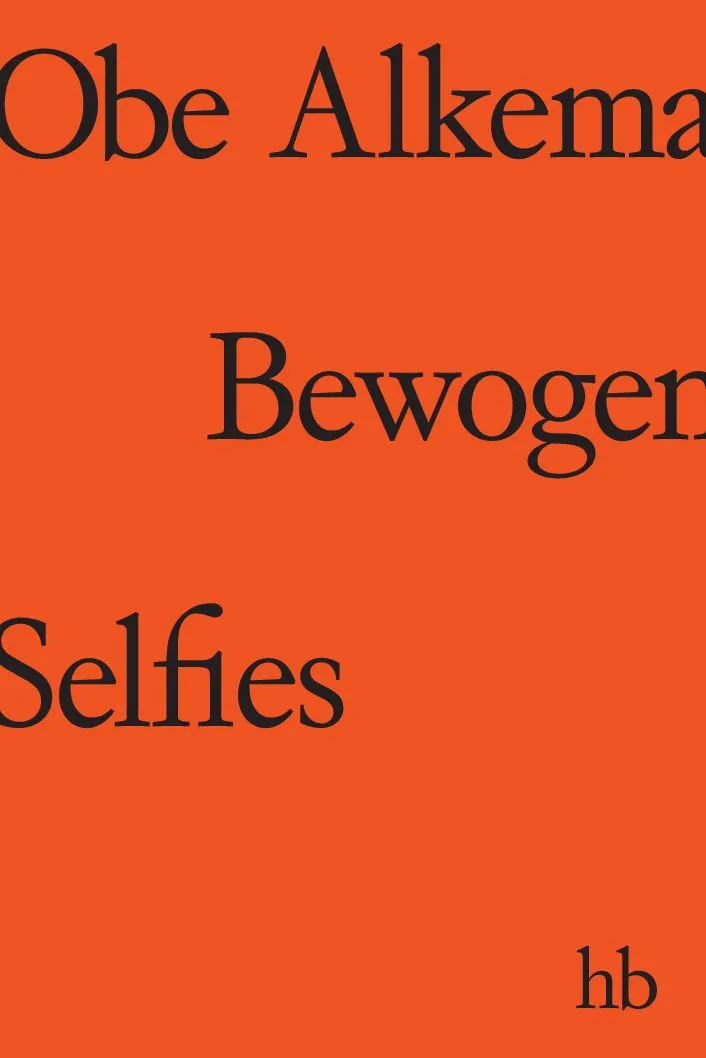
Bewogen selfies
In Bewogen selfies onderzoekt Obe Alkema de verhouding tussen landschap en herinnering. Wat treft hij aan bij terugkeer naar belangrijke plaatsen uit zijn geheugen? Wat herinnert hij zich niet, maar Google wel? Is er een gedenkschrift te puren uit zijn metadata?
Memoires, rechtstreeks verteld en met omwegen, uit eerste hand en van horen zeggen. Archieven en herinneringen eisen spreektijd, houden het niet meer droog of worden tot spreken gebracht. Wat hebben ze eigenlijk te melden? Ze lopen helemaal leeg, net als Alkema zelf. Een leven zoals zovele, poedelnaakt en geretoucheerd, vol zin en onzin.

Mountainish
Zsuzsanna Gahse, Katy Derbyshire
A narrator and her dog are criss-crossing the Swiss Alps. She travels with friends who share her interest in food, languages and their topographical contexts. They collect colours, even look for colourlessness, and develop the idea of a walk-in diary, a vain attempt to archive their observations, encompassing portraits, descriptions and ruminations on mountains, hotels, people, language, food, flora and fauna.
Gradually, other mountains appear in their observations and memories, as do the mountains of literature and art. Mountains may be sites of fear and awe, of narrow-mindedness, racism and ever-looming collapse; Alpine lodges may be places of hospitality, retreat and unexpected encounters; of nature under threat.
In 515 notes, Zsuzsanna Gahse unfolds a finely woven interplay between her six characters while giving us a vivid panorama of mountain worlds, a multi-layered typology of all things mountainish.

Ripcord
A novel about escape and connection, class, sex, and queer intimacy in the American Midwest.
The oldest story: an insider pretends to be an outsider and receives praise for his empathy and imagination and intelligence. Maybe some asshole even says bravery. An outsider pretends to be an insider, is exposed as a fraud, a liar, and burned to the ground.
In Ripcord, Nate Lippens continues his meditations on escape and connection, class, sex, and intimacy. Stuck in Milwaukee, the narrator cobbles together a living by bartending and catering weddings, enmeshed in a semiaffair with a younger, married man. Cruising apps while tallying his youthful romantic failures, he fantasizes about disappearance but finds both solace and frustration in his friendships with Charlie, an aging punk who was prominent in the 1990s Chicago queercore scene, and Greer, a painter who never broke through but continues making work.

Darryl
Darryl Cook is a cuckold, and that’s exactly how he likes it. He has an inheritance that spares him from work, a manageable and seemingly consequence-free drug habit, and a lovely wife called Mindy who’s generally game for anything—and for as much of it as she can get. But after an accidental overdose and some serious oversharing, Darryl’s world begins to crack up. Tormented by what seems to be the secret truth in sex, and less assured of that secret’s form, Darryl steps into what used to be called real life . . . Darryl is a disarmingly funny and unabashedly intelligent look at a community of people parsing masculinity, marriage, sex (and love) on their own terms.
Underneath the sharp satire and hilarious sexual irreverence this is a deadly serious book: a brilliant novel of a seeker, like The Pilgrim’s Progress refracted by queer internet culture. —Torrey Peters
Ess is what I might call a burgeoning cult literary figure, armed with an unmistakable lyric deadpan and a taste for provocative subject matter. — Stephen Ira, Poetry Project
What Darryl is looking for is a crisis of sufficient severity that it will cause him to feel real to himself. — Dominic Fox, Review 31

Passage to the Plaza
In Bab Al-Saha, a quarter of Nablus, Palestine, sits a house of ill repute. In it lives Nuzha, a young woman ostracized from and shamed by her community. When the Intifada breaks out, Nuzha’s abode unexpectedly becomes a sanctuary for those in the quarter: Hussam, an injured resistance fighter; Samar, a university researcher exploring the impact of the Intifada on women’s lives; and Sitt Zakia, the pious midwife.
In the furnace of conflict at the heart of the 1987 Intifada, notions of freedom, love, respectability, nationhood, the rights of women, and Palestinian identity—both among the reluctant residents of the house and the inhabitants of the quarter at large—will be melted and re-forged. Vividly recounted through the eyes of its female protagonists, Passage to the Plaza is a groundbreaking story that shatters the myth of a uniform gendered experience of conflict.

Mahagony
Édouard Glissant’s novels, closely tied to the theories he developed in Poétique de la Relation (Poetics of relation), are rich explorations of a deported and colonized people’s loss of their own history and the ever-evolving social and political effects this sense of groundlessness has caused in Martinique. In Mahagony Glissant identifies both the malaise of and the potential within Martinican society through a powerful collective narrative of geographic identity explored through multiple narrators. These characters’ lives are viewed back and forth over centuries of time and through tales of resistance, linked always by the now-ancient mahogany tree.
Attempting to untangle the collective memory of Martinique, Mathieu, the contemporary narrator, creates a conscious history of these people in that place—a record that unearths the mechanics of misrepresentation to get at the fundamental, enduring truths of that history, perhaps as only the mahogany tree knows it.

Bodies of Sound: Becoming a Feminist Ear
‘I am concerned with the power of sound! and what it can do to the body and the mind,’ wrote composer Pauline Oliveros. In the body, histories and politics come together with sound and listening, memory and feeling. Bodies of Sound offers a resonant exploration of feminist sonic cultures and radical listening in over fifty contributions. In this book of echoes, a variety of forms – from essays to text scores to art, fiction and memoir – speak across gender, ways of knowing, witnessing, sounding and voicing, translation, displacement, violence and peace.
With contributions from:
Sara Ahmed, Ximena Alarcón, Svetlana Alexievich, Ain Bailey & Frances Morgan, Anna Barham, Xenia Benivolski, Leanne Betasamosake Simpson & Kite, Elena Biserna, Karen Barad & Black Quantum Futurism, Anne Bourne, Daniela Cascella, Theresa Hak Kyung Cha, Maria Chávez, Don Mee Choi, Carson Cole Arthur, Petero Kalulé & AM Kanngieser, Lindsay Cooper, Julia Eckhardt, Lucia Farinati & Claudia Firth, Ella Finer, Annie Goh, Louise Gray, Christina Hazboun, Johanna Hedva, Sarah Hennies, Tomoko Hojo, IONE, Lee Ingleton, Hannah Catherine Jones, Christine Sun Kim, Nat Lall, Cathy Lane, Jeanne Lee & Lona Foote, Marysia Lewandowska, Annea Lockwood & Jennifer Lucy Allan, Cannach MacBride, Elaine Mitchener & Hannah Kendall, Alison O'Daniel, Naomi Okabe, Pauline Oliveros, Daphne Oram, Gascia Ouzounian, Holly Pester, Roy Claire Potter, Anna Raimondo, Tara Rodgers, Aura Satz & Barbara London, Shortwave Collective, Sisters of the Order of Celestial Nephology, Sop, Syma Tariq, Marie Thompson, Trinh T. Minh-ha & Stoffel Debuysere, Salomé Voegelin

Vesicapiscis
Vesicapiscis details a poetics of self-reflection / self-projection. What cannot be defined is pulled into the body, examined, dissected, regurgitated. Its form is prodded and rearranged. Every word / phrase / sentence is suseptible to mutation. And these mutations inevtiably proliferate onto the speaker's tongues, their throat, deep into their nervous system. Language is a virus, and as such, it must be studied.
Here we are, at the abyss.

All That's Left to You
"All That's Left to You presents the vivid story of twenty-four hours in the real and remembered lives of a brother and sister living in Gaza and separated from their family. The desert and time emerge as characters as Kanafani speaks through the desert, the brother, and the sister to build the powerful rhythm of the narrative. The Palestinian attachment to land and family, and the sorrow over their loss, are symbolized by the young man's unremitting anger and shame over his sister's sexual disgrace. This collection of stories provides evidence to the English-reading public of Kanafani's position within modern Arabic literature. Not only was he committed to portraying the miseries and aspirations of his people, the Palestinians, in whose cause he died, but he was also an innovator within the extensive world of Arabic fiction.
Ghassan Kanafani was a refugee, a journalist, an editor, and a political activist. First and foremost, though, he was a writer, "a commando who never fired a gun, whose weapon was a ball-point pen," said his obituary in Lebanon's Daily Star. He was born in 1936 in Akka (Acre) and was part of the 1948 exodus from Palestine. A politically active journalist in Beirut during the 1960s, Kanafani was killed in the explosion of his booby-trapped car in July 1972. He is the author of the highly acclaimed novel Men in the Sun and is considered a leading novelist in the Arab world. His works have been translated into 17 languages and published in 20 countries.

Mammoth
Mammoth’s protagonist is a disenchanted young lesbian. She’s inexperienced, irritated by life, eager to gestate, and determined to strip everything else down to essentials. She seduces men at random, swaps her urban habitat for an isolated farmhouse, befriends a shepherd, nurses lambs, battles stray cats, waits tables, cleans house, and dabbles in sex work – all in pursuit of life in the raw. This small bomb of a novel, not remotely pastoral, builds to a howling crescendo of social despair, leaving us at the mercy of Eva Baltasar’s wild voice.

The Book of Disappearance
Alaa is haunted by his grandmother’s memories of being displaced from Jaffa and becoming a refugee in her homeland after the Nakba. Ariel, Alaa’s neighbour and friend, is a liberal Zionist, critical of the military occupation of the West Bank and Gaza yet faithful to the project of Israel. When he wakes up one morning to find that all Palestinians have suddenly vanished, Ariel begins searching for clues to the secret of their collective disappearance.
That search, and Ariel’s reactions to it, intimately reveal the fissures at the heart of the Palestinian question. Between the stories of Alaa and Ariel are the people of Jaffa and Tel Aviv – café patrons, radio commentators, flower-cutters – against whose ordinary lives these fissures and questions play out.
Critically acclaimed in Arabic, spare yet evocative, intensely intelligent in its interplay of perspectives, The Book of Disappearance is an unforgettable glimpse into contemporary Palestine as it grapples with both the memory of loss and the loss of memory.

In Thrall
Dear Miss Maxfeld . . . What I’m really afraid of is that I am a homosexual human being. I wish you were one too but I don’t think it’s possible there could be so many in one school, do you? Probably there is only one person who is homosexual in one place at one time and that one person (I am afraid) is me . . .
After sixteen-year-old Lynn writes her thirty-seven-year-old English teacher a letter they embark on one of the funniest and saddest love affairs in fiction, shrouded in secrecy and guilt. Set in the year Kennedy was shot, all Lynn knows about “lezbos” is that they wear their hair in crew cuts, buy suits like her father’s, and sprout mustaches over their upper lips. Trying to pass, Lynn continues to neck with her boyfriend and make bigoted jokes with her friends. Feigning innocence with her parents, each night she checks the mirror for tell-tale signs of perversion. Profound, witty, poignant, and highly charged, In Thrall is the first in Jane DeLynn’s trilogy of novels on sexuality and authority. It is as believable in its depiction of a closeted teen as it is heartbreaking.
With an introduction by Colm Tóibín
Flawless comic timing. —Colm Tóibín, from the Introduction
All Lynn’s phobias, aversions and hang-ups make her exaggerated but real . . . The great triumph of this novel is that DeLynn has captured the way adolescents felt, talked, and behaved during the early 1960s. —San Francisco Chronicle
A dazzlingly gritty exposure of a girlhood experience usually neglected by both private and public consciousness. —Reba Maybury

To After That (Toaf)
A warm-spirited elegy to an abandoned work, brilliantly comic and wryly contemplative, by one of the great artist-investigators of our time.
Originally published in 2008 in the groundbreaking Atelos series, To After That (TOAF) introduced a new kind of writing—somewhere between criticism and memoir and philosophy—that Renee Gladman has continued to explore in books like Calamities and My Lesbian Novel.
TOAF is a recuperative song, an effort to give space and life to an abandoned project, but it is also, itself, a beautiful meditation on process and distance and duration, and a reminder that time is the subject of any writing.

My Death
A widowed writer begins to work on a biography of a novelist and artist—and soon uncovers bizarre parallels between her life and her subject’s—in this chilling and singularly strange novella by a contemporary master of horror and fantasy.
The narrator of Lisa Tuttle’s uncanny novella is a recent widow, a writer adrift. Not only has she lost her husband, but her muse seems to have deserted her altogether. Her agent summons her to Edinburgh to discuss her next book. What will she tell him? At once the answer comes to she will write the biography of Helen Ralston, best known, if at all, as the subject of W.E. Logan’s much-reproduced painting Circe , and the inspiration for his classic children’s book.
But Ralston was a novelist and artist in her own right, though her writing is no longer in print and her most storied painting too shocking, too powerful—malevolent even—to be shown in public. Over the months that follow, Ralston proves a reluctantly cooperative subject, even as her biographer uncovers eerie resonances between the older woman’s life and her own. Whose biography is she writing, really?

The Seers
The Seers follows the first weeks of a homeless Eritrean refugee in London. Set around a foster home in Kilburn and in the squares of Bloomsbury, where its protagonist Hannah sleeps, the novel grapples with how agency is given to the sexual lives of refugees, insisting that the erotic and intimate side of life is as much a part of someone’s story as ‘land and nations’ are.
Hannah arrives in London with her mother’s diary, containing a disturbing sexual story taking place in Keren, Eritrea, where the Allies defeated the Italians in the Second World War. In a gripping, continuous paragraph, The Seers moves between the present day and the past to explore intergenerational histories and colonial trauma alongside the psychological and erotic lives of its characters as their identities are shaped, but refused to be suppressed, by the bureaucratic processes of the UK asylum system.
Sulaiman Addonia is an Eritrean-Ethiopian-British novelist. He spent his early life in a refugee camp in Sudan, and his early teens in Jeddah, Saudi Arabia. He arrived in London as an underage unaccompanied refugee without a word of English and went on to earn an MA in Development Studies from SOAS and a BSc in Economics from UCL. His first novel, The Consequences of Love (Chatto & Windus, 2008), was shortlisted for the Commonwealth Writers’ Prize and was translated into more than 20 languages. His second novel, Silence is My Mother Tongue (Indigo Press, 2019; Graywolf, 2020), was a Finalist for the Lambda Literary Awards 2021, the Firecracker (CLMP) Awards, the inaugural African Literary Award from The Museum of the African Diaspora (MoAD) in San Francisco, and longlisted for the 2019 Orwell Prize for Fiction. Addonia’s essays appear in LitHub, Granta, Freeman’s, The New York Times, De Standaard and Passa Porta. He is a contributor to Tales of Two Planets (Penguin, 2020) and Addis Ababa Noir (Akashic Books, 2020).

Prairie, Dresses, Art, Other
In Prairie, Dresses, Art, Other Danielle Dutton imagines new models for how literature might work in our fractured times. Dutton’s writing is as protean as it is beguiling, using the different styles and different spaces of experience to create a collage of the depths and strangeness of contemporary life.
This hybrid literary collection covers an inventive selection of subjects in four eponymous sections which contrast and echo one another, challenging our expectations and pushing the limits of the dream-like worlds and moods that language might create.
‘Danielle Dutton is a writer whose work I wait for. When a new book comes, I keep it very close… Her growing body of work is among the most formally inventive (and therefore essential) I can think of, and Prairie, Dresses, Art, Other is a vital, enlivening addition to it.’ – Kate Briggs
Danielle Dutton is the author of the novels Margaret the First and SPRAWL, the prose collection Attempts at a Life, the illustrated nonfiction chapbook A Picture Held Us Captive, and she wrote the text interpolations for Richard Kraft’s Here Comes Kitty: A Comic Opera. Her fiction has appeared in magazines and journals including The New Yorker, The Paris Review, The White Review, Harper’s, BOMB, and NOON. Dutton teaches at Washington University in St. Louis and is cofounder and editor of the award-winning feminist press Dorothy, a publishing project. Born and raised in California, she has lived on the (former) prairie now for roughly twenty years.

I will pay to make it bigger
You wake up in the footwell of a mid-sized hatchback somewhere on a highway in outer Bangkok. You compile neurotic spreadsheets of the best ‘party destinations’ in Europe, whilst your work emails pile up without ever being read. You quit your job. You launch a banal start-up. You grieve for a past relationship. You stare endlessly at the waves coming in from a beach in Koh Pha Ngan. You vape intensely. You spend money on feelings, on the performance of your own persona, whilst you observe yourself with a detached sense of horror.
i will pay to make it bigger is a novella, by poet and artist Ahren Warner, in which ‘you’ are the main character. Through text and image – autofiction, docufiction, and just plain fiction – you work your way through a tangle of preoccupations: from what it means to buy enjoyment, to the fragile construction of your own self as a cultural product.
i will pay to make it bigger is also a photobook, a collection of images produced whilst living in Thai ‘party hostels’. Although these photographs might seem to exist as the documentation of intimate or ecstatic moments, they are in fact quite painstakingly, and artificially, constructed: composited and manipulated from multiple still frames of film footage to produce images that advertise the calculated artifice of their own hedonism, emotion and seemingly raw experience.
With a Coda by Hana K. Ohnewehr, commissioned by Yu’an Huang

My Lesbian Novel
The latest in writer and visual artist Renee Gladman's ever-expanding body of imaginative investigation is a sui generis novel of queerness and art-making, philosophy and sex.
The narrator of My Lesbian Novel is Renee Gladman, an artist and writer who has produced the same acclaimed body of experimental art and prose as real-life Renee Gladman, and who is now being interviewed by an unnamed interlocutor about a project in process, a seeming departure from her other works, a lesbian romance.
Between reflections on art making and on the genre of lesbian romance - "though aspects of the formula drive me crazy... people who write these stories understand how beautiful women are" - a romance novel of her own takes shape on the page, written alongside the interview, which sometimes skips whole years between questions, so that time and aging become part of the process.
The result is a beautifully orchestrated dialogue between reflection and desire, or clarity and confusion, between the pleasures of form and the pleasures of freedom in the unspooling of sentences over time.
Renee Gladman is a writer and artist preoccupied with crossings, thresholds, and geographies as they play out at the intersections of poetry, prose, drawing, and architecture. She is the author of fourteen published works, including a cycle of novels about the city-state Ravicka and its inhabitants, the Ravickians, all published by Dorothy— Event Factory, The Ravickians, Ana Patova Crosses a Bridge, and Houses of Ravicka. She has been awarded fellowships, artist grants, and residencies from the Radcliffe Institute for Advanced Study at Harvard, Foundation for Contemporary Arts, the Lannan Foundation, and KW Institute for Contemporary Art (Berlin), and was a 2021 Windham-Campbell Prize winner in fiction. She makes her home in New England with poet-ceremonialist Danielle Vogel.