Fiction
Fiction

Wretched Strangers
In response to surges of violent British nationalism and political paranoia around borders, and to related social and ethical crises, JT Welsch and Ágnes Lehóczky have assembled an anthology to mark the vital contribution of non-UK-born writers to this country’s poetry culture. Wretched Strangers brings together innovative writing from around the globe, celebrating the irreducible diversity such work brings to ‘British’ poetry. While documenting the challenges faced by writers from elsewhere, these pieces offer hopeful re-conceptions of ‘shared foreignness’ as Lila Matsumoto describes it, and the ‘peculiar state of exiled human,’ in Fawzi Karim’s words.
The book is published by Boiler House Press to commemorate the anniversary of the June 2016 EU Referendum and in solidarity through struggles ongoing and to come. Proceeds will be donated to charities fighting for the rights of refugees.
Alireza Abiz • Astrid Alben • Tim Atkins • Andre Bagoo • Veronica Barnsley • Khairani Barokka • Leire Barrera-Medrano • Katherine E. Bash • Áine Belton • Caroline Bergvall • Sujata Bhatt • Rachel Blau DuPlessis • Fióna Bolger • Ben Borek • Andrea Brady • Serena Braida • Wilson Bueno • James Byrne • Kimberly Campanello • J.R. Carpenter • Mary Jean Chan • che • Matthew Cheeseman • Iris Colomb • Giovanna Coppola • Anne Laure Coxam • Sara Crangle • Emily Critchley • Ailbhe Darcy • Nia Davies • Tim Dooley • Benjamin Dorey • Angelina D’Roza • Katherine Ebury • Dan Eltringham • Ruth Fainlight • Kit Fan • León Felipe • Alicia Fernández • Veronica Fibisan • Steven J Fowler • Livia Franchini • Ulli Freer • Anastasia Freygang • Kit Fryatt • Monika Genova • Geoff Gilbert • Peter Gizzi • Chris Gutkind • Cory Hanafin • Edmund Hardy • David Herd • Jeff Hilson • Áilbhe Hines • Alex Houen • Anthony Howell • Nasser Hussain • Zainab Ismail • Maria Jastrzębska • Lisa Jeschke • Evan Jones • Loma Sylvana Jones • Maria Kardel • Fawzi Karim • Kapka Kassabova • Özgecan Kesici • Mimi Khalvati • Robert Kiely • Michael Kindellan • Igor Klikovac • Ágnes Lehóczky • Éireann Lorsung • Patrick Loughnane • John McAuliffe • Aodán McCardle • Niall McDevitt • Luke McMullan • Christodoulos Makris • Ethel Maqeda • Lila Matsumoto • Luna Montenegro • Stephen Mooney • Ghazal Mosadeq • Erín Moure • Vivek Narayanan • Cristina Navazo-Eguía Newton • Alice Notley • Terry O’Connor • Wanda O’Connor • Gizem Okulu • Claire Orchard • Daniele Pantano • Astra Papachristodoulou • Fani Papageorgiou • Richard Parker • Sandeep Parmar • Albert Pellicer • Pascale Petit • Adam Piette • Jèssica Pujol Duran • Alonso Quesada • Ariadne Radi Cor • Nat Raha • Nisha Ramayya • Peter Robinson • William Rowe • Lisa Samuels • Jaya Savige • Ana Seferovic • Sophie Seita • Seni Seneviratne • Timea Sipos • Zoë Skoulding • Irene Solà • Samuel Solomon • Agnieszka Studzinska • James Sutherland-Smith • George Szirtes • Rebecca Tamás • Harriet Tarlo • Shirin Teifouri • Virna Teixeira • David Toms • Sara Torres • Kinga Toth • Claire Trévien • David Troupes • Arto Vaun • Juha Virtanen • J. T. Welsch • David Wheatley • Elżbieta Wójcik-Leese • Jennifer Wong • Isaac Xubín • Jane Yeh

Ferrara Deux (Faits Divers)
faits divers are the various reports in a news bulletin, miscellaneous human interest stories, theorised by Roland Barthes as ‘total’ and ‘immanent’ information.
ferrara deux (faits divers) scrolls around the discovered corpse of a talented street musician named Landau, mangled and sealed into vacuum bags in the walk-in of a modern Italian-American restaurant. Street performance is content for an attention economy, playing on authenticities and profiting from recognition.
In this debut novel, artist Ivan Cheng reconfigures recent performance texts into an approximation of a murder mystery.

a queer anthology of wilderness
Featuring Zoe Leonard, Eileen Myles, Jimmy DeSana, Princess Julia, Olivia Laing, Simon Costin, Timothy Thornton, Mary Manning and many more. Published 2020.
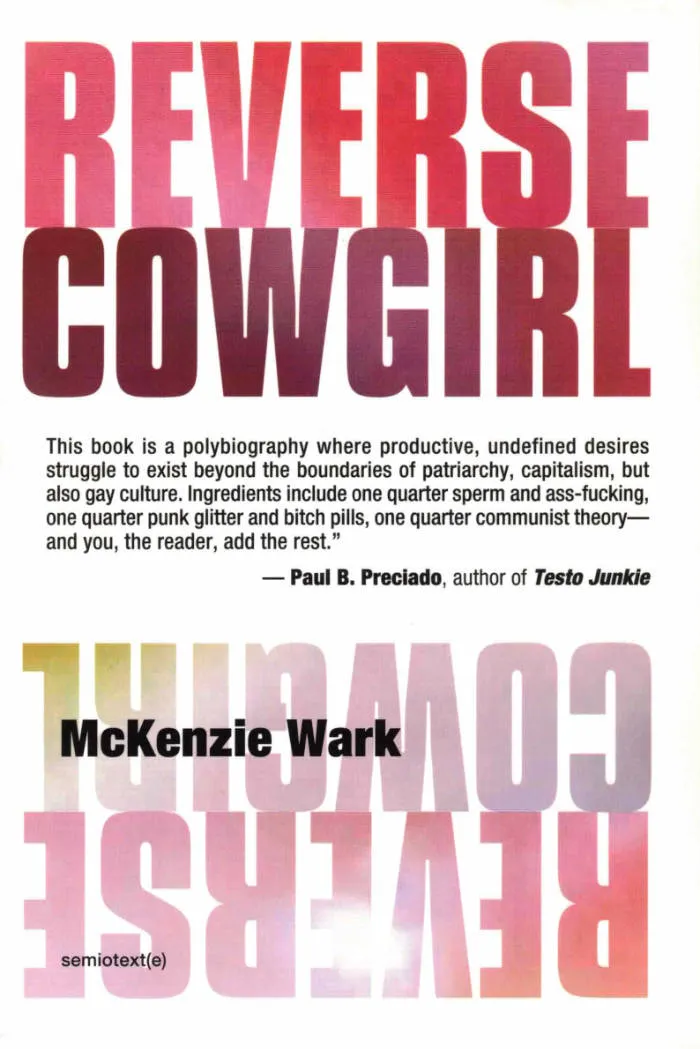
Reverse Cowgirl
McKenzie Wark invents a new genre for another gender: not a memoir but an auto-ethnography of the opacity of the self.
Another genre for another gender.
What if you were trans and didn't know it? What if there were some hole in your life and you didn't even know it was there? What if you went through life not knowing why you only felt at home in your body at peak moments of drugs and sex? What if you expended your days avoiding an absence, a hole in being? Reverse Cowgirl is not exactly a memoir. The author doesn't, in the end, have any answers as to who she really is or was, although maybe she figures out what she could become.
Traveling from Sydney in the 1980s to New York today, Reverse Cowgirl is a comedy of errors, chronicling the author's failed attempts at being gay and at being straight across the shifting political and media landscapes of the late twentieth century. Finding that the established narratives of being transgender don't seem to apply to her, Wark borrows from the genres of autofiction, fictocriticism, and new narrative to create a writing practice that can discover the form of a life outside existing accounts of trans experience: an auto-ethnography of the opacity of the self.

The Hundreds
Kathleen Stewart, Laurent Berlant
In The Hundreds Lauren Berlant and Kathleen Stewart speculate on writing, affect, politics, and attention to processes of world-making.
The experiment of the one hundred word constraint, each piece is one hundred or multiples of one hundred words long, amplifies the resonance of things that are happening in atmospheres, rhythms of encounter, and scenes that shift the social and conceptual ground.
What's an encounter with anything once it's seen as an incitement to composition? What's a concept or a theory if they're no longer seen as a truth effect, but a training in absorption, attention, and framing?
The Hundreds includes four indexes in which Andrew Causey, Susan Lepselter, Fred Moten, and Stephen Muecke each respond with their own compositional, conceptual, and formal staging of the worlds of the book.

Night Philosophy
Night Philosophy is collected around the figure of the child, the figure of the child not just as a little person under the tutelage of adults, but also the submerged one, who knows, who is without power, who doesn’t matter. The book proposes a minor politics that disperses all concentrations of power. Fanny Howe chronicles the weak and persistent, those who never assimilate at the cost of having another group to dominate. She explores the dynamics of the child as victim in a desensitized era, when transgression is the zeitgeist and the victim–perpetrator model controls citizens.
With an afterword by Chris Kraus.

Artificial Gut Feeling
If winning can only occur in a competition between equal opponents, someone who isn’t equal will need to adopt a different strategy and let go of the promise, or the curse, of victory. Anna Zett takes up the challenge in this collection of personal science fiction, registering the traces systems of power leave in the body, in its locomotory, nervous and digestive systems. Zett’s voice appears in several textual guises, addressing authority, resistance, trauma and the physicality of language. Dedicated to the feminist revolution, the post-socialist subject of Artificial Gut Feeling questions logocentric and capitalist beliefs about the economy of meaning. This book gathers together fists, guts and brains to gain a deeper understanding of the non-verbal roots of dialogue.
"This being is able to transform movement into speech. It winds itself about inside me like a thick snake and I have to use all my strength to let it spin and do what it does. When I wilfully try to stop it, it begins to whisper words to me and that is even more unpleasant. If I were to associate this gut feeling with an emotion, I would say disgust. But this disgust is not directly linked to your name."—Anna Zett

Mother Reader
'My aim for Mother Reader has been to bring together examples of the best writing on motherhood of the last sixty years, writing that tells firsthand of the mother's experience.
Many of the writings in Mother Reader comment on and interpolate one another, in citations, in footnotes, in direct homage. As I was assembling this collection one text would lead to one another, treasure-hunt fashion, the clue provided by an acknowledgement or bibliography. And just as often the writing circles back.
In Mother Reader chapters are excerpted from autobiographies, memoirs, and novels; entries are lifted from diaries; essays and stories are culled from collections, anthologies, and periodicals. My project has been to assemble a compendium or sampler of these ''kindred spirit'' works on motherhood, so that readers, and especially mothers with limited time on their hands, can access in one volume the best literature on the subject and know where turn to continue reading." [Moyra Davey in the introduction]
Writings by Margaret Atwood, Susan Bee, Rosellen Brown, Myrel Chernick, Lydia Davis, Buchi Emeta, Annie Ernaux, Mary Gaitskill, Susan Griffin, Nancy Hutson, Mary Kelly, Jane Lazarre, Ursula K. Le Guin, Doris Lessing, Ellen McMahon, Margaret Mead, Vivian Montgomery, Toni Morrison, Tillie Olsen, Alicia Ostrker, Grace Paley, Sylvia Plath, Adrienne Rich, Sara Ruddick, Lynda Schor, Mira Schor, Dena Schottenkirk, Mona Simpson, Elizabeth Smart, Joan Snyder, Elke Solomon, Susan Rubin Suleiman, Alice Walker, Joy Williams, Martha Wilson, Barbara Zucker.