Facsimile & Reprints
Facsimile & Reprints

La Maison des Maladies
Unica Zürn, Ruth Henry and 1 more
Unica Zürn dans La maison des maladies raconte, par un ensemble de textes et dessins, un séjour en hôpital où elle est soignée d’une jaunisse. Elle y écrit et compose ce carnet où le regard qu’elle pose sur son propre corps, les lieux qu’elle habite et les personnages qu’elle rencontre, témoigne d’une sensibilité hors-norme qui tire à la fantaisie, voire au délire.
Pour la première fois en France, La maison des maladies est publié intégralement.
Le texte est traduit de l’allemand par Ruth Henry & Robert Valençay. Un après-propos de Mathilde Girard clôture le livre.
CUNY Center for the Humanities
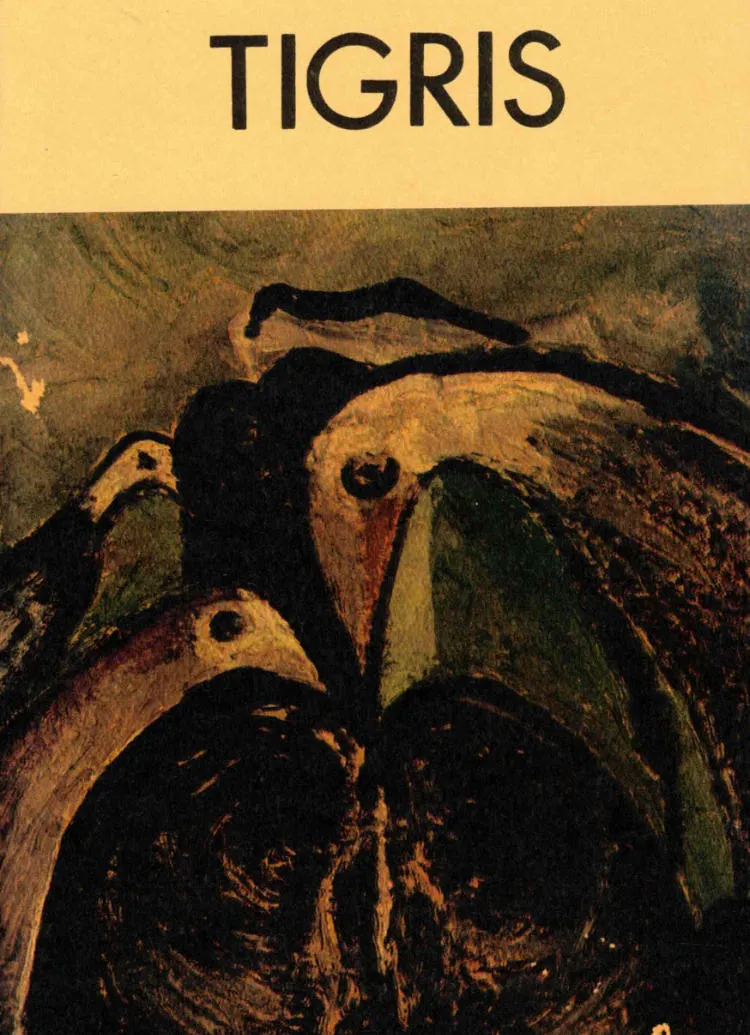
Tigris Vol. 1
In 1971, the great Iraqi poet Sargon Boulus (1944-2007) published a single issue of an English-language literary anthology that he called Tigris. The magazine—a whisper on the literary landscape that appeared three years after Boulus’s arrival in the US—brings together work by Boulus and several of his literary friends, in translation by Boulus and Etel Adnan.
Tigris was not an end in itself, but rather a temporary solution to the lifelong problem of how to devote oneself to poetry across different countries, eras, and styles: how to live poetry. Yet, in so doing, the small anthology includes significant work: Etel Adnan’s “Jebu,” translated by Adnan, and poetry by Boulus, Fouad Rifkah, Yusuf al-Khal, Mouayad al-Rawi, and Riadh Fakhouri, all in Boulus’s translations, as well as a work by Ankido, a “street-activist poet-café worker of importance to the Palestinian Liberation Movement.”

Efemmera Reissue #7: Cassandra Radical Feminist Nurses Newsletter
A reissue of the 1982 inaugural Cassandra Radical Feminist Nurses Newsletter: founding members explain their interests, intentions, and goals, and invite other nurses to join them.
Introductory text by Peggy Chinn, founding member, and also co-author of Peace & Power: A Handbook of Feminist Process.
The Alder & Frankia Efemmera Reissue series amplifies, graphically reinterprets, and shares historic feminist ephemera. What ideas, strategies, and tactics from the past can we inherit to bring forth a feminist future?

Terminal Boundaries and A natural water course diverted reduced or displaced
Made in 1969 but never published, Terminal Boundaries is an artist book by Lawrence Weiner, a sculptor whose medium was language. The manuscript for the publication, which was recently brought to light, contains two related bodies of work represented as typewritten statements on paper that Weiner pasted to the pages of a small composition notebook. The book’s absence from Weiner’s oeuvre plagued him as it marked a terminus of his relationship to the physical construction of his artworks, and illustrated the principle of “specific” and “general” which he applied to his art.
Created from a standard notebook purchased in a stationery store, the manuscript is two books in one: Terminal Boundaries and A natural watercourse diverted reduced or displaced. A tête-bêche with two front covers, the book can begin from either cover by turning it upside down.
Weiner was a traveler by nature and the materials he refers to in these works are those that one can encounter on a road trip. The artist was traveling across Europe when this manuscript was composed. Struck by the tumultuous times and the critical illuminations about the climate from the Club of Rome discussions, the works in this book are in Weiner’s words, “concerned with the relationship of natural resources in relation to human beings.” Distinct from his contemporaries associated with the Land Art movement, in Terminal Boundaries and A natural water course diverted reduced or displaced, Weiner constructs his landscape interventions in language—the specific and/or general act and the location are stated—offering the reader/viewer the opportunity to consider each work’s existence, to build it in their mind’s eye. One can only wonder what Weiner did to divert, reduce, or displace a natural water course in Saltsrumen, Norway, the location of the world’s strongest maelstrom, or in nearby Bodø at the site of Svartisen glacier. A work in Terminal Boundaries titled The joining of France Germany and Switzerland by rope demonstrates the geopolitical perspective of Weiner’s land art. Requiring physical and mental borders to be transgressed in performing this work; how and where could this happen?
Terminal Boundaries finds Weiner just off the cusp of his decision to make art that lived centered in language, emphasizing the viewer’s responsibility to engage with it to make it whole. The book marks a crucial inflection point in the artist’s practice, defining his direction to make work that “attempts to present something to people that is not just about me,” but about materials and the world we find ourselves in here and now.

fierce pussy
This eponymously titled publication by fierce pussy brings together thirty-nine of the legendary art collective’s posters, from works made in the urgent early days of the AIDS crisis to present-day advocacy for Queer and Trans rights. In keeping with fierce pussy’s activism in public spaces, the publication is designed to allow readers to tear out any of the posters to share, wheatpaste, scan, photocopy, and distribute or to easily open the book to any page to hang it on a wall. Combining calls for political and social action, proud reclamations of derogatory language, and pointed questions, the posters in fierce pussy address pressing sociopolitical issues in the group’s distinctive voice.
Emerging during a decade steeped in the AIDS crisis and LGBTQ+ activism, fierce pussy brought Queer identity directly into the streets in a manner characterized by the urgency of those years. In recent years they have expanded to also present their work in galleries and museums, while continuing to intervene in the public space, always working with an economy of means and a collective ethos of inclusion and solidarity.
This publication was originally published by Printed Matter in 2008 to coincide with a retrospective exhibition of the collective’s work. This new expanded edition includes twenty-five additional posters.
fierce pussy is an art collective formed in New York City in 1991. Originally composed of a fluid and often-shifting cadre of dykes, the collective was active through 1994. In 2008, the four core founding members Nancy Brooks Brody (1962–2023), Joy Episalla, Zoe Leonard, and Carrie Yamaoka began working together again. Adamantly low-tech and low-budget, fierce pussy has always relied on modest resources: old typewriters, found photographs, and their own baby pictures. In the early days, much of the work was produced using materials and resources they had on hand and the equipment at their day jobs. This publication exemplifies the ethos of the group—to share their work and messaging with the masses.
Managing Editor: Jules Spector
Designers: Garrick Gott and Bryce Wilner

Bird Watching and Their First Three Books of Poetry
Any future film director planning to make a movie of Myles's iconic novel Chelsea Girls (it's always just about to happen) would be wise to read Bird Watching first. Written in 1978 and unpublished until now, the central character of the book is a twenty-something that is already filled with memories. Living in New York City, resplendent, full of both grandeur and awkwardness, they are about to embark on a life fully invested in art. Bliss happens, as does uncertainty. Everything is here and now.
The Irony of the Leash, A Fresh Young Voice from the Plains, and Sappho's Boat, the other collections contained in the volume, comprise the first three books that Myles published, when their promise as one of the most important writers of their generation was just coming into view. Immensely readable, raw, and slightly unhinged, the poetry that comprises these three texts is post young. Slight creaky but fully functional, all of these poems are beautiful and funky.Bird Watching and Their First Three Books of Poetry contains a critical foreword by poet and scholar Rosa Campbell, along with a preface by Eileen Myles contextualizing the book within our contemporary moment.
Eileen Myles (them/them, b. 1949) is a poet, novelist and art journalist whose practice of vernacular first-person writing has made them one of the most recognized writers around town (globally). They live in New York & in Marfa, TX.

CUNY Center for the Humanities
“This Great River”—Translating the Beats into Arabic
Sargon Boulus, Khaled al-Hilli
The Great River—Translating the Beats into Arabic traces the literary encounters of Sargon Boulus (1944-2007), an Iraqi poet who was part of the vibrant literary scene of late 60’s San Francisco. His life was marked by a period of restless traveling, that he would later describe as an attempt to pursue a poetic imaginary. This project continues to map his proximity to the Beat poets, his short-lived Bay Area poetry journal, Tigris, and his other English language publications.
This publication includes a facsimile reproduction of Tigris, featuring a long poem “Jebu” by Boulus’ good friend Etel Adnan.

ESDS Archives 3 : Pascal Doury - carnet inédit c.97-99
Facsimilé d'un carnet inédit de Pascal Doury réalisé par Jonas Delaborde (Der Vierte Pförtner Verlag) et co-produit par les Editions l'Amazone, réalisé dans le cadre de la publication des Archives Elles Sont de Sortie suite à la parution de Choquer le monde à mort. Elles Sont de sortie. Bruno Richard - Pascal Doury.

The Stuart Sherman Papers
This collection of poetry, prose, and other texts is the first publication dedicated to the writing of the late performance, video, and visual artist Stuart Sherman.
The Stuart Sherman Papers presents a selection of facsimile reproductions from his archive at New York University's Fales Library. This collection of entries is not exhaustive but conveys the diversity in Sherman’s writing, which used the ever-expanding vocabulary of the English language as a plastic material to study the abundance of meaning that can be derived through playing with combinations, order, and proximity of words. The texts reproduced here leave his edits, scribbles, and notes to self intact, presenting the page as Sherman last engaged with it.
With text contributions by Sally Banes, Mark Bradford, Michiel Huijben, and Nicholas Martin. Photographs by Nathaniel Tileston and Paolo Rapalino.
Editor: Michiel Huijben
Graphic design: Loes Verstappen
Copy editing: Harriet Foyster
Lithography: Marc Gijzen
Stuart Sherman (1945–2001) was a New York-based artist best known for his performances and video, but working in a variety of visual and literary media. He performed, exhibited, and lectured throughout the United States, Europe, and Asia. Sherman died of AIDS in San Francisco in September 2001.

Contextures
Linda Goode Bryant, Marcy S. Philips
Contextures was originally published in 1978 by New York City’s legendary Just Above Midtown gallery. Edited by gallery founder Linda Goode Bryant and Marcy S. Philips, the publication provides an extensive history of Black artists working in abstraction from 1945 to 1978, while also articulating a newly-emerging movement of Black Conceptual Art in the 1970s.
The publication contains extensive writing by Goode Bryant and Philips drawn from interviews with the featured artists, as well as 58 black-and-white and 16 color images documenting the work of 25 artists: Banerjee, Frank Bowling, Donna Byars, Ed Clark, Houston Conwill, John Dowell, Mel Edwards, Wendy Ward Ehlers, Fred Eversley, Susan Fitzsimmons, Sam Gilliam, Gini Hamilton, David Hammons, Manuel Hughes, Suzanne Jackson, Noah Jemison, James Little, Al Loving, Senga Nengudi, Howardena Pindell, Betye Saar, Raymond Saunders, Sharon Sutton, Randy Williams, and William T. Williams. A newly commissioned afterword by Thomas (T.) Jean Lax, curator of the exhibition Just Above Midtown: Changing Spaces at the Museum of Modern Art, is also included.
Goode Bryant and Philips originally conceived Contextures to accompany The Afro-American Artists in the Abstract Continuum of American Art: 1945–1977. Functioning more like a textbook than a traditional catalog, the book nonetheless realizes a vital mission of their curatorial vision, placing Black artists within the still-prevalent, white-dominated canon of post-war abstract art. Despite its historical importance and visionary scholarship, Contextures was originally produced in a limited run of just a few hundred copies by the gallery and remains rare and largely unknown.
This new edition is produced in facsimile form and is a co-publication with Pacific.

Primetime Contemporary Art: Art by the Gala Committee as Seen on Melrose Place
A facsimile of the GALA Committee's mock auction catalog for an artistic intervention into the props and plots of Melrose Place.
Originally published in a limited run in 1998, Primetime Contemporary Art documented In the Name of the Place, a radical two-year intervention by a group of artists, initiated by Mel Chin and known as the GALA Committee, on the primetime television show Melrose Place. This extremely rare artist's book is reproduced for the first time as a facsimile edition.
The artists comprising the GALA Committee worked with the producers of Melrose Place to develop a series of political works that were used as props and plot devices across two seasons of the show, providing surreptitious commentary on reproductive rights, HIV/AIDS, the Gulf War, domestic terrorism, corporate malfeasance and substance abuse. Some of these topics were banned by the FCC at the time, and the group's works allowed for the artists and the show to create political commentary that went unnoticed by censors. The artworks they produced were exhibited at the Los Angeles Museum of Contemporary Art in 1997 and then sold at an auction at Sotheby's to support several charities. Primetime Contemporary Art was created by Mel Chin and Helen Nagge as a mock auction catalog documenting the artwork made for the show and the conceptual framework of the GALA Committee.

Greer Lankton: Sketchbook, September 1977
A fascinating account of Lankton's inquisitive, sociological and emotional ruminations in advance of her gender-affirming surgery.
This is one of the earliest of Greer Lankton's (1958-96) journals, sketchbooks and daybooks to appear in the artist's archives, and the first to be published in facsimile form. Written during her time as an art student at the School of the Art Institute of Chicago, the journal offers key insights into Lankton's mind at work before her career-defining move to New York in 1978, where she would become an important figure of the East Village art scene in the 1980s and early '90s with her lifelike dolls and theatrical sets.
Containing drawings, behavioral diagrams and aspirational, occasionally confessional writing, the journal is a record of imagining the body and mind reconciled through transformation. In these pages, the 19-year-old turns an inquisitive, sociological eye toward the emotional landscape and somatic effects of the days recorded here; days leading up to her decision to undergo hormone treatment and gender-affirming surgery in 1979. Lankton reflects with raw vulnerability and keen self-awareness on critical questions of self-image, social perception, gender normativity and human behavior.

Black Phoenix: Third World Perspectives on Contemporary Art and Culture
Facsimile compilation of the late-'70s journal on diasporic and colonial histories that paved the way for the British Black Arts Movement.
Published in three issues between 1978 and 1979, Black Phoenix: Journal of Contemporary Art & Culture in the Third World (the subtitle was changed to Third World Perspectives on Contemporary Art and Culture for its second and third issues) stands as a key document of its time. More than a decade after '60s liberation movements and the historic Bandung and Tricontinental Conferences that called for social and political alignment and solidarity to dismantle Western imperialism and (neo)colonialism, Black Phoenix issued a rallying call for the formation of a Third World, liberatory arts and culture movement on the eve of Margaret Thatcher's election in 1979.
Based in the UK, and both international and national in scope, Black Phoenix positioned diasporic and colonial histories at the center of an evolving anti-racist and anti-imperialist consciousness in late 1970s Britain—one that would yield complex and nuanced discourses on race, class and postcolonial theory in England in the decade that followed.
A precursor to the British Black Arts Movement that formed in 1982 (which encompassed such cultural practitioners as the Black Audio Film Collective and cultural studies theorist Stuart Hall), Black Phoenix proposed a horizon for Blackness beyond racial binaries, across the Third World and the colonized of the interior in the West.
This single-volume facsimile reprint gathers all three issues of the journal, which include contributions by art critics, scholars, artists, poets and writers, including editors Rasheed Araaen and Mahmood Jamal, Guy Brett, Kenneth Coutts-Smith, Ariel Dorfman, Eduardo Galeano, N. Kilele, Babatunde Lawal, David Medalla, Ayyub Malik, Susil Sirivardana and Chris Wanjala.

Piero Heliczer. Poems & Documents / Poèmes & Documents
Sophie Vinet, Benjamin Thorel and 1 more
Poet, editor, filmmaker, actor, child star in Mussolini’s Italy, founder of The Dead Language Press and of the Paris Filmmakers Cooperative, Piero Heliczer (1937–1993) was an essential yet secret agent of the 1960s and ’70s counterculture. In the course of his nomadic existence in Rome, New York, London, Amsterdam, Paris, and Préaux-du-Perche, where he spent the last few years of his life, he met and worked with a constellation of avant-garde writers, forged friendships with figures from the Beat Generation and the British Poetry Revival as well as the New York art scene. At the crossroads of many underground experiences, Heliczer’s name appears in books dedicated to the artists and poets he collaborated with during his lifetime—names by the likes of Gregory Corso, Barbara Rubin, Andy Warhol, Jack Smith, Ira Cohen, or The Velvet Underground, a band he participated in creating with his friend Angus MacLise.
This myth obscures the fact that Piero Heliczer was first and foremost a poet. Today, this part of his work is overlooked; it is all the more difficult to encounter because Heliczer himself never collected it. So it was scattered, or lost, in the course of his wanderings. Heliczer favored the circulation of his works rather than their archiving: he was committed to the production of mobile forms—flyers, broadsides, and other ephemera—disseminated his verses in magazines, and preferred public readings and performances to the finished form of the book.
The present volume gathers a significant number of Heliczer’s poetic works through facsimile reproduction of his contributions to more than thirty periodicals—mostly stemming from poets’ presses or universities—published between 1958 and 1979. This collection isn’t “complete”—but it makes available again poems that, in some cases, never circulated after their initial publication.
Un recueil de poèmes de Piero Heliczer (1937–1993), auteur, éditeur et cinéaste, figure de l’underground et de la contre-culture, proche de Andy Warhol, Gerard Malanga, et Jack Smith. Sa poésie, héritière de la Beat Generation, restitue en métaphores et images saisissantes des expériences et des visions personnelles, tout en s’appuyant sur des formes héritées de la tradition anglaise et des partis-pris typographiques originaux. Ce recueil rassemble des facsimilés des publications originales de poèmes de Heliczer – périodiques d’artistes, revues miméographiées, petits magazines… – accompagnées de leurs traductions en français, ainsi que de plusieurs documents, parmi lesquels une reproduction intégrale d’une publication rare de 1961, Wednesday Paper, et, en insert, un facsimilé d’un placard de 1975, The Handsome Policeman.
Traduction des poèmes: Rachel Valinsky
Publié avec l’aide du CNAP