Art
Art

Sad Sack
Sad Sack is a book of collected writing by Sophia Al-Maria, taking feminist inspiration from Ursula K. Le Guin’s 1986 essay ‘The Carrier Bag Theory of Fiction’; opposing ‘the linear, progressive, Time’s-(killing)-arrow mode of the Techno-Heroic.’ Encompassing more than a decade of work, Sad Sack tracks Al-Maria’s speculative journey as a writer, from the first seed of her ‘premature’ memoir, through the coining and subsequent critique of ‘Gulf Futurism’, towards experiments in gathering, containing, welling up and sucking dry.
For me this book is a bag... Like any single-use carrier bag – I disapprove. It shouldn’t exist, it contributes to pollution, it should be banned... And yet, in spite of the fact I know this book may be a waste product... I’m still writing, redacting, expanding... I’m still waiting, wasting, wanting. According to Ursula, ‘It is a human thing to do to put something you want, because it’s useful, edible, or beautiful, into a bag.' – Sophia Al-Maria

All the Stories
They recite all the stories of the world in a loud voice. When they're done, all the stories, all time and all places will have passed through their lips...’ With the minimum of instructions and a restricted format of four lines, Dora García’s collaborative and participatory project has now collected over 2,500 stories. Ranging from mundane to the extraordinary, these four line vignettes reveal the shared fears and fantasies of the contributors, the pervasiveness of popular culture and the possibilities of the imagination.

Being Together Precedes Being
Being Together Precedes Being offers a text book for the project “The Kids Want Communism,” which was initiated towards the 99th anniversary of the Soviet Revolution of October 1917 as a series of exhibitions, symposiums and conferences, screening programs, publications and a summer camp. In this textbook, communism does not merely describe an “us versus them” relation, but also offers that we are becoming the future. This trajectory of communism runs parallel to us at every single moment and its guiding principle is that being together precedes being.

Scripts

We are behind
Presented as the blueprints for three public lectures, We are behind proposes alternative routes through Emily Wardill’s work and represents three different attempts at embodying and dissembling knowledge. Using different formal textual devices, from which they also deviate – a standard lecture, the subject of which becomes something felt, not taught; an a-chronological conversation; and the transcript of a play rendered as a formal essay – each section describes the different facets of an ongoing dialogue between the authors. Fragmented not only by dialogic turns, appropriated texts, images, a score and quotations, and containing extensive reproductions of Wardill’s work, the book’s content and design reflects the labyrinthine, and sometimes hallucinogenic quality of her films and their radical combination of form, content and idea.
Each section focuses on specific works. Section One, The Object, uses The Diamond (Descartes Daughter), SEA OAK, and Gamekeepers without Game, to explore ideas of the rational, public art, the public, linguistic framing and the irrational, via Gladys Knight and the Pips, a hand-drawn hallucinogenic section, Seth Price’s essay Dispersion, Norman Mailer, The Rockridge Institute and Peter Gidal. Section Two, The Window follows a conversations between the authors, that opens onto desire, politics, mirrors, and the films Basking in what feels like ‘An Ocean of Grace’ I soon realise that I am not looking at it but rather, I AM it, recognising myself, Split the View in Two (Part Two), and Sick Serena and Dregs and Wreck and Wreck. In the final part, The Theatre, an apparently formal essay on the implications of framing live action, the proscenium arch as a link between theatre and cinema, Dan Graham, perspective, power and its collapse, transforms into a collection of dialogues around Ben, Sick Serena and Dregs and Wreck and Wreck, authenticity, reality and fiction.
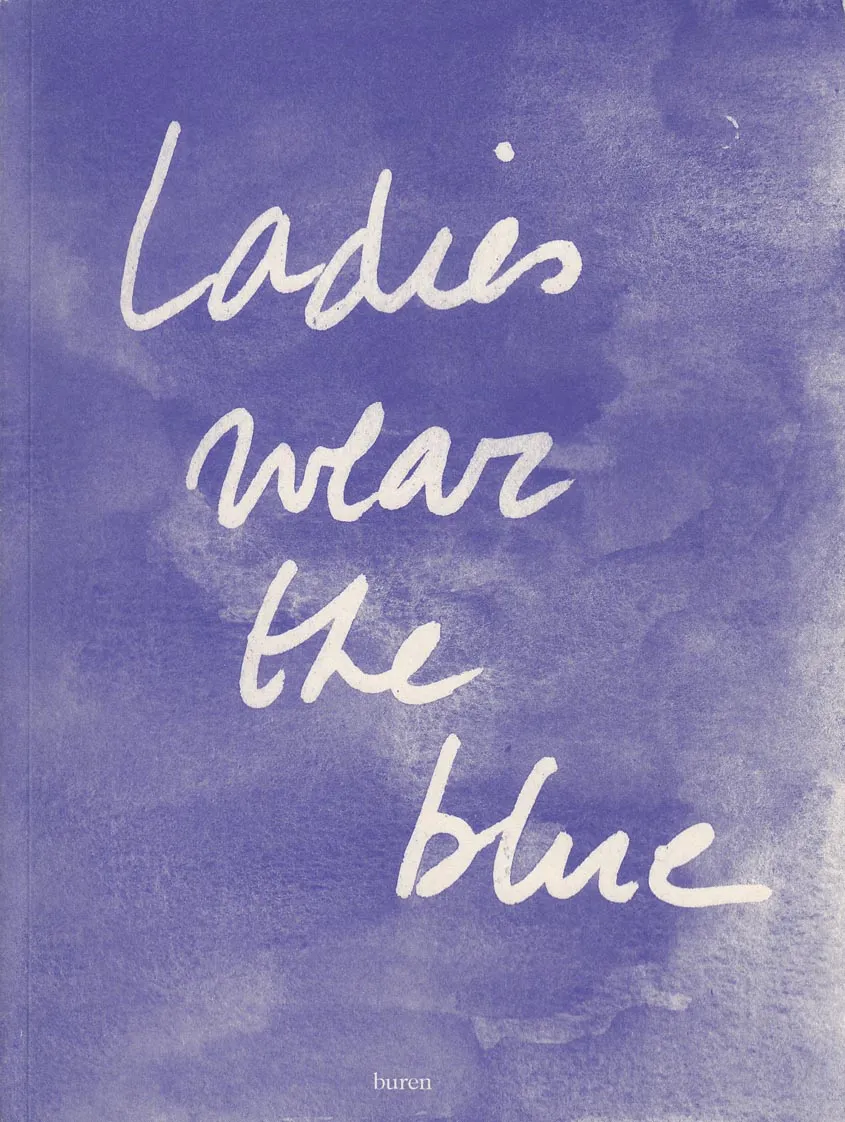
Ladies Wear the Blue
Ladies wear the blue is a collection of watercolour drawings by the hand of Melissa Mabesoone and Oshin Albrecht. The blue watercolours portray women from different moments in time. The adjacent texts describe these women's existence, roles, desires or ideosyncrasies deriving from the 'blue' in their lives. From the first female police officers and Alices all around, to Courtney Love's blue baby dolls and the girl with the blue tattoo Olive Oatman, this publication is an ode to women venturing into the world, and a way to continue telling their herstories.

Skinned Detouched
Skinned and Detouched, a pair of artists books, are a portal to a single performative stage in the industrial production of two large scale sculptures, one of which is on show at Large Glass. The books, including writing by Jennifer Boyd, photography by Thierry Bal and design by Europa, imaginatively document the multiple embodiments and disembodiments involved in one moment in the production of the two works.


Sleep is the Lover I fear
Sleep is the lover I fear is a translation of the work Das ›Nein‹ scheint für den Traum nicht zu existieren into the 2-dimensional space of printing in the format of a typographic score, taking shape as a long folded leporello,. The work is a close observation of the visual and sonic qualities a text can have by itself. Through arrainging text fragments from Freud’s Traumdeutung as well as feminist science-fiction I create an onomatopoetic language-landscape, that explres ideas around physicality, sleep, dreams and desire.

Living in the Future

How to Sleep Faster 1
How to Sleep Faster is published as part of the collaborative discussion that form the critical direction of the gallery. and sits alongside the first two exhibitions – Sleep Faster (February), and How to Carve Totem Poles (March). It has been put together as an open ended continuation of this dialogue through which we seek to understand the contradictions / complexities that define and form our experience, existence and participation in a contemporary digital-analogue creative environment.
Arcadia Missa Publications; Rozsa Farkas, Tom Clark, Jammie Nicholas, Laura Farley (eds).

The Art Issue
Sinister Wisdom 73: The Art Issue documents the lives of Lesbians through their artwork. This issue contains drawings, paintings, quilts, sculptures, and photographs done by Lesbian artists.
Creative Work By
Sierra Lonepine Briano
Dean Brittingham
Lynn Brown
Cathy Cade
Lenore Chinn
Karen Cooper
Tee A. Corinne
Jan Couvillon
Max Dashu
Fran Day
Francine
Tina Friemuth
Kim Fusch
Diane Germain
Marjorie Greenhut
Morgan Gwenwald
Virginia Harris
And More!