rile*books

Search books

Search books by title, author, publisher, keywords...

Cover of The Art Issue

Sinister Wisdom

The Art Issue

Sinister Wisdom

€7.00

Sinister Wisdom 73: The Art Issue documents the lives of Lesbians through their artwork. This issue contains drawings, paintings, quilts, sculptures, and photographs done by Lesbian artists.

Creative Work By

Sierra Lonepine Briano
Dean Brittingham
Lynn Brown
Cathy Cade
Lenore Chinn
Karen Cooper
Tee A. Corinne
Jan Couvillon
Max Dashu
Fran Day
Francine
Tina Friemuth
Kim Fusch
Diane Germain
Marjorie Greenhut
Morgan Gwenwald
Virginia Harris

And More!

Language: English

recommendations

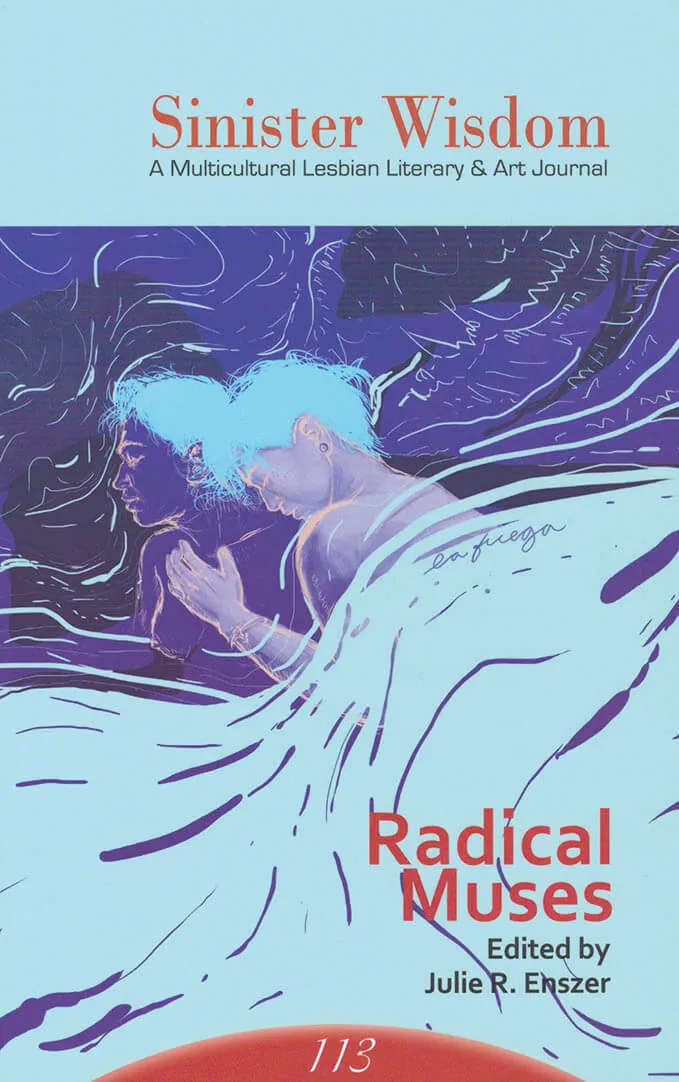
Cover of Radical Muses (Sinister Wisdom nr. 113)

Sinister Wisdom

Radical Muses (Sinister Wisdom nr. 113)

Julie R. Enszer

Sinister Wisdom 113: Radical Muses features an eclectic array of contemporary poetry, prose, and art by lesbians from around the world, including new work by: Andrea Assaf, Tara Shea Burke, Cheryl Clarke, Marina Chirkova, Estela González, Barbara Haas, Nancy E. Lake, Vi Khi Nao, H. Ní Aódagaín and much more!

Cover of Cunt Coloring Book

Last Gasp

Cunt Coloring Book

Tee A. Corinne

Over three dozen c**ts of every size and description for you to color. Originally used for a sex-education class. Crayons not included. First published in 1975 by lesbian activist and artist Tee Corinne.

"In 1973 I set out to do drawings of women’s genitals for use in sex education groups. I wanted the drawings to be lovely and informative, to give pleasure and affirmation. I organized the drawings into a coloring book because a major way we learn to understand the world, as children, is by coloring. As adults many of us still need to learn about our external sexual anatomy." —Tee Corinne

Tee Corinne was born November 3rd, 1943 and grew up in St. Petersburg, Florida. Her mother, also an artist, introduced her to the creative principles and techniques that would serve her all her life. She received a B.A. in printmaking and painting from the University of South Florida, then went on to get an M.F.A. in drawing and sculpture at Pratt Institute, graduating in 1968. Afterwards she taught for many years, traveled through Europe, and finally became enmeshed in the back-to-the-land movement and communal living. After nearly ten years of marriage to a man she referred to as her "best friend," Corinne came out of the closet amidst severe depression in 1975. The strength to accomplish this difficult effort would later propel her to heights and achievements that would distinguish her as "one of the most visible and accessible lesbian artists in the world." From the mid-1960’s to the day she died Corinne created, published, and exhibited her art and writing around the world. She was a co-facilitator of the Feminist Photography Ovulars and a co-founder of The Blatant Image, A Magazine of Feminist Photography. She was the author of one novel, three collections of short stories, four books of poetry and numerous arts publications. In 1980, she was one of ten selected artists invited to have their work exhibited in the Great American Lesbian Art Show. The world lost Tee Corinne to cancer in 2006.

Cover of Celebrating the Michigan Womyn's Music Festival

Sinister Wisdom

Celebrating the Michigan Womyn's Music Festival

Sinister Wisdom

Sinister Wisdom 103: Celebrating the Michigan Womyn's Music Festival honors the forty-year legacy of the Michigan Womyn’s Music Festival (1976–2015). Sinister Wisdom 103: Celebrating the Michigan Womyn's Music Festival celebrates this embodiment of radical feminist separatist collaboration, transformational self-defined autonomous spaces, a commitment to sisterhood and matriarchal culture, and a musical city sprung from the earth for one week in the woods.

A collective of five womyn each with a deep connection to Fest operated by consensus to create this issue. Striving to represent a range of womyn’s voices, values, traditions, and experiences of Fest, the collective highlighted what Fest has meant to generations of womyn, documented its chronology, and bore witness to the power of this community. Sinister Wisdom 103: Celebrating the Michigan Womyn's Music Festival includes womyn from multiple races, geographies, sexualities, generations, and gender and other social identities. Just as Fest brought together womyn from various backgrounds, our collection includes a range of artistic experience, from seasoned authors and photographers to those womyn new to publishing.
Sinister Wisdom 103: Celebrating the Michigan Womyn's Music Festival remembers the transformations, possibilities, and hopes for spaces cultivating the ongoing empowerment of womyn.

Cover of HOOT nr. 9 — Moyra Davey & Sophie T. Lvoff

GUFO

HOOT nr. 9 — Moyra Davey & Sophie T. Lvoff

Sophie T. Lvoff, Moyra Davey

Periodicals €12.00

The 9th HOOT pops up for the winter 2022-23, but the conception of this issue started well over a year ago at our beloved Plage Avant (Traduttore, traditore’s studio, Marseille). 

We met Sophie T. Lvoff at many openings and art related events in Marseille these last few years, having a practice that appears mainly as photography, Gufo got curious about all the processes that she uses which involve sound, installation, writing… and more. She welcomed us in her studio of the city of Marseille where she recently settled.

We found out about the “trompe-l’œil” of this iconic checkered table, witnessed the installations of translucid and colored objects evolving on the sunny wall, and looked through her photographic chamber it’s called a large-format camera, but this is funny… For this issue, Sophie suggested to interview another artist, Moyra Davey, who also works in photography and writing, and appeared to have shared experiences too.

The topics of everyday life, intimacy that images embody in both their works, take another dimension as soon as their thoughts, voices and writing expand and express the entirety of their gestures.

This issue is the first interview between two native English-speaking artists, who have ties to the French language from childhood.

The penpals are the main characters of that encounter where we are very welcome to join in their very generous conversations. This is only an excerpt of a long and well referenced correspondence.

Cover of Mousse #94

Mousse Publishing

Mousse #94

Periodicals €16.00

Petrit Halilaj and Danh Vo in conversation; Forensic Architecture (Eyal Weizman, Nour Abuzaid, and Elizabeth Breiner); Gabrielle Goliath; Edward W. Said; Shumon Basar; Dani Blanga Gubbay; Yvonne Rainer; Thomas Eggerer and Jochen Klein; Tobias Pils; Travis Jeppesen...

Collective intelligence (along with its wildly popular counterpart, brain rot) is a recurring subject of late. This issue is woven together through reflections on methodologies of the collective, larger-than-ourselves dynamics and "what goes unuttered (of, perhaps, what is painfully unutterable)," as Zoé Samudzi writes about Gabrielle Goliath—whose project for the South African pavilion at the upcoming Venice Biennale has been cancelled by the Arts and Culture Minister of her country for being "divisive." We stand in solidarity with the artist. Forensic Architecture's Eyal Weizman speaks of new ways of detecting "hyper-relations" as strategies to confront systemic violence. Edward W. Said, in his crucial 1993 essay "Speaking Truth to Power" (reprinted here), argues that "the intellectual's voice is lonely, but it has resonance because it associates itself freely with [. . .] the common pursuit of a shared ideal." And in our Curators section, Shumon Basar memetically reaffirms that now more than ever, "Comment is king."
Let's not shy away from commenting.

This issue comes with different covers, randomly distributed.

Cover of HOOT nr. 3 — Kamilé Krasauskaité

GUFO

HOOT nr. 3 — Kamilé Krasauskaité

Gufo, Clément Faydit and 1 more

Last year, on a summer night in Marseille, someone, within all the hungry people I am meeting during my dinners, specifically set her attention on my projects. Later during the fall I received a call from Austė ZDANČIŪTĖ, the cultural attache at the Lithuanian embassy in France, who introduced me to Kamilè Krasauskaitè. Since that fall, we kept on exchanging and making future plans in France where she would have a residency. The more we chatted, the closest we began. Kamilè is a almost-thirty-years-old Lithuanian artist that has been including sourdough bread in her work and builds a poetic and mesmerising world around that dimension of food, fermentation, senses, environment, rituals...Through our communication I decided to share that encounter that we managed to welcome in Marseille. We kneaded some bread together, shared it in a forest of Marseillais sunflowers, walked the streets, met people, questioned and compared artists' lives in Europe. This issue might be an excerpt of all the long conversations we had, it was hot and sunny in Marseille, it was in June.

Cover of a queer anthology of wilderness

Pilot Press

a queer anthology of wilderness

Richard Porter

Periodicals €15.00

Featuring Zoe Leonard, Eileen Myles, Jimmy DeSana, Princess Julia, Olivia Laing, Simon Costin, Timothy Thornton, Mary Manning and many more. Published 2020.

Cover of Parapraxis 05: Economies

Parapraxis

Parapraxis 05: Economies

Periodicals €25.00

Like Freud’s prototypical baby, we struggle over whether to keep our body together or to give it away. We all live these scenes of bodily loss. Freud and Marx both sing harmoniously: what we give up, we give under duress. We are not easy with what we’ve been tasked with, but the task has been the same since birth, doubled in the name of emancipation: first, there’s nothing less than to survive alienation and exploitation, then there’s staying alive for one another’s sake. Perhaps the storied antagonism between Freud and Marx turns on the difficulty of holding these tasks together, balanced on the knife’s edge that separates self-interest from collective liberation.

Capitalism does not produce itself all alone, no matter its disciplines and political-economic constraints on the reproduction of society. If Marx taught us anything, it’s that capitalism produces its own gravediggers, the proletariat—“the unreason of reason,” he quipped, where the dominant social order encounters its unconscious element. Through the bad exchange of capitalism comes a gothic reversal, from preconscious life to premature death, where workers end up burying themselves instead of the system that provides the grave plot. That exchange is felt internally, in a rift that cleaves open the self. Freud, for his part, helps us describe how political economy hammers our lives into unreasonable and reasonable shapes, imaginary and real, as countless and heterogeneous as the individual faces in a collective mass. For each and for all, we bring psychoanalysis to bear on the political-economic problems we suffer in common.

King Ketamine. Beyond the vibecession. Austere Mothers. Sick at Work. Money, Feces, Babies, Gifts. Essays by Juliana Spahr, Peter Coviello, Nicolás Medina Mora, Jyoti Rao, and Hannah Proctor. Images of Red Vienna from Wilhelm Reich’s camera, dispatches from Lebanon, and more.