rile*books

Search books

Search books by title, author, publisher, keywords...

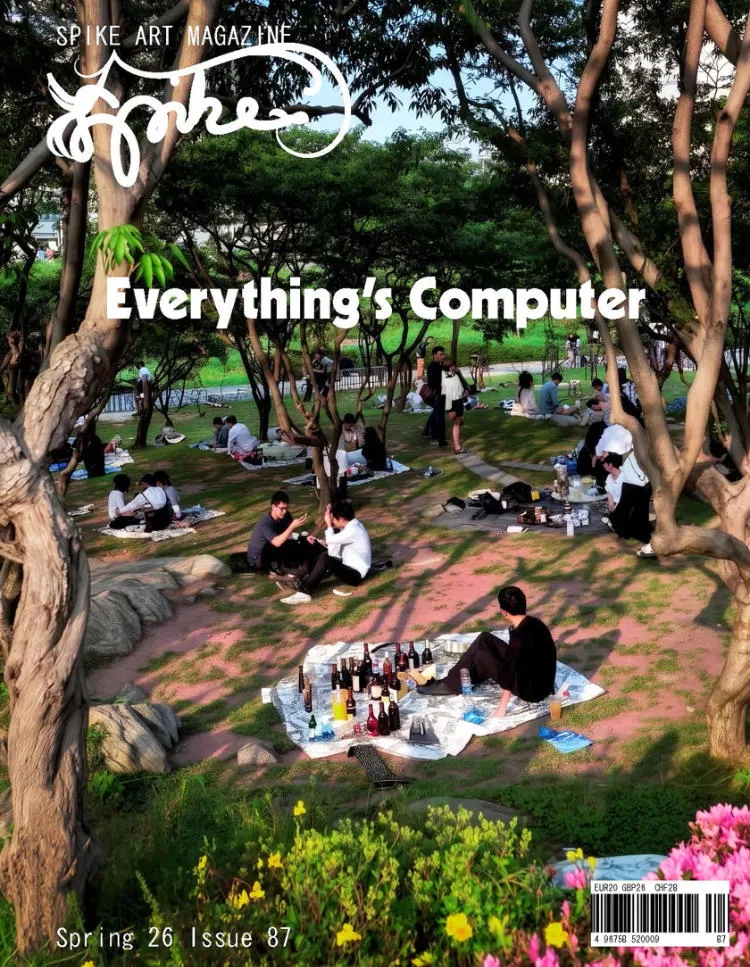
Cover of Spike #87 – Everything's Computer

Spike Magazine

Spike #87 – Everything's Computer

€20.00

Art in the digital age. 

Go on, admit it. There's no longer a meaningful distinction between "real life" and life online, up to and including sitting around in the park. So why shouldn't art reflect the furious, melancholic, psychedelic sensation that, even when we make our screens dark, we've all been permanently logged on? A new era deserves new aesthetics, but also fables, values, and protocols. Everything is interwoven. Everything's computer.

Featuring Brian Droitcour on lore and NFTs; Marek Poliks & Roberto Alonso Trillo on exocapitalism; the godmother of internet girlhood, Ann Hirsch; locating the tech-feminist to tech-fascist spectrum with Anan Fries; Anika Meier on the post-artist; a visual essay by Ruba Al-Sweel & Al Hassan Elwan (POSTPOSTPOST); a defense of useless images by Gideon Jacobs; the second life of memes by Dena Yago; a prophecy of a neo-oral age by Günseli Yalcinkaya; a primer on internet cinema with Dana Dawud; Gary Zhexi Zhang's guide to Shenzhen, "China's Silicon Valley"; and the never-miss backpage from Tea Hačić-Vlahović: "Underground communities prevail against odds. Like rats and nuclear bombs." Plus! Our new lifestyle section, LIFEMAXXING.

Published in 2026 ┊ 160 pages ┊ Language: English

recommendations

Cover of Spike #86 – Salad Days!

Spike Magazine

Spike #86 – Salad Days!

Periodicals €20.00

Spike #86 is turning to the wild season of youth – life’s Salad Days.

Forget all the Boomer panic about a generational crisis; the kids are alright, living out our hyperconnected present to its strangest limits. New kinds of aesthetics, of activism, of entrepreneurship; new images as much as new perspectives on what images are; and, above all, a new, very quantum attitude towards fact and fiction, history and the future: young people are modeling how to be in our very confused times – and producing some of the most interesting forms of culture we’ve ever seen.

Featuring a Zoomer’s guide to the Slopgeneration; an essay of on being young at art in the Instagram age; a rundown of contemporary art’s nepo babies; reality checks on culture’s obsessions with youth and dying young; portraits of couture-sculptor Tenant of Culture, Turner Prize-nominated photographer Rene Matić, e-waste sculptor Brian Oakes, and Austrian painter Lukas Posch; send-ups of teenage fiction’s ecstatic weirdness and youth-quakers’ political promise; a critique from Silicon Valley of the industrialization of young risk-taking; art’s perfect Los Angeles metaphor; and a splash of back-page advice: “You shouldn’t be fun at twenty-one. You should be tortured.” 

Cover of Exocapitalism – Economies with absolutely no limits

becoming press

Exocapitalism – Economies with absolutely no limits

Roberto Alonso Trillo, Marek Poliks

Essays €16.00

A rigorous and mind-blowing account of the dynamics of capitalism today through an in-depth exposition of software, speculative finance, and the highest scales of arbitrage.

At the centre of Marek Poliks and Roberto Alonso Trillo's argument is the idea that capital does not belong to humans, it belongs to—and is governed by—itself. Traditional economic theory struggles to keep up with the rapid rate of acceleration, and this book steps in to address this:

"The critical orthodoxy is slowing; it's tired, it's not especially good at the internet, it's probably never manned a Starbucks counter or an anonymous cubicle. Its younger adepts—though digitally native—are chronically underemployed, unavailable, drowning in the student debt (or student opportunity cost) required for entry into the critical apparatus. Few have any patience for the numbing slop-speak of the LinkedIn economy, the libertarian enclave of forex and HFT and memecoins, the quarter-zip depravity of employment at the charnel houses of McKinsey or Deloitte or Accenture, the blazingly random mood-swings of venture capital that lubricate all of the above. This impatience is—in the parlance of the above—a blocker: it means that the critical apparatus underestimates the power of the software economy, struggles to articulate the morphological density of digitally-realized capitalism, comprehensively ignores the functional death of labor, and doesn't understand scale."

Introduction by Charles Mudede.
Afterword by Alex Quicho.

"A masterpiece... Nick Land for adults."
— 0nty

Cover of Viscose 01: Style

Viscose Journal

Viscose 01: Style

Jeppe Ugelvig

Periodicals €35.00

The very first issue of Viscose tackles the expansive notion of “style”. Both a noun and a verb, style can be understood as the most basic unit or currency of fashion. Style names the very movement of aesthetics in society, and thus holds an important place in the critique of art and visual culture more broadly.

As a verb, it connotes a tactic: a dynamic tool for persuasion and communication through the bricolage of signifiers. It also relates directly to the contemporary profession of “styling”; a practice native to the fashion industry, but increasingly prevalent across the arts, media, consumerism, and politics. Thiss issue of Viscose sets out to critically gesture to all of these connotations and their potential intermingling through concrete case studies and cross disciplinary philosophical speculation.

with contributions by:
Shanzhai Lyric, David Lieske, Bakri Bakhit, Dena Yago, Matthew Linde, Burke Battelle & Ada O’Higgins, Davide Stucchi, Taylore Scarabelli, Mahoro Seward, Jordan Richman, Giorgi Gago Gagoshidze, Hito Steyerl, & Milos Trakilović, Laura Gardner, Avena Gallagher, Alex Esculapio, Elise by Olsen and Jeppe Ugelvig

Cover of Image RIP: After Printing, Work & Planet Earth

Source Type

Image RIP: After Printing, Work & Planet Earth

Geoff Han

Image RIP, the first publication from Source Type, is centered around New York graphic designer Geoff Han’s investigation into the Shenzen-based printer Artron and explores subjects ranging from design, production, work, and the environment in the post-industrial economy. The book gathers essays by Danielle Aubert, David Bennewith, Geoff Han, Ming Lin, Shanzhai Lyric, David Reinfurt, Mindy Seu, and Dena Yago, and features images by Ann Woo. Image RIP reflects a consistent theme in Han’s practice of the manipulation of image reproduction, printing, production, code, and other techniques to affect the process of viewing and reading.

Cover of Viscose 02: Clothes

Viscose Journal

Viscose 02: Clothes

Jeppe Ugelvig

Periodicals €35.00

Issue 2 inverts issue 1’s focus on the immaterial notion of style to instead explore the most material of fashion’s building blocks: clothes Clothes are literally everywhere and cite complicated systems of production, distribution, and exchange on their paths around the world. Still, they never fully reveal their journey or destination, and may often signify little else than their own commodity status, the total genericness of the fashion product.

Bringing together a wide range of artists, thinkers, and writers, the issue sets out to explore clothes as a signifier at once empty and over-burdened: as expressions of desires, people and places, as palimpsests for capitalist production cycles and histories of dressed bodies, and even, as nondescript material debris. While not necessarily foregoing an analysis of the fashion system, we hope to develop a form of fashion criticism that begins – and perhaps ends – with the single garment, that takes the everyday use of clothing objects as an intellectual starting point.

What knowledge can we gather from the studying of fashion objects, be they material or immaterial? What is the difference between clothes and fashion? And to which extent is even “fashion” ever successfully signified by things?

with contributions by:
Shanzhai Lyric, David Lieske, Bakri Bakhit, Dena Yago, Matthew Linde, Burke Battelle & Ada O’Higgins, Davide Stucchi, Taylore Scarabelli, Mahoro Seward, Jordan Richman, Giorgi Gago Gagoshidze, Hito Steyerl, & Milos Trakilović, Laura Gardner, Avena Gallagher, Alex Esculapio, Elise by Olsen and Jeppe Ugelvig

Cover of Le Chauffage #3 - Day Job

Le Chauffage

Le Chauffage #3 - Day Job

Francesca Percival, Felix Rapp and 1 more

Periodicals €20.00

The third issue of Le Chauffage is an inquiry into the relationship between the practices of artists/ writers and their day jobs. This subject stems from a question fundamental to the existing mandate of Le Chauffage: 'how do you keep warm?' and subsequently, 'how do you pay the bills?' As these perennial concerns occupy our everyday lives, we ask artists/writers to consider the influence that their day jobs, side hustles, creative or non- creative forms of employment have on their respective practices.

This issue tries to account for the significant ways in which complex economic realities come to shape the art we produce, look at, and discuss. How do we deal with limited time and resources? How do we reclaim and steal time back? How do our day jobs shape and influence what we make? How do we subvert the means of production of the workplace? Can the constraint of a day job also be a way to alleviate the pressure of professionalising?

With contributions by Daniel Bozhkov, Nathan Crompton Pippa Garner, Chauncey Hare Marisa Kriangwiwat Holmes, Garrett Lockhart, Jannis Marwitz Reba Maybury, Tiziana La Melia, Dan Miller, Ragen Moss, Jean Luc Moulène, Jean Katambayi Mukendi Paul Niedermayer, Sophie Nys, Megan Plunkett, Chris Reinecke, Jacquelyn Zong Li Ross On Gabrielle L Hirondelle Hill Margaux Schwarz, Eleanor Ivory Weber James Welling, Werker, The Wig.

Cover of HOOT nr. 3 — Kamilé Krasauskaité

GUFO

HOOT nr. 3 — Kamilé Krasauskaité

Gufo, Clément Faydit and 1 more

Last year, on a summer night in Marseille, someone, within all the hungry people I am meeting during my dinners, specifically set her attention on my projects. Later during the fall I received a call from Austė ZDANČIŪTĖ, the cultural attache at the Lithuanian embassy in France, who introduced me to Kamilè Krasauskaitè. Since that fall, we kept on exchanging and making future plans in France where she would have a residency. The more we chatted, the closest we began. Kamilè is a almost-thirty-years-old Lithuanian artist that has been including sourdough bread in her work and builds a poetic and mesmerising world around that dimension of food, fermentation, senses, environment, rituals...Through our communication I decided to share that encounter that we managed to welcome in Marseille. We kneaded some bread together, shared it in a forest of Marseillais sunflowers, walked the streets, met people, questioned and compared artists' lives in Europe. This issue might be an excerpt of all the long conversations we had, it was hot and sunny in Marseille, it was in June.

Cover of A Dance Mag - Issue 04: Structure

Dance Lit

A Dance Mag - Issue 04: Structure

Jana Al Obeidyine

Periodicals €19.00

Issue 04, Structure, traces the scaffolding of our lives, seen and unseen. We travel from the palaces of Versailles to the basements of Russian resistance, from origami folds to mechanized labor, from cosmic geometry to the twitch of a stimming hand. These are the choreographies that hold us, train us, divide us, and sometimes set us free. This issue moves through power's choreography with Vinícius Portella tracing repression from TikTok algorithms to Candomblé persecution, Sasha Portyannikova documenting dance as survival under Russian authoritarianism, and Ellen Jeffrey revealing how stimming becomes its own radical dance practice. Mariam Ala-Rashi finds cosmic alignment in contortion while Michael O'Connor explores the body as origami, structure folded into self. Katja Vaghi contrasts baroque precision with contemporary chaos, and Nathaniel Moore exposes the market forces shaping European dance. Cover and insert artist, Maria Harfouche, captures structure through double-exposed analog photography and layered compositions that reveal how moments build upon each other.

A Dance Mag is an independent magazine that looks at the world through the lens of dance. It transcends differences, distances, and disciplines to tell the stories of people from all over the world, who are dancing their lives and giving their bodies a voice. 

Cover of Celebrating the Michigan Womyn's Music Festival

Sinister Wisdom

Celebrating the Michigan Womyn's Music Festival

Sinister Wisdom

Sinister Wisdom 103: Celebrating the Michigan Womyn's Music Festival honors the forty-year legacy of the Michigan Womyn’s Music Festival (1976–2015). Sinister Wisdom 103: Celebrating the Michigan Womyn's Music Festival celebrates this embodiment of radical feminist separatist collaboration, transformational self-defined autonomous spaces, a commitment to sisterhood and matriarchal culture, and a musical city sprung from the earth for one week in the woods.

A collective of five womyn each with a deep connection to Fest operated by consensus to create this issue. Striving to represent a range of womyn’s voices, values, traditions, and experiences of Fest, the collective highlighted what Fest has meant to generations of womyn, documented its chronology, and bore witness to the power of this community. Sinister Wisdom 103: Celebrating the Michigan Womyn's Music Festival includes womyn from multiple races, geographies, sexualities, generations, and gender and other social identities. Just as Fest brought together womyn from various backgrounds, our collection includes a range of artistic experience, from seasoned authors and photographers to those womyn new to publishing.
Sinister Wisdom 103: Celebrating the Michigan Womyn's Music Festival remembers the transformations, possibilities, and hopes for spaces cultivating the ongoing empowerment of womyn.

Cover of Parapraxis 06: Resistance

Parapraxis

Parapraxis 06: Resistance

Essays €25.00

In 1911, Sigmund Freud addressed his followers gathered at Nuremberg, where he restated the import of his practice: “the task of psychoanalysis lies not at all in the discovering of complexes, but in the dissolving of resistances.” A formal antipode to political resistance, psychoanalytic resistance dams up desire and obstructs traumatic knowledge. It is conservative, allergic to change, and aims for the kind of frictionless normativity against which the unconscious drives rail. Meanwhile, we associate political resistance with change itself, with a blockade that pushes for revolution—rather than a blockage that censors its very possibility. If we read Freud as urging his followers to help their patients move through their resistance, psychoanalysis is a project on the side of material and political reality by bringing patients out of isolation and into social struggles. However, psychoanalysis is often glossed in reverse: as a project of isolated relief for the stubborn individual.

Should psychoanalysis only succeed at rendering patients compliant in their cure? Is psychoanalysis a tool for nullifying political resistance? If so, Freud’s edict for the aim of psychoanalysis is now but an epitaph. It would be easy, then, to give up the ghost, to let psychoanalysis go. But why should psychoanalysis retreat from collective symptoms back into the consulting room for individual treatment—away from strikes, riots, and uprisings, and toward complacency and normativity, if not quite literally marriage and babies? Why should the clinic not dare to be in and of the world?

Feeling restless. Hunger tactics. Laughing in the face of fascism. Breaking through. Diagnosing revolution. Madness in the Maghreb. Essays by Fady Joudah, Jamieson Webster, Dylan Saba, Yasmin El-Rifae, Ussama Makdisi, Mary Turfah, Hannah Proctor, and more.

In Memory of Joshua Clover (1962-2025).