rile*books

Search books

Search books by title, author, publisher, keywords...

Explore

Categories
Visit
Collections
Publishers
Back in stock
Any books
Cover of Dyke Lives

Sinister Wisdom

Dyke Lives

Sinister Wisdom

€7.00

Sinister Wisdom 46: Dyke Lives is dedicated to be a community space for dykes all over. This issue wants to see trouble, sharpen the edges of dissatisfaction into action, suspect its own comfort and compromises, and see the patriarchy end in its lifetime.

Creative Work By

Janet Aalfs
Terri Jewell
Deb Parks-Safferfield
olga Krause
Teya Schaffer
Susan Hawthorne
Joanna Kadi
Lorrie Sprecher
Elana Dykewomon
Elizabeth Clare
Deborah Schwartz
Lorrie Sprecher
Lierre Keith
Renee Hahn
Sharon Lim-Hing
Diane Fraser
Patt Kelly

And More!

Language: English

recommendations

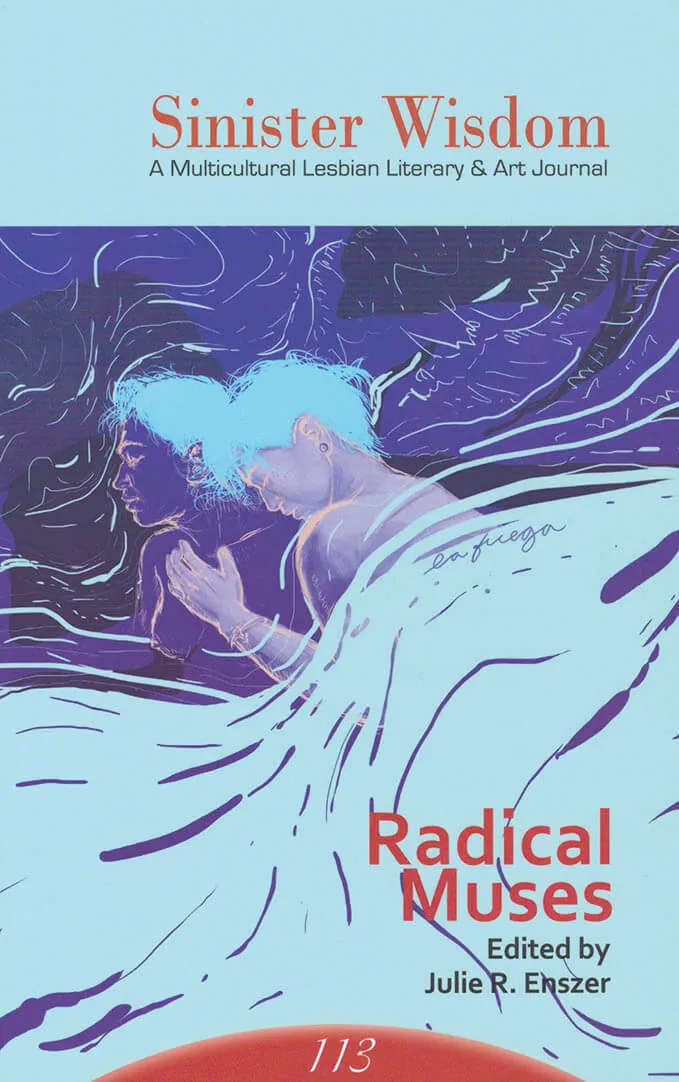
Cover of Radical Muses (Sinister Wisdom nr. 113)

Sinister Wisdom

Radical Muses (Sinister Wisdom nr. 113)

Julie R. Enszer

Sinister Wisdom 113: Radical Muses features an eclectic array of contemporary poetry, prose, and art by lesbians from around the world, including new work by: Andrea Assaf, Tara Shea Burke, Cheryl Clarke, Marina Chirkova, Estela González, Barbara Haas, Nancy E. Lake, Vi Khi Nao, H. Ní Aódagaín and much more!

Cover of Celebrating the Michigan Womyn's Music Festival

Sinister Wisdom

Celebrating the Michigan Womyn's Music Festival

Sinister Wisdom

Sinister Wisdom 103: Celebrating the Michigan Womyn's Music Festival honors the forty-year legacy of the Michigan Womyn’s Music Festival (1976–2015). Sinister Wisdom 103: Celebrating the Michigan Womyn's Music Festival celebrates this embodiment of radical feminist separatist collaboration, transformational self-defined autonomous spaces, a commitment to sisterhood and matriarchal culture, and a musical city sprung from the earth for one week in the woods.

A collective of five womyn each with a deep connection to Fest operated by consensus to create this issue. Striving to represent a range of womyn’s voices, values, traditions, and experiences of Fest, the collective highlighted what Fest has meant to generations of womyn, documented its chronology, and bore witness to the power of this community. Sinister Wisdom 103: Celebrating the Michigan Womyn's Music Festival includes womyn from multiple races, geographies, sexualities, generations, and gender and other social identities. Just as Fest brought together womyn from various backgrounds, our collection includes a range of artistic experience, from seasoned authors and photographers to those womyn new to publishing.
Sinister Wisdom 103: Celebrating the Michigan Womyn's Music Festival remembers the transformations, possibilities, and hopes for spaces cultivating the ongoing empowerment of womyn.

Cover of How to Sleep Faster 2

Arcadia Missa

How to Sleep Faster 2

Various

Periodicals €12.00

How to Sleep Faster 2 is the second of our biannually published journals that form the backbone of Arcadia Missa’ critical collaborative discourse on participation, post-digital visual-production and institutional subjectivity.This issue explores moments of collapse, shift and potential in a cultural moment framed by economic, political and societal disturbance.

Arcadia Missa Publication; eds Rozsa Farkas, Tom Clark et al.

Cover of Still Life 4

Self-Published

Still Life 4

Hamish MacPherson

STILL LIFE is an online and printed zine about relationships and configurations in which one person is still while others are not. Or where one person is passive and others are active. It’s about how we put ourselves in other people’s hands. Or how we are put in other people’s hands. It’s about care and power and vulnerability and agency. And other things not so clearly named. It’s about the different kinds of knowledge that people have about their own and other people’s bodies. And the kind of philosophical and political understandings woven into that knowledge.

Cover of Le Chauffage — Issue #1

Le Chauffage

Le Chauffage — Issue #1

Emile Rubino, Felix Rapp

Le Chauffage (french for “The Heater”) is an artist-run publication based in Brussels. It is conceived as a cross-continental, community oriented platform. Bringing together the work and writing of artists / friends from different cities, Le Chauffage intends to spark discussions and fuel casual forms of critical discourse.

Cover of OEI #86/87 Publishing Practices, Publishing Poetics

OEI editör

OEI #86/87 Publishing Practices, Publishing Poetics

Tobi Maier, Cecilia Grönberg and 1 more

Periodicals €40.00

Once more, an astonishing issue of OEI – a thrilling, compelling, stimulating feast of ideas regarding publishing and the book: the perfect big companion to read and hug in bed while the virus spreads outside.

Bringing together contributions from circa 130 publishing structures, publishing communities, magazines, small press endeavors, artists, poets, writers, editors, theoreticians, curators, scholars, and art bookstores, OEI # 86–87 reflects upon the challenges, pressures and possibilities of publishing and creating publics in different contexts and places in a time of far-reaching – economical, medial, political, social, technological – transformations.

The potential and the versatility of publishing open it to a diversity of practices and approaches in the arts, but as an eminently social form of art, a collective or micro-collective work with shared responsibilities, it is also a never-ending process of “crafting a variegated approach to how you create, publish, distribute, and build a social ecosystem around your efforts”, of trying to “build up and strengthen the community around these printed forms” (Temporary Services).

It is the conviction of OEI #86–87 that print has the power to play an important part in the construction of social spaces, of a social world. As Benjamin Thorel puts it in one of the essays in the issue, “conceiving of the dynamics of publishing as making publics as well as making things public is not a pun – insofar as the artists/publishers encompass, beyond the book itself, its possible ‘lives’, imagining the different spaces, and the different people, amongst whom a publication will circulate.” This is what Michael Warner has called “a public [as] poetic worldmaking”, implying “that all discourse or performance addressed to a public must characterize the world in which it attempts to circulate, projecting for that world a concrete and livable shape, and attempting to realize that world through address.”

This is also, as stressed by Annette Gilbert and others, what can make publishing such an active force, a force co-constituting texts and publications and publics. Indeed, with Michalis Pichler, it is tempting to say that in publishing as practice – perhaps more than in any other art field – “artists have been able to assert the aesthetic value of their own socio-politically informed concerns and to engage, often under precarious conditions, in cultural activities fully aligned with their political values.”

OEI #86–87 also includes sections on and with contemporary poetry from Canada; Fluxus publishing; Krister Brandt/Astrid Gogglesworth; Kalas på BORD (Öyvind Fahlström); Lars Fredrikson; Claude Royet-Journoud’s poetry magazines; Carl Einstein; Gail Scott; Ållebergshändelser; OEI #79: edit/publish/distribute!; “det offentligas försvinnande” and many many other things. [publisher’s note]

Design by Konst & Teknik

Cover of Unbidden Tongues #10: Professional Agitator

Unbidden Tongues

Unbidden Tongues #10: Professional Agitator

Jo Freeman

From the beginning, Unbidden Tongues has claimed to publish 'previously produced yet relatively uncirculated work by cultural practitioners busy with questions surrounding civility and civic life-particularly in relation to language and its administration.' However, over the course of the first nine issues, the 'civic' aspect has been relatively less pronounced, though undeniably subtextual. As such, Professional Agitator-a publication that includes two landmark feminist articles by Jo Freeman-is an attempt to bring civic responsibility more overtly to the surface. While first penned in the 1970s, the articles have a timely relevance, not only because, shockingly, many of the issues on the bill for the women's movement at Freeman's time of writing-employment discrimination, affordable childcare, reproductive rights and sexuality- are back on the table in the U.S. and elsewhere with full force, but also because, in thinking intersectionally as the movement taught me to do, we find ourselves in a moment of necessary and urgent mobilisation for Palestine; with speaking up and out being reprimanded with various forms of organised silencing. 

(From the foreword)