rile*books

Search books

Search books by title, author, publisher, keywords...

Cover of 15th Anniversary Retrospective

Sinister Wisdom

15th Anniversary Retrospective

Sinister Wisdom

€12.00

Sinister Wisdom 43/44: The 15th Anniversary Retrospective is a distillation of our part in the lesbian and women's movements in the United States over the last fifteen years. This issue is a monument to our work: solid, strong, fixed in place. This issue is a marker of our movement: small and bright, bobbing in a difficult channel, sometimes obscured by waves and weather, showing direction. We hope this Retrospective will serve both lesbians who have been active in our movements for the last twenty years and new generations just getting started.

Creative Work By

Harriet Ellenberger
Julia Penelope
Audre Lorde
June Arndold and Susan Griffin
Judith McDaniel
Harriet Desmoines
Catherine Nicholson
Gloria Gyn
Emily Oddwoman
Barbara Grier
Pat Suncircle
Barbara Deming
Linda Marie

And More!

Language: English

recommendations

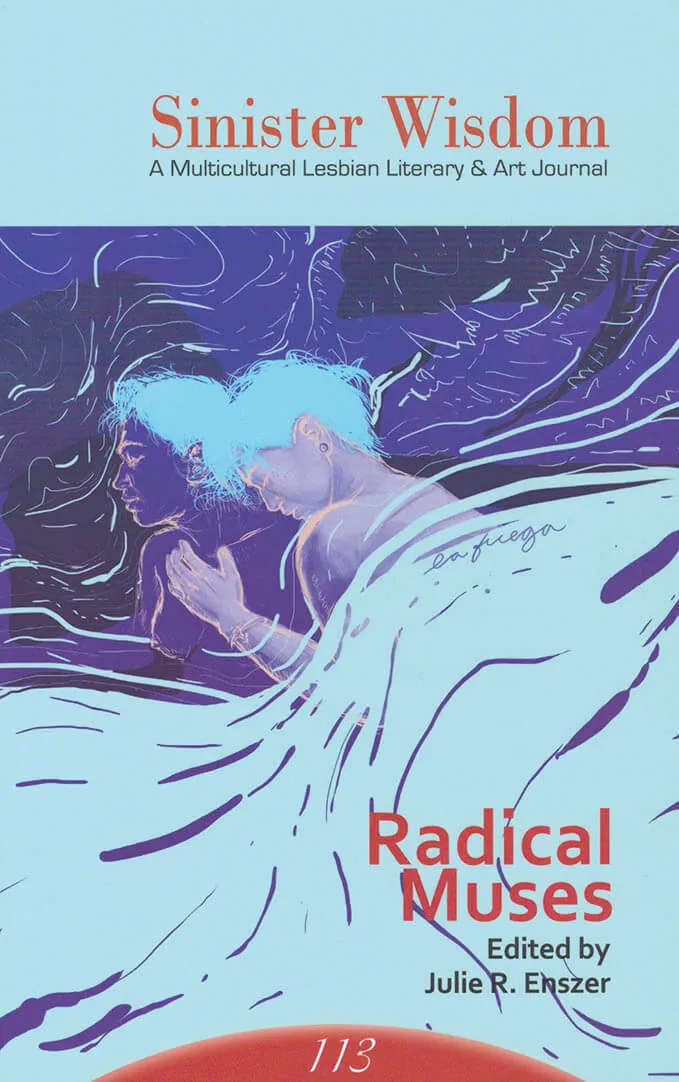
Cover of Radical Muses (Sinister Wisdom nr. 113)

Sinister Wisdom

Radical Muses (Sinister Wisdom nr. 113)

Julie R. Enszer

Sinister Wisdom 113: Radical Muses features an eclectic array of contemporary poetry, prose, and art by lesbians from around the world, including new work by: Andrea Assaf, Tara Shea Burke, Cheryl Clarke, Marina Chirkova, Estela González, Barbara Haas, Nancy E. Lake, Vi Khi Nao, H. Ní Aódagaín and much more!

Cover of Celebrating the Michigan Womyn's Music Festival

Sinister Wisdom

Celebrating the Michigan Womyn's Music Festival

Sinister Wisdom

Sinister Wisdom 103: Celebrating the Michigan Womyn's Music Festival honors the forty-year legacy of the Michigan Womyn’s Music Festival (1976–2015). Sinister Wisdom 103: Celebrating the Michigan Womyn's Music Festival celebrates this embodiment of radical feminist separatist collaboration, transformational self-defined autonomous spaces, a commitment to sisterhood and matriarchal culture, and a musical city sprung from the earth for one week in the woods.

A collective of five womyn each with a deep connection to Fest operated by consensus to create this issue. Striving to represent a range of womyn’s voices, values, traditions, and experiences of Fest, the collective highlighted what Fest has meant to generations of womyn, documented its chronology, and bore witness to the power of this community. Sinister Wisdom 103: Celebrating the Michigan Womyn's Music Festival includes womyn from multiple races, geographies, sexualities, generations, and gender and other social identities. Just as Fest brought together womyn from various backgrounds, our collection includes a range of artistic experience, from seasoned authors and photographers to those womyn new to publishing.
Sinister Wisdom 103: Celebrating the Michigan Womyn's Music Festival remembers the transformations, possibilities, and hopes for spaces cultivating the ongoing empowerment of womyn.

Cover of Lost & Found: The CUNY Poetics Document Initiative, Series VII

CUNY Center for the Humanities

Lost & Found: The CUNY Poetics Document Initiative, Series VII

Audre Lorde, Toni Cade Bambara and 3 more

Anthology €35.00

Building on previous projects centered on the pedagogy of poets, and friendship through correspondence, LOST & FOUND SERIES VII breaks new ground to present unpublished and presently unavailable materials by novelist, filmmaker, and activist Toni Cade Bambara; iconic poet-activist-teachers Audre Lorde and June Jordan; scholar, activist, and poet Dr. Jack D. Forbes, and letters between North American poet and translator Paul Blackburn and Argentinian in exile novelist, poet, and translator Julio Cortázar.

While Cortázar and Blackburn forged their own institution of sorts, through a friendship that would help ignite the Latin American boom, Forbes, Bambara, Jordan, and Lorde worked in and out of institutions to help transform the landscape of our educational and historical horizons and expectations. For some years Bambara, Jordan, and Lorde all taught together in the City University of New York, the largest urban system in the United States, collaborating with activist students and other faculty to create new curriculum in Black Studies, Ethnic Studies, and Women's Studies. At the same time, Blackburn also taught part-time at City University, while bringing the vision of another world into American English, through his translations of Cortázar, a champion of the Cuban revolution and a writer of unparalleled influence in Latin America. On the other side of the country, Dr. Jack Forbes's vision of hemispheric Indigenous life was brought to bear on his involvement in the creation of D-Q University, the first Indigenous university in California, as well as the creation of Native American Studies at UC Davis, a program that would be emulated at other universities in North America. At the same time, his extraordinary and almost unknown poetry, featured here along with notable materials on his educational activism, presents a vision of Los Angeles cutting across race, class, and ethnicity that the work of all the writers in this Series help us realize.

SERIES VII Includes:

Audre Lorde
"I teach myself in outline," Notes, Journals, Syllabi, & an Excerpt from Deotha 

Toni Cade Bambara
"Realizing the Dream of a Black University," & Other Writings (Parts I & II)

June Jordan
"Life Studies," 1966-1976 

Jack Forbes
"Yanga Ya," Selected Poems & The Goals of Education 

Paul Blackburn & Julio Cortázar
"Querido Pablito"/"Julissimo Querido," Selected Correspondence, 1958-1971 (Parts I & II) 

Cover of After Sex

Silver Press

After Sex

Alice Spawls, Edna Bonhomme

Essays €18.00

Who decides what happens after sex? The last decade has seen many significant changes to the laws governing women’s reproductive rights around the world, from liberalisation in Ireland to new restrictions in the USA. After Sex offers personal and political perspectives from the mid-20th century to the present day, setting feminist classics alongside contemporary accounts. These essays, short stories and poems trace the debates and tell the stories; together, they ask us to consider what reproductive justice might look like, and how it could reshape sex.

The writers pay special attention to people — both fictional and real — who have sought control over their sexual lives, and the joy, comedy, difficulties and disappointments that entails. But above all, After Sex testifies to the power of great writing to show us why that freedom is worth pursuing — without shame and without apology.

With contributions from: 
Lauren Berlant, Joanna Biggs, Edna Bonhomme, Gwendolyn Brooks, Beverley Bryan, Stella Dadzie and Suzanne Scafe, Storm Cecile, Lucille Clifton, Rachel Connolly, T.L. Cowan, ’Jane Does’, Maggie Doherty, Nell Dunn, Andrea Dworkin, Anne Enright, Deborah Friedell, Tracy Fuad, Kristen Ghodsee, Vivian Gornick, Donna Haraway, bell hooks, Barbara Johnson, Jayne Kavanagh, Lisa Hallgarten and Angela Poulter, Jamaica Kincaid, Patricia Knight, R.O. Kwon, Ursula K. Le Guin, Natasha Lennard, Sophie Lewis, Audre Lorde, Amelia Loulli, Erin Maglaque, Holly Pester, Adrienne Rich, Denise Riley, Sally Rooney, Loretta J. Ross, Madeleine Schwartz, SisterSong, Sophie Smith, Annabel Sowemimo, Amia Srinivasan, Keeanga-Yamahtta Taylor, Judith Jarvis Thomson, Alice Walker and Bernard Williams.

Cover of Fuel

Nightboat Books

Fuel

Rosie Stockton

Poetry €18.00

Traversing multivalent intimacies from the underworld of California’s Central Valley oil fields to the quotidian domestic and love’s painful retraction, Stockton’s poems articulate the blurry modes of extraction, fantasy, loss, gender, and labor as they interact and overlap in the shadow of environmental and personal collapse. Between gas station gifts, Venmo requests, and nocturnal love letters, Fuel unravels the self and violent systems of domination, longing for a togetherness that transcends its own ending.

In these poems, Stockton plunges into petrologic, long drives, the beginnings of ends—whatever enters into love between people and makes it so abstract, or common. In other words, its great subject is the edge, and Fuel is a book of horizons. - Benjamin Krusling

Rosie Stockton is the author of Permanent Volta (Nightboat Books 2021) which was the recipient of the Sawtooth Prize as well as being a finalist for the California Book Awards in Poetry and the Publishing Triangle’s Audre Lorde Award for Lesbian Poetry. Their poems have been published by Social Text Journal, VOLT, Jubilat, Apogee, Mask Magazine, Tripwire and WONDER PRESS. They hold an M.A. in Creative Writing from Eastern Michigan University and are currently a Ph.D. Candidate in the Gender Studies Department at UCLA. Rosie lives and works in Los Angeles.

Cover of The Lesbian Body

Winter Editions

The Lesbian Body

Monique Wittig

Fiction €22.00

In this genre- and gender-breaking work of theory-fiction, legendary writer and cofounder of the 1970s French feminist movement Monique Wittig celebrates the body—lesbian, literary and defiantly political—and challenges the order of heterosexuality in literature. 

First published in French in 1973, The Lesbian Body mines the relationship between a lover and a beloved—also a writer and a text—to explore the ideological and historical constructions of the female subject. Organized according to the principle of montage, poetic passages are juxtaposed with anatomic lists that mark lesbian eros. Through expressions of joy, violence, and tenderness, the site of pleasure is celebrated. In her transfiguration of gender and its paradigms, Wittig transformed French vocabulary, feminizing grammar and lesbianizing myths. This edition brings the English translation of Wittig’s groundbreaking work back into circulation for the first time since the mid-1980s, revised according to the author's notes, and with an introduction by Paul B. Preciado.

The Lesbian Body is a fundamental work of lesbian existence. Wittig's applied vision is a state of natural delirium, a revolutionary excess of utopianism, refusal, and mutual self-creation. Revisiting it reveals how much passionate free thought has been lost, and simultaneously, how many of her tropes and discoveries have integrated into our collective consciousness.” — Sarah Schulman

“In this stunning new rendering of The Lesbian Body by the French author, theorist, activist and teacher, the late Monique Wittig, we are plunged into an imagined world of passionate violence and erotic lesbian mayhem intertwined in strikingly bold poetic images. Wittig, in the reach and volatility of her imagination, stands alongside such important American writers as Audre Lorde, Adrienne Rich, and Valerie Solanas, all of whose work deserves to be read again, or for the first time.” — Esther Newton

“To read the book is to be forced by Wittig into another grammar and happily contaminated by its strange forms. You will never think straight again.” — Jack Halberstam

“For me, Wittig opened up a sense of the world that had been, quite literally, unimaginable. She tore us apart.” — Judith Butler

“Together with Ursula Le Guin and Samuel R. Delany, Wittig is the first to design a nonbinary utopia, a world in which the binary categorization of sexes and genders will have ceased to exist.” — Paul B. Preciado

Introduction by Paul B. Preciado
Translated by David Le Vay

Cover of Issue #52/53 - Sovereign Movements

Movement Research Performance Journal

Issue #52/53 - Sovereign Movements

Moriah Evans

Periodicals €10.00

Movement Research announces Issue 52/53 of its print publication, the Movement Research Performance Journal. For this issue, Sovereign Movements: Native Dance and Performance, guest editor, choreographer Rosy Simas invited writer, Ahimsa Timoteo Bodhrán, to work with her. Together they assembled contributors from Native and Indigenous communities to reflect upon their practices, the historical conditions out of which they operate as well as movement, performance, and choreography as a socio-political project. Just as it is important for physical institutions to acknowledge that they sit upon occupied land of Native and Indigenous people, so too must institutions of history, practice, and epistemology acknowledge their occupation of knowledge and memory.

Throughout this issue, dance and movement is posited as a powerful strategy against settler-colonial mindsets and as an effective tool against erasure of Native and Indigenous cultural traditions. These pages discuss the importance of Native sovereignty and analyze various histories of resistance to settler-colonialism. Artists in the issue propose alternative artistic models to probe the roles of art and artists in society towards a more expansive constellation that fundamentally critiques the Western reward system in culture as well as the often celebrated cult of authorship.

Cover of Unbidden Tongues #10: Professional Agitator

Unbidden Tongues

Unbidden Tongues #10: Professional Agitator

Jo Freeman

From the beginning, Unbidden Tongues has claimed to publish 'previously produced yet relatively uncirculated work by cultural practitioners busy with questions surrounding civility and civic life-particularly in relation to language and its administration.' However, over the course of the first nine issues, the 'civic' aspect has been relatively less pronounced, though undeniably subtextual. As such, Professional Agitator-a publication that includes two landmark feminist articles by Jo Freeman-is an attempt to bring civic responsibility more overtly to the surface. While first penned in the 1970s, the articles have a timely relevance, not only because, shockingly, many of the issues on the bill for the women's movement at Freeman's time of writing-employment discrimination, affordable childcare, reproductive rights and sexuality- are back on the table in the U.S. and elsewhere with full force, but also because, in thinking intersectionally as the movement taught me to do, we find ourselves in a moment of necessary and urgent mobilisation for Palestine; with speaking up and out being reprimanded with various forms of organised silencing. 

(From the foreword)