Books
Books

Up Your Ass
Valerie Solanas's rarely published, legendary play, Up Your Ass, explodes social and sexual mores and the hypocritical, patriarchal culture that produces them through her signature irreverence and wit, incisiveness and camp.
The play, whose full title is Up Your Ass Or From the Cradle to the Boat Or The Big Suck Or Up from the Slime, marches out a cast of screwy stereotypes: the unknowing john, the frothy career girl, the boring male narcissist, two catty drag queens, the sex-depraved housewife, and a pair of racialized pickup artists, among others. At the center is protagonist Bongi Perez—a thinly veiled Solanas—a sardonic, gender-bending hustler who escorts us through the back alleys of her street life. The fictionalized predecessor to SCUM Manifesto, the play shares the same grand, subversive, implicative language, equally spitting and winking, embracing the margins, the scum, and selling a trick along the way.
Valerie Solanas (1936-1988) is an American radical feminist intellectual, known for her SCUM Manifesto—a pamphlet with which she declares the power of women and imagines a political future through the margin—, and for having tried to assassinate Andy Warhol.
Edited by Leah Whitman-Salkin.
With a contribution by Paul B. Preciado.
Graphic design: Roxanne Maillet.

DAISYWORLD MAGAZINE #4
CONTRIBUTORS Anna Bierler, India Boxall, Craig P Burrows, Alex Hampshire, Kayla Adara Lee, Marijn van der Leeuw, Melanie Matthieu, Gabriella T Moreno, Amira Prescott, Harrison Pickering, Astarte Posch, Ananda Serné, Zazie Stevens, Gedvile Tamosiunaite, Mia You.
cover image Ananda Serné & Poyen Wang
DAISYWORLD MAGAZINE is a seasonal art publication on perception, the sensory, the non-human, ecology & erotica with an emphasis on interconnectedness. The artist's intimate knowledge based on observation, questioning anthropocentrism through beauty & language. Reflecting on the past season while softly moving into the next, each issue launches in-between seasons; appreciating experience, transition, and metamorphosis instead of anticipating the next big thing.

Living on air: the films and words of Sandra Lahire
Charlotte Procter, María Palacios Cruz
Compiled on the occasion of a Sandra Lahire retrospective at Courtisane festival 2021. This cahier was developed in collaboration with Elías Querejeta Zine Eskola (San Sebastian). Edited by María Palacios Cruz and Charlotte Procter.
Living on air: the films and words of Sandra Lahire is the first monograph dedicated to the work of Sandra Lahire and brings together new and existing texts on Lahire as well as writing by herself, with contributions by Gill Addison, Jo Comino, Pam Cook, Laura Guy, Maud Jacquin, Julia Knight, Michael Mazière, Sarah Pucill, Irene Revell & Kerstin Schroedinger, Lis Rhodes, Selina Robertson & Ricardo Matos Cabo (with So Mayer), Vicky Smith, Sarah Turner and Ana Vaz.

The Rambling Figures of Mani Kaul
Arindam Sen, Stoffel Debuysere
Published on the occasion of the program Soft Notes on A Sharp Scale — The Rambling Figures of Mani Kaul, produced as part of the Courtisane festival 2018, as well as the associated Mani Kaul programme organized by the Essay Film Festival 2018, in collaboration with the Otolith Group.

Wound Building: Dispatches from the Latest Disasters in UK Poetry
Wound Building is a volume of essays, with digressions, on one group of contemporary poets active in a self-organizing political poetry scene in the UK, most of whom have little to no audience outside of the little magazines that they publish and the reading series they put on. The book is a front-line report on the rapid development of this poetry in the period between 2015 and 2020, with a particular focus on the relationship of poetry to violence and its representation. The poets discussed here write violent love poems and violent elegies as well as violent fantasies composed in stabs of violent verse and violet prose. The poems themselves comprise fantasies of killing David Cameron, dreams of being split open along a seam, basement songs, hundreds of pages of notes on working life in a privatized care home in Hove, East Sussex, a four-line slogan about the Cologne groping scandal of New Year 2016, variations on the Refugees Medical Phrasebook, a life wasted in a factory in Guangzhou, an autobiographical sci-fi internet fever dream, an anarchist elegy, and a refusal to argue. Ultimately, Hayward argues that the lessons this poetry teaches is never to write a "worthy" narrative when a fucked up collage will do. Rather than a cohesive "account" of a "school" of poets, or a "contribution" to the boring tittle-tattle of aesthetic debates over British poetry as an institution, Wound Building is a front-line report on the local disasters of a contemporary UK poetry caught in the grip of the historical cataclysm of capitalist culture.
Wound Building is further concerned with aesthetic problems related to Marxism, anarchism, contemporary trans politics, and class, though its "theoretical" preoccupations are subordinated to its desire to provide a ground-level view on the writing itself, its production, its intellectual aporia, and the ways it finds itself outstripped by the ongoing "march of events." The book will be of interest not only for those concerned with contemporary British political and experimental poetry, but also more generally for anyone who wishes to think carefully about what it means to make art about present-day history and its many horrible enormities.
The book's title is derived from the idea of sublime woundedness that subtends the context of the poets discussed here: the impressions of wounds opening up like LED-lit shopfronts in the night, in a parallel universe in which injury is intoxicatingly impersonal and structural, and which forms the environment in which the poems fight to absolutize the value of every last breath, or face into the reality of extravagantly violent wish fulfillment, or dissolve themselves in a search for new ways of professing love, or transform into a kind of expressionism of vomiting up medical-diagnostic categories found in abstract social labor, or pump their verses full of the convulsive rhythms of surprise and sudden relief, without any guarantee that this is the right thing to do or that anyone will even fucking hear. Wound Building does not historicize this state of affairs as much as it attempts to live alongside the immediacy of this work, in order to see what is still possible for poetry, and criticism, to make and do.

Modern Love
Constance DeJong’s long-neglected 1977 novel, Modern Love, is one thing made up of many: It is science fiction. It is a detective story. It is a historical episode in the time of the Armada and the dislocation of Sephardic Jews from Spain to an eventual location in New York’s Lower East Side. It is a first-person narrator’s story; Charlotte’s story; and Roderigo’s; and Fifi Corday’s. It is a 150-year-old story about Oregon and the story of a house in Oregon. Modern Love’s continuity is made of flow and motion; like an experience, it accumulates as you read, at that moment, through successive moments, right to the end.
An important figure of downtown New York’s performance art and burgeoning media art scene in the late 1970s and early 1980s, DeJong designed Modern Love herself and published it with help from Dorothea Tanning on the short-lived Standard Editions imprint. Critically acclaimed in its time, Modern Love is now back in print on the 40th anniversary of its original publication.
Constance DeJong is an artist and writer who has worked for thirty years on narrative form within the context of avant-garde music and contemporary art. Considered one of the progenitors of media art, or “time-based media,” DeJong shapes her intricate narrative form through performances, audio installations, print texts, electronic objects, and video works. Since the 1980s, DeJong has collaborated with Phillip Glass, Tony Oursler, and the Builders Association on performances and videos at Walker Art Museum, Minneapolis, MN; the Wexner Center, Columbus, OH; Philadelphia Museum of Art; and in New York, at The Kitchen, Thread Waxing Space, the Whitney Museum of American Art, and the Dia Center for the Arts. Her books include I.T.I.L.O.E. and SpeakChamber, and her work is included in the anthologies Up is Up, But So is Down: New York’s Downtown Literary Scene, 1974–1991 (NYU Press, 2006); Blasted Allegories (New Museum/MIT, 1987); and Wild History (Tanam Press, 1985).

Notes on a life not lived
This publication is based on a project by Despina Vassiliadou that ran from 2015-16. It presents a collection of photographs taken during the period, accompanied by fictional short stories.

Eecchhooeess
American poet Norman H. Pritchard's second and final book, EECCHHOOEESS was originally published in 1971 by New York University Press. Pritchard's writing is visually and typographically unconventional. His methodical arrangements of letters and words disrupt optical flows and lexical cohesion, modulating the speeds of reading and looking by splitting, spacing and splicing linguistic objects. His manipulation of text and codex resembles that of concrete poetry and conceptual writing, traditions from which literary history has mostly excluded him. Pritchard also worked with sound, and his dynamic readings—documented, among few other places, on the album New Jazz Poets (Folkways Records, 1967)—make themselves heard on the page.
EECCHHOOEESS exemplifies Pritchard's formal and conceptual sensibilities, and provides an entryway into the work of a poet whose scant writings have only recently achieved wider recognition. DABA's publication of EECCHHOOEESS is unabridged and closely reproduces the design of the original 1971 volume.
Norman H. Pritchard (1939-96) was affiliated with the Umbra group, a predecessor to the Black Arts Movement. He taught writing at the New School for Social Research and published two books: The Matrix: Poems 1960-1970 (Doubleday, 1970) and EECCHHOOEESS (New York University Press, 1971). His work was anthologized in publications including The New Black Poetry (1969), In a Time of Revolution: Poems from Our Third World (1969), Dices or Black Bones: Black Voices of the Seventies (1970), Ishmael Reed's 19 Necromancers from Now (1970), Text-Sound Texts (1980) and others.

The History of Sexuality, Volume 1: An Introduction
Michel Foucault offers an iconoclastic exploration of why we feel compelled to continually analyze and discuss sex, and of the social and mental mechanisms of power that cause us to direct the questions of what we are to what our sexuality is.

the mind is the body
Printed on thick cardboard, this book throws you right back into the child-like explorer mode we know from when we were young. It illustrates the mindful written words of Lisa Gutscher journey through the inner body based on a large archive from found images, screenshots and other image sources to unfold a whole new world in front of your eyes.

Supplication: Selected Poems of John Wieners
Supplication: Selected Poems of John Wieners gathers work by one of the most significant poets of the Black Mountain and Beat generation. Includes poems that have previously never been published, the full text of the 1958 edition of his influential The Hotel Wentley Poems, plus poems from rare sources, facsimiles, notes, and collages by Wieners. An invaluable collection for new and old fans.
John Wieners (1934-2002) was a founding member of the New American poetry that flourished in America after the Second World War. Upon graduating from Boston College in 1954, Wieners enrolled in the final class of Black Mountain College. Following Black Mountain's closure in 1956, he founded the small magazine Measure (1957-1962) and embarked on a peripatetic life, participating in poetry communities in Boston, San Francisco, New York, and Buffalo throughout the late 1950s and 1960s, before settling at 44 Joy Street in Boston in 1972. He is the author of seven collections of poetry, three one-act plays, and numerous broadsides, pamphlets, uncollected poems, and journals. Robert Creeley described Wieners as the greatest poet of emotion of their time.

BFTK — Issue 4: On Translation, Transmission & Transposition
Andrew Walsh‐Lister, Matthew Stuart and 2 more
Bricks from the Kiln is an irregular journal edited by Andrew Lister and Matthew Stuart, sometimes with guest editors, that presents graphic design and typography as disciplines activated by and through other disciplines and lenses such as language, archives, collage, and more. It borrows its title from the glossary notes of Ret Marut’s "Der Ziegelbrenner," which was the ‘size, shape and colour of a brick’, and ran for 13 issues between 1917 and 1921.
The latest installment, "#4: On Translation, Transmission & Transposition," was published as an event (and now) a publication, with events at London College of Communication, Burley Fisher Books & Pig Rock bothy, Socttish National Gallery of Modern Art, and Inga (in November, 2019).
GREENING
Helen Marten
(front / back flaps)
JOY & HAPPINESS, FIDELITY
& INTIMACY IN TRANSLATION
Sophie Collins
(pp.4–13)
PLANETARY TRANSLATION
Don Mee Choi
(pp.15–19)
TRANSLATION AND A LIPOGRAM:
OR, ON FORMS OF AGAIN-WRITING
AND NO- (OR NOT THAT-) WRITING
Kate Briggs
(pp.23–33)
UNHOMING (1 of 4):
FOLLOWING HÖLDERLIN’S ‘HEIMAT’
Phil Baber
(pp.35–47)
SNOW WHITE AND THE WHITE
OF THE HUMAN EYEBALLS
Joyce Dixon
(pp.51–62)
ALTAMIRALTAMIRALTAMIRA
Florian Roithmayr
(pp.65–116)
LEVEL UP, LEVEL DOWN
Jen Calleja
(pp.119–124)
TRANS.MISSION [A.DIALOGUE]:
A JAVASCRIPT FOR THREE VOICES
J.R. Carpenter
(pp.127–134)
THE MECHANISATION OF ART
Edgar Wind
(glosses / annotations / insertions by
Natalie Ferris & Bryony Quinn)
(pp.137–144)
UNHOMING (2 of 4)
Phil Baber
(p.147)
COMMISSION FOR A NOIR MOVIE
B IN THE BAY OF BISCAY
Rebecca Collins
(pp.151–157)
UNHOMING (3 of 4)
Phil Baber
(pp.150–162)
EVERY CONTACT LEAVES A TRACE;
TRANSCRIBING OSTEON
Naomi Pearce
(pp.165–170)
HOW DOES A WORK END?
Karen Di Franco
(pp.173–193)
METONYMY Op.1 & Op.2
James Bulley
(pp.197–201)
AFRIKAN ALPHABETS EXTENDED
Saki Mafundikwa
(pp.204–207)
SUSAN HILLER: 1983
Natalie Ferris
(pp.209–217)
EVERY TELLING HAS A TALING /
EVERY STORY HAS AN ENDING
Matthew Stuart
(pp.220–233)
GRAPHIC PROPRIOCEPTION
James Langdon
(pp.235–254)
UNHOMING (4 of 4)
Phil Baber
(pp.257–263)
TUNNELLING AND AGGREGATING
FOR DESIGN RESEARCH
Bryony Quinn (text) &
Peter Nencini (images)
(pp.265–272)
LET IT PERCOLATE:
A MANIFESTO FOR READING
Sophie Seita
(pp.275–280)
288 pgs, 22.4 × 17 cm, Softcover, 2020
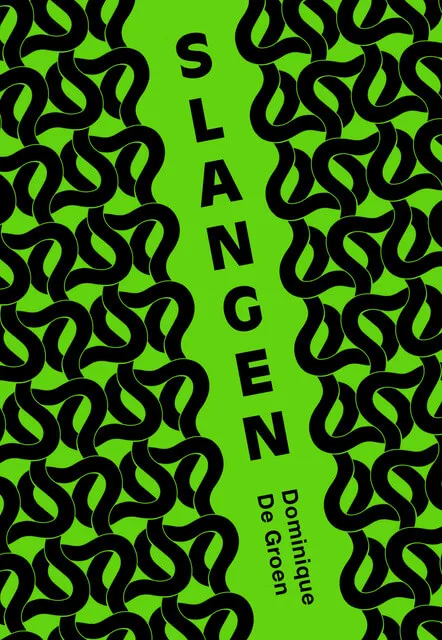
Slangen
Slangen krioelen in de sarcofaag van het heden, in de krochten van de popcultuur, in de mummie van de natuur, in wondes en rot vlees, in artificiële woestijnen en op geoliede dad bods. Ze wentelen zich rond beursgrafieken, raken verstrengeld met wurgende algoritmes, orkestreren een trage ondergrondse revolutie. Een meisje snijdt zich aan een nepdiamanten piramide en werpt haar slangenvel van zich af.
Dominique De Groen is schrijver en beeldend kunstenaar. Ze publiceerde de dichtbundels Shop Girl (2017), Sticky Drama (2019) en offerlam (2020). Ze werd genomineerd voor de Poëziedebuutprijs Aan Zee 2018, de Herman de Coninckprijs 2020 en de Fintroliteratuurprijs 2021 en won de Frans Vogel Poëzieprijs 2019 en de Fintropublieksprijs 2021.

How to disappear
Robin Moger, Haytham El-Wardany and 1 more
This publication proposes a set of aural exercises that show readers how to disappear, reappear, join a group, or leave a group. Its annex is a lexicon of some of the sounds that dwell in or are banished from the middle-class household.
Text: Haytham El-Wardany
Editors: Maha Maamoun and Ala Younis
Translated from Arabic by Jennifer Peterson (Preliminary Exercises) and Robin Moger (Sounds of the Middle Classes)

OEI #92-93 Lettrist Corpus: The Complete Magazines (1946–2016)
Frédéric Acquaviva, Jonas J. Magnusson and 1 more
“Un livre qui fera date. Deux ans de recherches, 512 pages, 1.361 illustrations en quadrichromie, 119 revues lettristes parues de 1946 à 2016 pour un total de 1.200 ouvrages décrits (avec la couverture et le sommaire de chaque numéro). Qui d’autre que les éditeurs suédois de OEI (Jonas J. Magnusson et Cecilia Gronberg) aurait pu sortir ce travail anthologique? Personne!” — www.mauricelemaitre.org
“The ‘unreasonable’ idea for this ‘catalogue raisonné’ came to me as an attemps to draw up a complete inventory of all the journals and periodicals of the Lettrist group, from its birth until today. Because the lifespan of the Lettrist movement has exceeded that of all the other avant-garde movements, we are undoubtedly in front of the most immense corpus ever produced in terms of magazines, coverin a period from 1946 to 2016. It presents more than a hundred different titles with more than one thousand items and hundreds of authors. . . . I hope that this comprehensive work will give the reader an opportunity to understand the different paths of the Lettrist groups and the many areas addressed, if not shaken, beyond the books of Isidore Isou and Maurice Lemaître. Since other Lettrists have published relatively few monographic books, and very little outside their own magazines, OEI #92-93 is a unique database for most of the Lettrist texts that we can access, also making it possible for new readers to come across Lettrism.”
— from Frédéric Acquaviva’s introduction
Design by Fält

OEI #90/91 Sickle of Syntax & Hammer of Tautology
Tobi Maier, Cecilia Grönberg and 1 more
OEI # 90-91: Sickle of Syntax & Hammer of Tautology offers the first English language overview of the history of concrete and visual poetry production in socialist Yugoslavia between 1968 and 1983.
By focusing on mass-produced examples of concrete poetry, this publication presents these poetic experiments as organically linked to social movements, critical theories, and youth cultural revolutions. In his extensive introduction, Sezgin Boynik, the guest editor of this special issue of OEI, discusses concrete and visual poetry in socialist Yugo-slavia as an uneven and combined development, and emphasizes its confrontational and organizational aspects.
By means of interviews, translations, reproductions, and theoretical and historical statements, OEI # 90-91 offers a picture of a very lively scene of concrete and visual poetry in Yugoslavia, which unfortunately is not as recognized interna-tionally as it would deserve.
Hoping that OEI # 90-91 could contribute to this task in a substantial way, we present episodes from the early years of OHO formation and its complex theories of words and things; an interview with Rastko Močnik on programmed art and political formalism; militant polemics of Goran Babić; Signalist contradictions; subjective structural devices of Judita Šalgo; zaum experiments of Vojislav Despotov; detective meta-texts of Slavoj Žižek; poetic self-management studies of Vujica Rešin Tucić; a feminist historicisation of Ažin school for experimental poetry; democratisation of visual poetry by Westeast; selections from special issues of the journals Pitanja, Problemi, Ulaznica, Dometi, Delo, Koraci, Vidik, Pegaz, and many other materials translated here for the first time and presented in one publication.

OEI #86/87 Publishing Practices, Publishing Poetics
Tobi Maier, Cecilia Grönberg and 1 more
Once more, an astonishing issue of OEI – a thrilling, compelling, stimulating feast of ideas regarding publishing and the book: the perfect big companion to read and hug in bed while the virus spreads outside.
Bringing together contributions from circa 130 publishing structures, publishing communities, magazines, small press endeavors, artists, poets, writers, editors, theoreticians, curators, scholars, and art bookstores, OEI # 86–87 reflects upon the challenges, pressures and possibilities of publishing and creating publics in different contexts and places in a time of far-reaching – economical, medial, political, social, technological – transformations.
The potential and the versatility of publishing open it to a diversity of practices and approaches in the arts, but as an eminently social form of art, a collective or micro-collective work with shared responsibilities, it is also a never-ending process of “crafting a variegated approach to how you create, publish, distribute, and build a social ecosystem around your efforts”, of trying to “build up and strengthen the community around these printed forms” (Temporary Services).
It is the conviction of OEI #86–87 that print has the power to play an important part in the construction of social spaces, of a social world. As Benjamin Thorel puts it in one of the essays in the issue, “conceiving of the dynamics of publishing as making publics as well as making things public is not a pun – insofar as the artists/publishers encompass, beyond the book itself, its possible ‘lives’, imagining the different spaces, and the different people, amongst whom a publication will circulate.” This is what Michael Warner has called “a public [as] poetic worldmaking”, implying “that all discourse or performance addressed to a public must characterize the world in which it attempts to circulate, projecting for that world a concrete and livable shape, and attempting to realize that world through address.”
This is also, as stressed by Annette Gilbert and others, what can make publishing such an active force, a force co-constituting texts and publications and publics. Indeed, with Michalis Pichler, it is tempting to say that in publishing as practice – perhaps more than in any other art field – “artists have been able to assert the aesthetic value of their own socio-politically informed concerns and to engage, often under precarious conditions, in cultural activities fully aligned with their political values.”
OEI #86–87 also includes sections on and with contemporary poetry from Canada; Fluxus publishing; Krister Brandt/Astrid Gogglesworth; Kalas på BORD (Öyvind Fahlström); Lars Fredrikson; Claude Royet-Journoud’s poetry magazines; Carl Einstein; Gail Scott; Ållebergshändelser; OEI #79: edit/publish/distribute!; “det offentligas försvinnande” and many many other things. [publisher’s note]
Design by Konst & Teknik

OEI #82-83 Art in the Age of Kleptomania
Tobi Maier, Cecilia Grönberg and 1 more
Aeron Bergman and Alejandra Salinas, co-editors at INCA Press (along with Irena Borić), are the guest-editors of this issue of OEI: it contains essays, artworks, and archival materials by 21 artists, theorists, writers, and artist-run spaces (mostly from the Americas).
The subject of the issue is art and neoliberalism, and it encompasses essays, images and other works by Dorothée Dupuis, Max Jorge Hindered Cruz, Luciano Concheiro, Yvonne Osei, Diego Bruno, John Riepenhoff, Suhail Malik, Good Weather, The Luminary, Bikini Wax, Beta-Local and more.

Água Viva
In Água Viva Clarice Lispector aims to 'capture the present'. Her direct, confessional and unfiltered meditations on everything from life and time to perfume and sleep are strange and hypnotic in their emotional power and have been a huge influence on many artists and writers, including one Brazilian musician who read it one hundred and eleven times. Despite its apparent spontaneity, this is a masterly work of art, which rearranges language and plays in the gaps between reality and fiction.
Clarice Lispector (December 10, 1920 – December 9, 1977) was a Brazilian writer acclaimed internationally for her innovative novels and short stories. Born to a Jewish family in Podolia in Western Ukraine, as an infant she moved to Brazil with her family, amidst the disasters engulfing her native land following the First World War.

Visualisation. L'interprétation modélisante
Les diagrammes, cartes et visualisations de données ont conquis le domaine de la recherche en arts, lettres et sciences humaines. Pour certains chercheurs, ces formes graphiques consistent à exploiter des données quantitatives jusqu’ici délaissées, pour d’autres, elles offrent la possibilité d’explorer les relations discrètes qu’entretiennent des corpus hétérogènes. Mais sur quels fondements épistémologiques reposent ces opérations techniques et intellectuelles ? Dans le cadre de la production du savoir et de son interprétation en régime numérique, est-il possible de dépasser le simple effet d’affichage des données, certes bluffant au premier abord, et d’envisager autrement les interfaces et les logiciels ?
Considérée aujourd’hui comme l’une des plus importantes théoriciennes des humanités numériques, Johanna Drucker livre dans cet ouvrage, spécialement rédigé pour la collection, une alternative aux formes dominantes de la visualisation de l’information. Héritière de la tradition humaniste, elle propose une approche qui réhabilite l’idée d’un sujet situé et incarné qui expérimente et conceptualise les connaissances par le prisme de la représentation graphique.

La Gentrification des Esprits
La Gentrification des esprits est un retour captivant sur la crise du sida et l’activisme d’ACT UP dans le New York des années 1980 et 1990. Sarah Schulman, elle-même new-yorkaise et militante de la cause LGBT, se souvient de la disparition du centre-ville, pratiquement du jour au lendemain, de la culture rebelle queer, des loyers à bas coût et du prolifique mouvement artistique qui se développait au coeur de Manhattan, remplacés par des porte-parole gays conservateurs, ainsi que par le consumérisme de masse.
Elle décrit avec précision et engagement le « remplacement d’une communauté par une autre » et le processus de gentrification qui toucha ces quartiers concomitamment à la crise du sida. Sarah Schulman fait revivre pour nous le Lower East Side qu’elle a connu. Elle ravive autant le souvenir de ses ami•e•s de l’avant-garde queer que celui de l’ombre inquiétante des premières années de la crise du sida, telles que vécues par une militante. Les souvenirs personnels s’entremêlent à une analyse percutante des deux phénomènes, et du poids invisible qu’ils font aujourd’hui peser sur la société américaine.
L’auteure rend compte de son expérience en tant que témoin de la « perte de l’imagination » de toute une génération, et des conséquences entraînées par cette perte.

Le conflit n’est pas une agression
Des relations intimes aux politiques globales, Sarah Schulman fait le constat d’un continuum: individus comme États font souvent basculer les situations conflictuelles dans le registre de l’agression, criminalisant leurs opposants pour couper court à la contradiction et échappant ainsi à leur propre responsabilité dans les conflits. En distinguant conflit et agression, l’autrice interroge notre culture de la stigmatisation.
Ce travail profond, aussi courageux qu’impertinent, montre comment la sanction et la répression prennent le pas sur l’auto-analyse à l’échelle individuelle et collective, et comment l’altérité sert de justification à la violence et à l’exclusion. Ce livre intentionnellement polémique offre un aperçu des dynamiques contemporaines et historiques qui prennent les différences intimes, raciales et géopolitiques pour des éléments déclencheurs de la course à l’injustice, à l’exclusion et à la répression.
Le conflit n’est pas une agression est un virulent plaidoyer contre le phénomène culturel de l’accusation, révélant combien les personnes en situation de pouvoir exacerbent et manipulent la crainte de l’« autre » pour éviter toute remise en question.

Mon musée de la Cocaïne
L’or et la cocaïne sont les deux matériaux bruts de Mon musée de la Cocaïne. C’est au cours de leur transformation et raffinement que ces deux substances ramènent avec elles une histoire de l’oppression et de l’esclavage.
Dans ce livre, l’anthropologue australien Michael Taussig prend comme point de départ la proposition de bâtir un musée de la Cocaïne (qui serait l’image reflétée du musée de l’Or de la Banque de la République à Bogotá) et dresse un portrait sans concession de la vie des mineurs afro-colombiens aspirés dans le monde dangereux de la production de cocaïne au fin fond de la forêt tropicale, sur la côte pacifique de la Colombie. Il décrit la violence, la pauvreté, mais aussi les croyances qui surgissent des marais envahis de mangroves et des rivières tropicales qui, pendant plus de cinq cent ans, ont attiré, ruiné et décontenancé Amérindiens, orpailleurs, conquistadors et pirates, esclaves africains, ingénieurs russes et guérilleros marxistes.
Mon musée de la Cocaïne se présente comme un assemblage éclectique d’histoires et d’anecdotes, présenté comme autant de salles d’un hypothétique musée de la Cocaïne, au sein desquelles le lecteur est invité à déambuler, en croisant des références qui vont de Charles Dickens à Franz Kafka en passant par la poésie de Seamus Heaney.

Palma Africana
Dans Palma africana, l’anthropologue australien Michael Taussig explore la production d’huile de palme en Colombie. Alors que cette dernière envahit tout, des chips au vernis à ongles, l’auteur examine les conséquences écologiques, politiques et sociales de cette exploitation.
Bien que la liste des horreurs induites par la culture du palmier à huile soit longue, nos terminologies habituelles ne permettent plus de rendre compte des réalités qu’elles décrivent. À travers cette déambulation anthropo-poétique au cœur des marécages colombiens, c’est donc la question du langage que l’auteur interroge. Comme William Burroughs, pour qui les mots sont aussi vivants que des animaux et n’aiment pas être maintenus en pages – Michael Taussig souhaite couper ces dernières, et les rendre à leur liberté.
Pensé à partir d’une vie d’exploration philosophique et ethnographique, Palma africana cherche à contrecarrer la banalité de la destruction du monde et offre une vision pénétrante de notre condition humaine. Illustré de photographies prises par l’auteur et écrit avec la verve expérimentale propre à l’anthropologue, ce livre est le Tristes Tropiques de Michael Taussig pour le XXIe siècle.
Traduit de l’anglais par Marc Saint-Upéry.