Poetry
Poetry

Supplication: Selected Poems of John Wieners
Supplication: Selected Poems of John Wieners gathers work by one of the most significant poets of the Black Mountain and Beat generation. Includes poems that have previously never been published, the full text of the 1958 edition of his influential The Hotel Wentley Poems, plus poems from rare sources, facsimiles, notes, and collages by Wieners. An invaluable collection for new and old fans.
John Wieners (1934-2002) was a founding member of the New American poetry that flourished in America after the Second World War. Upon graduating from Boston College in 1954, Wieners enrolled in the final class of Black Mountain College. Following Black Mountain's closure in 1956, he founded the small magazine Measure (1957-1962) and embarked on a peripatetic life, participating in poetry communities in Boston, San Francisco, New York, and Buffalo throughout the late 1950s and 1960s, before settling at 44 Joy Street in Boston in 1972. He is the author of seven collections of poetry, three one-act plays, and numerous broadsides, pamphlets, uncollected poems, and journals. Robert Creeley described Wieners as the greatest poet of emotion of their time.
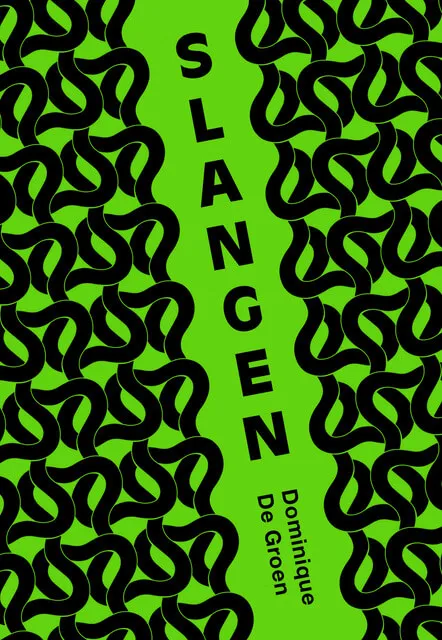
Slangen
Slangen krioelen in de sarcofaag van het heden, in de krochten van de popcultuur, in de mummie van de natuur, in wondes en rot vlees, in artificiële woestijnen en op geoliede dad bods. Ze wentelen zich rond beursgrafieken, raken verstrengeld met wurgende algoritmes, orkestreren een trage ondergrondse revolutie. Een meisje snijdt zich aan een nepdiamanten piramide en werpt haar slangenvel van zich af.
Dominique De Groen is schrijver en beeldend kunstenaar. Ze publiceerde de dichtbundels Shop Girl (2017), Sticky Drama (2019) en offerlam (2020). Ze werd genomineerd voor de Poëziedebuutprijs Aan Zee 2018, de Herman de Coninckprijs 2020 en de Fintroliteratuurprijs 2021 en won de Frans Vogel Poëzieprijs 2019 en de Fintropublieksprijs 2021.

OEI #92-93 Lettrist Corpus: The Complete Magazines (1946–2016)
Frédéric Acquaviva, Jonas J. Magnusson and 1 more
“Un livre qui fera date. Deux ans de recherches, 512 pages, 1.361 illustrations en quadrichromie, 119 revues lettristes parues de 1946 à 2016 pour un total de 1.200 ouvrages décrits (avec la couverture et le sommaire de chaque numéro). Qui d’autre que les éditeurs suédois de OEI (Jonas J. Magnusson et Cecilia Gronberg) aurait pu sortir ce travail anthologique? Personne!” — www.mauricelemaitre.org
“The ‘unreasonable’ idea for this ‘catalogue raisonné’ came to me as an attemps to draw up a complete inventory of all the journals and periodicals of the Lettrist group, from its birth until today. Because the lifespan of the Lettrist movement has exceeded that of all the other avant-garde movements, we are undoubtedly in front of the most immense corpus ever produced in terms of magazines, coverin a period from 1946 to 2016. It presents more than a hundred different titles with more than one thousand items and hundreds of authors. . . . I hope that this comprehensive work will give the reader an opportunity to understand the different paths of the Lettrist groups and the many areas addressed, if not shaken, beyond the books of Isidore Isou and Maurice Lemaître. Since other Lettrists have published relatively few monographic books, and very little outside their own magazines, OEI #92-93 is a unique database for most of the Lettrist texts that we can access, also making it possible for new readers to come across Lettrism.”
— from Frédéric Acquaviva’s introduction
Design by Fält

OEI #90/91 Sickle of Syntax & Hammer of Tautology
Tobi Maier, Cecilia Grönberg and 1 more
OEI # 90-91: Sickle of Syntax & Hammer of Tautology offers the first English language overview of the history of concrete and visual poetry production in socialist Yugoslavia between 1968 and 1983.
By focusing on mass-produced examples of concrete poetry, this publication presents these poetic experiments as organically linked to social movements, critical theories, and youth cultural revolutions. In his extensive introduction, Sezgin Boynik, the guest editor of this special issue of OEI, discusses concrete and visual poetry in socialist Yugo-slavia as an uneven and combined development, and emphasizes its confrontational and organizational aspects.
By means of interviews, translations, reproductions, and theoretical and historical statements, OEI # 90-91 offers a picture of a very lively scene of concrete and visual poetry in Yugoslavia, which unfortunately is not as recognized interna-tionally as it would deserve.
Hoping that OEI # 90-91 could contribute to this task in a substantial way, we present episodes from the early years of OHO formation and its complex theories of words and things; an interview with Rastko Močnik on programmed art and political formalism; militant polemics of Goran Babić; Signalist contradictions; subjective structural devices of Judita Šalgo; zaum experiments of Vojislav Despotov; detective meta-texts of Slavoj Žižek; poetic self-management studies of Vujica Rešin Tucić; a feminist historicisation of Ažin school for experimental poetry; democratisation of visual poetry by Westeast; selections from special issues of the journals Pitanja, Problemi, Ulaznica, Dometi, Delo, Koraci, Vidik, Pegaz, and many other materials translated here for the first time and presented in one publication.

OEI #86/87 Publishing Practices, Publishing Poetics
Tobi Maier, Cecilia Grönberg and 1 more
Once more, an astonishing issue of OEI – a thrilling, compelling, stimulating feast of ideas regarding publishing and the book: the perfect big companion to read and hug in bed while the virus spreads outside.
Bringing together contributions from circa 130 publishing structures, publishing communities, magazines, small press endeavors, artists, poets, writers, editors, theoreticians, curators, scholars, and art bookstores, OEI # 86–87 reflects upon the challenges, pressures and possibilities of publishing and creating publics in different contexts and places in a time of far-reaching – economical, medial, political, social, technological – transformations.
The potential and the versatility of publishing open it to a diversity of practices and approaches in the arts, but as an eminently social form of art, a collective or micro-collective work with shared responsibilities, it is also a never-ending process of “crafting a variegated approach to how you create, publish, distribute, and build a social ecosystem around your efforts”, of trying to “build up and strengthen the community around these printed forms” (Temporary Services).
It is the conviction of OEI #86–87 that print has the power to play an important part in the construction of social spaces, of a social world. As Benjamin Thorel puts it in one of the essays in the issue, “conceiving of the dynamics of publishing as making publics as well as making things public is not a pun – insofar as the artists/publishers encompass, beyond the book itself, its possible ‘lives’, imagining the different spaces, and the different people, amongst whom a publication will circulate.” This is what Michael Warner has called “a public [as] poetic worldmaking”, implying “that all discourse or performance addressed to a public must characterize the world in which it attempts to circulate, projecting for that world a concrete and livable shape, and attempting to realize that world through address.”
This is also, as stressed by Annette Gilbert and others, what can make publishing such an active force, a force co-constituting texts and publications and publics. Indeed, with Michalis Pichler, it is tempting to say that in publishing as practice – perhaps more than in any other art field – “artists have been able to assert the aesthetic value of their own socio-politically informed concerns and to engage, often under precarious conditions, in cultural activities fully aligned with their political values.”
OEI #86–87 also includes sections on and with contemporary poetry from Canada; Fluxus publishing; Krister Brandt/Astrid Gogglesworth; Kalas på BORD (Öyvind Fahlström); Lars Fredrikson; Claude Royet-Journoud’s poetry magazines; Carl Einstein; Gail Scott; Ållebergshändelser; OEI #79: edit/publish/distribute!; “det offentligas försvinnande” and many many other things. [publisher’s note]
Design by Konst & Teknik

OEI #80/81 The Zero Alternative
Tobi Maier, Cecilia Grönberg and 1 more
OEI #80-81 is not an anthological publication, and has no representative ambition. It is a montage-based publication trying, in as material a way as possible, to register, prolong, transform and reflect upon energies from the work of Portuguese artist Ernesto de Sousa and his fellows (Alberto Carneiro, Túlia Saldanha, Álvaro Lapa, Fernando Calhau, Lourdes Castro, Ana Vieira, Ana Hatherly, E.M. de Melo e Castro, António Barros...).
Ernesto de Sousa and his fellows defined themselves as aesthetic operators and worked as filmmakers, photographers, curators, critics, writers, folk art researchers, multimedia artists... OEI #80-81 also gathers texts on magazines such as Poesia Experimental, Operação, Nova, A Urtiga, and Alternativa; and works by artists from younger generations such as Isabel Carvalho, Paulo Mendes and Mariana Silva, in dialogue with that of de Sousa.

Piero Heliczer. Poems & Documents / Poèmes & Documents
Sophie Vinet, Benjamin Thorel and 1 more
Poet, editor, filmmaker, actor, child star in Mussolini’s Italy, founder of The Dead Language Press and of the Paris Filmmakers Cooperative, Piero Heliczer (1937–1993) was an essential yet secret agent of the 1960s and ’70s counterculture. In the course of his nomadic existence in Rome, New York, London, Amsterdam, Paris, and Préaux-du-Perche, where he spent the last few years of his life, he met and worked with a constellation of avant-garde writers, forged friendships with figures from the Beat Generation and the British Poetry Revival as well as the New York art scene. At the crossroads of many underground experiences, Heliczer’s name appears in books dedicated to the artists and poets he collaborated with during his lifetime—names by the likes of Gregory Corso, Barbara Rubin, Andy Warhol, Jack Smith, Ira Cohen, or The Velvet Underground, a band he participated in creating with his friend Angus MacLise.
This myth obscures the fact that Piero Heliczer was first and foremost a poet. Today, this part of his work is overlooked; it is all the more difficult to encounter because Heliczer himself never collected it. So it was scattered, or lost, in the course of his wanderings. Heliczer favored the circulation of his works rather than their archiving: he was committed to the production of mobile forms—flyers, broadsides, and other ephemera—disseminated his verses in magazines, and preferred public readings and performances to the finished form of the book.
The present volume gathers a significant number of Heliczer’s poetic works through facsimile reproduction of his contributions to more than thirty periodicals—mostly stemming from poets’ presses or universities—published between 1958 and 1979. This collection isn’t “complete”—but it makes available again poems that, in some cases, never circulated after their initial publication.
Un recueil de poèmes de Piero Heliczer (1937–1993), auteur, éditeur et cinéaste, figure de l’underground et de la contre-culture, proche de Andy Warhol, Gerard Malanga, et Jack Smith. Sa poésie, héritière de la Beat Generation, restitue en métaphores et images saisissantes des expériences et des visions personnelles, tout en s’appuyant sur des formes héritées de la tradition anglaise et des partis-pris typographiques originaux. Ce recueil rassemble des facsimilés des publications originales de poèmes de Heliczer – périodiques d’artistes, revues miméographiées, petits magazines… – accompagnées de leurs traductions en français, ainsi que de plusieurs documents, parmi lesquels une reproduction intégrale d’une publication rare de 1961, Wednesday Paper, et, en insert, un facsimilé d’un placard de 1975, The Handsome Policeman.
Traduction des poèmes: Rachel Valinsky
Publié avec l’aide du CNAP

Haiku
Haiku originated in New York City in 1964, when Beat Generation poet Diane di Prima gave West Coast assemblage artist George Herms a series of seasonal poems that would lead him to create a suite of woodcuts illustrating them.
Diane di Prima (1934-2020) was a poet whose writing, activism, and organizing helped define the Beat Generation. She has published more than thirty collections of poetry, as well as memoirs and short stories. She was named Poet Laureate of San Francisco in 2009 and has received the National Poetry Association's Lifetime Service Award.
George Herms (born 1935 in Woodland, California) is an artist/alchemist whose work finding the beautiful in found and discarded objects has led to his being known as one of the founders of the West Coast “assemblage” movement. He has created jazz-inspired sculpture, installations, paintings, drawings, prints, and music all based on an ethics of discovery, rearrangement, and play.

My Life and My Life in the Nineties
New edition of one of the founding works of Language writing.
Lyn Hejinian is among the most prominent of contemporary American poets. Her poem My Life has garnered accolades and fans inside and outside academia. First published in 1980, and revised in 1987 and 2002, My Life is now firmly established in the postmodern canon. This Wesleyan edition includes the 45-part prose poem sequence along with a closely related ten-part work titled My Life in the Nineties. An experimental intervention into the autobiographical genre, My Life explores the many ways in which language — — the things people say and the ways they say them — shapes not only their identity, but also the very world around them.

Biarritz
Written and edited in Biarritz, Borgerhout and Midsommarkransen, 2016—2021. Dedicated to Räffi, with much love. Another version of this text was published in Pfeil Magazin 10 (Montez Press, 2018); editor: Anja Dietmann, copy-editor: Stacy Skulnik. Epigraph from Numéro Deux (1975) by Anne-Marie Miéville and Jean-Luc Godard. Presented on Saturday February 5th 2022 at Kransen, Borgerhout.
128x201mm, 40p, staple bound. Riso-printed on Arcoprint Edizioni Avorio 90g and Clairefontaine Blue 210g. Design by Kaye–Matthé, typefaces: Tribute, Gillies Gothic Light. Printed by Risiko Press at Kransen, covers silkscreened at Afreux, bound by Drukkerijcollectief De Wrikker. Edition of around 200.

David Robilliard Notebooks 1983-1988
This book follows the first exhibition of Robilliard’s notebooks, ‘Disorganised Writings and Sketches’ with Rob Tufnell in Cologne in April 2019. It was made with support from the Elephant Trust and the book’s designers, A Practice for Everyday Life and with assistance from James Birch, one of David’s gallerists, and Chris Hall, custodian of the estate of Andrew Heard. The book is dedicated to Andrew Heard.
Rob Tufnell presents a new publication of extracts from the notebooks of the poet and artist David Robilliard (b.1952 – d.1988). After his premature death from an AIDS-related illness in 1988, Robilliard left a large number of notebooks in the care of his close friend and fellow artist Andrew Heard. These were obsessively filled with drafts of poems, diary entries, addresses and telephone numbers, blunt observations, quiet reflections, short stories, ideas for paintings, portraits and crude drawings. Robilliard’s superficially simple, pithy prose and verse is riddled with the dichotomies of an era that was both exuberant and miserable. His notebooks reveal his creative process, his interests, ideas, ambitions and then his illness but always embody his often repeated belief that ‘Life’s not good it’s excellent.’
Many of the books contain the inscription: ‘If found please return to 12 Fournier Street, London E1. Thank you’ – the home and studio of his patrons, Gilbert & George. In their lament ‘Our David’ (1990) they describe their protégé as:
“...the sweetest, kindest, most infuriating, artistic, foul-mouthed, witty, sexy, charming, handsome, thoughtful, unhappy, loving and friendly person we ever met... Starting with pockets filled with disorganised writings and sketches, he went on to produce highly original poetry, drawings and paintings.”
The publication exists in two editions: yellow and pink.

The Albertine Workout
The Albertine Workout contains fifty-nine paragraphs, with appendices, summarizing Anne Carson's research on Albertine, the principal love interest of Marcel in Proust's Á la recherche du temps perdu.

The Essential June Jordan
The Essential June Jordan honors the enduring legacy of a poet fiercely dedicated to building a better world. In this definitive volume, featuring an afterword by Pulitzer Prize-winner Jericho Brown, June Jordan’s generous body of poetry is distilled and curated to represent the very best of her works.
Written over the span of several decades―from Some Changes in 1971 to Last Poems in 2001―Jordan’s poems are at once of their era and tragically current, with subject matter including racist police brutality, violence against women, and the opportunity for global solidarity amongst people who are marginalized or outside of the norm. In these poems of great immediacy and radical kindness, humor and embodied candor, readers will (re)discover a voice that has inspired generations of contemporary poets to write their truths. June Jordan is a powerful voice of the time-honored movement for justice, a poet for the ages.

Wistlin is did
Chris Mann is an Australian-American composer, poet and performer specializing in compositional linguistics. Mann studied Chinese and linguistics at the University of Melbourne, and his interest in language, systems, and philosophy is evident in his work. Mann founded the New Music Centre in 1972 and taught at the State College of Victoria in the mid-1970s. Mann moved to New York in the 1980s and was an associate of American composers John Cage and Kenneth Gaburo. Mann has recorded with the ensemble Machine For Making Sense with Amanda Stewart and others, Chris Mann and the Impediments, and Chris Mann and The Use. Mann currently teaches in the Media Studies Graduate program at The New School.

Midwinter Day
Midwinter Day, as Alice Notley noted, is an epic poem about a daily routine. A poem in six parts, Midwinter Day takes us from awakening and emerging from dreams through the whole day-morning, afternoon, evening, night-to dreams again:...
a plain introduction to modes of love and reason/ Then to end I guess with love, a method to this winter season/ Now I've said this love it's all I can remember/ Of Midwinter Day the twenty-second of December// Welcome sun, at last with thy softer light/ That takes the bite from winter weather/ And weaves the random cloth of life together/ And drives away the long black night!

The Descent of Alette
The Decent Of Alette is a rich odyssey of transformation in the tradition of The Inferno. Alice Notley presents a feminist epic: a bold journey into the deeper realms. Alette, the narrator, finds herself underground, deep beneath the city, where spirits and people ride endlessly on subways, not allowed to live in the world above. Traveling deeper and deeper, she is on a journey of continual transformation, encountering a series of figures and undergoing fragmentations and metamorphoses as she seeks to confront the Tyrant and heal the world. Using a new measure, with rhythmic units indicated by quotations marks, Notley has created a spoken text, a rich and mesmerizing work of imagination, mystery, and power.
Alice Notley is a poet whose twenty previous titles include The Descent of Alette, Beginning with a Stain, Homer's Art, and Selected Poems. She wrote the introduction for her late first husband Ted Berrigan's Selected Poems. She lives in Paris.
Published 1996.

Harmless Medicine
Fiercely devoted to the margins of life in the generation after the devastating first wave of the AIDS epidemic, this cathartic collection of poems explores illness, travel, contagion, the meaning of home, identity, tainted purity, and the bits of life that contain them and hold them together in spite of the harsh exigency of daily life. In more than 40 pieces, Chin fearlessly delivers everything from his first exposure to science (Magnified) to a mail order fantasy experience (I Buy Sea Monkeys); from backroads travel in Asia (Little Everest in Your Palm) to the plight of immigrants in America (The Men's Restroom at the INS Building). Chin's brutal honesty and sharp humor frame a profound and original collection.
Justin Chin is the author of two collections of poetry, Harmless Medicine and Bite Hard (Manic D Press), and two collections of essays, Burden of Ashes (Alyson Press) and Mongrel: Essays, Diatribes and Pranks (St. Martin's Press). In the 1990's, as a performance artist, he created several performance works that were presented nationally and abroad.

Mucus in my Pineal Gland
Mucus in My Pineal Gland is the debut collection of New York-based artist and writer Juliana Huxtable (born 1987). Gathering poems, performance scripts and essays, this startling volume expands Huxtable's critique of gender, sexuality, politics, whiteness and history while establishing her as a singular poetic voice.
Juliana Huxtable is a New York City-based writer, performer, and artist. Her work has been featured in numerous publications, including Artforum, Candy, Tropical Cream, and Mousse. She was included in the 2015 New Museum Triennial, curated by Ryan Trecartin and Lauren Cornell.

Active Reception
A vibrant work of lyric, conceptual, and confessional poetic modes pitched to enact a queer politics of liberation.
Active Reception is a book of bottoming lovers, the world around us, and a history of letters, that thinks through a queer mode of writing from the bottom, a kind of coalition based politics of receptivity and expansion that is open to the world around us, its myriad life forms, its systemic oppressions, its hidden ghosts.
Noah Ross is a bookseller, editor, and poet based in Berkeley, CA. Noah is the author of Swell, and an editor of Baest: a journal of queer forms & affects, and Mo0on/IO with Lindsay Choi.

If Not, Winter
Of the nine books of lyrics the ancient Greek poet Sappho is said to have composed, only one poem has survived complete. The rest are fragments. In this miraculous new translation, acclaimed poet and classicist Anne Carson presents all of Sappho's fragments, in Greek and in English, as if on the ragged scraps of papyrus that preserve them, inviting a thrill of discovery and conjecture that can be described only as electric, or, to use Sappho's words, as "thin fire . . . racing under skin."
By combining the ancient mysteries of Sappho with the contemporary wizardry of one of our most fearless and original poets, If Not, Winter provides a tantalizing window onto the genius of a woman whose lyric power spans millennia.

Autobiography of Red
Geryon, a young boy who is also a winged red monster, reveals the volcanic terrain of his fragile, tormented soul in an autobiography he begins at the age of five. As he grows older, Geryon escapes his abusive brother and affectionate but ineffectual mother, finding solace behind the lens of his camera and in the arms of a young man named Herakles, a cavalier drifter who leaves him at the peak of infatuation. When Herakles reappears years later, Geryon confronts again the pain of his desire and embarks on a journey that will unleash his creative imagination to its fullest extent.
By turns whimsical and haunting, erudite and accessible, richly layered and deceptively simple, Autobiography of Red is a profoundly moving portrait of an artist coming to terms with the fantastic accident of who he is.

Don't Call Us Dead
Award-winning poet Danez Smith is a groundbreaking force, celebrated for deft lyrics, urgent subjects, and performative power. Don’t Call Us Dead opens with a heartrending sequence that imagines an afterlife for black men shot by police, a place where suspicion, violence, and grief are forgotten and replaced with the safety, love, and longevity they deserved here on earth. Smith turns then to desire, mortality—the dangers experienced in skin, body, and blood—and a diagnosis of HIV positive. “some of us are killed / in pieces,” Smith writes, “some of us all at once.” Don’t Call Us Dead is an astonishing collection, one that confronts America where every day is too often a funeral and not often enough a miracle.
Danez Smith is the author of [insert] boy, winner of the Lambda Literary Award for Gay Poetry and the Kate Tufts Discovery Award. Smith has received fellowships from the McKnight Foundation and the Poetry Foundation, and lives in Minneapolis.

The Vertical Interrogation of Strangers
The Vertical Interrogation of Strangers blends the narratives of the travelog and the coming of age novel. It is written by a young Indian woman whose travels take her between homes in two countries, India and England, and through parts of the United States. These short pieces reveal new ways of belonging in the world and possibilities for an art grounded in a localized cosmopolitan culture.
Bhanu Kapil has written three full-length prose/poetry works, THE VERTICAL INTERROGATION OF STRANGERS (Kelsey Street Press, 2001), INCUBATION: A SPACE FOR MONSTERS (Leon Works, 2006), and HUMANIMAL [A PROJECT FOR FUTURE CHILDREN] (Kelsey Street Press, 2009). Born in the UK to Indian parents, Bhanu lives in Colorado, where she teaches in The Jack Kerouac School of Disembodied Poetics at Naropa University.
Published 2001

New and Selected Poems of Cecilia Vicuña
New and Selected Poems of Cecilia Vicuña is a telling of old cultures, modern nation states and lives in exile. Rodrigo Toscano calls Vicuña's poetry the outer out, beyond nation states, passed 'inter state' affairs, in other words, close in, as close as we get to our fair planet's sources, and to each other. In this bilingual collection, Vicuña and her translator, Rosa Alcalá, are artist witnesses to a natural world that is a storehouse of sacred words, seeds, threads and songs. Present everywhere, they are sources for a rebalancing in human relationships and for new forms of grace and healing. In Vicuña's vision, art is life and intimacy with it is transformative.
Cecilia Vicuña is a Chilean poet, artist and filmmaker. The author of twenty poetry books published in Europe, Latin America and the U.S., she performs and exhibits her work widely. A precursor of conceptual, impermanent art and the improvisatory oral performance, her work deals with the interactions between language, earth and textiles. Her recent books are NEW AND SELECTED POEMS OF CECILIA VICUÑA (Kelsey Street Press, 2018), SPIT TEMPLE: THE SELECTED PERFORMANCES OF CECILIA VICUÑA (Ugly Duckling Presse, 2012), Chanccani Quipu, a new artist book by Granary Books, and SABORAMI (ChainLinks, 2011). She co-edited The Oxford Book of Latin American Poetry (2009). Since 1980 she divides her time between Chile and New York.