Art
Art

Index Cards: Selected Essays
In these essays, the acclaimed artist, photographer, writer, and filmmaker Moyra Davey often begins with a daily encounter, with a photograph, a memory, or a passage from a book, and links that subject to others, drawing fascinating and unlikely connections, until you can almost feel the texture of her thinking.
While thinking and writing, she weaves together disparate writers and artists, Mary Wollstonecraft, Jean Genet, Virginia Woolf, Janet Malcolm, Chantal Akerman, and Roland Barthes, among many others, in a way that is both elliptical and direct, clearheaded and personal, prismatic and self-examining, layering narratives to reveal the thorny but nourishing relationship between art and life.
Published May 2020.

Letters to Jill
The reprint of Pati Hill's 1979 book, composed of images and texts by Hill through which she intended to contextualize and explain her working methodology to Jill Kornblee, her New York gallerist.
Published on occasion of Pati Hill's first posthumous solo exhibition at Kunstverein München in 2020.
Pati Hill (1921, Ashland, Kentucky – 2014, Sens, France) left behind an artistic output spanning roughly 60 years and encompassing various disciplines. Untrained as an artist, she began to use the photocopier as an artistic tool in the early 1970s and continued to do so until her death, leaving behind an extensive oeuvre that explores the relationship between image and text. In addition to this comprehensive body of xerographic work, she published four novels, a memoir, several short stories, artists books, and poetry. Drawing also became an essential part of her practice.
By using the copier—a machine that was stereotypically linked to secretarial work and thus to feminized labor—to trace everyday objects such as a comb, a carefully folded pair of men's trousers, or a child's toy, Hill developed an artistic practice that programmatically translated invisible domestic labor into a visual and public language. Through her use of this reproductive apparatus, she created a model of artistic production that critically opposes the convention of individual expression as well as the supposed neutrality of technologically produced images.

Deux Soeurs
From Audre Lorde and Adrienne Rich to Basma Alsharif and Pauline Oliveros, Deux Soeurs brings together a chorus of voices that explore representations of parenthood, friendship, and disobedience.
The book acts as a reader to artist Beatrice Gibson's films, I Hope I'm Loud When I'm Dead (2018) and Two Sisters Who Are Not Sisters (2019), and includes material that informed Gibson's working process, together with the artist's texts and notes used in both films. Turning to the figure of the poet as a guide in times of chaos, Deux Soeurs presents a framework for an ethics of artistic and social collaboration.

Dilara: Warrior Sorceress
Benjamnin AE Filby, Amy TIipper-Hale
“Dilara: Warrior Sorceress” is a traditional 70s style comic where Dilara is a superhero, a warrior queen with magical powers, living in a floating castle in a sea of the skulls of her opponents.
We join Dilara on an adventure through time and space, kidnapping a glam metal band and teaming up with historical figures to save the world from calamity. The comic is drawn by Benjamin Filby with a story by fantasy writer Amy Tipper-Hale. All of the characters have been styled by Dilara Findikoglu.
It features everyone's favourite fashion designer transformed in to a warrior queen using her magical powers to save the world. Drawn by Benjamin AE Filby and written by Amy Tipper-Hale, this comic is printed in a limited edition of 250.
Pulp paper
Golden centre spread
Deluxe cover with gold inks
28 pgs, 24 × 16 cm, Softcover, 2017

Oslo National Academy of the Arts
Segunda Vez: How Masotta Was Repeated
Publication documenting the research made by Dora García for a video project on Oscar Masotta, pioneer of Lacanian psychoanalysis in Latin America and influential art critic.
It features a selection of Masotta's writings as well as contextual essays on his work.Segunda Vez is an art research project centered on the figure of Oscar Masotta (Buenos Aires, 1930, Barcelona, 1979), an author of groundbreaking texts about the Happening, art, and dematerialization, a pioneer of Lacanian psychoanalysis in the Spanish-speaking world, and a happenista. The project has yielded a full-length and four medium-length films by Dora García, two Cahiers documenting the research, and this book. Segunda Vez: How Masotta Was Repeated offers a selection of Masotta's writings, including his early study of Argentinean author Roberto Arlt, as well as texts that contextualize Masotta's thought and broaden the reach of his reflections on the intersections between performance and psychoanalysis, art and politics.
Edited by Emiliano Battista.
Texts by Dora García, Oscar Masotta, Roberto Bolaño, Jorge Jinkis, Inés Katzenstein, Ana Longoni, Emiliano Battista, Aaron Schuster, Julio Cortázar.
English edition
13,5 x 21 cm (hardcover)
320 pages (color & b/w ill.)

Piles of Bricks / Piles de briques
‘Piles of Bricks / Piles de briques’ by Bie Michels presents the working proces of her project ‘Bricks in Madagascar’. This project consists of two films, ‘La couleur de la brique’ and ‘Ingahy Kama’, the installation ‘Circular construction versus human body—referring to Toshikatsu Endo’, which she showed in Madagascar (October 2017) and Argos Brussels (May 2018), and the performance ‘Piles of bricks (working process)’, on which she will work 8 weeks before the book presentation and which will be performed at that moment.
Besides images and stills, five writers deliver a contribution in their own working field related to the project: Hobisoa Raininoro (Art assistent and former director of CRAAM (Centre de Ressources des Arts Actuels de Madagascar, MG), Rafolo Andrianaivoarivony (Professor History University of Antanarivo, MG), Petra Van Brabandt (Doctor philosophy Sint Lucas Antwerp, B), Gwyn Campbell (Professor History Mc Gill University, CA) and Nanne op ‘t Ende (writer, NL)
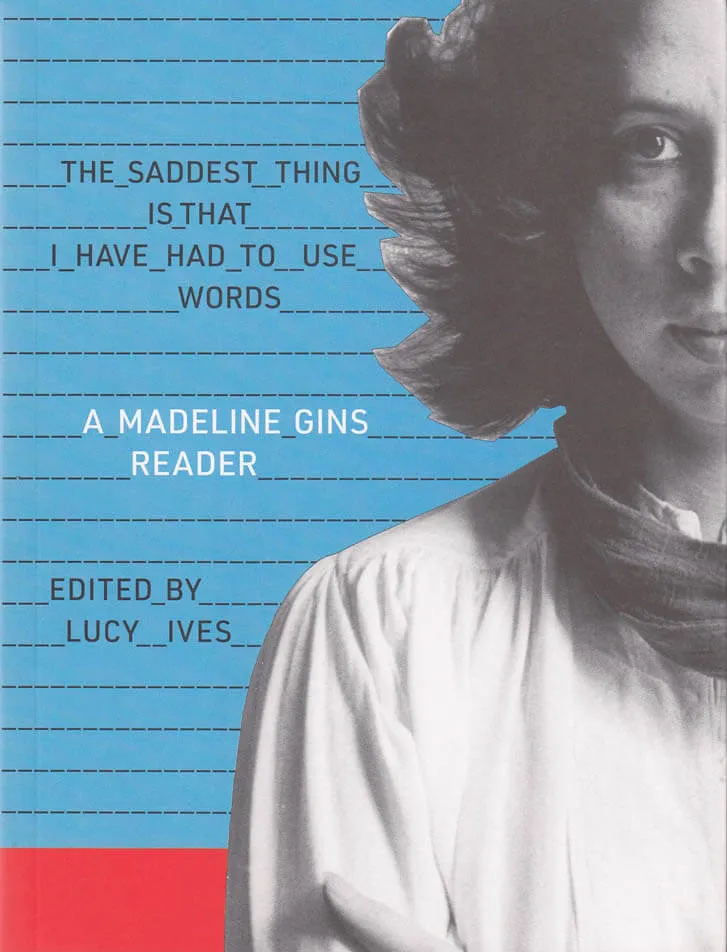
The Saddest Thing Is That I Have Had to Use Words: A Madeline Gins Reader
Poet, philosopher, speculative architect and transdisciplinary artist, Madeline Gins is well known for her collaborations with her husband, the artist Arakawa, on the experimental architectural project Reversible Destiny, in which they sought to arrest mortality by transforming the built environment. Yet, her own writings — in the form of poetry, essays, experimental prose and philosophical inquiries — represent her most visionary and transformative work. Like Gertrude Stein before her, Gins transfigures grammar and liberates words. Like her contemporaries in conceptual art, her writing is attuned to the energized, collaborative space between reader and page.
The Saddest Thing Is That I Have Had to Use Words: A Madeline Gins Reader is a revelatory anthology, edited and with an introduction by the writer and critic Lucy Ives. It brings never-before-published poems and essays together with a complete facsimile reproduction of Gins' 1969 masterpiece, WORD RAIN (or A Discursive Introduction to the Intimate Philosophical Investigations of G, R, E, T, A, G, A, R, B, O, It Says), along with substantial excerpts from her two later books What the President Will Say and Do!! (1984) and Helen Keller or Arakawa (1994). Long out of print or unpublished, Gins' poems and prose form a powerful corpus of experimental literature, one which is sure to upend existing narratives of American poetics at the close of the 20th century.
Edited by Lucy Ives.
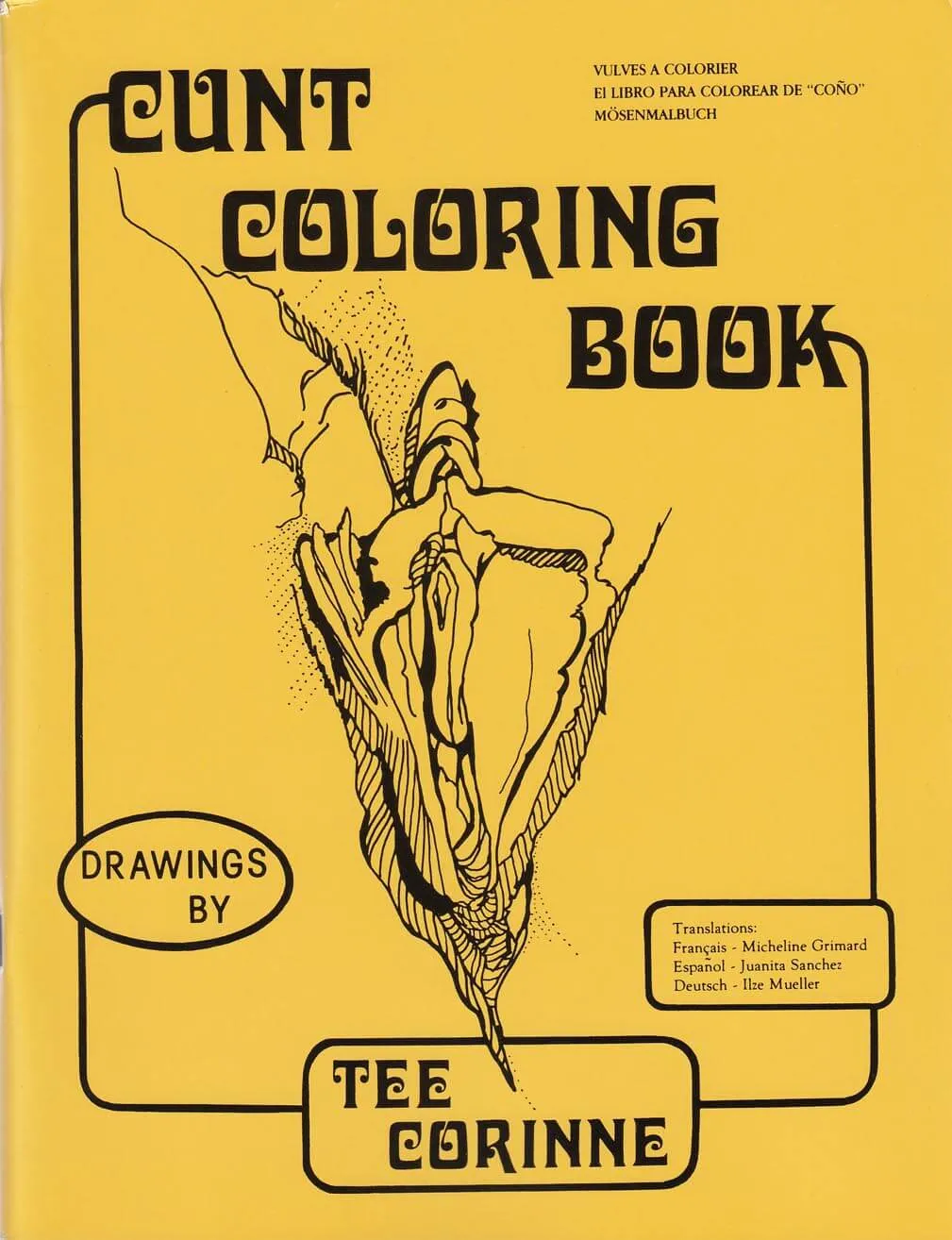
Cunt Coloring Book
Over three dozen c**ts of every size and description for you to color. Originally used for a sex-education class. Crayons not included. First published in 1975 by lesbian activist and artist Tee Corinne.
"In 1973 I set out to do drawings of women’s genitals for use in sex education groups. I wanted the drawings to be lovely and informative, to give pleasure and affirmation. I organized the drawings into a coloring book because a major way we learn to understand the world, as children, is by coloring. As adults many of us still need to learn about our external sexual anatomy." —Tee Corinne
Tee Corinne was born November 3rd, 1943 and grew up in St. Petersburg, Florida. Her mother, also an artist, introduced her to the creative principles and techniques that would serve her all her life. She received a B.A. in printmaking and painting from the University of South Florida, then went on to get an M.F.A. in drawing and sculpture at Pratt Institute, graduating in 1968. Afterwards she taught for many years, traveled through Europe, and finally became enmeshed in the back-to-the-land movement and communal living. After nearly ten years of marriage to a man she referred to as her "best friend," Corinne came out of the closet amidst severe depression in 1975. The strength to accomplish this difficult effort would later propel her to heights and achievements that would distinguish her as "one of the most visible and accessible lesbian artists in the world." From the mid-1960’s to the day she died Corinne created, published, and exhibited her art and writing around the world. She was a co-facilitator of the Feminist Photography Ovulars and a co-founder of The Blatant Image, A Magazine of Feminist Photography. She was the author of one novel, three collections of short stories, four books of poetry and numerous arts publications. In 1980, she was one of ten selected artists invited to have their work exhibited in the Great American Lesbian Art Show. The world lost Tee Corinne to cancer in 2006.
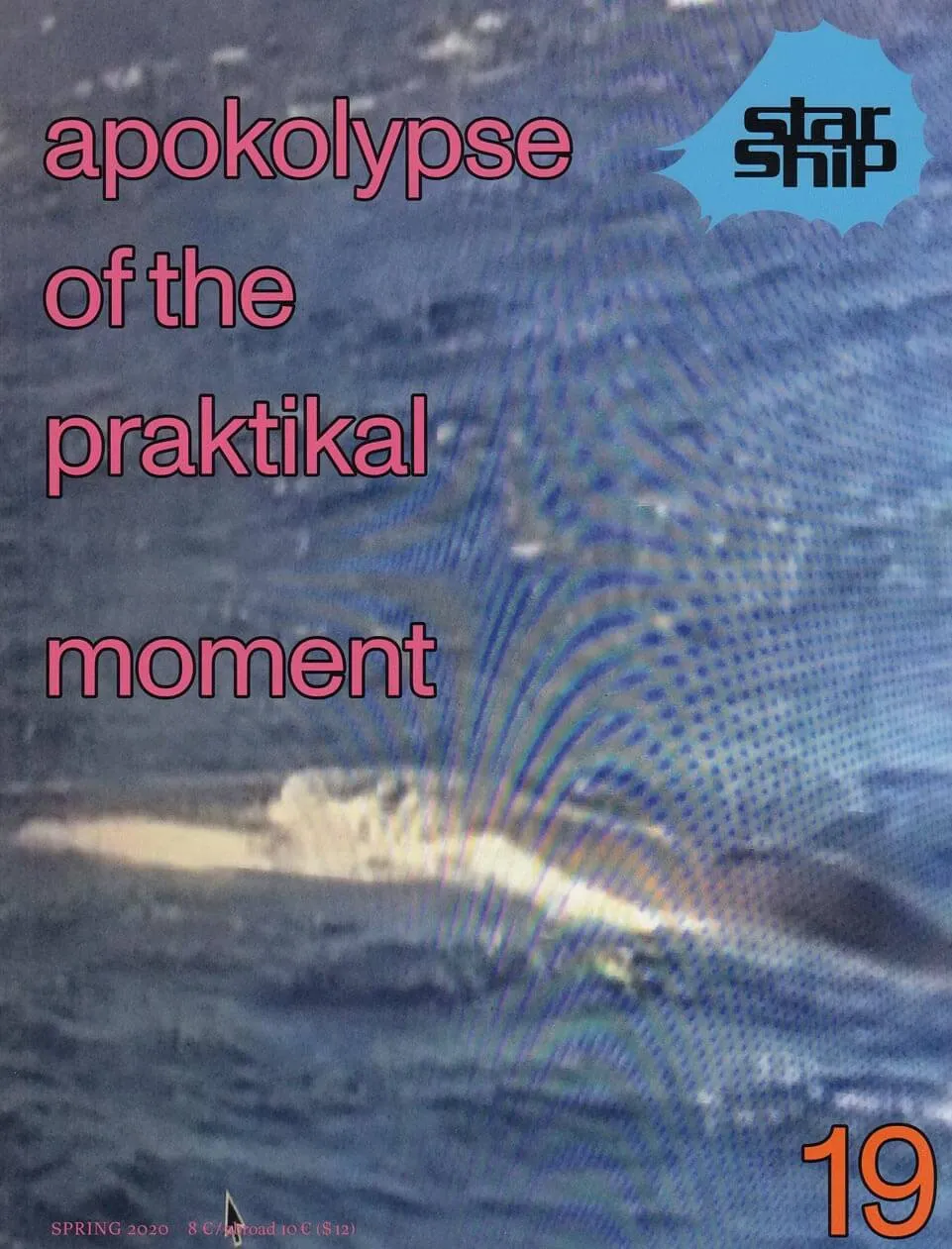
Apokolypse of the praktikal moment
Starship Magazine #19 presents contributions by John Boskovich, Elijah Burger, Simon Denny, Cornelia Herfurtner, Yuki Kimura, Vera Palme, Nora Schultz, Jack Smith; and by Rosa Aiello, Carter Frasier, María Galindo, Samuel Jeffery & Daniel Herleth, Elisa R. Linn, Paul B. Preciado, and Haytham El-Wardany
introducing new columnists: Mihaela Chiriac, Michèle Graf & Selina Grüter, Julia Jung, The Parliament of Bodies, and Ulla Rossek
and our columnists: Tenzing Barshee, Gerry Bibby, Mercedes Bunz, David Bussel, Eric D. Clark, Jay Chung, Hans-Christian Dany with Valérie Knoll, Francesca Drechsler, Stefanie Fezer & Vera Tollmann, Julian Göthe, Karl Holmqvist, Stephan Janitzky, Jakob Kolding, Lars Bang Larsen, Ariane Müller with Huang Rui, Robert M. Ochshorn, Mark von Schlegell, Max Schmidtlein, Amelie von Wulffen, and Florian Zeyfang
and artworks by Melvin Edwards, Elizabeth Ravn, Nong Shoahua, and Mark van Yetter.

Ce Que Laurence Rassel Nous Fait Faire
Agathe Boulanger, Signe Frederiksen and 1 more
In 2018, a group of three visual artists — Agathe Boulanger, Signe Frederiksen and Jules Lagrange— started a year-long conversations with Laurence Rassel, exploring her social and educational background, her ways of working, and examining the tools she applies in her daily practice of running institutions: feminism, the open source and free software movements, and the institutional psychotherapy developed by François Tosquelles and Jean Oury in the psychiatric field around the mid-20th century.

Soon
By means of a dialogue between the text and the visual material from the videos, Steyn Bergs and Emma van der Put want to take a critical look at how images are mobilised, not only to illustrate certain visions of the future, but also how they contribute to the creation of such visions—which are never ‘neutral’—in the present. On the basis of the videos made by Van der Put, this publication focuses on the specific working and politics of images in the Noordwijk and the Expo area in Brussels. Within these locations, developments that are currently taking place throughout Europe (from property speculation to migration flows) manifest themselves in a concrete and local manner.

Pfeil Magazine #10 – Mainstream
Within the format of a magazine, each page of Pfeil represents the floor, walls, or ceiling which together create an imagined room displaying a printed exhibition. Each issue is dedicated to a specific word, and artists are invited and given space to work on and with this term, and to construct or deconstruct the architecture around it. Combined, the contributions transform into an organic display surrounding the leitmotif.
The tenth issue is dedicated to Mainstream, this volume questions exercised motions of majorities, practiced over long or short distances and timeframes, that can become patterns, sometimes taken for granted, sometimes followed unconsciously, automatically, or even mechanically.
Contributions by: Alice Creischer, Annette Kelm, Charlotte Simon, Dodo Voelkel, Emily Pope, Hans-Christian Dany, Harry Gamboa Jr., Heike-Karin Föll, Holly White, Jan Matthé, Jannis Marwitz, Karl Holmqvist, Kevin Gallagher, Lars Bang Larsen, Magdalena Los, Marina Pinsky, Merle Radtke, Nicola Gördes, Pablo Schlumberger, Penny Goring and Stella Rossié.
Editor: Anja Dietmann

Sirens
‘Masturbation in between the crimes against you will become a deciding matter in the kangaroo court. Philosophical questions will be answered without inquiry.’
If you have ever wondered how a cross between a funding application gone wrong and a tabloid column about the art world would read, this is it. Mellor presents a unique combination of novel and image, creating a polymorphous narrator who moves between personifications. Perhaps the most hazardous of these is Tippy Rampage, who is satisfyingly livid with the state of, well, everything.
In a series of paintings, female police officers from British television shows such as Happy Valley and The Bill are positioned in an array of apocalyptic settings: freezing, burning, and backdropped by flooding. The accompanying text chronicles an acute feeling of being watched, what it feels like to watch whoever is watching you, or, as Mellor writes, how it feels to be kettled in your own flat, by your own paintings.
Fragmented accounts map the protagonist’s shifting relationship to crime, gender, class and sexuality from multiple perspectives: as a child in Gamesley in the ‘70s, a lesbian performer in sex clubs in the mid ‘90s, an artist with and without gallery representation, and as a lecturer within an academic institution. These changes of position mix the language of a rally cry with an acerbic satire of the authorial voice and everyone they encounter.
Published by Montez Press, Sirens is the first novel by Dawn Mellor and includes the complete set of the Sirens paintings.
Dawn Mellor (b.1970) is an artist based in London, who has been exhibiting internationally since the 1990s. Solo exhibitions and special projects include Sixty Years at Tate Britain; London, Vile Affections at Studio Voltaire; London, Dawn Mellor at The Migros Museum; Zurich, Sirens at Team Gallery; New York, Madame X and The Party Tricks at Victoria Miro; London, Michael Jackson On The Wall at The National Portrait Gallery; London (touring), What Happened to Helen? Focal Point Gallery; Southend and Malerei, Böse at Kunstverein; Hamburg.

Return To Leptis Magna
Anna Barham’s Return To Leptis Magna is a book which compiles anagrams of the title sentence. We designed the rules which allowed the artist to compose the book, including a typeface which has different letterforms for characters that appear more than once, so that each letter is unique.
Design by Anna Barham & Julia. Typeset in Leptis, designed by Julia.

Poisonous Oysters
The material in Poisonous Oysters was generated during a live production reading group held in Newcastle University’s Fine Art Department on 26.01.18. Passages from the texts listed below were read aloud by the participants and interpreted by speech recognition software over and over, creating a poly-vocal feedback loop with the machine. The output is rewritten here as a score, flattening the time of the event and aligning the different versions of the texts to reveal the sound mutations between them.
Precarious Life, Judith Butler
The Waves, Virginia Woolf
Vampyroteuthis Infernalis, Vilém Flusser
Body Pressure, Bruce Nauman
Testo Junkie, Beatriz Preciado
The Politics of Translation, Gayatri Spivak
Creating trance and hypnosis scripts, Gemma Bailey
Untitled document, John Latham

Wimper
Alex Farrar’s book Wimper (the Dutch term for eyelash, or a potential misspelling of the English for ‘whimper’) presently held by the reader is an extension of an exhibition, which may be experienced in its own right, after the space has been vacated. It operates on the limits of material evidence by reprising a series of earlier prints entitled Behavioural Residues (second sweep), featuring barely perceptible images of single eyelashes spread throughout the texts and pages. Apart from their significance as intimate materials discarded by the body over time, such as hair or skin, they submit to the almost nothing of an aesthetics of disappearance, while lingering in a dialectics of misunderstanding that commits to a lack of closure.
Texts by Nicolas de Oliveira and Nicola Oxley, and David Price. Graphic design by studio Hendriksen, risograph printed by Alex Farrar in studio Hendriksen, Amsterdam, with the cover offset printed by ZwaanLenoirSchuring and bound by AGIA (The Netherlands) in a print run of 300 copies.

Under Current
Companion reader for Under Current, an exhibition and film by Alice dos Reis. With 'Blue Carbon' by Holly Childs, 'Hydrofeminism: Or, On Becoming a Body of Water' by Astrida Neimanis, 'King Tide' by Sophia Al-Maria, 'Notes on a Dotted Red Wave' by Danea Io, 'Smart Oceans, Alien Times: Octopi Engineering' by Bogna M. Konior, 'To a Current's Ear' by Alice dos Reis and more. Bilingual edition (Spanish-English).

Theatrum Botanicum
This publication emerges from Uriel Orlow's Theatrum Botanicum (2015-18), a multi-faceted project encompassing film, sound, photography, and installation, which looks to the botanical world as a stage for politics. Working from the dual vantage points of South Africa and Europe, the project considers plants as both witnesses to, and dynamic agents in, history. It links nature and humans, rural and cosmopolitan medicine, tradition and modernity across different geographies, histories, and systems of knowledge—exploring the variety of curative, spiritual, and economic powers of plants. The project addresses "botanical nationalism" and "flower diplomacy" during apartheid; plant migration; the role and legacies of the imperial classification and naming of plants; bioprospecting and biopiracy; and the garden planted by Nelson Mandela and his fellow inmates at Robben Island prison.

Master Rock
Master Rock is a repertoire for a mountain.
Rough land, open palm. Bodies are machines that shake. Big boned faces, big hands, big claws, ah Jesus, well-used. Bore. Blast. Smash. Force on loan. Must be hard and clever to survive in this technological age. Granite knows the biological. Gods inside the mountain, just plain men outside.
Working through the cavernous space in Ben Cruachan, the largest peak on the west coast of Scotland, Maria Fusco exhumes three fictional voices from fact: Tunnel tigers, the Irish explosives experts who emptied out the mountain to build a power station; Elizabeth Falconer, the artist who produced a mural inside that only the site’s workers ever see; and Granite, the 450 million year-old rock of Cruachan itself as a main character.

The Floor Is Uneven. Does It Slope?
In 1987, artist and poet Madeline Gins (1941–2014) and her partner, painter Arakawa (1936–2010), formed the Architectural Body Research Foundation (later to become the Reversible Destiny Foundation)—an architectural office pursuing the radical conviction that architecture would provide humanity with the necessary tools and training to overcome death. Their wide variety of theories investigated how a person might interact with their environment, and how that environment might condition and enhance the body to increase its capabilities—through a constant undoing and unsettling of subject formation. Taking the work and writings of Madeline Gins and Arakawa as a broad provocation, The Floor Is Uneven. Does It Slope? aims to swallow and masticate the duo’s thought into a new sort of pulp: a collective fan fiction work. Less a book about Gins and Arakawa than a book after them, it tries to seed their work to various fans—writers and makers indebted to the duo’s thinking or suspected to be enthralled by it.
Contributors speak about Gins and Arakawa through the language of their own practice, through academia, poetry, essays, photography, experimental writing, and fiction—thinking about what Gins and Arakawa might mean to their individual fields.
Texts by Henry Andersen, Lila Athanasiadou, Ben Thorp Brown, Lucas Crawford, Bryana Fritz, Laura Herman, Daisuke Kosugi, Joyelle McSweeney, Simone C. Niquille, Andros Zins-Browne.

Verlag der Buchhandlung Walther König
Collected Interviews 1990–2018
This substantial archive offers an ideal point of entry into the work and reception of Los Angeles–based performance artist and writer Andrea Fraser (born 1965). The interview format provides particular insight into Fraser's self-positioning as a central aspect of her practice. By presenting the artist's voice as mediated through various interlocutors (ranging from professional peers to popular media), Collected Interviews, 1990–2018 uniquely contextualizes Fraser's practice in the artistic and institutional fields in which she intervenes.

i apologize
(...) There is no one on the chair, there is no hand on the table, perhaps nobody on the floor. The set up is empty, but some kind of unsettling presence is undeniable. The set up is so obviously fake that there must be something behind it. I am not going to lie: I am going to lie.
If I lie, there is a deliberated stand. I don't have to be "true", to myself, to others. My intention is not to find lying moving, but those who can never lie cannot grow either, cannot discover who they really are. The people, that every day are forced to rip off their personality into fragments, know something about themselves and about life that nobody could teach them. Lying, betraying, is to want to or be able to transform a situation, a fact, an emotion, oneself. The act of lying suddenly un-conceals what has been considered as neutral or as the reference point. The power relations already in place are being revealed, "normality" appears as hegemony. The lie embodies a transgression. It is an attempt to escape normative structures and the refusal to assimilate them. (...)
Includes contributions by Christian Noelle Charles, Andrej Dubravsky, Sandra Golubjevaite, Lewis Hammond, Tarek Lakhrissi, Nils Amadeus Lange, Floriane Michel, Stijn Pommée, Adam Ulbert

Language Pieces
In the late 1960s, Lee Lozano conceived of and executed a series of 'language pieces,' written in the pages of her notebooks, consisting of rules and parameters for the actions that would constitute a piece. From offering money to house-guests to smoking as much marijuana as possible, Lozano boldly tested social norms, culminating in two of her most famous works: 'General Strike Piece' (1969), which saw her retreating from the art world completely, and 'Decide to Boycott Women' (1971), in which she ceased engaging with all members of her own gender.

Queer Direct
Queerdirect is an LGBTQI+ Artist support network, curatorial platform and arts programme. Initiated by Gaby Sahhar in 2017. Co-run With Lily Cheetah. Queerdirect hold regular events and curate exhibitions around London and provide queer artists with a platform and support. Queerdirect is the UK’s first contemporary arts platform and project space dedicated to queer arts.
This is the first edition, September 2019.
A5 perfect bound publication, 81 pp., published by Queerdirect & Camp Books and featuring 31 LGBTQIA+ artists working in and around London.