rile*books

Search books

Search books by title, author, publisher, keywords...

Cover of Vava Dudu

Tabloid Publications

Vava Dudu

Vava Dudu

€13.50

The first anthology of poetry by fashion designer, musician, painter, and Paris icon Vava Dudu. Vava’s poems are culled from language she prints and publishes on garments, as well as song lyrics from her electro-punk band La Chatte. Here her texts are translated from French to English by New York artist, musician and educator Geo Wyeth, and edited by Castilian writer and curator Alberto García del Castillo.

The book was completed in residency at the Centre for Fine Arts, Brussels (BOZAR), as part of the public program accompanying a retrospective exhibition of Keith Haring.

The edition comes in both blue and black prints.

Language: English

recommendations

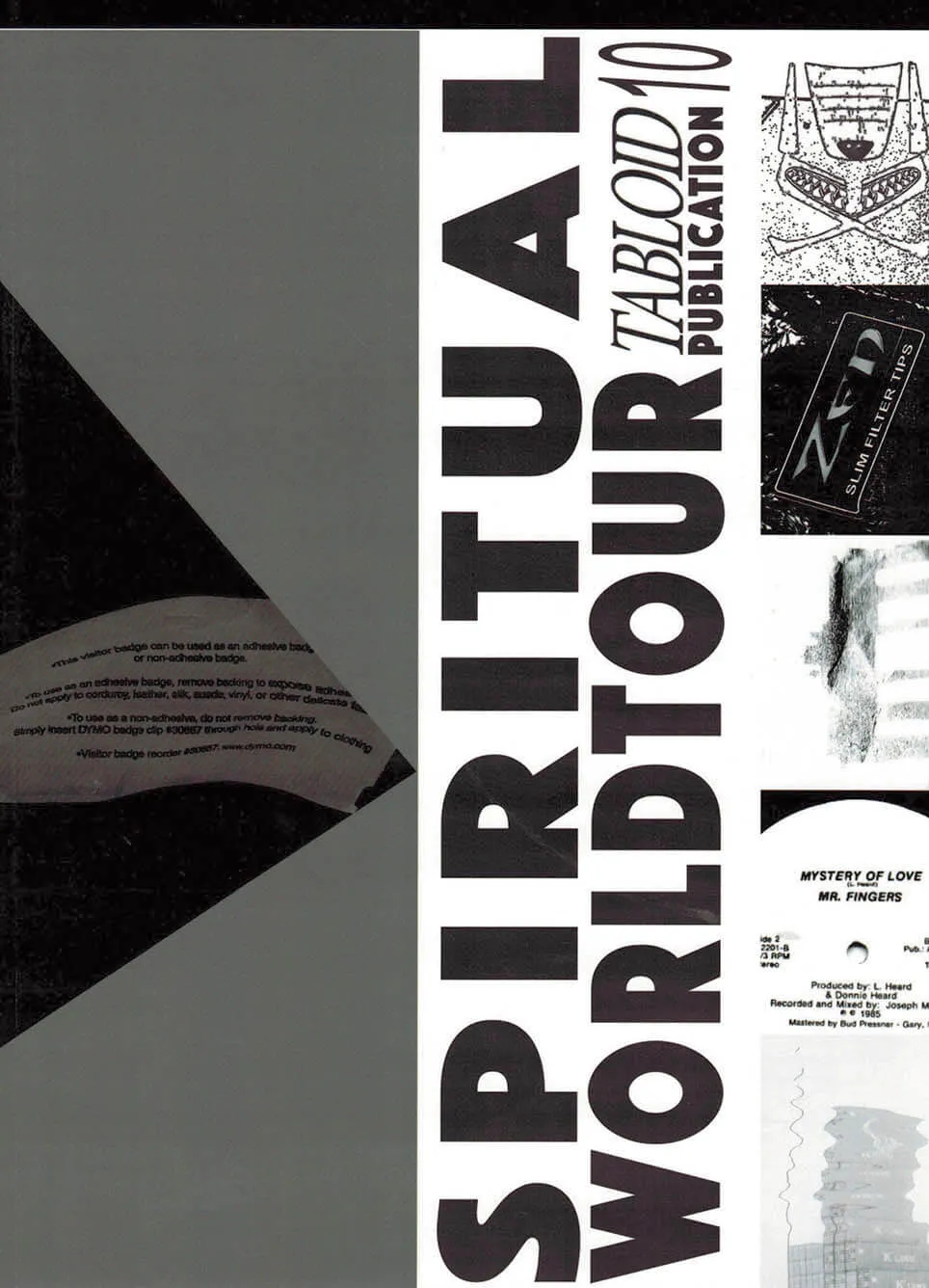
Cover of Spiritual World Tour

Tabloid Publications

Spiritual World Tour

Nat Marcus

Spiritual World Tour by Nat Marcus.
Cover of The Flesh

Tabloid Publications

The Flesh

Yves B. Golden

Poetry €18.00

The Flesh is a collection of Yves B. Golden's poems, lyric essays and social criticism – and often these generic distinctions become blurred. Published by Ediciones La Escocesa (Barcelona, ES), TABLOID facilitated this book's production as editors and book designers. A selection of Golden's texts are also translated by Leto Ybarra, rendering the author's work into Spanish for the first time.

“Respectfully! The Flesh feels like a conjuring and a force of nature—unyieldingly raw, full of delectable sensitivity that shapes a world Yves B. Golden deliveries with formidable honesty—where her word is the journey, the body and the bond. Yves writes: ‘not one bird is declined entry into heaven’. The Flesh is succulent in the mouth of the mother— Yves is a steward of time machines, celestial bliss and untethered healing. The Flesh unties the tongue, waters the mouth and the garden. Within Yves’ 5th book she offers us a timeline in recognizing that all birds and angels alike can touch the sky. We are always, already, held and drenched in glory and deserving of love and safety. The Flesh is Black like obsidian. May our love bloom like the flesh in every lifetime.”
- keioui keijaun thomas

“Yves B Golden has given us a protection spell against tyranny; a Blue Guide for the conscious and the daydream; raw free jazz that knows the standards as well. Golden’s linguistically liberated fantasies can transmute into a body of politically imperturbable ethoses in the same sentence. This book offers information for an evolutionary sensitivity, for the next level of sense-making and particularity of the human being. Though the poet urges us to de-realize the flesh, to split our own heads open, we must also accommodate the flesh’s intangibles that interlock, conjoin, negate, and negotiate: such ‘outward and inward facing conundrums’ go on and on. Welcome this ‘bearer of turbulent news.’”
- Losarc Raal

Cover of Fous Moi La Paix

Goswell Road

Fous Moi La Paix

Vava Dudu

Goswell Road presents Fous Moi La Paix a book of drawings by multidisciplinary artist Vava Dudu. Vava made 37 exclusive drawings for the publication, which launched at Paris Ass Book Fair 2024 at Palais de Tokyo. The drawings are offset with her texts, poems and several images of her iconic clothing and accessories.

"The multidisciplinary artist Vava Dudu refuses to follow convention: she draws and writes poetry, makes clothes and accessories, and builds furniture and guitars. She asserts her position as an outsider in contemporary art by stating that she “prefers extremes to the middle ground.” Her work as an independent stylist goes hand in hand with her activity as a singer in La Chatte, an electro-zouk punk new wave band founded in 2013 with Stéphane Argillet and Nicolas Jorio, aka “Nikolu.” Her underground artistic world, which joyously combines text and image, is expressed through various media.

Vava Dudu was born in 1970 in Paris, where she lives and works."

Text from Lafayette Anticipations website

Cover of Oriental Cyborg

Essay Press

Oriental Cyborg

Aditi Kini

Essays €15.00

Who is the Oriental Cyborg? asks Aditi Kini in this collection of notes, jokes, and queries into the provenance of a creature designed for labor, 3-D printed in the technoscientific post-colonies, modeled on old automata. Race is a technology, that we know, and technology can be raced — so why inquire into this at all? Perhaps this, the Oriental Cyborg, is a fantasy more than a memory, or an echo more than a form — or just an essayist’s extraction of personal anguish and humor from globalist decay.

Taking on the form of historical analysis / lyrical essay / documentary poem / experimental buzzword / positionality statement, this chapbook and its titular character might still be an elusive mystery even after reading.

“’What is a ghost but a person removed from corporeality?’ This is one among layers of questions Aditi Kini poses in Oriental Cyborg, a lyrical excavation into survival in the era of techno racial capitalism, and its “deleting touch” that so easily voids—reduces to faceless services—the exploited individuals performing various acts of techno-labor. A grieved searching drives this hybrid essay, which feels urgent and necessary as threats from AI grab headlines. This work compels us to see our culture’s love affair with technological progress as a means for continued colonization and domination. It also reminds us, and celebrates, that those erased don’t stay silent forever. We privileged may not be able to hear them yet, but those who are listening know. They roar.” — Allison Cobb

“In the mirror of Aditi Kini’s Oriental Cyborg, I become the monster—a hopeless automaton, an intelligence stripped of roar. With titanium-threaded theory, Kini radiantly stitches together the ideal Asian working machine. Get your own Oriental cyborg today: super dazzling and sexy, historically embroidered, an oracular truth who never tires, never complains, forever mute, what perfection!” — Lily Hoàng

Aditi Kini is an undisciplined writer. They’ve done both NYC and the MFA (at UC San Diego). They were a finalist/alternate for the 2020-22 Jerome Award for Literature. They edit Lumpenpockets, “a nonquarterly sick rag.” Read their words in Hayden’s Ferry Review, The Rumpus, Denver Quarterly, The New York Times, and elsewhere. They’re at work on multiple projects, all at once. They are blessed with two dogs, Lucy the Happy and Charly Kong, who make life worth living.

Cover of Fuel

Nightboat Books

Fuel

Rosie Stockton

Poetry €18.00

Traversing multivalent intimacies from the underworld of California’s Central Valley oil fields to the quotidian domestic and love’s painful retraction, Stockton’s poems articulate the blurry modes of extraction, fantasy, loss, gender, and labor as they interact and overlap in the shadow of environmental and personal collapse. Between gas station gifts, Venmo requests, and nocturnal love letters, Fuel unravels the self and violent systems of domination, longing for a togetherness that transcends its own ending.

In these poems, Stockton plunges into petrologic, long drives, the beginnings of ends—whatever enters into love between people and makes it so abstract, or common. In other words, its great subject is the edge, and Fuel is a book of horizons. - Benjamin Krusling

Rosie Stockton is the author of Permanent Volta (Nightboat Books 2021) which was the recipient of the Sawtooth Prize as well as being a finalist for the California Book Awards in Poetry and the Publishing Triangle’s Audre Lorde Award for Lesbian Poetry. Their poems have been published by Social Text Journal, VOLT, Jubilat, Apogee, Mask Magazine, Tripwire and WONDER PRESS. They hold an M.A. in Creative Writing from Eastern Michigan University and are currently a Ph.D. Candidate in the Gender Studies Department at UCLA. Rosie lives and works in Los Angeles.

Cover of The Power of Adrienne Rich: A Biography

Nan A. Talese

The Power of Adrienne Rich: A Biography

Hillary Holladay

Poetry €30.00

The first comprehensive biography of Adrienne Rich, feminist and queer icon and internationally revered National Book Award winning poet.

Adrienne Rich was the female face of American poetry for decades. Her forceful, uncompromising writing has more than stood the test of time, and the life of the woman behind the words is equally impressive. Motivated by personal revelations, Rich transformed herself from a traditional, Radcliffe-educated lyric poet and married mother of three sons into a path-breaking lesbian-feminist author of prose as well as poetry. In doing so, she emerged as both architect and exemplar of the modern feminist movement, breaking ranks to denounce the male-dominated literary establishment and paving the way for the many queer women of letters to take their places in the cultural mainstream. Drawing on a wealth of unpublished materials, including Rich's correspondence and in-depth interviews with numerous people who knew her, Hilary Holladay digs deep into never-before-accessed sources to portray Rich in full dimension and vivid, human detail.

Cover of Black Ark

Edition Patrick Frey

Black Ark

Lee Scratch Perry

The point of departure for the book «Black Ark» with Lee “Scratch” Perry (1936–2021), a Jamaican musical and visual artist who was based in Switzerland, is a detailed inventory of photographs and writings (Spring 2021) from the Black Ark Studios in Kingston, Jamaica, where Lee produced his music from 1973 on. He was a seminal pioneer of dub, an electronic subgenre of reggae that uses sampling, looping, remixing, reverb and echoes to create new songs as well as rework  and appropriate pre-recorded songs and tracks.

Black Ark Studios was one of the cradles of dub. It’s also where Lee “Scratch” Perry’s musical approach found an enduring visual counterpart in the form of continuously evolving mural paintings and drawings  as well as shape-shifting assemblages of records, instruments, found objects, posters, newspaper and magazine clippings, and appropriated books. The artworks form actual layers upon layers that are rhizomatically intertwined with the studio building itself  as well as with the furniture inside—and with Perry’s biography and persona.

Perry created his very own, dense and eclectic world—a world that is documented in «Black Ark», before it disappears for good: the premises have recently been sold. The photographic documentation of the studio was supplemented by efforts to secure and preserve Perry’s cultural objects as part of a joint project with various cultural institutions.

«Black Ark» which reflects the rhythm and layering effects of collage both in its content and the materials used to craft the book. Perry was involved in the conception of the book in its early stages. It also interweaves various media and chronologies. The new photographs of the Black Ark Studios will be juxtaposed with stills from old documentaries and archival photos.

The idea of a “house” serves as both a working hypothesis and a metaphor. It will be the starting point and endpoint of various thematic strands, both visual and textual: for example, the book will explore the Black Ark as a “spiritual yard” in the context of African diaspora, as well as looking into archeomusicological aspects. Furthermore, extended captions by Perry’s biographer will provide the backdrop for a kaleidoscopic panorama of Perry’s eclectic and ingenious work.

Cover of Men in Aïda

Uitgeverij

Men in Aïda

David Melnick

Poetry €24.00

David J. Melnick published the first book of Men in Aida, a homophonic, but also homoeroticized translation of Homer's epic Iliad, in December 1983 in an edition of 450 at Tuumba Press. After appearing in many guises and fragments, Book Two was published online in 2002 as part of the Eclipse Archive. Book Three appears for the first time in the present publication, which brings together all three books of one of the most important American avant-garde poems. 

According to Sean Gurd, who wrote the introduction to this unified edition: "The labor of more than 20 years, Men in Aïda filters the sound of Homer's Iliad through the words and phraseology of English. Far more than an exercise in homophonic translation, David J. Melnick's epoch-marking poem packs thousands of years of linguistic history into three riotous books."