rile*books

Search books

Search books by title, author, publisher, keywords...

Explore

Categories
Visit
Collections
Publishers
Back in stock
Any books
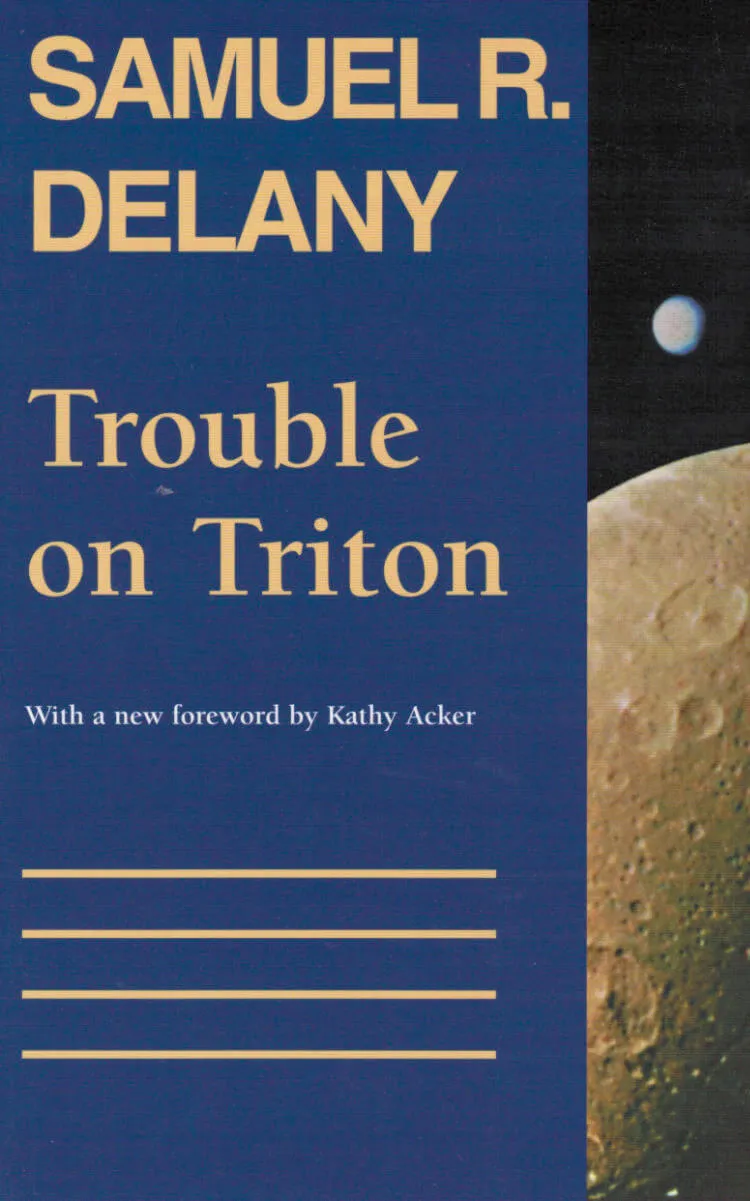
Cover of Trouble on Triton

Wesleyan

Trouble on Triton

Samuel R. Delany

€18.00

In a story as exciting as any science fiction adventure written, Samuel R. Delany's 1976 SF novel, originally published as Triton, takes us on a tour of a utopian society at war with our own Earth. High wit in this future comedy of manners allows Delany to question gender roles and sexual expectations at a level that, 20 years after it was written, still make it a coruscating portrait of "the happily reasonable man", Bron Helstrom - an immigrant to the embattled world of Triton, whose troubles become more and more complex, till there is nothing left for him to do but become a woman.

Against a background of high adventure, this minuet of a novel dances from the farthest limits of the solar system to Earth's own Outer Mongolia. Alternately funny and moving, it is a wide-ranging tale in which character after character turns out not to be what he - or she - seems.

Language: English

recommendations

Cover of Silence: Lectures and Writings

Wesleyan

Silence: Lectures and Writings

John Cage

Essays €27.00

Silence: Lectures and Writings is a book by American experimental composer John Cage (1912–1992), first published in 1961 by Wesleyan University Press. Silence is a collection of essays and lectures Cage wrote during the period from 1939 to 1961.

Most of the works are preceded by a short commentary on their origins, some have an afterword provided. Several works feature unorthodox methods of presentation and/or composition. "The Future of Music: Credo" juxtaposes paragraphs of two different texts. The text of the first part of "Composition as Process" is presented in four columns, the text of "Erik Satie" in two. "45' for a Speaker" is similar to Cage's "time length" compositions: it provides detailed instructions for the speaker as to exactly when a particular sentence or a phrase should be said. "Where Are We Going? and What Are We Doing?" is presented in several types of typeface to better reflect the concept of the lecture, which was originally presented as four tapes running simultaneously. "Indeterminacy" is a collection of various anecdotes and short stories taken from life or books Cage read: the concept is to tell one story per minute, and to achieve the speaker has to either speed up or slow down, depending on the length of the story.

Cover of My Life and My Life in the Nineties

Wesleyan

My Life and My Life in the Nineties

Lyn Hejinian

Fiction €17.00

New edition of one of the founding works of Language writing. 

Lyn Hejinian is among the most prominent of contemporary American poets. Her poem My Life has garnered accolades and fans inside and outside academia. First published in 1980, and revised in 1987 and 2002, My Life is now firmly established in the postmodern canon. This Wesleyan edition includes the 45-part prose poem sequence along with a closely related ten-part work titled My Life in the Nineties. An experimental intervention into the autobiographical genre, My Life explores the many ways in which language — — the things people say and the ways they say them — shapes not only their identity, but also the very world around them.

Cover of The Original 1939 Notebook of a Return to the Native Land: Bilingual Edition

Wesleyan

The Original 1939 Notebook of a Return to the Native Land: Bilingual Edition

Aimé Césaire

Poetry €18.00

The first bilingual edition of this radically original work.

Aimé Césaire's masterpiece, Notebook of a Return to the Native Land, is a work of immense cultural significance and beauty. This long poem was the beginning of Césaire's quest for négritude, and it became an anthem of Blacks around the world. Commentary on Césaire's work has often focused on its Cold War and anticolonialist rhetoric—material that Césaire only added in 1956. The original 1939 version of the poem, given here in French, and in its first English translation, reveals a work that is both spiritual and cultural in structure, tone, and thrust. This Wesleyan edition includes the original illustrations by Wifredo Lam, and an introduction, notes, and chronology by A. James Arnold.

Cover of  Drawing the Surface of Dance: A Biography in Charts

Wesleyan

Drawing the Surface of Dance: A Biography in Charts

Annie-B Parson

Performance €26.00

Soloing on the page, choreographer Annie-B Parson rethinks choreography as dance on paper. Parson draws her dances into new graphic structures calling attention to the visual facts of the materiality of each dance work she has made. These drawings serve as both maps of her pieces in the aftermath of performance, and a consideration of the elements of dance itself. 

Divided into three chapters, the book opens with diagrams of the objects in each of her pieces grouped into chart-structures. These charts reconsider her dances both from the perspective of the resonance of things, and for their abstract compositional properties. In chapter two, Parson delves into the choreographic mind, charting such ideas as an equality in the perception of objects and movement, and the poetics of a kinetic grammar. Charts of erasure, layering and language serve as dynamic and prismatic tools for dance making. Lastly, nodding to the history of chance operations in dance, Parson creates a generative card game of 52 compositional elements for artists of any medium to cut out and play as a method for creating new material. Within the duality of form and content, this book explores the meanings that form itself holds, and Parson's visual maps of choreographic ideas inspire new thinking around the shared elements underneath all art making.

ANNIE-B PARSON is a choreographer and artistic director of Big Dance Theater. Parson has also made choreography for rock shows, marching bands, symphonies, movies, museums, objects, augmented reality, and people: David Byrne, David Bowie, St. Vincent, Mikhail Baryshnikov, Wendy Whelan, Laurie Anderson, Nico Muhly, Jonathan Demme, and the Martha Graham Dance Co. SIOBHAN BURKE writes on dance for the New York Times and other publications. She teaches at Barnard College.

Cover of The Lesbian Body

Winter Editions

The Lesbian Body

Monique Wittig

Non-fiction €22.00

In this genre- and gender-breaking work of theory-fiction, legendary writer and cofounder of the 1970s French feminist movement Monique Wittig celebrates the body—lesbian, literary and defiantly political—and challenges the order of heterosexuality in literature. 

First published in French in 1973, The Lesbian Body mines the relationship between a lover and a beloved—also a writer and a text—to explore the ideological and historical constructions of the female subject. Organized according to the principle of montage, poetic passages are juxtaposed with anatomic lists that mark lesbian eros. Through expressions of joy, violence, and tenderness, the site of pleasure is celebrated. In her transfiguration of gender and its paradigms, Wittig transformed French vocabulary, feminizing grammar and lesbianizing myths. This edition brings the English translation of Wittig’s groundbreaking work back into circulation for the first time since the mid-1980s, revised according to the author's notes, and with an introduction by Paul B. Preciado.

The Lesbian Body is a fundamental work of lesbian existence. Wittig's applied vision is a state of natural delirium, a revolutionary excess of utopianism, refusal, and mutual self-creation. Revisiting it reveals how much passionate free thought has been lost, and simultaneously, how many of her tropes and discoveries have integrated into our collective consciousness.” — Sarah Schulman

“In this stunning new rendering of The Lesbian Body by the French author, theorist, activist and teacher, the late Monique Wittig, we are plunged into an imagined world of passionate violence and erotic lesbian mayhem intertwined in strikingly bold poetic images. Wittig, in the reach and volatility of her imagination, stands alongside such important American writers as Audre Lorde, Adrienne Rich, and Valerie Solanas, all of whose work deserves to be read again, or for the first time.” — Esther Newton

“To read the book is to be forced by Wittig into another grammar and happily contaminated by its strange forms. You will never think straight again.” — Jack Halberstam

“For me, Wittig opened up a sense of the world that had been, quite literally, unimaginable. She tore us apart.” — Judith Butler

“Together with Ursula Le Guin and Samuel R. Delany, Wittig is the first to design a nonbinary utopia, a world in which the binary categorization of sexes and genders will have ceased to exist.” — Paul B. Preciado

Introduction by Paul B. Preciado
Translated by David Le Vay

Cover of We Circle Through The Night and Are Consumed by Fire

SB34

We Circle Through The Night and Are Consumed by Fire

Simon Asencio, Pauline Hatzigeorgiou

This publication acts as a postscriptum to the exhibition project Through The Valley of The Nest of Spiders by Simon Asencio for SB34—The Pool in Brussels. Dedicated to Samuel R. Delany's sci-fi and sexutopia novel, the exhibition was conceived as a process of annotating the book, expanding on the ethics discussed by the characters of the novel through installation, performative readings and with the complicity of other artists and their works. This devious object pursues such an intertextual process, extending and disseminating the writings forged by the exhibition. 

Cette publication se présente comme le post-scriptum de l'exposition de Simon Asencio Through The Valley of The Nest of Spiders pour SB34—The Pool à Bruxelles. Dédiée au roman de science-fiction et de sexutopie de Samuel R. Delany dont elle porte le titre, l'exposition a été pensée comme un processus d'annotation de ce livre, développant les formes éthiques mises en pratique par les personnages du récit, à travers des installations, des lectures et situations performatives, avec la complicité d'autres artistes. Cet objet interlope poursuit ce processus intertextuel, en prolongeant et disséminant les écritures forgées par l'exposition.

With contributions by / avec les contributions de: Reinhold Aman, Henry Andersen, Simon Asencio, Jen Brodie, Chloe Chignell, Jack Cox, Samuel R. Delany, Diana Duta, Loucka Fiagan, gladys, Stefa Govaart, Sean Gurd, Pauline Hatzigeorgiou, Maxime Jean-Baptiste, Bernard-Marie Koltès, David J. Melnick, Matthieu Michaut, Margaret Miller, LaTasha N. Nevada Diggs, Anouchka Oler Nussbaum, Grisélidis Réal, Páola Revenióti, Sabrina Seifried, Raphaëlle Serres, Valerie Solanas, sabrina soyer, Megan Susman.

Cover of The Stone Door

New York Review of Books

The Stone Door

Leonora Carrington

Fiction €16.00

The Stone Door is a surrealist allegory intertwining myth, mysticism, and romance. Written by Leonora Carrington after World War II, the novel follows a woman's symbolic journey through esoteric teachings, ancient lands, and dreamlike visions in pursuit of spiritual awakening and the unification of male and female forces. Both a metaphysical adventure and a tribute to Carrington's personal love story, it offers a visionary exploration of transformation and liberation.

Cover of The Ultraviolet Catastrophe

Zero Books

The Ultraviolet Catastrophe

Susan Finlay

Fiction €18.00

Legal-high addict, gaming enthusiast, and principal shareholder of AstroLabs™, Lex Rameses, has recently discovered—and purchased—Proserpina: a planet with a near-identical ecosystem to Earth’s. Yet, although his humanistic, hipster pretensions mean that many people admire him, there is still one thing standing in the way of his space-colonization program: as of yet, there is no way to travel to Proserpina safely.

Enter a cast of mad scientists, Astro–Marxists, a neurorobotic AI hivemind, an extinction anxiety addict, the victims of an interrelated crypto-currency gaming scam, and a seemingly endless succession of ravers and gamers in search of the ultimate hallucinogenic, carcinogenic, neü-space-age high…

The Ultraviolet Catastrophe is raucous, hilarious, irreverent, and wildly smart, taking aim at techno-salvation fantasies, startup culture, and the eternal humiliation of having a body under the ridiculous conditions of late capitalism. Finlay's new novel is as unexpected and unique as all of her work. Read it now.
Elvia Wilk, author of Oval and Death by Landscape 

Cover of Girl On Girl: Stories

Rejection Letters

Girl On Girl: Stories

Emily Costa

Fiction €20.00

What happens when you peak in high school, or maybe earlier, or maybe not at all? When you hate your friends, or love them too much? When the warmth of nostalgia starts to slowly poison you? In Girl on Girl, Emily Costa explores desperation and loneliness, screen obsession, and casual cruelty as characters—mostly women and girls—struggle to be seen.

Cover of The Carrier Bag Theory of Fiction

Silver Press

The Carrier Bag Theory of Fiction

Ursula K. Le Guin

Sci-Fi €10.00

In The Carrier Bag Theory of Fiction, visionary author Ursula K. Le Guin tells the story of human origin by redefining technology as a cultural carrier bag rather than a weapon of domination.

Hacking the linear, progressive mode of the Techno-Heroic, the Carrier Bag Theory of human evolution proposes: ‘before the tool that forces energy outward, we made the tool that brings energy home.’ Prior to the preeminence of sticks, swords and the Hero’s killing tools, our ancestors’ greatest invention was the container: the basket of wild oats, the medicine bundle, the net made of your own hair, the home, the shrine, the place that contains whatever is sacred. The recipient, the holder, the story. The bag of stars. 

This influential essay opens a portal to terra ignota, where the possibilities of human experience and knowledge can be discovered anew. 

Cover of Merchant

Goldsmiths Press

Merchant

Alexandra Grunberg

Sci-Fi €25.00

A post-apocalyptic retelling of William Shakespeare's The Merchant of Venice.

Who will survive when the world is destroyed? Can stories from the distant past teach us how to change a dismal present? Merchant shifts perspective between three survivors of a flooded world as they try to navigate the threat of mass starvation; Jessica, a patrilineal Jew from Venice (named after the Italian city but located on the mountain K2) who has memorized the complete works of Shakespeare; Cem, an orphan of Venice; and Shinobu, an advisor to the empress Ama in Fuji. Ama has been gifting edible algae blocks to nations worldwide, but Jessica's arrival in Fuji to beg for more food for Venice upsets the delicate international balance Shinobu has been maintaining. As a series of buried secrets and miscommunications carry consequences of potential global destruction, everyone must determine what they are willing to do to survive in a hopeless world.

Alexandra Grunberg attended New York University's Tisch School of the Arts earning a BFA in Theatre. She earned her MLitt and DFA in Creative Writing at The University of Glasgow. Grunberg presented her research at various academic conferences in the UK, including “Once and Future Fantasies” at the University of Glasgow, “CRSF 2021 10th Anniversary Conference—Speculative Futures & Survival” by the University of Liverpool, “Beast Modernisms Conference 2019” at The University of Glasgow, “Creative Writing: Processes, Theory, and Influences” at The University of Edinburgh, and “The Literary Self: From Antiquity to the Digital Age” at The University of Edinburgh.