Peninsula Press
Peninsula Press

Cast in Doubt
It is 1974. American and English expatriates, artists, writers, and eccentrics find their home in a quiet town on the island of Crete. Among them is Horace Vaughn, a sixty-five-year-old gay American writer who has long been at work on Household Gods, his attempt at the Great American Novel, and who in the meantime supports himself by dashing off detective stories.
Horace’s young Greek lover often annoys him, provides little satisfaction, and Horace idles his time away with alcohol, friends, and machinations. That is, until a young, enigmatic nineteen-year-old American woman named Helen arrives, another outsider. In Helen, Horace discovers someone brilliant, beautiful, and stubbornly mysterious. He is fascinated by her punk style and elusive pose. In this small town, gossip spreads fast, and Helen’s past begins to follow her to Crete: a suicidal ex-lover appears without warning, and there are whispers of her long-dead sister. The Henry Moore crowd dislike her, and a Greek waiter’s wife threatens to murder her.
When Helen vanishes, Horace is determined to follow her, to find her, especially her diary. His journey around Crete in his beat-up VW bug is funny and poignant, and for Horace, the mystery continues.

On Breathing
A beautiful, expansive essay about care, dependence, and what it means to breathe in an age of environmental catastrophe.
A few moments after birth we begin to use our lungs for the first time. From then on, we must continue breathing for as long as we are alive. And although this mostly happens unconsciously, in a society plagued by anxiety, climate change, environmental racism, and illness, there are more and more instances that ‘teach us about the privilege that is breathing.’
Why do we so easily forget the air that we breathe in common? What does it mean to breathe when the environment that sustains life now threatens it? And how can life continue to flourish under conditions that are increasingly toxic?
To approach these questions, Jamieson Webster draws on psychoanalytic theory and reflects on her own experiences as an asthmatic teenager, a deep-sea diver, a palliative psychologist during covid, a psychoanalyst attentive to the somatic, and a new mother. The result is a compassionate and timely exploration of air and breathing as a way to undo the pervasive myth of the individual by considering our dependence on invisible systems, on one another, and the way we have violently neglected this important aspect of life.

The Dissenters
Amna, Nimo, Mouna – these are all names for a single Egyptian woman whose life has mirrored that of her country. After her death in 2015, her son, Nour, climbs to the attic of their house where he glimpses her in a series of ever more immersive visions: Amna as a young woman forced into an arranged marriage in the 1950s; as a coquettish student of French known to her confidants as Nimo; a self-made divorcee and a lover; a ‘pious mama’ donning her hijab; and, finally, as a feminist activist during the Arab Spring.
Charged and renewed by these visions of a woman he has always known as Mouna, Nour begins a series of fevered letters to his sister – who has been estranged from Mouna and from Egypt for many years – in an attempt to reconcile what both siblings know about this mercurial woman, their country, and the possibility for true revolution after so much has failed.
Hallucinatory, stylish, and erotic, The Dissenters is a transcendent portrait of a woman and an era that explodes our ideas of faith, gender roles, freedom, and political agency.
YOUSSEF RAKHA is an Egyptian author of fiction and nonfiction working in Arabic and English. He is the author of The Book of the Sultan’s Seal, The Crocodiles, and Paulo, which was long-listed for the International Prize for Arabic Fiction and won the 2017 Sawiris Award.
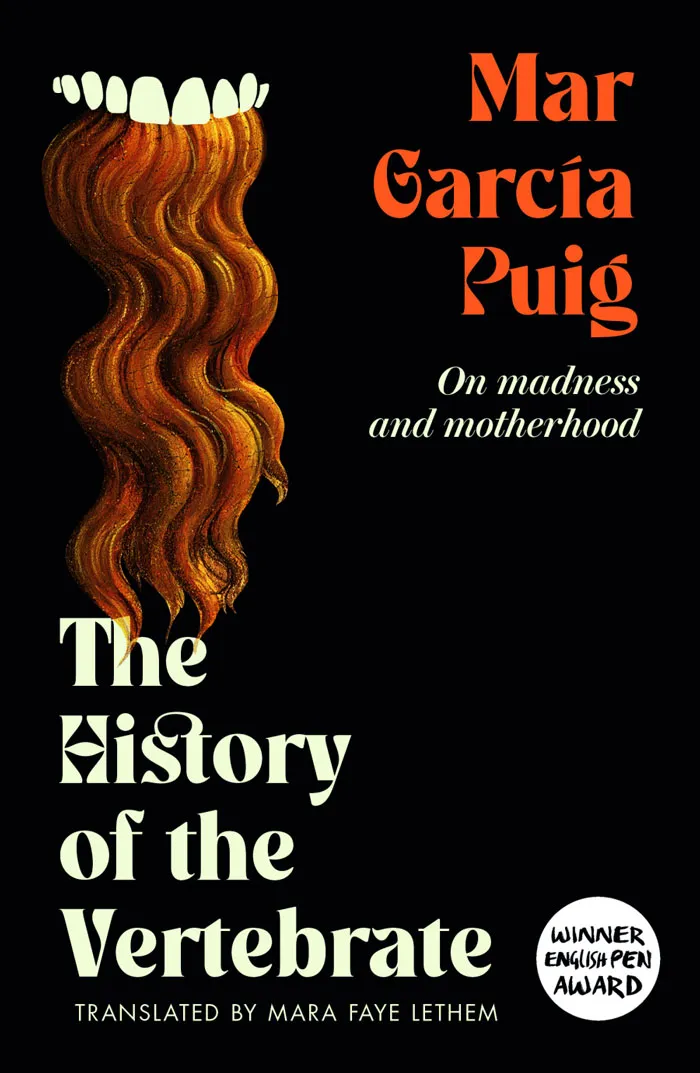
The History of the Vertebrate
Mar García Puig, Mara Faye Lethem
‘On 20 December 2015 I became a mother and I went mad.’
On a single day, Mar García Puig gives birth to twins and becomes elected to the Spanish Parliament as a member of the insurgent left-wing party Podemos. What might have been the best day of her life becomes the start of a terrifying ordeal; García Puig’s grip on reality begins to slip as she grapples with uncertainty, the weight of expectation, and misogyny in both of her new roles.
In defiance of a culture that tells her the problem lies within, García Puig chooses to look outwards, examining the imbrication of madness and motherhood across centuries of science, myth, and politics while dissecting the ways in which women have been pathologized and banished from public life.
At once intimate and epic, The History of the Vertebrate is a searing account of postpartum madness. Moving between memory, culture, and the history of medicine, García Puig transforms her experience into a story about the countless women who have felt that sanity was leaving them, and about the patriarchal forces that have silenced them.
MAR GARCÍA PUIG is an editor and author. From 2015 to 2023 she was a member of the Spanish Congress of Deputies for Podemos, where she served on the Culture Committee and the Equality Committee. Her books include The History of the Vertebrate and This Thing of Darkness.

A Nazi Word for a Nazi Thing
An essay on art, bodies and fascism.
In an era where identity politics is being weaponised against the very people it has sought to make visible, how can we reclaim complexity?
In 1937 the Nazis staged an exhibition of seized modernist artworks. Named Entartete ‘Kunst’ – Degenerate ‘Art’ – it sought to define degeneracy, display it and destroy it.This act of violent appropriation is one episode in a long and ongoing history of the erasure of queer and non-normative cultures.
A Nazi Word for a Nazi Thing works against this erasure; it is a manifesto – a catalogue for an exhibition that could never take place. Drawing on work from dissident sexologist Magnus Hirschfeld to South African artist Zanele Muholi, as well as a century of queer cinema from Sergei Eisenstein to Pedro Almodóvar, So Mayer creates an archive of resistance.
‘This book is a small revolution that becomes a party that you won’t be leaving soon. I believe we’re living in a time of fresh erasures, systemic violences working that global pandemic to take some other bodies out. Looking so freshly at the history of queerness, sexual deviance and the long long coordinated erasures of colonialism, bigotry and transphobia the essential non binary nature of art opens up right here like the wildly singing flower it is and So Mayer’s compelling version makes sense, makes me listen.’
— Eileen Myles
‘A Nazi Word for a Nazi Thing is a reflective, creative walk through some of the worst – and best – people of the last hundred years, looking at the power of images and their relationship(s) with text. In a time of rising fascism, So Mayer highlights ways that artists have found strategies of resistance, and offers hope in historical analysis.’
— Juliet Jacques