rile*books

Search books

Search books by title, author, publisher, keywords...

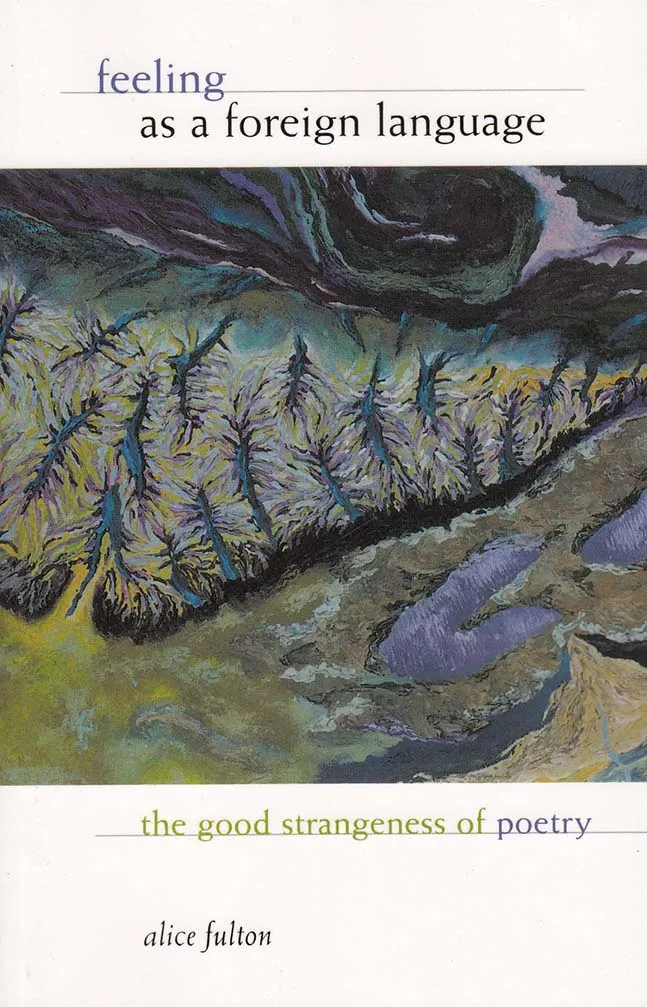
Cover of Feeling as a foreign language

Graywolf Press

Feeling as a foreign language

Alice Fulton

€18.00

In Feeling as a Foreign Language, poet and critic Alice Fulton considers poetry's uncanny ability to access and recreate emotions so wayward they go unnamed. How does poetry create feeling? What are fractal poetics? 

In a series of provocative, beautifully written essays concerning "the good strangeness of poetry," Fulton contemplates the intricacies of a rare genetic syndrome, the aesthetics of complexity theory, and the need for "cultural incorrectness." She also meditates on electronic, biological, and linguistic screens; falls in love with an outrageous 17th-century poet; argues for a Dickinsonian tradition in American letters; and calls for a courageous poetics of "inconvenient knowledge."

Language: English

recommendations

Cover of Dysphoria Mundi: A Diary of Planetary Transition

Graywolf Press

Dysphoria Mundi: A Diary of Planetary Transition

Paul B. Preciado

Essays €22.00

A revolutionary book tracing the collapse of the paradigms that have organized the world for centuries. 

In Dysphoria Mundi, Paul B. Preciado, best known for his 2013 cult classic Testo Junkie, has written a mutant text assembled from essays, philosophy, poetry, and autofiction that captures a moment of profound change and possibility. Rooted in the isolation of the COVID-19 pandemic, and taking account of the societal convulsions that have ensued, Preciado tries to make sense of our times from within the swirl of a revolutionary present moment.

The central thesis of this monumental work is that dysphoria, to be understood properly, should not be seen as a mental illness but rather as the condition that defines our times. Dysphoria is an abyss that separates a patriarchal, colonial, and capitalist order hurtling toward its end from a new way of being that, until now, has been seen as unproductive and abnormal but is in fact the way out of our current predicament.

With echoes of visionaries such as William S. Burroughs and Kathy Acker, Preciado’s theoretical writing is propelled by lyric power while providing us with a critical toolbox full of new concepts that can guide our thinking and our transition, cognitive emancipation, denormalization, disidentification, “electronic heroin,” digital coups, necro-kitsch. Dysphoria Mundi is Preciado’s most accessible and significant work to date, in which he makes sense of a world in ruins around us and maps a joyous, radical way forward.

Cover of Homie

Graywolf Press

Homie

Danez Smith

Poetry €16.00

Homie is Danez Smith’s magnificent anthem about the saving grace of friendship. Rooted in the loss of one of Smith’s close friends, this book comes out of the search for joy and intimacy within a nation where both can seem scarce and getting scarcer. In poems of rare power and generosity, Smith acknowledges that in a country overrun by violence, xenophobia, and disparity, and in a body defined by race, queerness, and diagnosis, it can be hard to survive, even harder to remember reasons for living. But then the phone lights up, or a shout comes up to the window, and family—blood and chosen—arrives with just the right food and some redemption.

Part friendship diary, part bright elegy, part war cry, Homie is the exuberant new book written for Danez and for Danez’s friends and for you and for yours.

& colin kaepernick is my president, who kneels on the air
bent toward a branch, throwing apples down to the children
& vets & rihanna is my president, walking out of global summitswith wine glass in hand, our taxes returned in goldto dust our faces into coins
& my mama is my president, her grace stuntson amazing, brown hands breaking brown bread overmouths of the hungry until there are none unfed & my grandma is my president
& her cabinet is her cabinetcause she knows to trust what the pan knowshow the skillet wins the war  
—from “my president”

Cover of The Argonauts

Graywolf Press

The Argonauts

Maggie Nelson

Memoir €17.00

Maggie Nelson's The Argonauts is a genre-bending memoir, a work of autotheory offering fresh, fierce, and timely thinking about desire, identity, and the limitations and possibilities of love and language. It binds an account of Nelson's relationship with her partner and a journey to and through a pregnancy to a rigorous exploration of sexuality, gender, and family. An insistence on radical individual freedom and the value of caretaking becomes the rallying cry for this thoughtful, unabashed, uncompromising book.

Cover of The Hormone of Darkness: A Playlist

Graywolf Press

The Hormone of Darkness: A Playlist

Tilsa Otta, Farid Matuk

Poetry €19.00

In Tilsa Otta’s The Hormone of Darkness, we find a queer, Latinx person who has lived through iterations of authoritarian rule, and who answers these conditions by creating poetry that doubles down on a life force that precedes and exceeds received notions of the poetic. Here poetry is bawdy, fabulist, and spiritual—in short, it is alive. Otta has created a heaven where readers can go after they die. 

Drawing from four volumes spanning Otta’s career, translator-poet Farid Matuk has curated a playlist we can dance and dream to, one that honors Otta’s drive toward liberation through both perreo in the club and transdimensional wandering among the stars.

We can go on like that forever
building paradise from our urges
out of our fetishes our loves our vices
How lucky
We’ll wait for you then
Don’t be too long
Bookmark the page
We’ll be Here
—From “The New Heaven”

Translated from the Spanish by Farid Matuk.

Cover of The Rose

Graywolf Press

The Rose

Ariana Reines

Poetry €17.00

Drawing on the history of “romance” as the troubadours knew it and the titular flower’s ancient allegories for sexuality and mystery, Reines plunges into feminine archetypes to explore masculine pain: “I have always liked helpless / & terrible men because they break my mind.” In these poems, inherited ideologies of gender performance are replaced with bold vulnerability: paradoxes of power and surrender transmute the speaker’s understanding of suffering, desire, and the soul.

The voice in The Rose is wry and bare, approaching the connection between erotic love and spirituality with humor. Investigating war, maternity, violent sensuality, and the role of language in magical acts, Reines is unafraid to uncover the “secret / & terrible shovelings / Of love,” and the result is a bloody and pulsing, sexy and unabashed bloom.

Cover of The History Of Breathing

Diaphanes

The History Of Breathing

Allison Grimaldi Donahue

Poetry €15.00

In the tradition of poets such as Charles Olsen, Alice Notley and Sappho, Allison Grimaldi Donahues poetry connects the history of breath and language with narratives about the discovery and loss of our own voice.

The Etruscan language knew no blank spaces, no breaks between words—its texture resembled an uninterrupted flow of speech; more singing than speaking, form rather than content. Only in the dictum of the pause, the meaningful fragmentation of the breath and the staccato of the Atemwende (Paul Celan) does language become comprehensible rhythmic expression.

In a world full of slogans and catchphrases, Allison Grimaldi Donahue defends the poetological demand of Sound over Content! The History of Breathing weaves linguistics and poetry, verse and song, meaning and sound into a dense narrative about breathing, rhythm, and the gaps in language that allow words to take on meaning in the first place.

Allison Grimaldi Donahue (born 1984 in Middletown, Connecticut, USA, lives and works in Bologna, Italy) works in text and performance exploring modes in which language and text can move between individual and collective experience. She is author of Body to Mineral and On Endings, and translator of Blown Away by vito m. bonito and Self-portrait by Carla Lonzi. She has given performances at Short Theatre, Almanac Turin, MACRO, MAMbo, Fondazione Giuliani, Kunsthalle Bern, Hangar Biccoca, and Flip Napoli.

Cover of Blame It On The Rain

no more poetry

Blame It On The Rain

Hana Pera Aoake

Poetry €15.00

The second poetry collection from artist, curator and writer Hana Pera Aoake. The book begins with a placenta placed into a Pohutukawa tree and spirals out across manifold interrogations and anecdotes of the poet’s life. the poetry harnesses a vibrant decolonial commentary on the life/death cycle:

“Bodies that span the past, present and future 
It’s non linear, omnipresent, human and non human” 

The poetry maps ways in which the lived and living memories of colonial histories are held, endured and warped inside one’s body, which is to say the whole Earth.  “Pain and age are knotted together” she states. In many ways the book attempts to illustrate a delicate symbiosis of all living and non-living things, yet localises the pain and joy which manifests from these systems within her own life. The poetry asks how ideology changes the way we love, parent and make art.

Hana Pera Aoake expands these cyclical frameworks of flux and impermanence across her otherwise diaristic and witty verse. Hana Pera Aoake writes on sculpture, anger, labor, detention, greed, genocide, the ocean, the family, sovereignty, sanity and love. The writing spares no opportunity for irony and opinion, housing articulations of political dreaming within a resilient and potent humour. The book is generous in its exploration of Māori belief systems and indigenous solidarity as much as it is on rhythmic, free-associative verse. An exciting and expansive collection of poems. 

Cover of La rabbia / Anger

Tenement Press

La rabbia / Anger

Pier Paolo Pasolini

Poetry €24.00

In a first-time English language translation by Cristina Viti to mark the poet’s centenary, Tenement Press will publish Pier Paolo Pasolini’s groundbreaking, filmic work of prose and verse, La rabbia / Anger.

Why is our life dominated by discontent, by anguish, by the fear of war, by war? In order to answer this question I have written La rabbia, not following a chronological or perhaps even a logical thread, but only my political reasons and my poetic sense. - Pier Paolo Pasolini

Written in response to producer Gastone Ferranti’s request for his comments on a set of newsreel items, the poet would respond with a montage of his own. Via the unfolding of a chrysalis of images, in La rabbia (1963), Pasolini’s lens pans over Soviet repression in Hungary; the Cuban revolution; (the utopian object of) space exploration; political imprisonment in Algeria; the liberation of the former European colonies; the election of Pope John XXIII; the prospect of revolution in Africa and the Middle East; in Europe and in Latin America... Here, we’ve a panoply of photorealist intimations of Pasolini’s ‘poetic sense.’ The death of Marilyn Monroe crests as an idea in this tidal pooling of reflections, and as the poet’s line lights out for conceptual rhymes and counterpoints.

In Viti’s translation, the weave of prose and poetry that forms La rabbia portrays the vitality of Pasolini’s work in its capacity to speak to both the specifics of his contexts, the character of our own present tense, and the ironic fact of a life lived against the gulf of discontent in its myriad forms. Here, we’ve a startling confrontation of a revolutionary struggle in stasis set in lines that crystallise a rallying call against blindness. ‘I’ll not have peace, not ever,’ he writes. A lucid acceptance of the poet’s restlessness, and a marker for Pasolini’s commitment to a solidarity with the oppressed that we find reaffirmed on every page, in La rabbia the poet charts how ‘the powerful world of capital takes an abstract painting as its brash banner’ in this unravelling of ‘crisis in the world.’