rile*books

Search books

Search books by title, author, publisher, keywords...

Cover of Wisdom

Sinister Wisdom

Wisdom

Sinister Wisdom

€10.00

Sinister Wisdom 33: Wisdom asks the questions: How do we express the wisdom we've come to have, the wisdom we still seek? How has wisdom been passed on to us? What's stayed through time - from family, other womyn, from what we've read, from experience?

Creative Work By

Adrienne Rich
Gloria Anzaldúa
Chrystos
Melanie Kaye/Kantrowitz
Leslita Williams
Barbara Ruth
Paula Brooks
Teya Schaffer
Lynn Crawford
Jan Hardy
Judy Meisksin
Margaret Tongue
Rose Romano
Nancy Humphreys
Patricia Filipowska

And More!

Language: English

recommendations

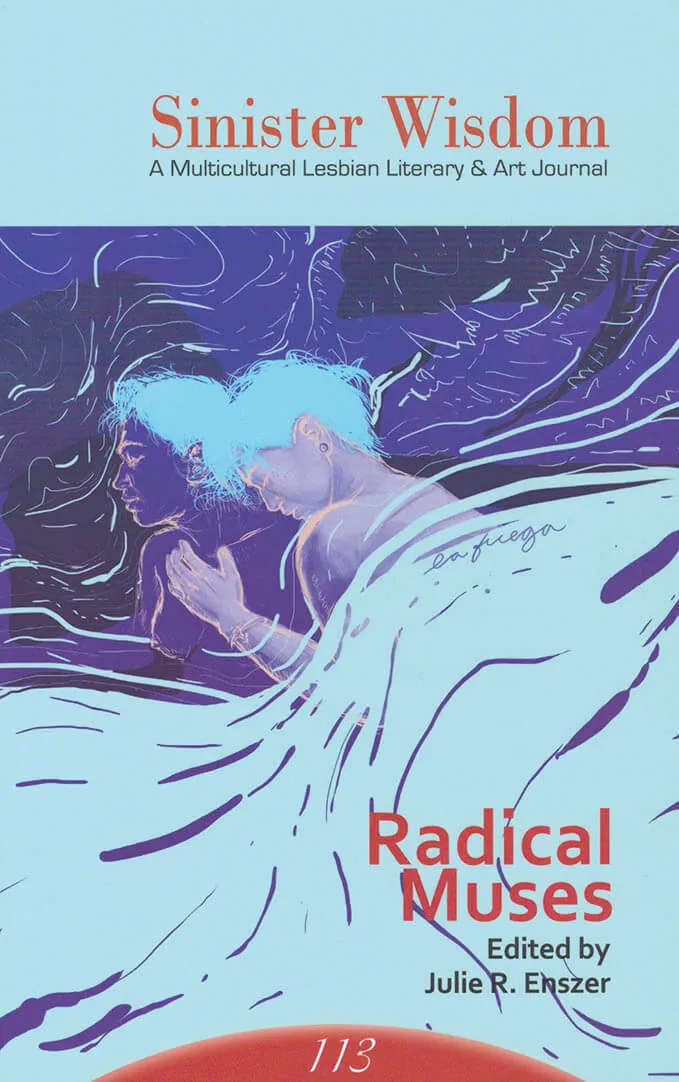
Cover of Radical Muses (Sinister Wisdom nr. 113)

Sinister Wisdom

Radical Muses (Sinister Wisdom nr. 113)

Julie R. Enszer

Sinister Wisdom 113: Radical Muses features an eclectic array of contemporary poetry, prose, and art by lesbians from around the world, including new work by: Andrea Assaf, Tara Shea Burke, Cheryl Clarke, Marina Chirkova, Estela González, Barbara Haas, Nancy E. Lake, Vi Khi Nao, H. Ní Aódagaín and much more!

Cover of Celebrating the Michigan Womyn's Music Festival

Sinister Wisdom

Celebrating the Michigan Womyn's Music Festival

Sinister Wisdom

Sinister Wisdom 103: Celebrating the Michigan Womyn's Music Festival honors the forty-year legacy of the Michigan Womyn’s Music Festival (1976–2015). Sinister Wisdom 103: Celebrating the Michigan Womyn's Music Festival celebrates this embodiment of radical feminist separatist collaboration, transformational self-defined autonomous spaces, a commitment to sisterhood and matriarchal culture, and a musical city sprung from the earth for one week in the woods.

A collective of five womyn each with a deep connection to Fest operated by consensus to create this issue. Striving to represent a range of womyn’s voices, values, traditions, and experiences of Fest, the collective highlighted what Fest has meant to generations of womyn, documented its chronology, and bore witness to the power of this community. Sinister Wisdom 103: Celebrating the Michigan Womyn's Music Festival includes womyn from multiple races, geographies, sexualities, generations, and gender and other social identities. Just as Fest brought together womyn from various backgrounds, our collection includes a range of artistic experience, from seasoned authors and photographers to those womyn new to publishing.
Sinister Wisdom 103: Celebrating the Michigan Womyn's Music Festival remembers the transformations, possibilities, and hopes for spaces cultivating the ongoing empowerment of womyn.

Cover of The Lesbian Body

Winter Editions

The Lesbian Body

Monique Wittig

Fiction €22.00

In this genre- and gender-breaking work of theory-fiction, legendary writer and cofounder of the 1970s French feminist movement Monique Wittig celebrates the body—lesbian, literary and defiantly political—and challenges the order of heterosexuality in literature. 

First published in French in 1973, The Lesbian Body mines the relationship between a lover and a beloved—also a writer and a text—to explore the ideological and historical constructions of the female subject. Organized according to the principle of montage, poetic passages are juxtaposed with anatomic lists that mark lesbian eros. Through expressions of joy, violence, and tenderness, the site of pleasure is celebrated. In her transfiguration of gender and its paradigms, Wittig transformed French vocabulary, feminizing grammar and lesbianizing myths. This edition brings the English translation of Wittig’s groundbreaking work back into circulation for the first time since the mid-1980s, revised according to the author's notes, and with an introduction by Paul B. Preciado.

The Lesbian Body is a fundamental work of lesbian existence. Wittig's applied vision is a state of natural delirium, a revolutionary excess of utopianism, refusal, and mutual self-creation. Revisiting it reveals how much passionate free thought has been lost, and simultaneously, how many of her tropes and discoveries have integrated into our collective consciousness.” — Sarah Schulman

“In this stunning new rendering of The Lesbian Body by the French author, theorist, activist and teacher, the late Monique Wittig, we are plunged into an imagined world of passionate violence and erotic lesbian mayhem intertwined in strikingly bold poetic images. Wittig, in the reach and volatility of her imagination, stands alongside such important American writers as Audre Lorde, Adrienne Rich, and Valerie Solanas, all of whose work deserves to be read again, or for the first time.” — Esther Newton

“To read the book is to be forced by Wittig into another grammar and happily contaminated by its strange forms. You will never think straight again.” — Jack Halberstam

“For me, Wittig opened up a sense of the world that had been, quite literally, unimaginable. She tore us apart.” — Judith Butler

“Together with Ursula Le Guin and Samuel R. Delany, Wittig is the first to design a nonbinary utopia, a world in which the binary categorization of sexes and genders will have ceased to exist.” — Paul B. Preciado

Introduction by Paul B. Preciado
Translated by David Le Vay

Cover of Mother Reader

Seven Stories Press

Mother Reader

Moyra Davey

Mothering €27.00

'My aim for Mother Reader has been to bring together examples of the best writing on motherhood of the last sixty years, writing that tells firsthand of the mother's experience.

Many of the writings in Mother Reader comment on and interpolate one another, in citations, in footnotes, in direct homage. As I was assembling this collection one text would lead to one another, treasure-hunt fashion, the clue provided by an acknowledgement or bibliography. And just as often the writing circles back.

In Mother Reader chapters are excerpted from autobiographies, memoirs, and novels; entries are lifted from diaries; essays and stories are culled from collections, anthologies, and periodicals. My project has been to assemble a compendium or sampler of these ''kindred spirit'' works on motherhood, so that readers, and especially mothers with limited time on their hands, can access in one volume the best literature on the subject and know where turn to continue reading." [Moyra Davey in the introduction]

Writings by Margaret Atwood, Susan Bee, Rosellen Brown, Myrel Chernick, Lydia Davis, Buchi Emeta, Annie Ernaux, Mary Gaitskill, Susan Griffin, Nancy Hutson, Mary Kelly, Jane Lazarre, Ursula K. Le Guin, Doris Lessing, Ellen McMahon, Margaret Mead, Vivian Montgomery, Toni Morrison, Tillie Olsen, Alicia Ostrker, Grace Paley, Sylvia Plath, Adrienne Rich, Sara Ruddick, Lynda Schor, Mira Schor, Dena Schottenkirk, Mona Simpson, Elizabeth Smart, Joan Snyder, Elke Solomon, Susan Rubin Suleiman, Alice Walker, Joy Williams, Martha Wilson, Barbara Zucker.

Cover of Cassell's Encyclopedia of Queer Myth, Symbol and Spirit

Cutt Press

Cassell's Encyclopedia of Queer Myth, Symbol and Spirit

Randy P. Conner, David Hatfield Sparks and 1 more

Bootleg edition by Cutt Press. 

Foreword by Gloria Anzaldua.

Drawing on religion, mythology, folklore, anthropology, history and the arts, this encyclopoedia is a collection of queer spirit. It contains articles on the world's spiritual traditions; entries on deities, symbols, spiritual teachers, spiritually focused artists; and related subjects.

Did you know that in medieval French folklore a person might change sex by passing under a rainbow? Or that same-sex unions have been celebrated by peoples of the ancient Mediterranean, Africa, China, and indigenous America? Or that Sappho, da Vinci, Emily Dickinson, Nijinsky, Benjamin Britten, Mishima, Adrienne Rich, Audre Lorde, Keith Haring, Boy George, and Derek Jarman number among those who have explored the spiritual dimension of gender and sexuality in their works? While the terms many of us employ today to identify ourselves – ‘queer’, ‘lesbian’, ‘gay’, ‘bisexual’, ‘transgendered’ – differ markedly from those of peoples of other times and places, we are nevertheless the bearers of a rich spiritual history that has been ignored or suppressed, a history encoded in sacred texts as well as in works of art, music, dance and other media. Drawing upon religion, mythology, folklore, anthropology, history and the arts, the Encyclopedia is a cornucopia of queer spirituality, containing over 1,500 alphabetically arranged entries from Aakulujjuusi to Zeus.

Cover of Spike #86 – Salad Days!

Spike Magazine

Spike #86 – Salad Days!

Periodicals €20.00

Spike #86 is turning to the wild season of youth – life’s Salad Days.

Forget all the Boomer panic about a generational crisis; the kids are alright, living out our hyperconnected present to its strangest limits. New kinds of aesthetics, of activism, of entrepreneurship; new images as much as new perspectives on what images are; and, above all, a new, very quantum attitude towards fact and fiction, history and the future: young people are modeling how to be in our very confused times – and producing some of the most interesting forms of culture we’ve ever seen.

Featuring a Zoomer’s guide to the Slopgeneration; an essay of on being young at art in the Instagram age; a rundown of contemporary art’s nepo babies; reality checks on culture’s obsessions with youth and dying young; portraits of couture-sculptor Tenant of Culture, Turner Prize-nominated photographer Rene Matić, e-waste sculptor Brian Oakes, and Austrian painter Lukas Posch; send-ups of teenage fiction’s ecstatic weirdness and youth-quakers’ political promise; a critique from Silicon Valley of the industrialization of young risk-taking; art’s perfect Los Angeles metaphor; and a splash of back-page advice: “You shouldn’t be fun at twenty-one. You should be tortured.” 

Cover of Initiales #05 — Andrea Fraser

École nationale supérieure des beaux-arts de Lyon

Initiales #05 — Andrea Fraser

Claire Moulène, Emmanuel Tibloux

Periodicals €15.00

Le cinquième numéro de la revue d'art et de recherche « rétro-prospective » est consacré à l'artiste et performeuse Andrea Fraser, figure clé de l'art des années 1990 et 2000 et du courant de la « critique institutionnelle » (une monographie complétée par une grande enquête sur l'espace critique réalisée auprès d'une cinquantaine d'artistes, critiques et philosophes internationaux).

Avec contributions de Kader Attia, Eva Barto, Sophie Bonnet-Pourpet, Marie de Brugerolle, Gregory Buchert, Daniel Buren, Marie Canet, Gregory Castéra, Inès Champey, Thierry Chancogne, Claire Fontaine, François Cusset, Judith Deschamps, Paul Devautour, Philippe Durand, Joao Enxuto & Erica Love, Andrea Fraser, Nicolas Frespech, Dora García, Romain Grateau, Emmanuel Guez, Thomas Hirschhorn, Aliocha Imhoff & Kantuta Quirós, Béatrice Josse, Franck Larcade, Ju Huyn Lee, Sven Lütticken, Fabrice Mabime, Bartomeu Mari, Chus Martínez, Gwenael Morin, Claire Moulène, Jean-Luc Moulène, Yan Moulier Boutang, Vincent Normand, François Pain, Gerald Petit, Anne Querrien, Thierry Raspail, Sinziana Ravini, Delphine Reist & Laurent Faulon, Christophe de Rohan Chabot, Phillippe Roux, Jean-Baptiste Sauvage, Thomas Schlesser, Ida Soulard, Fabien Steichen, Michel Surya, Emmanuel Tibloux, Vier 5, Ulf Wuggenig, Italo Zuffi.

Cover of Pina #2

Pina Magazine

Pina #2

Forensic Architecture, Edgar Calel

Periodicals €25.00

Exhibitions by Edgar Calel and Forensic Architecture, conversations with Lisette Lagnado and between Eyal Weizman, Agata Nguyen Chuong, Zoé Samudzi and Irmgard Emmelhainz, and short stories by Portia Subran and Rémy Ngamije.

Forensic Architecture presents ‘A Counter-Archive of the Ovaherero and Nama Genocide’, a powerful investigation into the early 20th-century genocide committed by German colonial powers in today’s Namibia. Drawing on years of archival research and spatial analysis, the exhibition traces the lasting impact of colonial violence in three parts: from the ideological roots of racialised imperialism, to the design of the concentration camp, to the ongoing environmental degradation and dispossession affecting Indigenous communities today.

Edgar Calel’s ‘Dreams and memories dazzle through the flickering of fireflies’ is an exploration of dreams, memory and everyday life within his multi-generational family home in Comalapa, Guatemala. Each morning, dreams are shared among family members, as a practical and poetical way to sense the energy of the day ahead. Concrete business plans and reminders to cook certain dishes emerge from these retellings: a ritual so entwined in the architecture of their every day, that, even when apart, they recount their visions through shared voice notes.

Pina is a printed, portable exhibition space. We function as a commissioning platform, collaborating with artists to create exhibitions existing solely within the pages of a magazine.