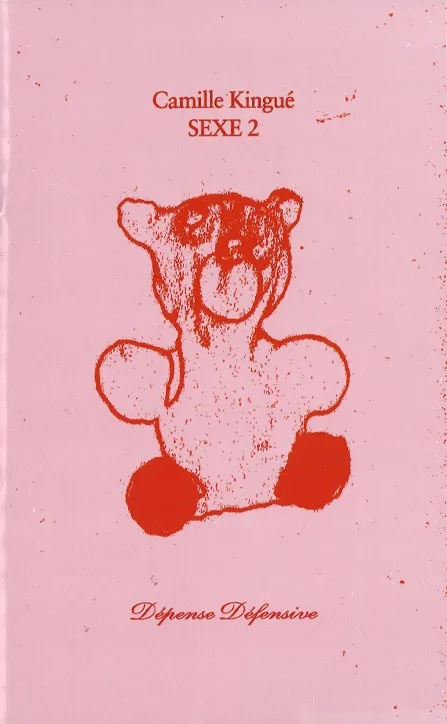
Sex I
Sex I, de Camille Kingué est un récit intime à la première personne qui traite des relations sexuelles/intimes comme espaces de (re) découverte de soi et d'(in) accessibilité à l'autre.
How To Become est une maison d'édition autogérée basée à Paris. Nous publions les textes d'auteuces engagés dans des pratiques féministes et peu diffusés par le réseau des grandes maisons d'édition françaises.
Créée en 2016, elle est composée d'artistes et écrivaires en majorité gouines, HTB publie de la litterature expérimentale née d'influences post-post- sapphiques ainsi qu'un choix de tradu d'auteuices non traduites en langue française. HTB s'articule autour d'ateliers d'écriture: How to Become a Lesbian, et d'une revue annuelle publiant les choses issues de l'atelier.
Aodhan Madden, Claire Star Finch
Oh oh this is the first issue of Tongue Ring, a journal of experimental writing in English & French, with original contributions and translations of texts* by Ariana Reines*, CAConrad*, Camille Kingué, Kaur Alia Ahmed*, Rafael Moreno, Taos Bertrand, and Théo Robine-Langlois*.
Vous voyez, c’est ça mon genre. Je ne sais pas ce que c’est.
Mais c’est mon genre. J’ai cet esprit en moi—qui est très ému
par la féminité. Je pourrais me mettre à pleurer. Je veux poser
mon manteau par terre pour la laisser marcher dessus
—Ariana Reines
Premier numéro de la nouvelle revue fantastique et bilingue (FR + EN) d’écriture expérimentale Tongue Ring, avec des contributions originales ainsi que des traductions* de textes de Ariana Reines*, CAConrad*, Camille Kingué, Kaur Alia Ahmed*, Rafael Moreno, Taos Bertrand, and Théo Robine-Langlois*.
Nasleep neemt de protesten rondom het Gezi Park in 2013 als vertrekpunt en verkent gaandeweg wat er is overgebleven van dit historische moment waarin een andere wereld voor het grijpen leek. Het zijn gedichten die laveren tussen ritmische, conceptuele en kritische noise enerzijds en postrevolutionaire affecten anderzijds, tussen politisering enerzijds en onmacht en radeloosheid anderzijds.
Stefan Govaart, Maia Means and 1 more
Bringing together thirty authors variously invested in dance, performance and/or choreography; This Container is a zine for texts produced through and alongside dance, performance and choreography. Some write more than dance; others dance more than write. Some practice choreography explicitly; others implicitly. However varied the authors gathered here may be, the expansive field of performance produces all kinds of texts that deserve public recognition, a readership, and an infrastructure for feedback and editing. This issue is another attempt at making this possible.
With contributions by: Paula Almiron, Jani Anders Purhonen, Simon Asencio, Mélanie Blaison, Oda Brekke, Juan Pablo Cámara, Laura Cemin, Matt Cornell, Stina Ehn, Emma Fishwick, Lucija Grbic, Sara Gebran, Andreas Haglund, Hugo Hedberg, Alice Heyward, Madlen Hirtentreu, Eleanor Ivory Weber, Nikima Jagudajev, Sonjis Laine, Yoojin Lee, Denise Lim, Theo Livesey, Naya Moll, Caterina Mora, Rhiannon Newton, Zander Porter, Lena Schwingshandl and Stav Yeini.
Since its inception, This Container has hoped to contribute to a feminist lineage of textual production. What constitutes this lineage? This is a vast question. The beginning of an answer might start by saying something about genre. If , as Lauren Berlant writes, genre is an “aesthetic structure of affective expectation”, a “formalization of aesthetic or emotional conventionalities”, then genre crafts expectation by pointing to what is recognizable in form.1 If feminism is about wanting the world to be otherwise, the multiplication of genres inducing the multiplication of (imagined) stories helps to recraft expectation toward a less oppressive, less boring, and more just world. Feminist work includes genre work. Poetry, diary, diagram, notes, recipe, critique, the sound file, the epistolary, the essay, the art project: they have all found their way in, sculpting a diverse set of readerly structures of affective expectation. They are to shift your worldly expectations.
More info at http://www.thiscontainer.com
The Loveliest Vowel Empties presents for the first time in English the collected poems of legendary Swiss Surrealist Meret Oppenheim, printed with facing-page originals in German and French.
Oppenheim's poetry, 49 poems written between 1933 and 1980, moves beyond Surrealism to inhabit a voice all her own, with imagery and sound that, as the Herald Tribune wrote, 'express witty and poetic responses to the surprises of life.' A key figure of the Paris art scene in the 1930s, Oppenheim moved in a circle that included Andér Breton, Man Ray, Marcel Duchamp, Max Ernst, and Elsa Schiaparelli. Writing for the Village Voice about her work, Gary Indiana noted that 'the singularity of Meret Oppenheim's work is such that nothing seems dated... the range of the work and its quirky self-assurance are striking.' The publication of her collected poems coincides with a major retrospective exhibition of her artwork at the Museum of Modern Art in New York.
A long lost poem purportedly by Rimbaud is finally made available in English.
Referenced only in a few letters of Paul Verlaine, The Spiritual Hunt is Arthur Rimbaud's forgotten masterwork, a poem in five parts that explored the mystic philosophy that guided the young poet's heart and hand. Considered lost for years, a typewritten manuscript appeared in Paris in the late 1920s, circulating around a close-knit group of booksellers, poets, and playwrights. Yet it wasn't until 1949 that Mercure de France took the initiative to publish the unauthenticated galley and unleashed a literary controversy that shook France. Sides were drawn, with Andre Breton leading the charge of forgery, calling the work an utter hoax, and others defending it as legitimate and an essential key to understanding Rimbaud and his work. Bookstores were raided for copies, critics were skewered in journals, and tempers flared on radio and in print, but no conclusive judgement could be drawn and Mercure de France withdrew the work from publication and pulped all the copies they could find.
Now, seventy-five years after its initial imbroglio, The Spiritual Hunt is available in English for the first time with a facsimile letterpress edition of the original. Featuring Pascal Pia's original introduction along with an edifying afterword by translator Emine Ersoy.
Ghayath Almadhoun, Catherine Cobham
Fluid and unselfconscious, Ghayath Almadhoun writes love poems in the shape of nightmares: I have brought you a severed hand is a surreal mix of absurd humour, heteroerotic lust and dead seriousness. Caught between two exiles, the one inherited from his Palestinian father and the one he chose and lives, Almadhoun attempts to explain water and tame hope.
This book never misses the defiant beat of an exile’s haunted footing across wars, seas and memory. Almadhoun turns the genocidal logic of colonialism upside down, emptying out the crumbs of humanity and civilisation. —Don Mee Choi
Almadhoun uses every possible means of silence to make the total devastation palpable. —Alfred Schaffer
Many poets attempt to traverse the gulf between the experience of tragedy and the ability to relay its magnitude to anyone else. But few living have done it with such flourish, such sustained passion and formal precision as Ghayath Almadhoun. —Kaveh Akbar
Ghayath Almadhoun (born 1979, Damascus) is a Syrian-Palestinian poet who moved to Sweden in 2008. He has published five collections of poetry in Arabic, the latest being Adrenalin (Almutawassit, 2017) and I have brought you a severed hand (Almutawassit, 2024). In 2017, Adrenalin was translated into English by Catherine Cobham and published by Action Books. In 2023, Almadhoun curated, edited and translated the poetry anthology Kontinentaldrift: Das Arabische Europa (Verlag Das Wunderhorn and Haus für Poesie), which includes thirty-one Arabic poets living in Europe. The English translation of I have brought you a severed hand is published simultaneously by Divided in the UK and Europe and by Action Books in the USA. Almadhoun currently lives between Berlin and Stockholm. His work has been translated into nearly thirty languages.
Catherine Cobham taught Arabic language and literature at the University of St Andrews, Scotland, for many years and was head of the department of Arabic and Persian from 2011 until 2021. She has translated the work of a number of Arab writers, including poetry by Adonis, Mahmoud Darwish, Ghayath Almadhoun, Tammam Hunaidy and Nouri al-Jarrah, and novels and short stories by Yusuf Idris, Naguib Mahfouz, Hanan al-Shaykh, Fuad al-Takarli and Jamal Saeed. She has written articles in academic journals and co-written with Fabio Caiani The Iraqi Novel: Key Writers, Key Texts (Edinburgh University Press, 2013).