rile*books

Search books

Search books by title, author, publisher, keywords...

Cover of Forty-Five Years: A Tribute to the Lesbian Herstory Archives

Sinister Wisdom

Forty-Five Years: A Tribute to the Lesbian Herstory Archives

Julie R. Enszer ed.

€14.00

Forty-five years ago movements of liberation made possible the birth of a new project in the world, the Lesbian Herstory Archives. In Sinister Wisdom 118 are some of the founding stories, telling what it meant to walk first into an apartment and later into a four-story limestone building, where shame became history, secrets became shared connections and complex lesbian, queer histories were enriched by maintaining intergenerational community.

A grassroots collection, the Archives was intentional about engaging with all facets and complexities of lesbian life, inclusive of diversity in race and gender-identity, from the bar life of the fifties and before, to the lesbian-feminist cultural richness of the mid-twentieth century and beynd, to the gender richness of the tweny-first. This issue honors an Archives that articulates the complexities of how lesbians make our way in the world.

Language: English

recommendations

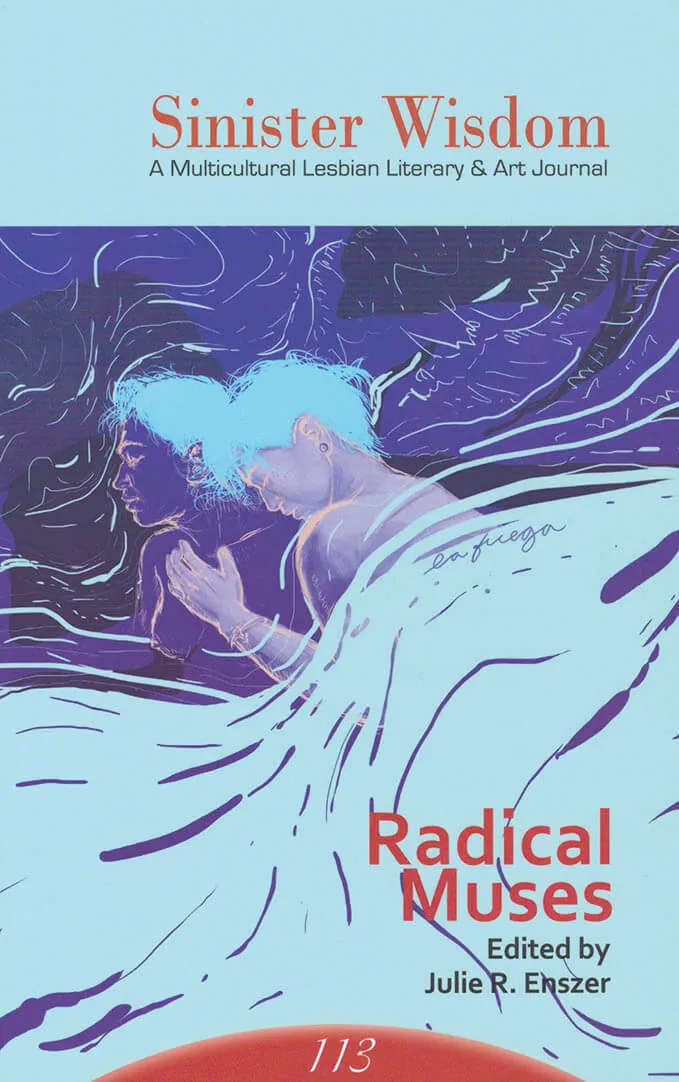
Cover of Radical Muses (Sinister Wisdom nr. 113)

Sinister Wisdom

Radical Muses (Sinister Wisdom nr. 113)

Julie R. Enszer

Periodicals €10.00

Sinister Wisdom 113: Radical Muses features an eclectic array of contemporary poetry, prose, and art by lesbians from around the world, including new work by: Andrea Assaf, Tara Shea Burke, Cheryl Clarke, Marina Chirkova, Estela González, Barbara Haas, Nancy E. Lake, Vi Khi Nao, H. Ní Aódagaín and much more!

Cover of The Letters of Audre Lorde and Pat Parker 1974-1989

the87press

The Letters of Audre Lorde and Pat Parker 1974-1989

Julie R. Enszer

Non-fiction €18.00

Poets Audre Lorde and Pat Parker first met in 1969; they began exchanging letters regularly five years later. Over the next fifteen years, Lorde and Parker shared ideas, advice, and confidence through the mail. They sent each other handwritten and typewritten letters and postcards often with inserted items including articles, money, and videotapes.

The Letters of Audre Lorde and Pat Parker 1974-1989 gathers this unique correspondence in which Lorde and Parker discuss their work as writers as well as the intimate details of their lives, including periods when each lived with cancer. These letters are a rare opportunity to glimpse inside the minds and friendship of two great twentieth century poets.

Introduction by Mecca Jamilah Sullivan.

Cover of Celebrating the Michigan Womyn's Music Festival

Sinister Wisdom

Celebrating the Michigan Womyn's Music Festival

Sinister Wisdom

Sinister Wisdom 103: Celebrating the Michigan Womyn's Music Festival honors the forty-year legacy of the Michigan Womyn’s Music Festival (1976–2015). Sinister Wisdom 103: Celebrating the Michigan Womyn's Music Festival celebrates this embodiment of radical feminist separatist collaboration, transformational self-defined autonomous spaces, a commitment to sisterhood and matriarchal culture, and a musical city sprung from the earth for one week in the woods.

A collective of five womyn each with a deep connection to Fest operated by consensus to create this issue. Striving to represent a range of womyn’s voices, values, traditions, and experiences of Fest, the collective highlighted what Fest has meant to generations of womyn, documented its chronology, and bore witness to the power of this community. Sinister Wisdom 103: Celebrating the Michigan Womyn's Music Festival includes womyn from multiple races, geographies, sexualities, generations, and gender and other social identities. Just as Fest brought together womyn from various backgrounds, our collection includes a range of artistic experience, from seasoned authors and photographers to those womyn new to publishing.
Sinister Wisdom 103: Celebrating the Michigan Womyn's Music Festival remembers the transformations, possibilities, and hopes for spaces cultivating the ongoing empowerment of womyn.

Cover of Tout geste est renversement – Every gesture is reversal

Gevaert Editions

Tout geste est renversement – Every gesture is reversal

Chloe Chignell, Laurianne Bixhain

Tout geste est renversement – Every gesture is reversal is a publication by artist Laurianne Bixhain comprising an imahe captured and silkscreen printed by Bixhain and a text written by Chloe Chignell. The work addresses the potential for mutual transformation between language and materials, whether human or non human. How does language traverse the body? What are its resonances? How does it shape physical presence, gestures or thoughts? 

A2 silkscreen printed poster
Designed by Morgane Le Ferec.
Printed in 300 Copies. 

Cover of How to Sleep Faster 2

Arcadia Missa

How to Sleep Faster 2

Various

Periodicals €12.00

How to Sleep Faster 2 is the second of our biannually published journals that form the backbone of Arcadia Missa’ critical collaborative discourse on participation, post-digital visual-production and institutional subjectivity.This issue explores moments of collapse, shift and potential in a cultural moment framed by economic, political and societal disturbance.

Arcadia Missa Publication; eds Rozsa Farkas, Tom Clark et al.

Cover of OEI #86/87 Publishing Practices, Publishing Poetics

OEI editör

OEI #86/87 Publishing Practices, Publishing Poetics

Tobi Maier, Cecilia Grönberg and 1 more

Periodicals €40.00

Once more, an astonishing issue of OEI – a thrilling, compelling, stimulating feast of ideas regarding publishing and the book: the perfect big companion to read and hug in bed while the virus spreads outside.

Bringing together contributions from circa 130 publishing structures, publishing communities, magazines, small press endeavors, artists, poets, writers, editors, theoreticians, curators, scholars, and art bookstores, OEI # 86–87 reflects upon the challenges, pressures and possibilities of publishing and creating publics in different contexts and places in a time of far-reaching – economical, medial, political, social, technological – transformations.

The potential and the versatility of publishing open it to a diversity of practices and approaches in the arts, but as an eminently social form of art, a collective or micro-collective work with shared responsibilities, it is also a never-ending process of “crafting a variegated approach to how you create, publish, distribute, and build a social ecosystem around your efforts”, of trying to “build up and strengthen the community around these printed forms” (Temporary Services).

It is the conviction of OEI #86–87 that print has the power to play an important part in the construction of social spaces, of a social world. As Benjamin Thorel puts it in one of the essays in the issue, “conceiving of the dynamics of publishing as making publics as well as making things public is not a pun – insofar as the artists/publishers encompass, beyond the book itself, its possible ‘lives’, imagining the different spaces, and the different people, amongst whom a publication will circulate.” This is what Michael Warner has called “a public [as] poetic worldmaking”, implying “that all discourse or performance addressed to a public must characterize the world in which it attempts to circulate, projecting for that world a concrete and livable shape, and attempting to realize that world through address.”

This is also, as stressed by Annette Gilbert and others, what can make publishing such an active force, a force co-constituting texts and publications and publics. Indeed, with Michalis Pichler, it is tempting to say that in publishing as practice – perhaps more than in any other art field – “artists have been able to assert the aesthetic value of their own socio-politically informed concerns and to engage, often under precarious conditions, in cultural activities fully aligned with their political values.”

OEI #86–87 also includes sections on and with contemporary poetry from Canada; Fluxus publishing; Krister Brandt/Astrid Gogglesworth; Kalas på BORD (Öyvind Fahlström); Lars Fredrikson; Claude Royet-Journoud’s poetry magazines; Carl Einstein; Gail Scott; Ållebergshändelser; OEI #79: edit/publish/distribute!; “det offentligas försvinnande” and many many other things. [publisher’s note]

Design by Konst & Teknik

Cover of Heatwave #2

Self-Published

Heatwave #2

Periodicals €17.00

 In an era when many “radical” theorists were seeking out the peaceable expression of politics in “everyday utopias,” Joshua Clover stressed that politics was always, at root, a fiery confrontation with the powers that be. To these ends, he not only helped bring together a new generation of young communists but also pushed them to engage directly with the rising tide of class conflict, understanding full well that the street and the shopfloor are the true classrooms of the partisan.

Heatwave is, in a sense, an attempt to embody this spirit at a larger scale. Like Joshua, we hope to serve as an engine of engagement, linking our readers to their own history and to one another. Like Joshua, we adopt a principle of ecumenicism, refusing the false dividing lines inherited from the long dissolution of the last global communist movement. At the same time, like Joshua, we also insist on a theoretically rigorous approach that invokes the real complexity of revolutionary theory and history, actively seeks evidence for its claims, and engages in good faith with opposing positions. And, like Joshua, we maintain that the partisan project is inherently incendiary, requiring confrontation with the rulers of the world, rather than gradualist compromise or secessionist retreat. Finally, communism requires an unambiguous commitment to internationalism. Although our project is currently anglophone, we recognize that elaborating a partisan politics requires learning from the self-activity of the dispossessed at the global scale.

The name "Heatwave" echoes that of an old Situationist magazine ("Britain's most incandescent journal" of 1966), but with added urgency in an era where every summer is the hottest on record. While the statistical certainty of catastrophe is inescapable, "revolt" names many species of conflagration, including that peculiar variety we call communism. We must sift through the ashes to find it.

Cover of Issue #9: Companions

Errant Journal

Issue #9: Companions

Irene de Craen, Katia Krupennikova

Periodicals €20.00

The editorial/imaginative centre of the ninth issue of Errant Journal is located in the regions that have experienced Russian imperial aggression from where it makes connections across times, geographies, and ontologies to explore the radical potential of companionship. Companionship is understood not as agreement, but as a shared responsibility across unequal histories. It means not being full without the other. While forms of imperial and colonial violence might differ in places and through times, the issue recognizes how colonial mechanisms are sustained, how they present themselves as if they were past while shapeshifting and continuing in new forms and places in the present. By bringing these contexts in relation, this issue aims to show how certain borders, biases, clichés, and power structures travel, mutate, and shape both human and non-human lives and landscapes. Ultimately, companionship is about prioritizing life and about insisting that no oppression is singular.

This issue is a concept by and co-edited with Katia Krupennikova.

Contributors: Adriana Arroyo, Keto Gorgadze, Andreas Kalkun, Chung Kai Lee, Samira Makki, Ana Mikadze, Petrică Mogoș, Fabienne Rachmadiev, Vaim Sarv, Victoria Soyan Peemot, Czyka Tumaliuan, Iryna Zamuruieva, Irene de Craen, Katia Krupennikova