rile*books

Search books

Search books by title, author, publisher, keywords...

Cover of Black Lesbians—We Are the Revolution!

Sinister Wisdom

Black Lesbians—We Are the Revolution!

Sinister Wisdom

€7.00

Sinister Wisdom 107: Black Lesbians—We Are the Revolution! lifts up the voices of African-American lesbians for us all to hear, see, and know. The creative work in Sinister Wisdom 107: Black Lesbians—We Are the Revolution! gathers together new writing by an array of emerging and established black lesbian and queer women writers. Sinister Wisdom 107 invites us all as readers, thinkers, activists, and cultural workers to engage in meaningful and productive ways with the voices and works of African-American lesbians as they write and imagine new worlds.

Behind the Issue
A Conversation with Black Lesbian Poet JP Howard at AfterEllen.com
Talkin’ About a Revolution: JP Howard on Raising Her Fist—and Queer Women’s Voices

Creative Work By

Pamela Sneed
Charan P. Morris
Nikkya Hargrove
Vanesa Evers
Omotara James
Renée Bess
Cheryl Boyce-Taylor
Arisa White
Cheryl Clarke
Ifalade TaShia Asanti
Linda Bellos

And more!

Language: English

recommendations

Cover of Celebrating the Michigan Womyn's Music Festival

Sinister Wisdom

Celebrating the Michigan Womyn's Music Festival

Sinister Wisdom

Sinister Wisdom 103: Celebrating the Michigan Womyn's Music Festival honors the forty-year legacy of the Michigan Womyn’s Music Festival (1976–2015). Sinister Wisdom 103: Celebrating the Michigan Womyn's Music Festival celebrates this embodiment of radical feminist separatist collaboration, transformational self-defined autonomous spaces, a commitment to sisterhood and matriarchal culture, and a musical city sprung from the earth for one week in the woods.

A collective of five womyn each with a deep connection to Fest operated by consensus to create this issue. Striving to represent a range of womyn’s voices, values, traditions, and experiences of Fest, the collective highlighted what Fest has meant to generations of womyn, documented its chronology, and bore witness to the power of this community. Sinister Wisdom 103: Celebrating the Michigan Womyn's Music Festival includes womyn from multiple races, geographies, sexualities, generations, and gender and other social identities. Just as Fest brought together womyn from various backgrounds, our collection includes a range of artistic experience, from seasoned authors and photographers to those womyn new to publishing.
Sinister Wisdom 103: Celebrating the Michigan Womyn's Music Festival remembers the transformations, possibilities, and hopes for spaces cultivating the ongoing empowerment of womyn.

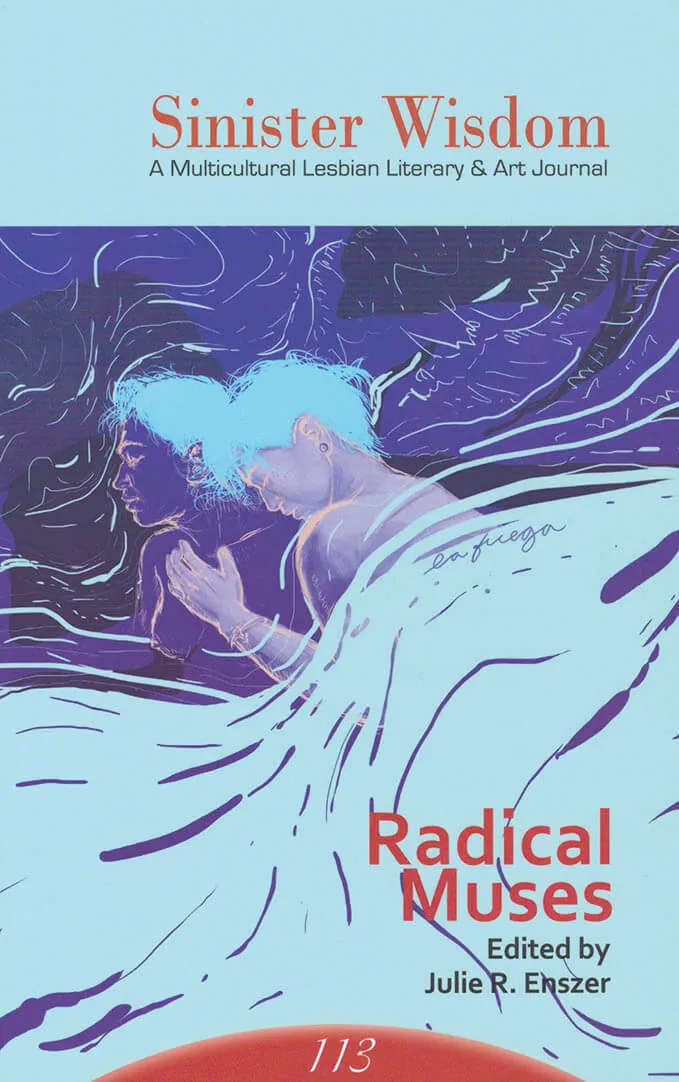
Cover of Radical Muses (Sinister Wisdom nr. 113)

Sinister Wisdom

Radical Muses (Sinister Wisdom nr. 113)

Julie R. Enszer

Sinister Wisdom 113: Radical Muses features an eclectic array of contemporary poetry, prose, and art by lesbians from around the world, including new work by: Andrea Assaf, Tara Shea Burke, Cheryl Clarke, Marina Chirkova, Estela González, Barbara Haas, Nancy E. Lake, Vi Khi Nao, H. Ní Aódagaín and much more!

Cover of Textdemic: A Retrospective on Jenny Holzer’s Laments

GenderFail

Textdemic: A Retrospective on Jenny Holzer’s Laments

A.L. Steiner

Poetry €22.00

Textdemic | A Retrospective on Jenny Holzer’s Laments” Ed. by A.L. Steiner and GenderFail, a publication based on A.L. Steiner + Friends on Jenny Holzer at Dia Chelsea. This book is based on the Artists on Artists Lecture Series when the Dia Art Foundation invited Steiner to curate a public program based on a work of the artist's choice.

Steiner chose Jenny Holzer’s Laments and invited Morgan Bassichis, Riel Bellow, Gregg Bordowitz, Alexander Chee, Malik Gaines, Guadalupe Maravilla + Alexa Mishell Guillen, Lucas Michael, Eileen Myles and Pamela Sneed to present in Dia’s first in-person program after the Covid-19 pandemic began in 2021. This publication features records of the poems, lectures, and performances during this memorial program. The book's design plays homage to the 1990 Laments publication by the Dia Art Foundation.

For this publication, Steiner and GenderFail invited Matilde Guidelli-Guidi, Associate Curator at Dia Art Foundation and the organizer of the Artists on Artists Lecture Series, to write an afterword for the book. In this, she states: "Dispensing altogether with the monographic formula that characterizes the institution, for her Lecture A.L. Steiner convened a group of artists, writers, and activists to join her in responding to Jenny Holzer’s 1989 text-based installation, Laments. Holzer identified the thirteen texts that comprise Laments as 'voices of the dead,' a visual choir in response to the raging HIV/AIDS epidemic and government inaction. Over the protracted COVID-19 lockdown, Steiner developed the idea to organize an evening for the voices of the living to lament today's crises.”

Cover of Across the Acheron

Winter Editions

Across the Acheron

Monique Wittig

Fiction €20.00

In her darkly funny 1985 take on Dante’s Divine Comedy, acclaimed French writer and activist Monique Wittig restages the journey through the circles of hell, limbo, paradise from a lesbian feminist perspective. 

Never-before published in the US, Across the Acheron follows the adventures of “Wittig” and her anti-Virgilian guide through laundromats, billiard parlors, dyke bars, and picnic grounds of a 1980s San Francisco populated by hunters and their prey, lost souls, and fantastical beasts, including a robotic eagle and angelic bikers. Wittig reimagines Dante’s epic poem through a feminist and queer lens, subverting his cosmological order and upending gender identities and literary traditions. This edition brings the English translation of Wittig’s final novel back into print for the first time since the early-1990s, revised according to the author's notes, and with a new introduction by Sophie Lewis.

Across the Acheron is a work of lesbian struggle and triumph across two kinds of hell. The hell of the classic western literary canon—and the hell of San Francisco. Monique Wittig brings all of her writerly powers and political experience to bear here, as witness to the horrors of heterosexual patriarchy and also to the possibility of another world for another life. Her work is a rare combination of deeply felt materialism and radical linguistic freedom. If we're to have another world, we'll need to create another language. She knew that, and she lived it.” McKenzie Wark

“Even in fiction Monique Wittig’s writing is critical, prescient, brilliant, satirical, searing, and way ahead of its time. I’m so glad this work is back in circulation to revisit and revel in.” Pamela Sneed

“In this unendurable yet compelling journey through the circles of patriarchal hell, Wittig encounters hordes of tortured women who do not struggle against their oppressors. Their brainwashing is as difficult to witness as their bloodied flesh. Only through communal activism does the seeker’s soul becomes tough enough to enter Paradise, where bare-breasted angels dismount motorcycles and offer baskets of 'cherries, strawberries, raspberries, apricots, peaches, plums, tomatoes, avocados, green melons, cantaloupes, watermelons, lemons, pawpaws, pineapples and coconuts.’ The bounties of Across the Acheron are lush and many.” Dodie Bellamy

“A Guernica of the human (feminist) condition, a blacker, bleaker, more vengeful Alice’s tea party, this is a novel as graphic as a painting, whose brilliance its translators have creditably preserved.” Publishers Weekly

Introduction by Sophie Lewis
Translated by David Le Vay with Margaret Crosland

Cover of MsHeresies 4 — Daffodils

Rietlanden Women's Office

MsHeresies 4 — Daffodils

Elisabeth Rafstedt, Johanna Ehde

This fourth issue of MsHeresies republishes the chapter *Daffodils* — a warped monologue about a domestic poisoning — from Rosalind Belben’s book Is Beauty Good (1989).

It is typeset alongside a collage of material from two medieval manuscripts: Isidore of Seville’s Etymologiae and De natura rerum (circa 1130–74), which was illuminated and transcribed by a group of eight nuns at the Benedictine abbey of Munsterbilzen in Maastricht; and the so called Claricia Psalter (late 12th–early 13th century) from the abbey of saints Ulrich and Afra in Augsberg, also made by a group of nuns and named after the novice Claricia who is believed to have drawn herself hanging like the tail of a drop-cap Q in the psalter section of the book.

Cover of Spike #85 – Nostalgia

Spike Magazine

Spike #85 – Nostalgia

Periodicals €20.00

For Fall 2025, Spike is getting to the bottom of the vintage aura around contemporary culture: Nostalgia. 

Are we doomed to ever-shorter cycles of cash-cow retromania, until AI memory-wipes us with pure simulation? Or is the root problem of our endless déjà vu actually the expectation that art "make it new," itself just so much nostalgia for a long-gone modernism? We're working out what the present owes to the past, if our goal is to conjure a better culture for tomorrow.

Featuring Jeppe Ugelvig's essay on the art world's uses and misuses of nostalgia; Simon Reynolds and Adina Glickstein talk exhausting the past; e-girl/theorist Alex Quicho critiques the end of newness; filmmaker Johan Grimonprez identifies with the hijacker in his dial H-I-S-T-O-R-Y (1997); a portrait of kitsch-savant painter Friedrich Kunath; cultural critic Rosanna McLaughlin on missing the white cube; Artist's Favorites by Diego Marcon; ex-dealers Margaret Lee and Jeff Poe escape the art game; Whitney Mallett on rebranding celebrity through book culture; making analog-ish art "under" the internet with Marc Kokopeli, Bedros Yeretzian, Flora Hauser, and Nicole-Antonia Spagnola; Sean Monahan forecasts our old-fashioned future; art historian Lynn Zelevansky on "New York/New Wave" at P.S.1 Contemporary (1981); artist Maja Bajevic's Yugostalgic report from Sarajevo; and Tea Hačić-Vlahović getting dewy-eyed catching up to her mother's age; plus, reviews of exhibitions by Mark Leckey, Wolfgang Tillmans, Women's History Museum, and more.

Founded by the artist Rita Vitorelli in 2004, Spike (Spike Art Quarterly) is a quarterly magazine on contemporary art published in English which aims at sustaining a vigorous, independent, and meaningful art criticism. At the heart of each issue are feature essays by leading critics and curators on artists making work that plays a significant role in current debates. Situated between art theory and practice and ranging far beyond its editorial base in Vienna and Berlin, Spike is both rigorously academic and stylishly essayistic. Spike's renowned pool of contributing writers, artists, collectors and gallerists observe and reflect on contemporary art and analyse international developments in contemporary culture, offering its readers both intimacy and immediacy through an unusually open editorial approach that is not afraid of controversy and provocation.

Cover of Starship 20

Starship Magazine

Starship 20

Henrik Olesen, Ariane Müller

Periodicals €11.00

Contributors to Starship № 20:

Rosa Aiello, Terry Atkinson, Tenzing Barshee, Gerry Bibby, Mercedes Bunz, David Bussel, Jay Chung, Eric D. Clark, Caleb Considine, Hans-Christian Dany, Albert Dichy, Nikola Dietrich, Martin Ebner, Ruth Angel Edwards, Stephanie Fezer, Jean Genet, Simone Gilges, Julian Göthe, Michèle Graf, Selina Grüter, Ulrich Heinke, Toni Hildebrandt, Beatrice Hilke, Karl Holmqvist, Stephan Janitzky, G. Peter Jemison, Charlotte Johannesson, Julia Jost, Julia Jung, Jakob Kolding, Nina Könnemann, Lars Bang Larsen, Anita Leisz, Norman Lewis, Elisa R. Linn, Sebastian Lütgert, Vera Lutz, Chloée Maugile, Robert McKenzie, Ariane Müller, Christopher Müller, Robert M. Ochshorn, Henrik Olesen, Kari Rittenbach, Nina Rhode, Ulla Rossek, Cameron Rowland, Mark von Schlegell, Ryan Siegan Smith, Philipp Simon, Valerie Stahl Stromberg, Josef Strau, Vera Tollmann, Eleanor Ivory Weber, Camilla Wills, Amelie von Wulffen and Florian Zeyfang.

"This is the 20th issue of Starship and we are proud and very happy to present it, and mainly want to thank all the artists, the contributors, the columnists, and the people who helped us gather images of exhibitions past, and gave us texts from books not yet published. Starship never starts with a clear concept about its future content, or what could be called a theme, but always with a sort of attentive interest. The theme may develop through its columnists—we now think it is easy to distinguish lines of thoughts, images, and texts answering each other. But it surely does so out of this editorial interest that wanders, and finds, and collects, is enthusiastic about artworks, and texts, and people, and then, well, brings this all together in a magazine. This was our working mode during the past year, and the responsiveness of those who regularly write for Starship (the columnists) has shown us that out there others are involved in thoughts that run very much in parallel. It is a strange form, a magazine like this, not getting funded, appearing irregularly, but still following a sort of conventional form that shows its consistency. It is at its core an excess of producing something that might prove itself valuable and liberating in the future."
—Ariane Müller, Henrik Olesen

Cover of Mousse #93

Mousse Publishing

Mousse #93

Periodicals €16.00

Andrew Berardini on Artificial Intelligence; Pepón Osorio; Arash Nassiri; Gloria E. Anzaldúa; Marcela Guerrero speaks with C. Ondine Chavoya; Daisy Lafarge; Dani Blanga Gubbay; Davide Stucchi speaks with Alex Bennett; Luca Lo Pinto on Hanuman Editions; Reynaldo Rivera & Abdellah Taïa; Jungle Books...

This issue comes with different covers, randomly distributed.