Semiotext(e)
Semiotext(e)

Foam
I am still transitioning, but I am unsure into what.
Who are all these Evas? They puncture and disrupt the domestic space and equilibrium of the narrator, who alternately relies upon them or administers their care. Foam is the latest boundary-blurring, genre-resistant, strange and speculative new fiction from Kate Zambreno, the inimitable and relentless literary stylist and conceptualist. Inspired by the absurdities of Eva Hesse and other soft sculpture, these are speculative art essays and textures, a document of precarity and slippery time—mischievous, moody, estranged—a masterwork of tone and atmosphere.

Schizo-Culture: The Event, The Book
Sylvère Lotringer, David Morris
The legendary 1975 "Schizo-Culture" conference, conceived by the early Semiotext(e) collective, began as an attempt to introduce the then-unknown radical philosophies of post-'68 France to the American avant-garde. The event featured a series of seminal papers, from Deleuze's first presentation of the concept of the "rhizome" to Foucault's introduction of his History of Sexuality project. The conference was equally important on a political level, and brought together a diverse group of activists, thinkers, patients, and ex-cons in order to address the challenge of penal and psychiatric institutions. The combination proved to be explosive, but amid the fighting and confusion "Schizo-Culture" revealed deep ruptures in left politics, French thought, and American culture.
The "Schizo-Culture" issue of the Semiotext(e) journal came three years later. Designed by a group of artists and filmmakers including Kathryn Bigelow and Denise Green, it documented the chaotic creativity of an emerging downtown New York scene, and offered interviews with artists, theorists, writers, and No Wave and pre-punk musicians together with new texts from Deleuze, Foucault, R. D. Laing, and other conference participants.
This slip-cased edition includes The Book: 1978, a facsimile reproduction of the original Schizo-Culture publication; and The Event: 1975, a previously unpublished and comprehensive record of the conference that set it all off. It assembles many previously unpublished texts, including a detailed selection of interviews reconstructing the events, and features Félix Guattari, William Burroughs, Kathy Acker, Michel Foucault, Sylvère Lotringer, Guy Hocquenghem, Gilles Deleuze, John Rajchman, Robert Wilson, Joel Kovel, Jack Smith, Jean-François Lyotard, Ti-Grace Atkinson, François Peraldi, and John Cage.

Memory
A spiritual homage to Bernadette Mayer's monumental artwork of the same title, Dorothea Lasky's Memory is a cycle of "poet's essays" stirred by two profound questions. What constitutes personhood and consciousness? What memories get lost, and why?
Expansive in her quest for answers, Lasky launches an inspired investigation of the forces that form our lives and deepest senses of ourselves. She identifies three dimensions of memory—ancestral, personal, and poetic—and in her singularly clear voice, undertakes to enter into their mysteries. From those recesses, she returns with a wide-ranging collection of essays that like lyric poems find the universal inside the particular. Memory reflects on the banal; private emotions and historical trauma; dear departed poets (Diane di Prima, Lucie Brock-Broido); her father's battle with Alzheimer's; and cultural events that have become charged sites of collective reminiscence (the moon landing, the music of Neutral Milk Hotel). Other pieces face the flip side of memory, asking what's left where memory is absent, and what's "real" beyond the horizon of death. The book closes with "Time, the Rose, and the Moon," an ars poetica published here in English for the first time, which offers the ancient symbol of the Ouroboros as a figure for the nonlinear processes of time, memory, and art.
Like Mayer before her, Lasky reveals memory to be huge and haunting, as she accumulates impressions that challenge the very possibility of fixed meaning. "Every rose has the scent of death," she writes. "And poetry is a perfume. That will stay on your body forever.... Whatever happens this time around, remember that."
Dorothea Lasky is the author of six full-length collections of poetry, including, most recently, The Shining (2023). She is also the author of the prose book Animal (2019) and a forthcoming book about Sappho, as well as the editor of Essays (2023) and a coeditor of Open the Door: How to Excite Young People About Poetry (2013). Her writing has appeared in POETRY, The New Yorker, The Paris Review, The Atlantic, and Boston Review, among other places.

Grand Rapids
Installed alongside the Grand River in downtown Grand Rapids, Michigan, Alexander Calder’s public sculpture La Grande Vitesse has come to symbolize the city. Tess moves there from Ypsilanti, Michigan in 2001—the same year that her mother dies, when everything begins to move, for her, in slow motion. Thrust into adolescence nearly rudderless, fifteen-year-old Tess is intoxicated, angsty, and sexually awake. A decade later, inspired by diary entries and TV reruns, she remembers this summer in the suburbs as the one that redefined her. Its echoes of death are frozen in time like the waves represented in the Calder sculpture or the concrete steps leading down to the churning river. She comes to see Grand Rapids as a collection of architecture and emblems, another home to which she cannot return.
Natasha Stagg is the author of Sleeveless: Fashion, Image, Media, New York 2011–2019 and Surveys: A Novel, both published by Semiotext(e). Her work has appeared in Artforum, Bookforum, Texte Zur Kunst, n+1, Spike Art, Flash Art, Dazed, V, Vice, 032c, and other publications.

hello, world?
Abandoned by their Dutch partner after giving up their home and their job to follow him to the Netherlands, humanities scholar Seasonal finds themself single in a strange place for the first time in a decade.
Dipping into the rabbit hole of digital eroticism, Seasonal soon meets László, a male sub who volleys back their cerebral sexts and is seeking a dominant guide. His dating-app profile—a photo of Foucault and the ingenuous greeting “Hello, World?”—thinly veils his desire to be annihilated. It's a desire that Seasonal senses they can fulfill. But to do this means crossing the frightening gap between their desires and capacities.
Seasonal and László embark on an experiment in remaking intimacy outside the Republic of Gender. But as it continues, the two realize they are staging separate confrontations with domination: Seasonal finds they must confront their own relation to the violence and anger that marked their upbringing in working-class, small-town Australia, while László stages his own confrontation with his decision to leave Viktor Orbán’s Hungary. As they attempt to improvise a theater of domination that opens up possibilities of reciprocity, the energies of their sexuality stalk this collaboration, threatening to give them exactly what they bargained or begged for.
A feminist paean to perversity in the tradition of Pauline Réage’s Story of O and Anaïs Nin's Delta of Venus, Anna Poletti's hello, world? dares to fully inhabit female power, and to fully face the violence, beauty, and uncharted territories of human sexuality.

Playboy
The prequel to Love Me Tender, narrating Debré's transformation from affluent career woman to broke single lesbian and writer.
I see all her beauty, I see the beauty of women. I see my own body, new. I tell myself there are so many things that are possible.
First published in France in 2018, Playboy is the first volume of Constance Debré's renowned autobiographical trilogy that describes her decision, at age forty-three, to abandon her marriage, her legal career, and her bourgeois Parisian life to become a lesbian and a writer.
The novel unfolds in a series of short, sharp vignettes. The narrator's descriptions of her first female lovers—a married woman fifteen years older than her, a model ten years her junior—are punctuated by encounters with her ex-husband, her father, and her son.
As Debré recently told Granta: “It was a bit like Saint Augustine and his conversion. In the same week, I had sex with a girl and I had the feeling that I could write. I had this incredible feeling that I could catch things, that life was there to be caught.”
Looking at the world through fresh eyes, the narrator of Playboy questions everything that once lay beneath the surface of her well-managed life. Laconic, aggressive, and radically truthful, she examines gender and marriage, selfishness and sacrifice, money and family, even the privilege inherent in her downward mobility.
Writing her way toward her own liberation, Debré chronicles the process that made her one of the most brilliant, important French writers today.

Alien Daughters Walk Into the Sun: An Almanac of Extreme Girlhood
The early writings of renowned poet and critical theorist Jackie Wang, drawn from her early zines, indie-lit crit, and prolific early 2000s blog.
Compiled as a field guide, travelogue, essay collection, and weather report, Alien Daughters Walk into the Sun traces Jackie Wang's trajectory from hard femme to Harvard, from dumpster dives and highway bike rides to dropping out of an MFA program, becoming a National Book Award finalist, and writing her trenchant book Carceral Capitalism. Alien Daughters charts the dream-seeking misadventures of an "odd girl" from Florida who emerged from punk houses and early Tumblr to become the powerful writer she is today. Anarchic and beautifully personal, Alien Daughters is a strange intellectual autobiography that demonstrates Wang's singular self-education: an early life lived where every day and every written word began like the Tarot's Fool, with a leap of faith.

Love Me Tender
A novel of lesbian identity and motherhood, and the societal pressures that place them in opposition.
The daughter of an illustrious French family whose members include a former Prime Minister, a model, and a journalist, Constance Debré abandoned her marriage and legal career in 2015 to write full-time and begin a relationship with a woman. Her transformation from affluent career woman to broke single lesbian was chronicled in her 2018 novel Play boy, praised by Virginie Despentes for its writing that is at once "flippant and consumed by anxiety."
In Love Me Tender, Debré goes on to further describe the consequences of that life-changing decision. Her husband, Laurent, seeks to permanently separate her from their eight-year old child. Vilified in divorce court by her ex, she loses custody of her son and is allowed to see him only once every two weeks for a supervised hour. Deprived of her child, Debré gives up her two-bedroom apartment and bounces between borrowed apartments, hotel rooms, and a studio the size of a cell. She involves herself in brief affairs with numerous women who vary in age, body type, language, and lifestyle. But the closer she gets to them, the more distant she feels. Apart from cigarettes and sex, her life is completely ascetic: a regime of intense reading and writing, interrupted only by sleep and athletic swimming. She shuns any place where she might observe children, avoiding playgrounds and parks "as if they were cluster bombs ready to explode, riddling her body with pieces of shrapnel."
Writing graphically about sex, rupture, longing, and despair in the first person, Debré's work is often compared with the punk-era writings of Guillaume Dustan and Herve Guibert, whose work she has championed. As she says of Guibert: "I love him because he says I and he's a pornographer. That seems to be essential when you write. Otherwise you don't say anything." But in Love Me Tender, Debré speaks courageously of love in its many forms, reframing what it means to be a mother beyond conventional expectations.

The Letters of Mina Harker
In Dodie Bellamy's imagined "sequel" to Bram Stoker's fin de siècle masterpiece Dracula, Van Helsing's plain Jane secretarial adjunct, Mina Harker, is recast as a sexual, independent woman living in San Francisco in the 1980s. The vampire Mina Harker, who possesses the body of author Dodie Bellamy, confesses the most intimate details of her relationships with four vastly different men through past letters. Simultaneously, a plague is let loose in San Francisco-the plague of AIDS.
Bigger-than-life, half goddess, half Bette Davis, Mina sends letter after letter to friends and co-conspirators, holding her reader captive through a display of illusion and longing. Juggling quivering vulnerability on one hand and gossip on the other, Mina spoofs and consumes and spews back up demented reembodiments of trash media and high theory alike. It's all fodder for her ravenous libido and "a messy ambiguous place where pathology meets pleasure." Sensuous and captivating, The Letters of Mina Harker describes one woman's struggles finding the right words to explain her desires and fears without confining herself to one identity.

Can the Monster Speak?: Report to an Academy of Psychoanalysts
Paul Preciado's controversial 2019 lecture at the École de la Cause Freudienne annual conference, published in a definitive translation for the first time.
In November 2019, Paul Preciado was invited to speak in front of 3,500 psychoanalysts at the École de la Cause Freudienne's annual conference in Paris. Standing in front of the profession for whom he is a mentally ill person suffering from gender dysphoria, Preciado draws inspiration in his lecture from Kafka's Report to an Academy, in which a monkey tells an assembly of scientists that human subjectivity is a cage comparable to one made of metal bars.
Speaking from his own mutant cage, Preciado does not so much criticize the homophobia and transphobia of the founders of psychoanalysis as demonstrate the discipline's complicity with the ideology of sexual difference dating back to the colonial era, an ideology which is today rendered obsolete by technological advances allowing us to alter our bodies and procreate differently. Preciado calls for a radical transformation of psychological and psychoanalytic discourse and practices, arguing for a new epistemology capable of allowing for a multiplicity of living bodies without reducing the body to its sole heterosexual reproductive capability, and without legitimizing hetero-patriarchal and colonial violence.
Causing a veritable outcry among the assembly, Preciado was heckled and booed and unable to finish. The lecture, filmed on smartphones, was published online, where fragments were transcribed, translated, and published with no regard for exactitude. With this volume, Can the Monster Speak? is published in a definitive translation for the first time.

Reynaldo Rivera
Lauren Mackler, Hedi El Kholti
Throughout the 1980s and 1990s, Reynaldo Rivera took personal photos of the Los Angeles that he lived in and knew: a world of cheap rent, house parties, subversive fashion, underground bands, and a handful of Latino gay and transvestite bars: Mugi’s, The Silverlake Lounge, and La Plaza. Most of these bars are long closed and many of the performers have died. But in Rivera’s photographs, these men and women live on in a silvery landscape of makeshift old-style cinematic glamour, a fabulous flight from unacceptable reality.
As a teenager, Rivera took refuge in used bookstores and thrift stores, where he discovered old photo books of Mexican film stars and the work of Lisette Model, Brassai, and Bresson. Inspired, he bought a camera and began photographing people at his hotel. In 1981 he moved to Echo Park and began taking photos for the LA Weekly.
This book is an ensemble of almost 200 images selected by Hedi El Kholti and Lauren Mackler spanning more than two decades in Los Angeles and Mexico. The book also includes Luis Bauz’s story, “Tatiana,” about one of the subjects of these photographs; a critical essay on Rivera’s work by Chris Kraus; and a novella-length conversation between Rivera and his friend and contemporary Vaginal Davis about their lives, work, fantasies, and collective histories.
Edited by Hedi El Kholti and Lauren Mackler
With Luis Bauz, Vaginal Davis and Chris Kraus

The Weight of the Earth
Audio journals that document Wojnarowicz's turbulent attempts to understand his anxieties and passions, and tracking his thoughts as they develop in real time.
"In these moments I hate language. I hate what words are like, I hate the idea of putting these preformed gestures on the tip of my tongue, or through my lips, or through the inside of my mouth, forming sounds to approximate something that's like a cyclone, or something that's like a flood, or something that's like a weather system that's out of control, that's dangerous, or alarming.... It just seems like sounds that have been uttered back and forth maybe now over centuries. And it always boils down to the same meaning within those sounds, unless you're more intense uttering them, or you precede them or accompany them with certain forms of violence."
—from The Weight of the Earth
Artist, writer, and activist David Wojnarowicz (1954-1992) was an important figure in the downtown New York art scene. His art was preoccupied with sex, death, violence, and the limitations of language. At the height of the AIDS epidemic, Wojnarowicz began keeping audio journals, returning to a practice he'd begun in his youth.The Weight of the Earth presents transcripts of these tapes, documenting Wojnarowicz's turbulent attempts to understand his anxieties and passions, and tracking his thoughts as they develop in real time.
In these taped diaries, Wojnarowicz talks about his frustrations with the art world, recounts his dreams, and describes his rage, fear, and confusion about his HIV diagnosis. Primarily spanning the years 1987 and 1989, recorded as Wojnarowicz took solitary road trips around the United States or ruminated in his New York loft, the audio journals are an intimate and affecting record of an artist facing death. By turns despairing, funny, exalted, and angry, this volume covers a period largely missing from Wojnarowicz's written journals, providing us with an essential new record of a singular American voice.

An Apartment on Uranus
A “dissident of the gender-sex binary system” reflects on gender transitioning and political and cultural transitions in technoscientific capitalism.
Uranus, the frozen giant, is the coldest planet in the solar system as well as a deity in Greek mythology. It is also the inspiration for uranism, a concept coined by the writer Karl Heinrich Ulrich in 1864 to define the “third sex” and the rights of those who “love differently.” Following Ulrich, Paul B. Preciado dreams of an apartment on Uranus where he might live beyond existing power, gender and racial strictures invented by modernity. “My trans condition is a new form of uranism,” he writes. “I am not a man. I am not a woman. I am not heterosexual. I am not homosexual. I am not bisexual. I am a dissident of the gender-sex binary system. I am the multiplicity of the cosmos trapped in a binary political and epistemological system, shouting in front of you. I am a uranist confined inside the limits of technoscientific capitalism.”
This book recounts Preciado's transformation from Beatriz into Paul B., but it is not only an account of gender transitioning. Preciado also considers political, cultural, and sexual transition, reflecting on issues that range from the rise of neo-fascism in Europe to the technological appropriation of the uterus, from the harassment of trans children to the role museums might play in the cultural revolution to come.
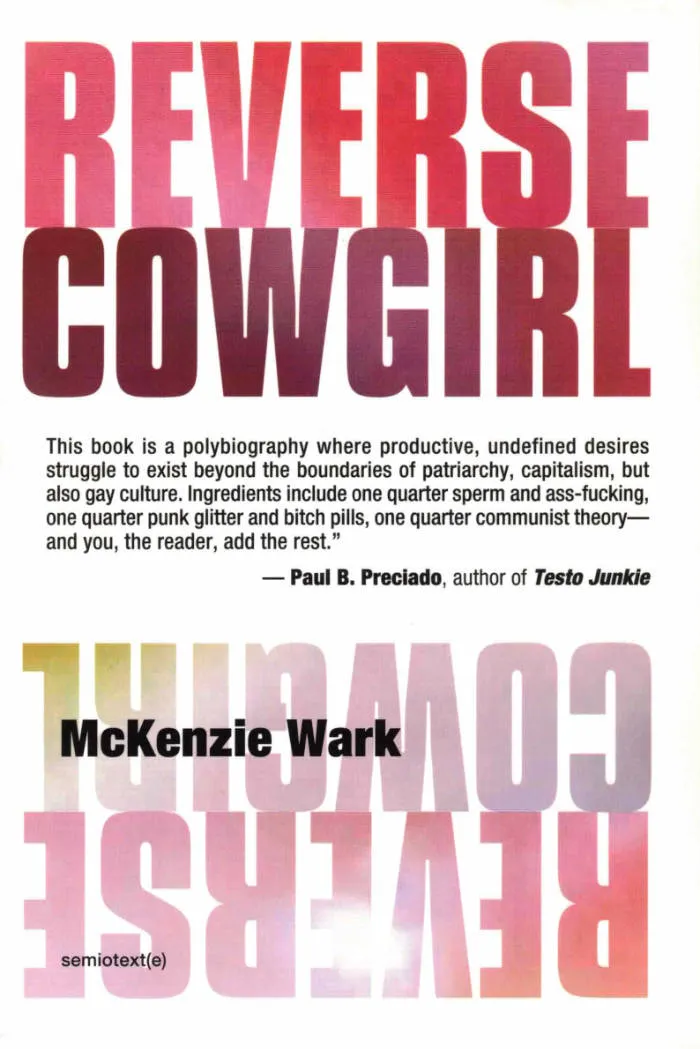
Reverse Cowgirl
McKenzie Wark invents a new genre for another gender: not a memoir but an auto-ethnography of the opacity of the self.
Another genre for another gender.
What if you were trans and didn't know it? What if there were some hole in your life and you didn't even know it was there? What if you went through life not knowing why you only felt at home in your body at peak moments of drugs and sex? What if you expended your days avoiding an absence, a hole in being? Reverse Cowgirl is not exactly a memoir. The author doesn't, in the end, have any answers as to who she really is or was, although maybe she figures out what she could become.
Traveling from Sydney in the 1980s to New York today, Reverse Cowgirl is a comedy of errors, chronicling the author's failed attempts at being gay and at being straight across the shifting political and media landscapes of the late twentieth century. Finding that the established narratives of being transgender don't seem to apply to her, Wark borrows from the genres of autofiction, fictocriticism, and new narrative to create a writing practice that can discover the form of a life outside existing accounts of trans experience: an auto-ethnography of the opacity of the self.