Books
Books
published in 1995

Thomas the Obscure
Maurice Blanchot, Robert Lamberton
Before Sartre, before Beckett, before Robbe-Grillet, Maurice Blanchot created the new novel, the ultimate post-modern fiction. Written between 1932 and 1940, Blanchot's first novel, here brilliantly translated by Robert Lamberton, contains all the remarkable aspects of his famous and perplexing invention, the ontological narrative—a tale whose subject is the nature of being itself. This paradoxical work discovers being in the absence of being, mystery in the absence of mystery, both to be searched for limitlessly. As Blanchot launches this endless search in his own masterful way, he transforms the possibilities of the novel. First issued in English in 1973 in a limited edition, this re-issue includes an illuminating essay on translation by Lamberton.

University of California Press
Screen Writings
"Ask audience to cut the part of the image on the screen that they don't like. Supply scissors."—Yoko Ono, Tokyo, June 1964
A dazzling range of unconventional film scripts and texts, many published for the first time, make up Scott MacDonald's newest collection. Illustrated with nearly 100 film stills, this fascinating book is at once a reference work of film history and an unparalleled sampling of experimental "language art." It contributes to the very dissipation of boundaries between cinematic, literary, and artistic expression thematized in the films themselves. Each text and script is introduced and contextualized by MacDonald; a filmography and a bibliography round out the volume.
This is a readable—often quite funny—literature that investigates differences between seeing and reading. Represented are avant-garde classics such as Hollis Frampton's Poetic Justice and Zorns Lemma and Morgan Fisher's Standard Gauge, and William Greaves's recently rediscovered Symbiopsychotaxiplasm: Take One. Michael Snow turns film loose on language in So Is This; Peter Rose turns language loose on theory in Pressures of the Text.
Some of the most influential feminist filmscripts of recent decades—Laura Mulvey and Peter Wollen's Riddles of the Sphinx, Su Friedrich's Gently Down the Stream, Trinh T. Minh-ha's Reassemblage, Yvonne Rainer's Privilege—confirm this book's importance for readers in gender and cultural studies as well as for filmmakers and admirers of experimental writing, independent cinema, and the visual arts in general.

Close to Me & Closer...(the Language of Heaven) and Desamere
Alice Notley's two books collected here, CLOSE TO ME & CLOSER... and DESAMERE, are works that are wholly their art, meaning they occur as their language shape measure. She's invented a measure. The text is a rich current crossing, as at the moment of imagining, into being in death and in an expanded life. Notley transgresses conventional contemporary categories of genre; rather than genre, the form of the writing is the mind's inner sense and motion.
"Alice Notley is, I think, the most challenging and engaging of our contemporary radical female poets...infused with uncommon verbal originality, intelligence and joyous playfullness, full of heart, intensity and wonder, provocatively addressing forever unsolved questions of form and identity, life and death, imagination and gender, Notley's poems are unsettling and inspiring"—the San Francisco Chronicle.

ONE
‘One’ is Dan Grahams version of the classic sliding game. However playing this particular game has only one possible outcome. The multiple consists of sixteen movable squares printed white on black bricks in a black plastic housing.
Second edition of 1000 copies
7.4 x 9 x 0.7 cm

The Rosy Medallions
"If a book can be yummy & brilliant, of course this is that. Reading THE ROSY MEDALLIONS I felt I had come upon a world with so many insides, moments forged, then strewn, by an alienated pleasure seeking 'I.' This author's perspective ranges back and forth over her life and memories like a hungry camera, doggily attracted to instances of beauty, cruelty and aeons of female privacy. Camille Roy's a pioneer in the new literature which used to be called autobiography, poetry, theater, prose or even the essay. See all their walls submissively crumble on her trek towards a gaudy piecemeal something resembling truth for the new dark ages and some light at the end of the tunnel"—Eileen Myles.
[These copies are from the original print from 1995. Some of them have damaged covers, mostly scratched ink. The insides are in perfect condition. No bend corners.]

The Black Unicorn
The Black Unicorn is a collection of poems by a woman who, Adrienne Rich writes, "for the complexity of her vision, for her moral courage and the catalytic passion of her language, has already become, for many, an indispensable poet."

The Marvelous Arithmetics of Distance
This collection, 39 poems written between 1987 and 1992, is the final volume by "a major American poet whose concerns are international, and whose words have left their mark on many lives, in the words of Adrienne Rich.
Audre Lorde (1934-1992) was the author of ten volumes of poetry and five works of prose. She was named New York State Poet in 1991; her other honors include the Manhattan Borough President s Award for Excellence in the Arts. The Marvelous Arithmetics of Distance was nominated for a National Book Critics Circle Award in 1994."
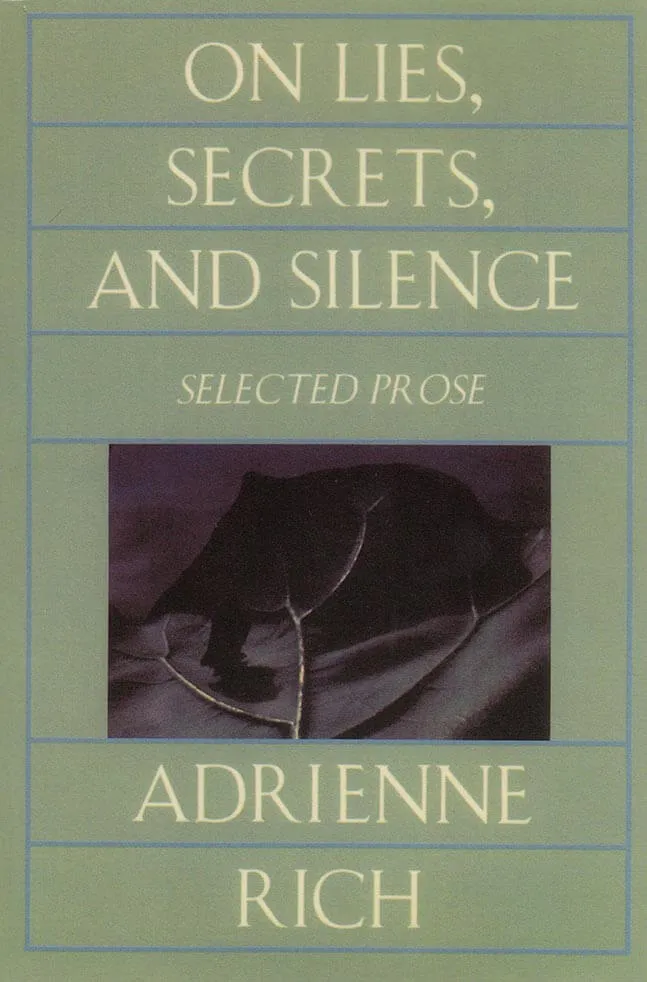
On Lies, Secrets And Silence
Collection of early prose writings by Adrienne Rich. On Lies, Secrets, and Silence is a sort of travel diary, documenting Adrienne Rich's journeys to the frontier and into the interior. It traces the development of one individual consciousness, 'playing over such issues as motherhood, racism, history, poetry, the uses of scholarship, the politics of language.' Rich has written a headnote for each essay, briefly discussing the circumstances of its writing.
Adrienne Rich (1929–2012) was for decades among the most influential writers of the feminist movement and one of the best-known American public intellectuals. She wrote two dozen volumes of poetry and more than a half-dozen of prose. Her constellation of honors includes two National Book Awards, a MacArthur Foundation “genius” grant, and a Medal for Distinguished Contribution to American Letters by the National Book Foundation. Ms. Rich’s volumes of poetry include The Dream of a Common Language, A Wild Patience Has Taken Me This Far, An Atlas of the Difficult World, The School Among the Ruins, and Telephone Ringing in the Labyrinth. Her prose includes the essay collections On Lies, Secrets, and Silence; Blood, Bread, and Poetry; an influential essay, “Compulsory Heterosexuality and Lesbian Existence,” and the nonfiction book Of Woman Born, which examines the institution of motherhood as a socio-historic construct. In 2010, she was honored with The Griffin Trust for Excellence in Poetry's Lifetime Recognition Award.