rile*books

Search books

Search books by title, author, publisher, keywords...

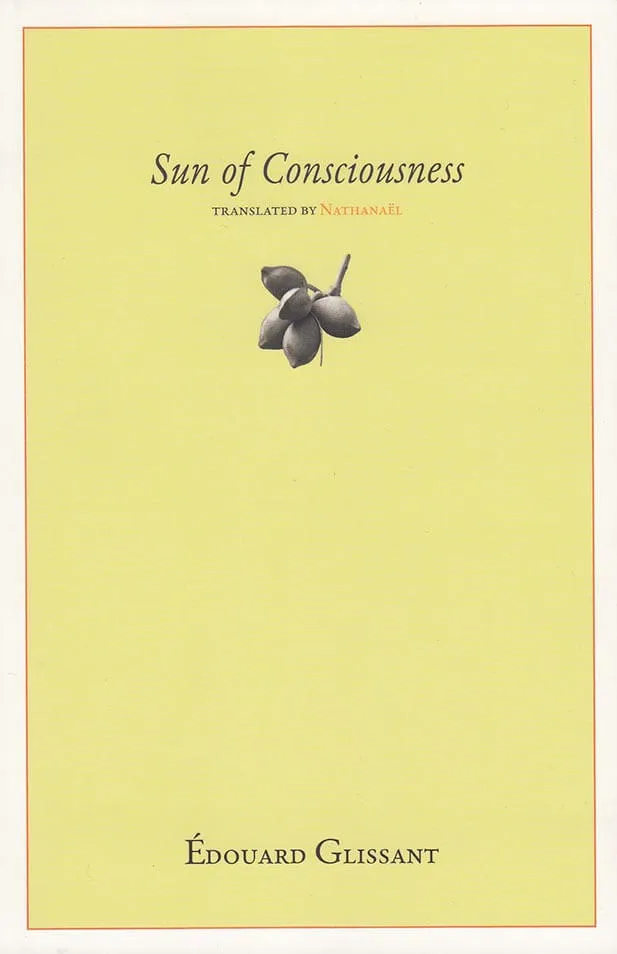
Cover of Sun of Consciousness

Nightboat Books

Sun of Consciousness

Edouard Glissant

€15.00

Soleil de la Conscience (Sun of Consciousness) was Martinican philosopher Édouard Glissant's first published work, and opened the Poétique (Poetics) strain of his oeuvre. This book-length essay, which is characterized by its exploratory, intimate character, announces Glissants concerns with créolisation (creolization), mondialité (worldliness, as against globalization), or opacité (opacity) and inscribes in this work a refusal of colonialism and of inverted exoticism. The sense of estrangement experienced by the author who arrives as a "foreigner" in a country to which he is bound by "the first page of his passport" is the author's principal preoccupation. By positioning himself as both different and same, Glissant opens a space for the writing of a(nother) history: that of the Caribbean.

Language: English

recommendations

Cover of Unsex Me Here

Nightboat Books

Unsex Me Here

Aurora Mattia

Fiction €19.00

If Aurora Mattia is a switchboard operator, then Unsex Me Here is her call log. Please hold. There’s someone on the other line. A spider, a sibyl, an angel, a mermaid, a goddess, or an ex-girlfriend.

Unsex Me Here is a prayer book tied together by the strings of a corset. Glamorous ramblers, haunted by the sense of another world drawing near, wander in and out of its inexplicable twilight. From a West Texas town with a supernatural past to a stalactite cavern in the birthplace of Aphrodite, from hotel rooms to gardens to the far horizon of a thought, they seek the source of the disturbance in their minds. Heartbreak is not so far from rapture; holy babble is another kind of gossip. Every pilgrimage is as dense with symbolism as it is refined by desire.

Cover of Ante body

Nightboat Books

Ante body

Marwa Helal

Poetry €16.50

An incisive poetic sequence that tracks the relationship between migration and complex traumas in this unsparing critique of the unjust conditions that brought us the global pandemic.

Ante body is a poetics of [un]rest. A project that started as an exploration of how the psychological impacts of migration and complex traumas manifest as autoimmune disease and grew into a critique of the ongoing unjust conditions that brought on the global pandemic. Continuing her use of the invented poetic form, the Arabic, and integrating Fred Moten's concept of "the ANTE," Helal creates an elliptical reading experience in which content and form interrogate the inner workings of patriarchy, capitalism, nationalism, and globalism.

Marwa Helal is the author of Ante body (Nightboat Books, 2022), Invasive species (Nightboat Books, 2019) and the chapbook I AM MADE TO LEAVE I AM MADE TO RETURN (No, Dear, 2017).

Cover of We Both Laughed in Pleasure

Nightboat Books

We Both Laughed in Pleasure

Lou Sullivan

Fiction €22.00

Drawn from Lou Sullivan’s meticulously kept journals, this landmark book records the life of arguably the first publicly gay trans man to medically transition.

We Both Laughed In Pleasure: The Selected Diaries of Lou Sullivan narrates the inner life of a gay trans man moving through the shifting social, political, and medical mores of the second half of the 20th century. Sullivan kept comprehensive journals from age eleven until his AIDS-related death at thirty-nine. Sensual, lascivious, challenging, quotidian and poetic, the diaries complicate and disrupt normative trans narratives. Entries from twenty-four diaries reveal Sullivan’s self-articulation and the complexity of a fascinating and courageous figure.

Edited by: Ellis Martin and Zach Ozma
Introduction by: Susan Stryker

Cover of Glove Money

Nightboat Books

Glove Money

Sophia Dahlin

Poetry €19.00

A hymn to perversity, a lyric pledge to desire and risk, Glove Money pages through the canon to “seed its sugar in your dreams.”

In this joyful and irreverent exploration of the role of poet-as lover, Sophia Dahlin plays Sappho, O’Hara, romantics and troubadours, assembling a self seaworthy of romance. With humor and a light touch, Glove Money dismisses bioessentialist gatekeeping and expands the lesbian imaginary.  

Cover of Active Reception

Nightboat Books

Active Reception

Noah Ross

Poetry €18.00

A vibrant work of lyric, conceptual, and confessional poetic modes pitched to enact a queer politics of liberation.

Active Reception is a book of bottoming lovers, the world around us, and a history of letters, that thinks through a queer mode of writing from the bottom, a kind of coalition based politics of receptivity and expansion that is open to the world around us, its myriad life forms, its systemic oppressions, its hidden ghosts.

Noah Ross is a bookseller, editor, and poet based in Berkeley, CA. Noah is the author of Swell, and an editor of Baest: a journal of queer forms & affects, and Mo0on/IO with Lindsay Choi.

Cover of Manifestos

Goldsmiths Press

Manifestos

Edouard Glissant, Patrick Chamoiseau

Essays €30.00

The collected manifestos of Édouard Glissant and Patrick Chamoiseau: for a postcolonial response to planetary crisis.

Manifestos brings together for the first time in English the manifestos written by Édouard Glissant and Patrick Chamoiseau between 2000 and 2009. Composed in part in the aftermath of Barack Obama's election in 2008, the texts resonate with the current context of divided identities and criticisms of multiculturalism. The individual texts grapple with concrete historical and political moments in France, the Caribbean, and North America. Across the manifestos, as well as two collectively signed op-eds, the authors engage with socio-political aspects of climate catastrophe, resource extraction, toxicity, and neocolonialism.  

Throughout the collection, Glissant and Chamoiseau engage with key themes articulated through their poetic vocabulary, including Relation, globalization, globality (mondialité), anti-universalism, métissage, the tout-monde (“whole-world”) and the tout-vivant (“all-living,” including the relationship of humans to each other and “nature”), créolité and the creolization of the world, and the liberation from community assignations in response to individualism and neoliberal societies.  

Translated as the first volume in the Planetarities series with Goldsmiths Press, the themes of Manifestos resonate with the planetary as they work in response to contemporary forms of (economic) globalization, western capitalism, identity politics, and urban, digital and cosmic ecosystems, as well as the role of the poet-writer. A distinguishing feature of this publication is its interventional aspect, which prioritizes engaged scholarship and practice while demonstrating the relevance of the poetic in response to the urgencies of planetary crisis. 

Translated by Betsy Wing and Matt Reeck

Afterword by Edwy Plenel

Cover of ISSUE TWO Traces

Marg1n Magazine

ISSUE TWO Traces

MARG1N is an annual Southeast Asian film magazine by writers, filmmakers, and artists. Our second issue honors memories and gazes that drift through Singapore and Vietnam. Through essays, visual scripts, archives, and more, TRACES unearths the flotsam, jetsam, and derelict that churns throughout or beneath today’s cinematic currents. 

Traces are fragmentary by nature. You can never deduce a comprehensive view from a trace. Traces gesture, shock, defy, and aspire toward a greater truth than their whole existence. In some way, a film is also a collection of traces, with the hope of invoking in its viewers a sense of wonder and resonance that makes us pause, perhaps rewatch, and rethink certain rigidities. The writings that we have worked with in this issue embody that generative power of traces.

Contributors (In Order of Appearance)
Tracey Toh, Bert Ackley (vinatapes), Daryl Cheong, Lananh Chu, Nguyễn Trinh Thi, Tan Pin Pin, Đỗ Văn Hoàng, Yeo Siew Hua, Lena Vu , Mai Huyền Chi, Hugo Hamon, Mark Chua, Lam Lishuen, Looi Wan Ping, Sasha Han, Dan N.Tran, Alex Lee, Nguyên Lê, The Yang One, Linh Duong, Ton-Nu Nguyen, An Trần, Grace Song, Krystalle Teh, and Dương Mạnh Hùng 

Featured Filmmakers
Toh Hun Ping, Tranh Anh Hung, Nhu Quynh, Dang Nhat Minh, Ho Tzu Nyen, Daniel Hui, Min-Wei Ting, Tony Bui, Truong Minh Quy, Nguyen Vu Tru, Trinh Thi Minh Ha

Editor-in-chief: Savunthara Seng
Managing editor: Alyssandra Maxine
Guest editor: Dương Mạnh Hùng

https://marg1n.com/

Cover of SIAHKAL 2.0: An A.I. resurrected discourse on Marxism & Islam

becoming press

SIAHKAL 2.0: An A.I. resurrected discourse on Marxism & Islam

Parham Ghalamdar

Essays €15.00

This is a limited edition book. The author trained an LLM on the texts of a deceased theorist, and then proceeded to interact with the LLM and produce simulations of what the theorist may have said in regards to various pertinent topics. The book is primarily a free online resource, but a few copies are being printed to commemorate the work. It has a foreword and afterword by the Editors. 

At the core of this project is a translation of “Marxist Islam or Islamic Marxism,” a groundbreaking text written by Bizhan Jazani during his imprisonment in the 1970s under the Shah’s oppressive regime. Translated by Parham Ghalamdar, this work is accompanied by an introduction contextualizing Jazani’s radical vision. Ghalamdar also contributes a series of ASCII-style illustrations and diagrams—AI-assisted reinterpretations of Jazani’s original paintings and photographs—that bridge the past and present, offering a new perspective on his revolutionary artistry. 

Siahkal names a place in the forests of Gilan and a threshold in revolutionary time. In 1971 a guerrilla action near Siahkal shook the order of the Shah. The action failed militarily yet seeded a myth for the People’s Fedai Guerrillas. Bizhan Jazani, a founding thinker, wrote and painted in prison and was executed in 1975. His work teaches that strategy rather than sentiment endures. // This book treats Siahkal as a Deep Object, a persistent attractor that gathers memory, images, and tactics. An AI model trained on Jazani’s writings and paintings translates his essay on Islamic Marxism and proposes annotations. The machine functions as a probe that widens attention while remaining accountable to the source. Parham Ghalamdar trained the AI, wrote the introduction, and composed ASCII diagrams and diagrammatic readings from Jazani’s artworks. Parsa Esmaeilzadeh contributes an essay that reads Jazani through Karatani and left accelerationism. // It is a call to reimagine and export revolution as a Deep Object that asks for Deep Time to unfold. This clandestine edition invites the reader to study, test, and build strategy that can outlast the news cycle and meet the future head on. 

Parham Ghalamdar is a multidisciplinary artist currently based in the UK. Ghalamdar’s work traces forgotten mythologies, buried philosophies, and visual ruins, reconfiguring them into speculative worlds where memory, fiction, and futurism collapse into one another. Drawing on cybernetic theory and generative AI, he explores how systems of feedback, simulation, and machine vision mediate our understanding of history and possibility. Through painting, film, and writing, he builds narratives that feel both ancient and yet-to-come, haunted by lost histories and animated by possible futures.